The alley smelled like rain, trash, and old bricks.
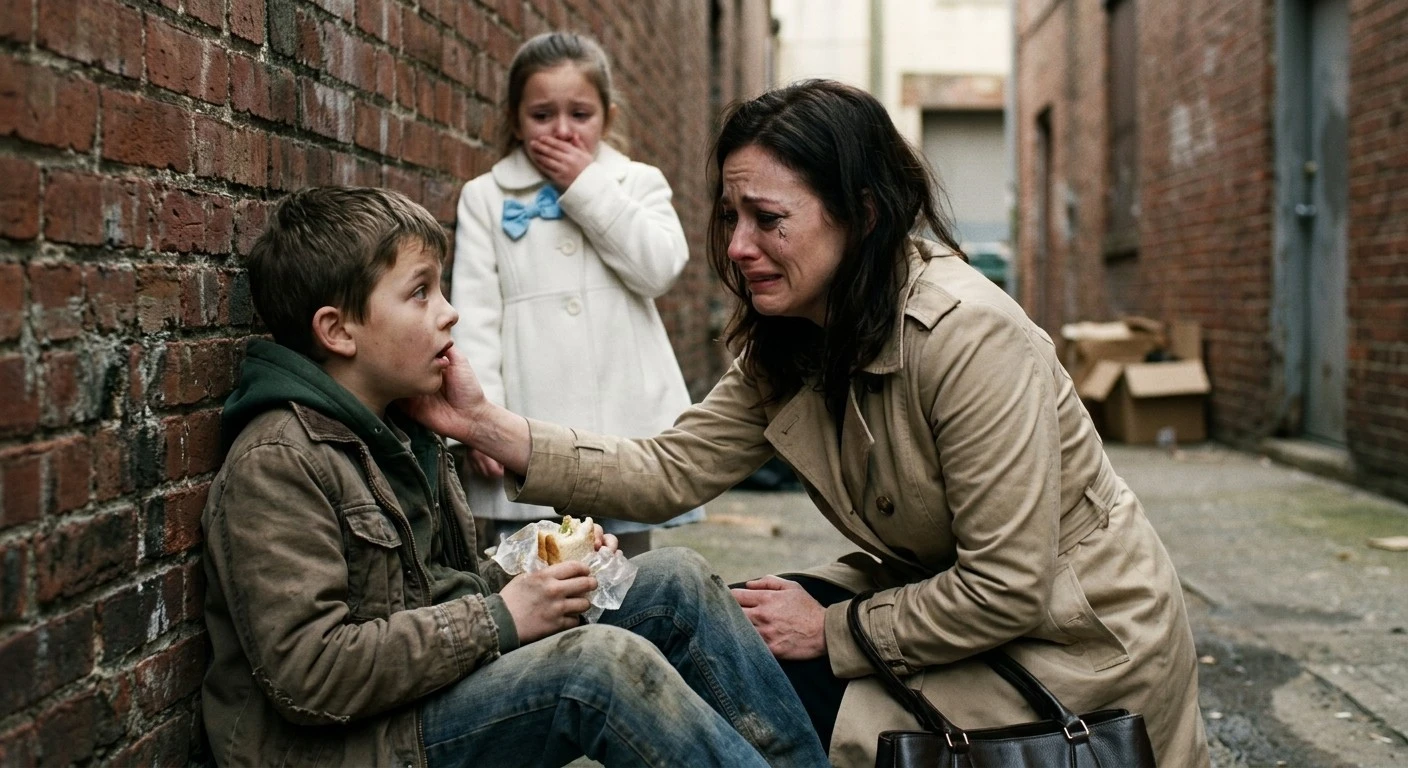
A boy sat curled against the wall. Gray clothes. Thin arms. A wrapped sandwich balanced in his dirty hands like it might break.
“Here,” a small voice said. “You can have it.”
He looked up. A girl in a white coat stood over him, a blue bow bright against the gray afternoon.
“Thank you,” he whispered.
She hugged him. Just for a second.
He froze, sandwich still in his hands, like kindness was a language he’d forgotten how to speak.
Footsteps came fast from the mouth of the alley.
“Emily, step back.”
A woman grabbed the girl’s shoulders, voice tight with fear.
“Mom, he’s hungry,” Emily said.
The woman turned to scold him. Ready to protect. Ready to pull her daughter away.
Then she looked at his face. Really looked.
Soot on his cheeks. Cracked lips. Eyes that flinched like they expected to be hit.
Her handbag hit the pavement.
“Mom?” the boy whispered.
She dropped to her knees so fast her coat soaked through.
“You left me,” he said.
“No,” she cried. “No, baby, no. They told me you were gone.”
She touched his cheek. The second her fingers found his skin, she broke.
“I looked for you,” she said. “Every shelter. Every station. Every street.”
“I waited for you,” he said.
Emily stood frozen, clutching her mother’s sleeve. “Mom?”
The woman pulled him into her arms.
“My son,” she whispered. “Oh my God. My son.”
He didn’t hug her back. Not yet. He was too tired. Too hurt.
Then his fingers let go of the sandwich and grabbed the back of her coat.
And in an alley where nothing was ever supposed to be found again, a boy who had been erased was finally held like he belonged.
Her name was Rachel Coyne. His name was Daniel.
Three years. She had spent three years being told he was gone.
“I need you to say his name again,” she said, still kneeling on the wet pavement. “Say it again. I need to hear it.”
“Daniel,” he said. “Daniel Coyne.”
She let out a sound that wasn’t a word. It came from somewhere under her ribs.
A jogger had stopped at the mouth of the alley, phone already out. “Ma’am? Do you need an ambulance?”
“I need a police officer,” Rachel said, not looking up. “Now. Please.”
Daniel’s hand tightened on her coat. “Don’t let them take me again.”
“No one is taking you anywhere,” Rachel said. “Not ever again.”
Officer Marcus Webb arrived nine minutes later. He crouched down slow, the way you do around something that might bolt.
“Ma’am, you said this is your son?”
“Daniel Robert Coyne,” Rachel said. “Born March fourth. Missing since he was seven. I filed the report myself. I have the case number memorized. I have it memorized because they never let me forget it.”
Webb looked at Daniel. Thin. Malnourished. Old bruises fading yellow along one forearm.
“Son, do you know this woman?”
Daniel didn’t look away from Rachel’s face.
“She’s my mom,” he said. “They told me she didn’t want me anymore.”
Rachel’s whole body went still, like something inside her had cracked clean through.
“Who told you that,” she said quietly.
Daniel’s eyes dropped to the sandwich still resting in his lap. “Aunt Denise.”
Rachel had not always been a single mother of two children who existed a floor apart in her memory. Three and a half years ago, she had been a widow of six months, still learning how to answer the phone without bracing for bad news, when Daniel didn’t come home from his aunt’s house on a Sunday afternoon.
“He probably just missed the bus,” the first officer had told her. “Boys wander off after a family loss. Give it a day.”
She had given it a day. Then a week. Then a caseworker named Patricia Holt had reviewed the file, noted Denise Coyne’s statement that Daniel had “run off before” and “always came back eventually,” and closed it as a low-priority juvenile runaway case eighteen months later, without a single home visit to the address where he’d last been seen.
Rachel hadn’t known that detail yet, standing in the alley. She only knew the shape of the hole in her life, and that shape had just, impossibly, stood up and hugged her back.
At Fairview General, they ran the tests fast — bloodwork, a swab for DNA, X-rays for the two fractures that had healed wrong. A nurse named Priya Anand kept her voice soft while she worked.
“He’s severely underweight,” she told the attending. “Signs of chronic neglect. Old fracture in the left wrist, never set properly. I want social services in here before anyone signs any release forms.”
Rachel stood at the edge of the curtain, arms crossed hard over her chest like she was holding herself together with them.
“Denise,” she said, mostly to herself. “My husband’s sister.”
Emily tugged her sleeve. “Mommy, is that really my brother?”
“Yes, baby.”
“Why didn’t I know I had a brother?”
Rachel crouched to her daughter’s height. “Because some very bad people made sure you didn’t.”
A detective named Renata Ortiz found her in the hallway an hour later, notepad already out.
“Mrs. Coyne. I pulled the original missing persons file. 2023. Reported by you. Closed eighteen months later as a presumed runaway, no further leads.”
“He was seven,” Rachel said. “Seven-year-olds don’t run away and vanish for three years.”
“No,” Ortiz agreed. “They don’t.”
“Someone closed that file,” Rachel said. “Someone decided my son wasn’t worth finding.”
Ortiz met her eyes. “I intend to find out who.”
Daniel wouldn’t eat the hospital tray. He held the plastic fork like it belonged to someone else.
“You can have all of it,” Rachel said gently, sliding the tray closer. “No one’s going to take it from you here.”
“That’s what she used to say too,” Daniel murmured.
“Who?”
“Aunt Denise. Before.”
Rachel felt her stomach drop. “Before what?”
Daniel’s jaw worked, like the words had teeth. “Before the men started coming.”
The room went silent except for the beeping monitor.
“What men, Daniel.”
He shook his head, fast, like a door slamming.
“It’s okay,” Rachel said, even though nothing in her felt okay. “You don’t have to say it right now. You don’t have to say anything you don’t want to.”
He looked up at her, eyes wet. “Are you going to leave again?”
“I never left,” Rachel said. “I need you to understand that. I never once stopped looking.”
“She said you sold me,” Daniel whispered. “For money. Because Emily was easier.”
Rachel’s hand came up over her mouth.
Detective Ortiz, standing just outside the curtain, wrote something down and didn’t stop writing for a long time.
Denise Coyne answered her door in Millbrook wearing a cardigan the color of oatmeal, and for three full seconds she smiled like nothing in the world was wrong.
“Rachel. What a surprise.”
“Where is he,” Rachel said. Her voice didn’t shake. She’d made sure of that in the car.
“Where’s who, sweetheart?”
“Don’t,” Rachel said. “Don’t you dare stand in that doorway and call me sweetheart. Daniel is alive. He’s in a hospital bed right now because of what you did to him.”
Denise’s smile didn’t move, but something behind her eyes did.
“I don’t know what you’re talking about.”
Detective Ortiz stepped forward from the driveway, badge already out. “Denise Coyne, we’d like you to come down to the station voluntarily. If you’d prefer, I can come back with a warrant.”
“This is insane,” Denise said, laughing once, too high. “I raised that boy when nobody else would. When Rachel was falling apart—”
“When I was falling apart,” Rachel said, “because you told the police he ran away. You told them he ran away, and then you kept him. For three years. In your basement, or wherever you kept him, while I slept four blocks from a police station begging them to reopen a case you made sure stayed closed.”
“You have no proof of any of that,” Denise said.
“He has a fracture in his wrist that never healed right,” Rachel said. “He flinches when anyone raises a hand near his face. He thought I sold him. He’s seven years old in his head still, because that’s the last age anyone let him be a person.”
Denise’s mouth opened. Nothing came out.
“Get your coat,” Ortiz said. “You’re coming with us.”
While a second officer stayed with Denise on the porch, Ortiz walked the perimeter of the house with a warrant already signed and waiting in her jacket pocket.
“Basement door’s bolted from the outside,” she called to her partner. “That’s not standard.”
Inside, they found a small room off the laundry area. A mattress on the floor. A bolt lock, mounted high, out of a child’s reach. A window painted shut.
Ortiz stood in the doorway for a long moment before she spoke into her radio.
“I need forensics out here,” she said. “And I need someone to walk Mrs. Coyne through what we found before she sees the photographs.”
Rachel never asked to see that room. She didn’t need to. She’d already seen it, every night for three years, in every version her mind could invent. The only difference now was that it was real, and it was finished.
“Was there anyone else in the house,” she asked Ortiz instead, “when you found it?”
“No,” Ortiz said. “Just the room.”
“Good,” Rachel said. “Because if there had been, I don’t know what I would have done, and I’d rather not find out.”
The case moved fast once Ortiz had a name.
A financial trail. Payments from a man named Curtis Vance, deposited into an account under Denise’s maiden name, six times over eighteen months. Vance ran what the FBI’s regional trafficking unit would later describe, carefully, as a “facilitation network” — men who paid families willing to look the other way.
Rachel learned the term sitting in a conference room at the DA’s office, hands wrapped around a paper cup of coffee she never drank.
“Facilitation,” she repeated. “Say what it actually is.”
Assistant District Attorney Grace Muñoz didn’t flinch. “She sold access to your son. Multiple times. We believe Vance’s network moved him between two other locations before your daughter found him in that alley three days ago, after he escaped a house on Delancey.”
“Escaped,” Rachel said.
“According to Daniel’s statement, yes. He ran. He’d been running for two days before your daughter gave him that sandwich.”
Rachel closed her eyes.
“I need you to understand something,” Muñoz said. “What he tells the forensic interviewer in the next few weeks is going to matter more than anything else in this case. I need you to be the steady one. Not the angry one. He needs steady right now.”
“I can be steady,” Rachel said.
“Good. Because Denise Coyne’s lawyer is already floating a plea deal, and I intend to refuse it.”
Daniel’s forensic interview happened behind a mirrored window, in a room with soft chairs and a stuffed rabbit no one expected him to want but he held anyway.
Rachel watched from the observation side with Ortiz and Muñoz, her hands pressed flat against her own knees to keep them from shaking.
“Daniel, can you tell me what happened after your mom stopped being able to find you?” the interviewer, a specialist named Dana Kwon, asked gently.
“Aunt Denise said Mom didn’t want me because I got sick a lot,” Daniel said. “She said it would be our secret. That I’d get to stay with her instead of foster care.”
“Did anyone else come to the house?”
Daniel’s hands twisted in his lap. “Sometimes.”
“Can you tell me about that?”
“I don’t want to.”
“That’s okay,” Dana said. “You don’t have to today.”
“Will Aunt Denise go to jail?”
“That’s up to a judge,” Dana said. “But I can tell you that what happened to you was never your fault. Not one second of it.”
Daniel was quiet for a long moment.
“Emily gave me a sandwich,” he said finally. “She didn’t know me. She just gave it to me anyway.”
“That must have felt like something,” Dana said.
“I forgot people did that,” Daniel said. “I forgot that was a thing people did.”
Behind the glass, Rachel pressed her hand to her mouth and didn’t make a sound, because she’d promised Muñoz she’d be steady, and steady was the only gift she had left to give him.
Curtis Vance was arrested at a storage facility outside Harrisburg six days later, in possession of two burner phones and a ledger the FBI would spend the next four months decoding. Federal agents linked his network to eleven other missing-child cases across three states.
Nurse Priya Anand testified before the grand jury about Daniel’s initial exam, her notes precise and clinical in a way that made the room go still.
“In fifteen years of pediatric emergency care,” she said, “I have seen neglect. I have seen abuse. I rarely see both compounded by three years of missed growth milestones in a single intake exam. His bone density scan alone should have triggered a mandatory report the moment any medical professional saw him — if any medical professional ever had the chance to.”
“Did they?” the grand jury foreperson asked.
“No,” Priya said. “That’s what troubles me most. For three years, no doctor, no dentist, no school nurse ever laid eyes on this child. That absence is its own kind of evidence.”
Denise Coyne was charged with kidnapping, child endangerment, and trafficking-related offenses. Her lawyer’s plea offer was rejected the same afternoon it was made.
“She wants five years,” Muñoz told Rachel over the phone. “I’m asking for twenty-two.”
“Will you get it?”
“With the ledger, the payments, and Daniel’s statement corroborated by the physical evidence? I think a jury gives me every year I ask for.”
Rachel sat on her kitchen floor after that call, back against the cabinets, and cried the way she hadn’t let herself cry in three years — loud, ugly, unafraid of being heard, because for the first time there was no one left to protect by staying quiet.
Emily found her there and sat down beside her without a word, small hand resting on her mother’s knee.
“Is Daniel coming home today?”
“Not today, baby. Soon.”
“Is he gonna live with us forever?”
“Forever,” Rachel said. “I promise you that.”
It took eleven weeks for the custody paperwork to clear — DNA confirmation, a guardian ad litem’s report, a home study, and a judge named Harriet Sloane who read every page of Daniel’s case file twice before she signed anything.
“Mrs. Coyne,” Judge Sloane said in chambers, “I want you to understand that I am not restoring a formality today. I am correcting a record that should never have existed. Daniel Robert Coyne was never a runaway. He was a stolen child, and the system that closed his file failed him as thoroughly as the people who took him.”
“Thank you, Your Honor.”
“Don’t thank me,” Sloane said. “The caseworker who closed that file in 2023 without a home visit is being referred to the state licensing board this afternoon. Some of the failing here wasn’t just human. It was procedural, and it will be fixed, or I will keep sending referrals until it is.”
Daniel sat outside the chambers on a hard bench, feet not quite reaching the floor, watching the door like it might change its mind.
When Rachel came out, she didn’t say anything. She just held up the signed order.
“Does that mean I get to stay,” Daniel asked.
“That means no one can ever take you again,” Rachel said. “Not legally. Not quietly. Not ever.”
He stood up off the bench slower than a boy his age should have to. Like his body still hadn’t caught up to the idea that safety was allowed to be permanent.
Then he hugged her. All the way this time. Both arms.
Daniel started seeing a trauma therapist named Dr. Felix Amara twice a week, in a small office with a fish tank and a box of fidget toys he never touched.
“You don’t have to talk today,” Dr. Amara told him during the third session. “You can just sit.”
“I don’t know how to just sit,” Daniel admitted. “Somebody always wanted something before.”
“I don’t want anything from you except for you to be safe in this room.”
Daniel picked at the hem of his sleeve. “What if I forget how to be a kid?”
“Then we practice,” Dr. Amara said. “Being a kid isn’t a memory you lose. It’s a muscle. We can build it back.”
At home, Emily had her own version of the same fear, quieter, harder for Rachel to catch.
“Mom, is it my fault?” she asked one night, out of nowhere, while Rachel braided her hair before bed.
“Is what your fault, baby?”
“That Daniel was gone so long. I didn’t even know he was real until the alley.”
Rachel set down the brush and turned her daughter around by the shoulders.
“None of this was ever your fault,” she said. “You are the reason he’s home. You didn’t know him, and you still gave him the only kind thing anyone had offered him in years. That’s not something you did wrong. That’s the bravest thing anyone in this family has ever done.”
Emily’s chin wobbled. “I just wanted him to not be hungry.”
“I know,” Rachel said, pulling her into a hug. “And because of that, he’s asleep down the hall right now instead of somewhere I can’t reach him. Don’t ever apologize for that.”
The story broke in the local paper first, then spread fast enough that Rachel had to change her phone number twice. A local news anchor asked, gently, if the family would consider an interview.
“No cameras,” Rachel said. “Not yet. Maybe not ever. He’s not a headline. He’s a ten-year-old boy trying to learn what Tuesdays feel like again.”
But the coverage did one thing Rachel hadn’t expected — it reached three other families in neighboring states who recognized details of Curtis Vance’s network from cases of their own long-missing children. Two of those cases led to recoveries within the month. The third ended in a confirmation no parent ever wants, and a funeral Rachel attended without being asked, because she understood, better than almost anyone alive, what that family needed simply by standing near them.
“You didn’t have to come,” the mother told her afterward, eyes raw.
“I know,” Rachel said. “I wanted you to know somebody else made it out, and it wasn’t luck. It was one person who refused to stop looking. I hope that means something, even today.”
The trial for Denise Coyne started in October. Rachel sat in the third row every day, Emily at school, a neighbor watching Daniel during the hours the testimony got hardest.
Denise took the stand in her own defense on the fourth day, in a cardigan the color of ash this time, and tried the only card she had left.
“I loved that boy like my own,” she told the jury. “Everything I did, I did because I believed I could give him a better life than his mother could.”
The prosecutor, Muñoz, let the silence sit a moment before she spoke.
“Ms. Coyne, would you describe selling access to a seven-year-old boy for cash, six documented times, as giving him a better life?”
“I didn’t know what Curtis was going to do with him.”
“You cashed the checks,” Muñoz said. “Six of them. Are you telling this jury you cashed six checks from a man you believed was simply babysitting?”
Denise’s composure finally cracked, just slightly, at the edges. “I made a mistake.”
“A mistake,” Muñoz repeated, turning to the jury. “Ladies and gentlemen, a seven-year-old boy has a fracture in his left wrist that healed without medical care, and internal records showing eighteen months of unexplained absences from a childhood he should have had. We will let the jury decide what to call that.”
Rachel testified on the fifth day. Muñoz kept her questions short, letting the facts carry their own weight.
“Mrs. Coyne, when did you last see your son before the alley?”
“Three years, two months, and eleven days,” Rachel said. “I counted every one of them.”
“And what did the defendant tell you, in the months after Daniel disappeared?”
“That he’d probably run off. That boys do that after they lose a father. That I shouldn’t blame myself.” Rachel’s voice stayed even. “She said that to me at Thanksgiving. While he was somewhere in her house.”
On cross-examination, Denise’s attorney tried once, carefully, to suggest Rachel had been an inattentive mother in the months following her husband’s death.
“Isn’t it true you were, in your own words, ‘barely functioning’ that year?”
“Yes,” Rachel said. “I was grieving. And in the middle of that grief, I filed a missing persons report the same day my son didn’t come home, and I called that detective’s office every single week for eighteen months until they stopped returning my calls. Grief didn’t make me stop looking. It’s the only thing that kept me looking, because he was all I had left of who my family used to be.”
The attorney had no further questions.
The jury took four hours to return.
Guilty. On every count.
Judge Sloane, when sentencing came three weeks later, did not hold back.
“Ms. Coyne, you did not make a mistake. A mistake is forgetting to pick up a prescription. What you did to this child was a sustained, profitable betrayal of the one thing a family is supposed to guarantee a boy — safety. This court sentences you to twenty-two years.”
Before sentencing, the court allowed a victim impact statement. Daniel had asked, quietly but firmly, to write his own.
Dr. Amara helped him practice it twice in her office, not to change the words, only to help him find his voice steady enough to say them once.
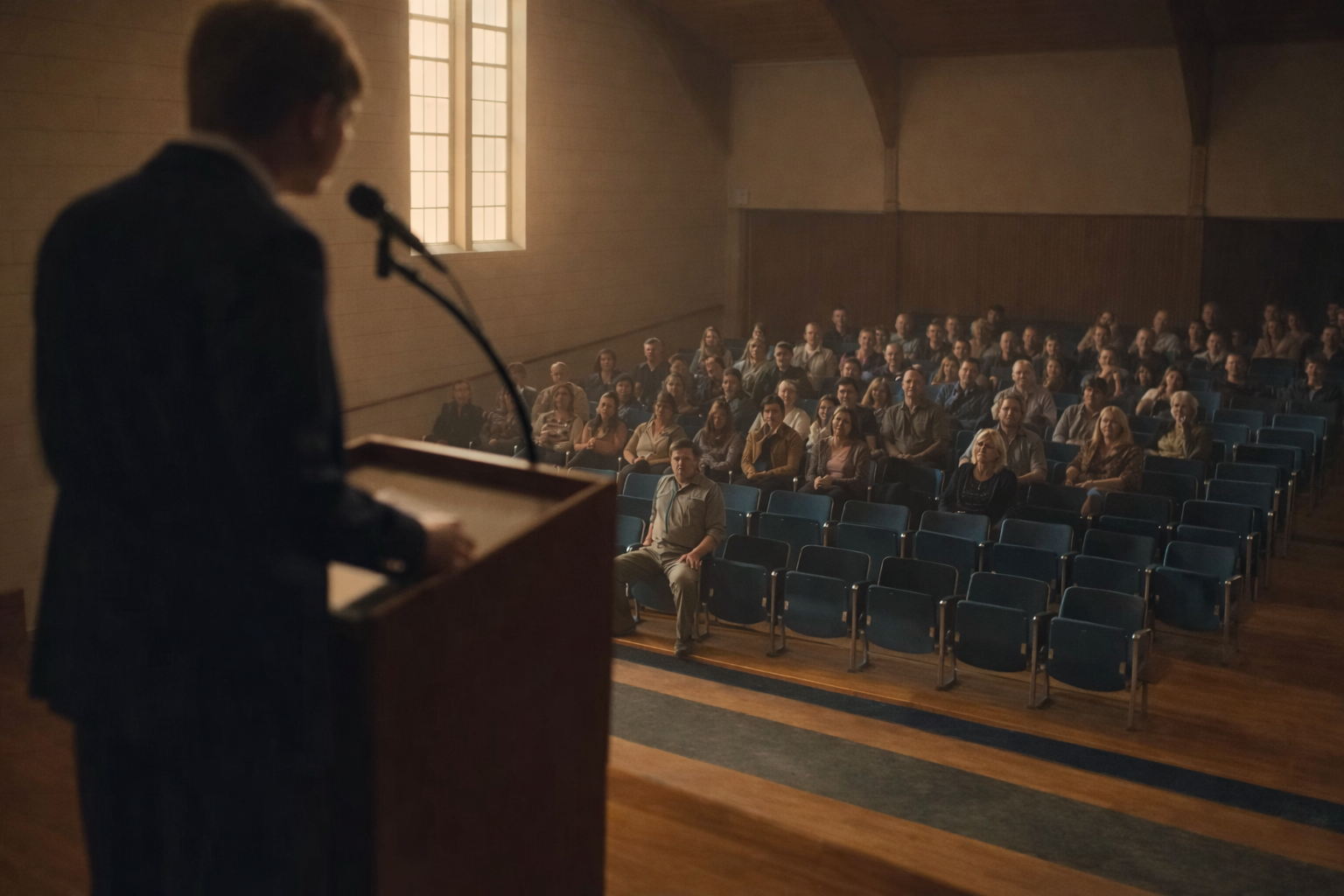
Standing at a podium too tall for him, a folded paper trembling slightly in his hands, Daniel looked at the judge instead of at Denise.
“You told me my mom didn’t want me,” he read. “For three years I believed that. I stopped believing people could be kind, because you told me kindness was something people used to trick you. But a girl who never met me gave me her lunch anyway, and my mom cried on the ground in the rain when she found me, and neither of them wanted anything back. That’s how I found out you were wrong.”
He folded the paper again.
“I don’t want you to have power over me anymore,” he said. “Not even in my head.”
He walked back to his seat and sat down next to Rachel, who took his hand and didn’t let go for the rest of the hearing.
Denise didn’t turn around as they led her out. Rachel didn’t need her to.
Curtis Vance’s federal trial concluded the following spring. Convicted on all counts tied to his network, including the charges connected to Daniel, he was sentenced to life without the possibility of parole. Eleven other families, in three other states, finally learned what had happened to the children they’d spent years searching for.
The caseworker who closed Daniel’s file in 2023 without conducting the required home visit lost her license permanently and was named in a state oversight report that led to new mandatory-verification rules for missing-child cases statewide. Rachel testified before the state legislative committee that drafted them.
“My son was missing for three years because a piece of paper got signed without anyone looking him in the eye,” she told the committee. “I am not asking you to feel sorry for my family. I am asking you to make sure no other family has to build a case against a system that was supposed to be looking for their child in the first place.”
The bill passed unanimously. They named it, at Rachel’s request, Daniel’s Law.
Daniel started fifth grade at Lindenwood Elementary in January, three months behind on paperwork and years behind on the small, ordinary confidence other kids seemed to carry without noticing.
His teacher, Mr. Ferris, kept an eye on him without hovering, the way Dr. Amara had suggested.
“You don’t have to raise your hand to leave the room,” Mr. Ferris told him the first week. “If it ever feels like too much in here, you just look at me and go stand in the hallway. Nobody’s going to ask why.”
Daniel used that hallway three times that first month. By March, he didn’t need it at all.
A boy named Owen sat next to him at lunch on his second day, uninvited, and didn’t ask a single question about where Daniel had been for three years, because ten-year-olds, it turned out, were sometimes kinder about silence than most adults.
“You want half my sandwich?” Owen asked, sliding his tray over. “My mom always packs too much.”
Daniel looked at the offered half for a long moment.
“Yeah,” he said finally. “Thanks.”
He ate slowly, like he still expected it to be taken back. It wasn’t.
By spring, Daniel had a permanent seat at Owen’s lunch table, a spelling test taped to the refrigerator with a ninety-four written in red pen, and a habit of sitting a little closer to Rachel on the couch than most boys his age might, which she never once mentioned, because some comforts don’t need naming to be allowed.
A year later, the house on Bellwood Street had a new kitchen table, big enough for three, and a small dog named Biscuit that Daniel had picked out himself at the shelter, because he said he understood, better than anyone, what it felt like to be the last one left waiting.
“You’re not gonna disappear on me, right?” Daniel asked him the first night, kneeling on the kitchen floor while the dog licked his fingers.
“Dogs don’t disappear,” Emily said seriously, sitting cross-legged beside him. “They just get old and then they’re in your heart forever. That’s what Mom said about Grandpa.”
“That’s a good way to think about it,” Daniel said.
Rachel stood in the doorway watching them, coffee gone cold in her hands, and let herself believe, fully, for the first time in three years, that this was simply what her life was now. Not a chapter waiting to be interrupted. Not a case number. A kitchen. A dog. Two kids arguing gently about whether Biscuit liked peanut butter or cheese better.
Daniel looked up and caught her watching.
“You okay, Mom?”
“Better than okay,” she said.
He smiled — a real one, the kind that reached his eyes now, the kind that had taken a year of therapy and a thousand small proofs to earn back.
“Good,” he said. “Because I’m not going anywhere.”
Outside, the evening was quiet, ordinary, unremarkable in every way a childhood is supposed to be. And in that kitchen, in that ordinary light, a boy who had once been erased from every system meant to protect him sat surrounded by people who had never, not for one single day, stopped looking for him.
That December, on the first anniversary of the alley, Rachel drove them all back to that same block, not because anyone needed reminding, but because Daniel had asked to see it again, on his own terms this time.
The alley still smelled faintly of rain and old bricks. It didn’t feel like a wound anymore. It felt like a place a story had started.
“This is where I gave you the sandwich,” Emily said, standing in almost the exact spot, arms crossed against the cold.
“I remember,” Daniel said. “I remember everything about that day. Every second of it.”
“Was it scary?” Emily asked. “Before I came?”
“Yeah,” Daniel said. “But you weren’t scary. You were just… there. Like it was normal to be nice to a stranger.”
“It is normal,” Emily said, matter-of-fact, the way only an eleven-year-old could be. “You’re just supposed to be nice to people. Mom says that all the time.”
Daniel looked at his mother, who stood a few feet back, letting the two of them have the moment without folding herself into it.
“She’s right,” Rachel said. “It really is that simple. It just took the right person, in the right alley, to prove it.”
Daniel reached out and took Emily’s hand, then Rachel’s, standing between them in the same spot where he had once been found.
“Can we get sandwiches?” he asked. “Actual ones. From somewhere warm.”
Rachel laughed — a real laugh, unguarded, the kind she hadn’t had in years.
“Yeah,” she said. “We can get sandwiches.”
They walked out of the alley together, and this time, nobody looked back to make sure it was still there. They already knew it would be. Some things, once you fight hard enough to keep them, simply stay.
He was found. And this time, for good, he stayed.
END.
Original fictional stories. AI-assisted creative content.