Ethan Price was never supposed to look rich.
That was his father’s rule, set the day Ethan was old enough to understand what money could do to people.
No designer clothes. No driver dropping him at school. No flashing the Price name to scare teachers or other kids.
“If people only respect you after they learn who your father is,” Richard Price had told him, “they never respected you at all.”
That morning, breakfast was quiet. Richard sat across the table scrolling through a folder labeled WILLOW ROAD — PHASE TWO, looking tired in a way that had nothing to do with sleep.
“You’re going riding again?” he asked, not looking up.
“Twenty minutes,” Ethan said. “Same as always.”
“Phone charged?”
“Dad.”
Richard finally looked up and almost smiled. “Just checking.”
“You always check.”
“That’s the job,” Richard said. “Yours is to be a normal kid for twenty minutes. Mine is to make sure that’s still possible.”
Ethan didn’t fully understand what that meant. Not yet.
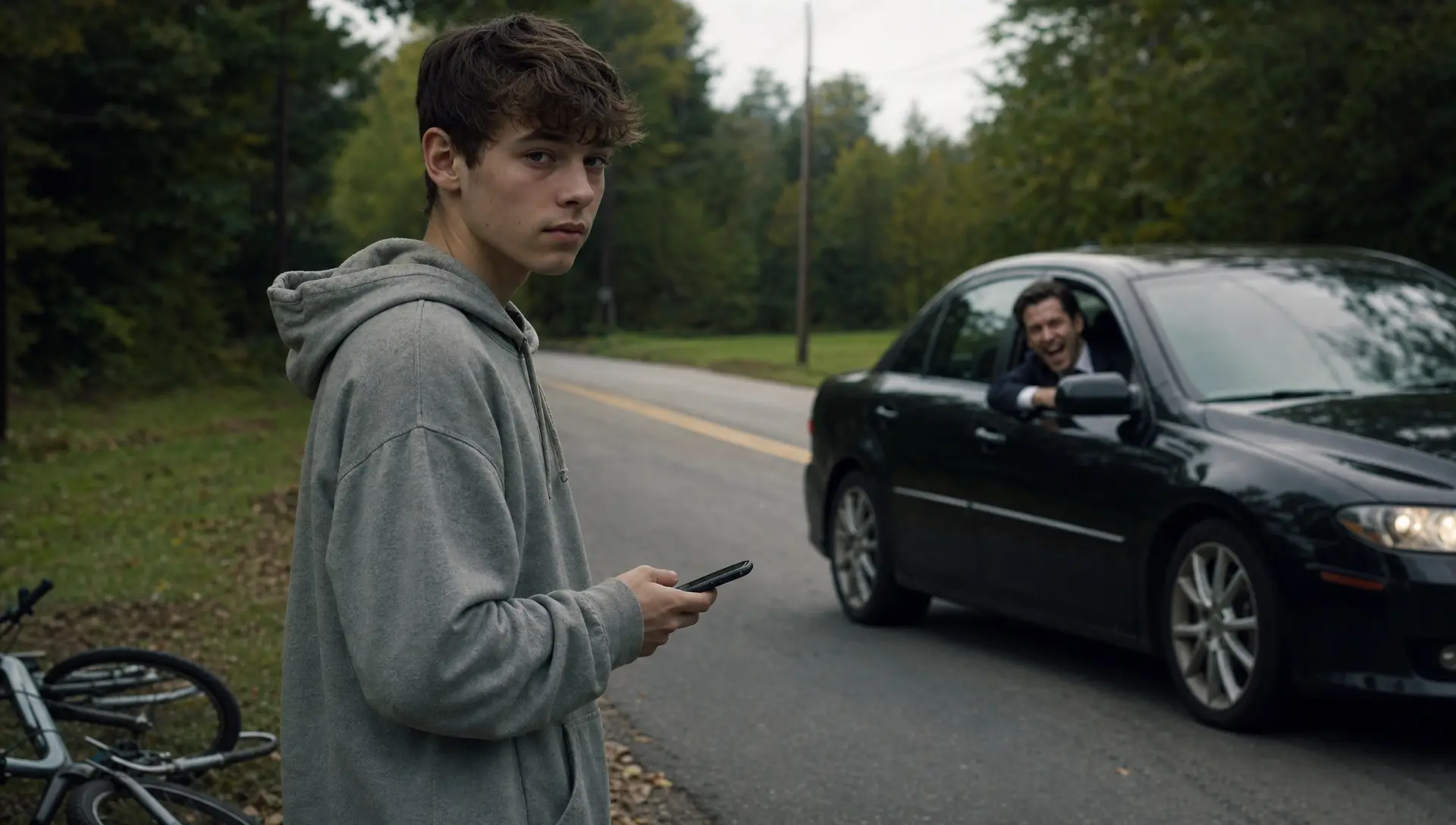
So on Saturday morning, Ethan rode his bicycle down Willow Road like any other fifteen-year-old in Caldwell County. Faded hoodie. Torn jeans. Cheap sneakers.
The only thing that hinted at another life was the contact pinned at the top of his phone.
Dad.
Willow Road was quiet. Green. The kind of street that felt like it was keeping secrets behind its old mailboxes and sloped lawns.
His mother used to call it “the last honest road in Caldwell.” She’d driven him here every spring to see the dogwoods bloom behind the stone church.
That was before she died. Ethan had been eight.
Some mornings he could still hear her voice if he tried — telling him to look up, that the blossoms only lasted two weeks a year, that some things were worth slowing down for.
He hadn’t told his father, but he still stopped at the dogwoods every single ride, whether they were blooming or not.
Now he was fifteen, and Willow Road wasn’t just a place anymore. It was a fight.
Developers wanted it widened. Investors wanted the land. And men in expensive suits had started telling elderly homeowners their quiet street was “inefficient.”
Ethan knew some of the names without knowing the danger behind them. Mr. Raymond Burke, two doors past the church, an eighty-year-old veteran who still mowed his own lawn. Mrs. Dorothy Nash, three houses down, widowed last spring, who waved at Ethan every time he passed.
He didn’t know that both of them had received letters in the past month calling their homes “non-compliant structures.” He didn’t know that neither letter had come from an actual inspector.
For the past year, Richard Price had worked quietly to stop it — pulling ownership records, donation trails, shell companies. All of it kept circling back to one name.
Grant Mercer.
Ethan didn’t know the details. He only knew his father’s jaw tightened every time that name came up.
That morning, Ethan wasn’t thinking about Grant Mercer. He was thinking about the wind in his face and how good it felt to ride without security trailing him.
Marcus Webb — his father’s head of security, a former military intelligence officer with eyes that made grown men stand straighter — hated when Ethan did that.
So Ethan had bargained for twenty minutes alone.
“One road,” he’d promised.
“Phone on,” his father said.
“Phone on.”
“If anything feels wrong?”
“I call.”
His father looked at him then — not like a billionaire, like a man who’d already lost too much. Then he nodded.
Ethan was halfway past the church when he heard the engine. Low. Polished. Aggressive.
A black sedan came up fast behind him.
He moved toward the shoulder. There was plenty of room to pass.
The sedan didn’t slow.
The horn blasted. Ethan flinched. Then the car swerved — not enough to hit him, just enough to remind him who was bigger.
The front tire slipped off the pavement. The bike jerked sideways. For one terrible second there was nothing but sky and black paint.
Then he hit the ground.
Pain shot through his elbow and his hip. His bike skidded into the grass.
The sedan stopped a few yards ahead, brake lights glowing like warning eyes.
Ethan pushed himself up, shaking. “Hey! You almost hit me!”
The driver’s window lowered. Black suit. Perfect hair. A smile that didn’t reach the eyes.
Ethan knew the face from a file on his father’s desk.
Grant Mercer.
Grant looked at the bike in the grass, then at Ethan. No concern. Only irritation.
“Then stay off the road, kid.”
“You nearly killed me.”
Grant laughed softly — the kind of laugh that made fear feel boring. “Relax. You fell off a bike. Don’t turn it into a courtroom drama.”
“You swerved at me.”
Grant stepped out, resting one polished shoe on the pavement. “This road is dangerous. That’s exactly why it needs redevelopment.”
To Grant, Ethan was just a kid in a cheap hoodie — maybe the son of one of the families he wanted gone.
“Where do you live?” Grant asked.
Ethan said nothing.
“That’s what I thought.” Grant stepped closer, but not too close. Men like him understood cameras and liability. They knew how to threaten without touching.
“This stretch of road isn’t a playground,” he said. “It’s part of a future commercial corridor. People with actual responsibilities are trying to improve this county.”
“By running kids off the road?”
Grant’s eyes hardened. “No. By removing obstacles.”
The word hung in the air.
Ethan looked at the old houses behind the trees — the place his mother had loved — and understood something his father had never quite said out loud.
Grant didn’t see homes. He saw obstacles. He didn’t see people. He saw problems to be moved.
Ethan thought of Mr. Burke mowing his lawn every Sunday. Of Mrs. Nash waving from her porch.
“They’re not obstacles,” Ethan said. “They’re just people who live here.”
Grant tilted his head, almost curious. “And you’re going to stop me? A kid with a busted bike?”
“I didn’t say I’d stop you.”
“Then what exactly do you think is happening here?”
Ethan’s voice was steadier than he felt. “I think you just made a mistake.”
Grant’s smile thinned. “The only mistake here was yours, for being in the road.”
That made Ethan angrier than the swerve had. He reached for his phone. Grant noticed. “What are you doing?”
“Dad,” Ethan said when the call connected, voice shaking. “I need help. I’m on Willow Road.”
Grant rolled his eyes. “Oh, wonderful. Bring the whole family.”
His father’s voice changed instantly. “Are you hurt?”
“No serious injury,” Ethan said, using the exact phrase Marcus had trained him to say. “Black sedan. Driver is Grant Mercer.”
Silence. Then one sentence.
“Stay where you are.”
The call ended. Grant’s smile faded a fraction. “You know who I am?”
Ethan said nothing.
Grant studied the hoodie, the scraped palms, the cheap bike — and decided there was nothing to fear. “Then you should also know I don’t have time for childish games.”
He flicked a business card toward the road. “Give that to your parents. Tell them if they want money for the bike, email my assistant.”
Grant Mercer. Senior Development Partner. Crestline Development Group. Building Tomorrow.
Ethan almost laughed. His elbow was bleeding and the man who’d run him off the road was still selling slogans.
“You’re not leaving,” Ethan said.
Grant’s amusement vanished. “What did you say?”
“You’re not leaving.”
He stepped toward Ethan. “Kid, you have no idea how badly this can go for your family.”
That was when the first engine came from the north.
A black SUV rounded the bend, fast but controlled. Then another from behind the sedan. Then two more from the opposite direction.
Four SUVs. No sirens. No lights. Just precision.
Ethan recognized the formation immediately — Marcus had drilled it into him during a family trip once, a joke that turned out not to be a joke. Lead vehicle blocks forward escape. Trail vehicle blocks reverse. Flanking vehicles cut off the shoulders. Nobody moves until the principal is secure.
He’d thought it was overkill at the time. It didn’t feel like overkill now.
They closed around Grant’s sedan and stopped without touching it. Doors opened. Men in black suits stepped out — empty hands, earpieces, cold faces.
Marcus Webb walked toward Grant like a man who already owned the moment.
“Step out of the vehicle, Mr. Kane.”
Grant’s mouth opened, then closed. “What is this? Who authorized this?”
“I did.”
Grant laughed once, but it cracked in the middle. “You have no authority over me.”
“I don’t need authority,” Marcus said. “I need patience. And I’ve run out.”
Richard Price’s town car came around the bend a moment later, unhurried, deliberate. He got out and walked straight to his son first — checked his arms, his knee, his face — before he even looked at Grant.
Richard’s hands were steady. His voice wasn’t.
“You’re sure you’re alright?”
“I’m sure,” Ethan said.
“You called. You followed the protocol. You did exactly right.”
It was such a small thing to be proud of, under the circumstances, but Ethan felt it anyway.
“Dad—” Ethan started.
“Later,” Richard said quietly. Then he turned.
For the first time, Grant’s confidence slipped completely. “Cole. You’re Richard Price.”
“And you just ran my son off the road.”
“I didn’t know who he—”
“That’s the problem,” Richard said. “You only show restraint for people you’re afraid of. Everyone else is an obstacle.”
Grant’s eyes darted between the SUVs, the suits, the boy in the gray hoodie who suddenly made terrible sense.
“This is harassment,” he tried. “I’ll have lawyers on this within the hour.”
“Good,” Richard said. “Bring them. Bring all of them. Because in about six hours, my legal team is filing everything we’ve spent a year collecting — the shell companies, the fake condemnation notices, the donation trail to the county zoning board. Every page.”
Grant went pale under the studio tan.
“And one more thing,” Richard said, voice dropping. “Three years ago, my wife wrote a letter. She named you. She died two months later in a car accident nobody ever fully explained.”
The road went silent.
“You don’t know what you’re talking about,” Grant said, but his voice had lost its polish.
“I know exactly what I’m talking about,” Richard said. “And so will a jury.”
Marcus stepped closer to Grant, voice low. “For the record, Mr. Kane — every word of this is on three different cameras. Yours included.”
Grant’s eyes flicked to the dashboard cameras clipped near the SUVs’ mirrors, and he said nothing else.
Two men in suits escorted him back to his sedan. Nobody touched him. Nobody needed to.
That night, Ethan sat in his father’s study with an ice pack on his elbow, reading a single line in his mother’s handwriting.
If anything happens to me, look at Grant Mercer.
His hands trembled. “Why didn’t you tell me?”
Richard looked older than Ethan had ever seen him. “Because I wanted you to have a childhood before you inherited our grief.”
“She knew.”
“Yes,” Richard said. “She knew.”
“And nobody listened.”
His father’s voice broke. “Not then.”
Ethan folded the note carefully. “Then we make them listen now.”
The weeks that followed moved faster than Ethan expected.
Sandra Hale, a soft-spoken records analyst Richard had quietly hired a year earlier, finally came forward with everything she’d been documenting — falsified inspection reports, signatures on permits that didn’t match the inspectors who supposedly filed them, wire transfers between Crestline Development Group and two county officials.
“I was afraid to bring this to anyone,” she told Richard, sliding a thick folder across his desk. “Grant has a way of finding out who talks.”
“Not anymore,” Richard said.
Mr. Burke and Mrs. Nash were the first to sign statements. Then three more families came forward. Then seven.
By the time the district attorney’s office opened a formal investigation, Grant Mercer’s name was attached to eleven separate complaints.
Grant didn’t go quietly.
Within days, a lawyer representing Crestline Development Group sent a letter accusing Richard Price of “orchestrating a coordinated harassment campaign” against a legitimate business. A second letter went to three of the families who’d signed statements, reminding them that “litigation can be costly for all parties involved.”
Mr. Burke brought his letter straight to the Price estate himself, hands shaking — not from fear, Ethan realized, but from anger.
“They think a letter’s going to scare an old man who already buried two brothers in two different wars,” Burke said, dropping it on Richard’s desk. “Tell them I said no.”
Mrs. Nash called that same afternoon. “I almost backed out,” she admitted. “Then I thought about what they did to this street for thirty years and I decided I was done being quiet.”
Not one family withdrew their statement.
Word got out anyway. A news van parked outside the Price estate gates within a week. Headlines called Ethan “the billionaire’s son who took on a land grab empire,” which embarrassed him more than it impressed him.
At school, kids who’d never spoken to him suddenly wanted to sit at his lunch table.
“You’re famous now,” one boy said.
“I just made a phone call,” Ethan said.
“Yeah, but you made it to the right person.”
Ethan didn’t correct him. He didn’t say the call had been to his father, not a lawyer, not a journalist — just a scared kid asking for help. That part never made the headlines.
Six months later, Willow Road looked different — not because it had been demolished, but because it had been saved.
The county approved a preservation order. The old stone church became a free legal clinic. The first sign went up on a bright spring morning.
Diane Reed Price Justice Center. Free legal aid for families facing housing intimidation and predatory development.
Richard funded it. Marcus ran security. And every Saturday, Ethan volunteered there — arriving on a new bicycle, black, simple, ordinary.
Grant Mercer’s trial lasted twelve days. He walked in every morning in a tailored suit, still trying to look untouchable.
The jury watched dashcam footage from Willow Road. They heard Ethan’s 911 call, his voice cracking on the words “Black sedan. Driver is Grant Mercer.”
Sandra Hale took the stand first. She laid out the falsified inspection reports one by one, her voice flat and precise, the kind of calm that came from months of being afraid to speak.
“Mr. Kane’s office filed condemnation notices on properties that were never inspected,” she said. “I have the inspector’s calendar for those dates. He was in Ohio.”
The defense objected. The judge overruled.
Then Raymond Burke took the stand, eighty-two years old, in a pressed shirt with a small American flag pin on the collar.
“I served this country for twenty-six years,” he said. “I thought the scariest letter I’d ever get was from the IRS. Then I got one from Crestline telling me my house — the house I built with my own hands in 1974 — was a safety hazard.”
“Did you believe it?” the prosecutor asked.
“I’m an old man, not a stupid one,” Burke said. “But I was scared enough to call a realtor. That’s exactly what they wanted.”
Dorothy Nash testified next, her hands folded tightly in her lap.
“They told me the house was structurally unsafe,” she said, voice trembling. “I signed papers I didn’t understand because I was told if I didn’t, the county would condemn it anyway and I’d get nothing.”
“Did anyone explain those papers to you?”
“No,” she said. “Nobody explained anything to me until Ms. Finch knocked on my door.”
By the time the prosecution rested its case against the county officials, three jurors were visibly in tears.
Then Ethan took the stand.
He looked smaller than the lawyers around him. Younger than the headlines had made him seem.
The defense attorney tried a different angle. “Mr. Price, isn’t it true your life is very different from the lives of the people on Willow Road?”
Ethan looked at the jury. “Yes.”
The attorney smiled — too soon.
“That’s exactly why what happened to me matters,” Ethan continued. “When Grant Mercer thought I was nobody, he treated me like nobody. He scared me. He threatened my family. He only got afraid once he learned my last name.”
He looked directly at Grant.
“So this case isn’t about me being special. It’s about everyone he hurt because he assumed they weren’t.”
No one in the courtroom spoke. Even the judge looked down for a moment.
Grant was convicted on every major count. Two county officials went down with him. Crestline Development Group was dissolved, and a restitution fund returned millions to the families he’d pushed out.
Some homes couldn’t be recovered. Some damage couldn’t be undone.
Richard never got his wife back. No verdict could do that.
But standing in the gallery as the verdict was read, he reached over and put a hand on his son’s shoulder — the same gesture from years ago, when Ethan was eight and didn’t yet understand what the world could take from people who didn’t share his last name.
But for the first time in years, the people of Willow Road stopped feeling like they were waiting to be erased.
Outside the courthouse after sentencing, a reporter shouted, “Ethan, do you feel like a hero?”
He thought of the fall. The pavement scraping his palms. Grant’s laugh through the car window. His mother’s handwriting on a folded note.
“No,” Ethan said. “I feel like a witness.”
“To what?”
He looked past the cameras, toward Willow Road in the distance.
“To what happens,” he said, “when the people you tried to scare finally get heard.”
That afternoon, Ethan rode his bicycle down Willow Road again. Same trees. Same sloped grass. Same houses behind their mailboxes.
This time, when a car came up behind him, it slowed. It gave him room. It passed carefully.
Mr. Burke was out mowing his lawn, same as always. He lifted a hand in a slow wave.
“Afternoon, Ethan.”
“Afternoon, Mr. Burke.”
Mrs. Nash was on her porch with a glass of lemonade, and she didn’t ask how he was doing — she just smiled, like the question wasn’t necessary anymore.
At the church, he stopped beside the new sign for his mother’s justice center. Marcus Webb was already there, pretending he hadn’t followed from a distance.
“Your father said twenty minutes,” Marcus said.
Ethan checked his phone. “It’s been nineteen.”
Marcus looked at the road, then the bike, then the boy who’d once been mistaken for powerless and had helped take down an empire built on fear.
“One more minute, then.”
Ethan looked up at his mother’s name on the sign.
Diane Reed Price. The last honest road in Caldwell.
Men like Grant Mercer had believed the road belonged to whoever could buy it or pave it over.
They were wrong. Some roads belong to memory — and memory doesn’t sell.
Original fictional stories. AI-assisted creative content.