Nobody remembers exactly when Raymond Holt started going to that diner on Tuesdays.
The waitress, a woman named Carol who had worked the morning shift for nineteen years, said it had been at least four years. Maybe five. He always ordered the same thing — black coffee, two eggs over easy, wheat toast. He always sat at the corner booth with his back to the wall. He always tipped exact. And he always wore his uniform.
Not because he had to. Raymond Holt was seventy-three years old, retired from the United States Army with the rank of Master Sergeant after three decades of service. He didn’t have to wear anything. He wore it because it was the only thing left that still fit right.
His wife, Margaret, had passed eighteen months ago. His son lived in Portland and called on birthdays. His daughter-in-law sent cards at Christmas. The house on Elm Street had four bedrooms and one occupant and a dog bed in the corner of the kitchen that still hadn’t been washed.
The dog that used to sleep in it was named Scout.
Raymond had raised Scout from eight weeks old, back when he thought retirement meant fishing and woodworking. Scout had been the kind of dog that learns your schedule before you do — already at the door when you reach for your keys, already at the food bowl forty seconds before you remember to fill it. Thirteen years of that. Then one morning Scout didn’t get up.
Raymond buried him in the backyard in November, in the rain, without calling anyone.
He was not a man who talked about things like that.
Which is why, when the trouble started, he didn’t talk about it either.
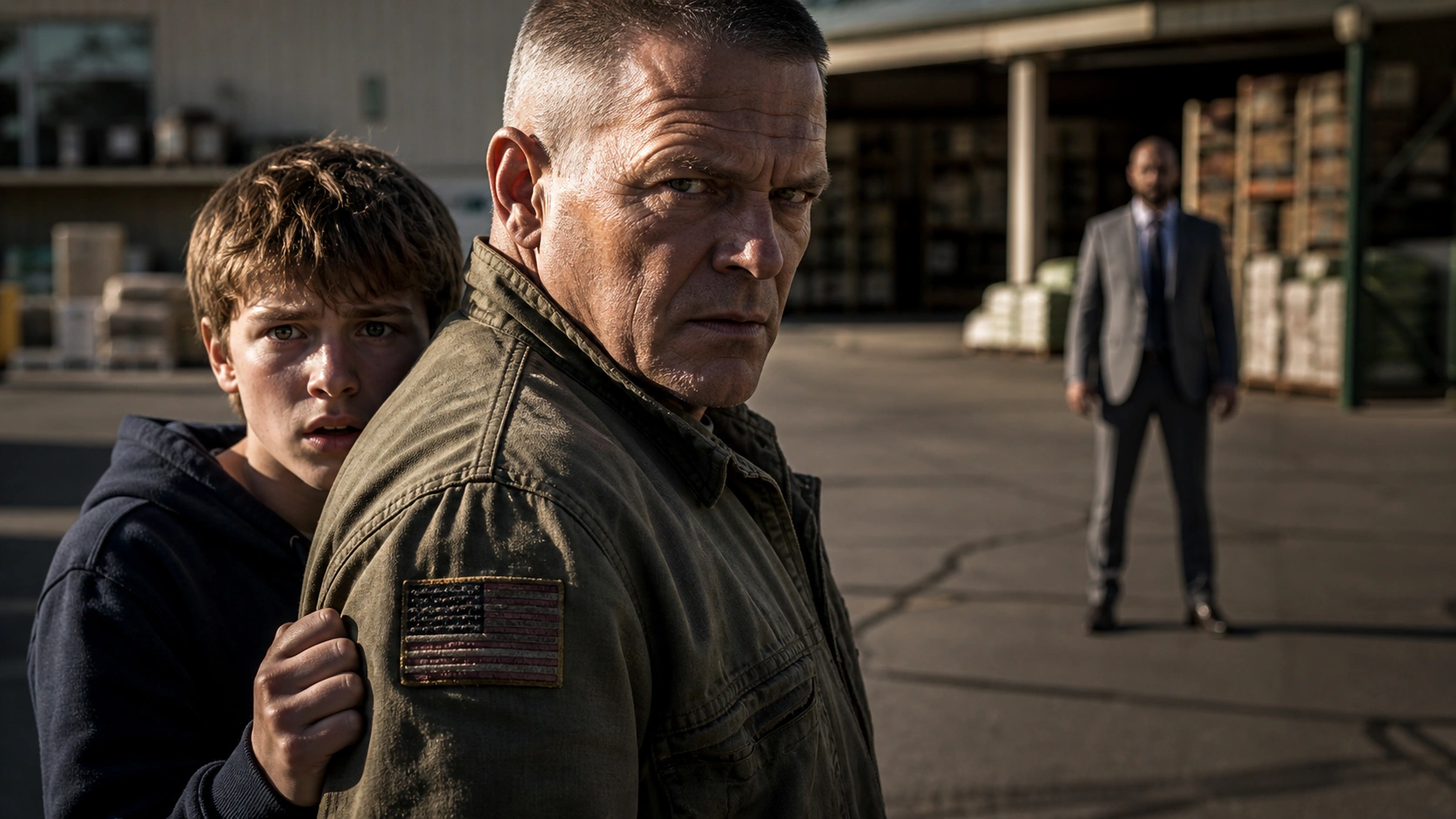
It began in March. Raymond was walking back to his car from the grocery store — parking lot, ten o’clock at night, bad lighting. A man came around the side of a van fast, from his left. Raymond didn’t think. He reacted. Thirty years of muscle memory made the decision before his brain caught up.
The man — twenty-six, drunk, reaching for his dropped car keys — spent four days in the hospital with a fractured collarbone and a broken wrist.
Raymond turned himself in the next morning.
The district attorney assigned to the case was a man named Stuart Greaves. Forty-seven, ambitious, eighteen months from an election he needed to win. He looked at the case and saw an angle: a decorated veteran with combat trauma, a history of violence-adjacent service, and a victim young enough to generate sympathy. He filed aggravated assault charges and called a press conference.
The public defender’s office assigned Raymond an attorney named Nina Carver. She was thirty-one, two years out of law school, and she had the kind of quiet that makes people underestimate her.
She read Raymond’s file in one sitting and then sat very still for a long time.
Then she started making calls.
The courtroom on the morning of the hearing was standing room only. The press had gotten hold of the story — Decorated Vet Charged After Parking Lot Altercation — and turned it into something it wasn’t. Half the gallery was there to watch Raymond burn. The other half had served with someone like him, or been raised by someone like him, and they had come for a different reason entirely.
Raymond sat at the defendant’s table in full dress uniform. His medals were lined up the way a man lines up the things he has earned and cannot give back. His hands were flat on the table. His face was still.
He was seventy-three years old and he looked like a man who had already survived things that would have broken most people, and was prepared to survive one more.
Nina leaned toward him. “How are you holding up?”
“Fine,” Raymond said.
She had learned, in the weeks since she’d taken his case, that fine from Raymond Holt covered a range of territory that most people would require several sentences to describe.
Stuart Greaves stood at the prosecution table and smoothed his jacket. He had a witness list, a behavioral expert, and what he believed was a finishing move.
“Your Honor,” he said, once Judge Carolyn Marsh had called the room to order, “the prosecution requests permission to introduce a Military Working Dog unit as part of our behavioral demonstration. We intend to show that the defendant exhibits the kind of uncontrolled threat response that made this attack not only possible but inevitable.”
Judge Marsh looked at him over her glasses. She was sixty-one and had been on the bench for twenty years and she had seen a great many things in her courtroom. “You want to bring a dog in here, Mr. Greaves?”
“A certified MWD unit, Your Honor. Handler included.”
“For what purpose, precisely?”
“To demonstrate that the defendant’s combat conditioning creates an inherent danger to the public.”
A murmur ran through the gallery.
Judge Marsh set down her pen. “Proceed. But Mr. Greaves — I will be watching this very carefully.”
The side door opened.
Officer Dana Reyes entered first, in uniform, holding a short leash. At the end of it was a Belgian Malinois — tan and black, seventy pounds, vest on, eyes scanning the room with the focused calm of a dog that has been trained to read environments.
Her name, stenciled on the vest in white block letters, was BELLA.
Officer Reyes walked five steps into the courtroom and stopped.
The gallery murmured and settled.
Reyes looked across the room at the defendant’s table, where Raymond Holt stood — Nina had asked him to stand — in full uniform, hands at his sides, white-haired and straight-backed and completely still.
“Sir,” Reyes said, her voice carrying clearly through the room. “Do you know this dog?”
Bella’s nose went up.
One beat.
Two.
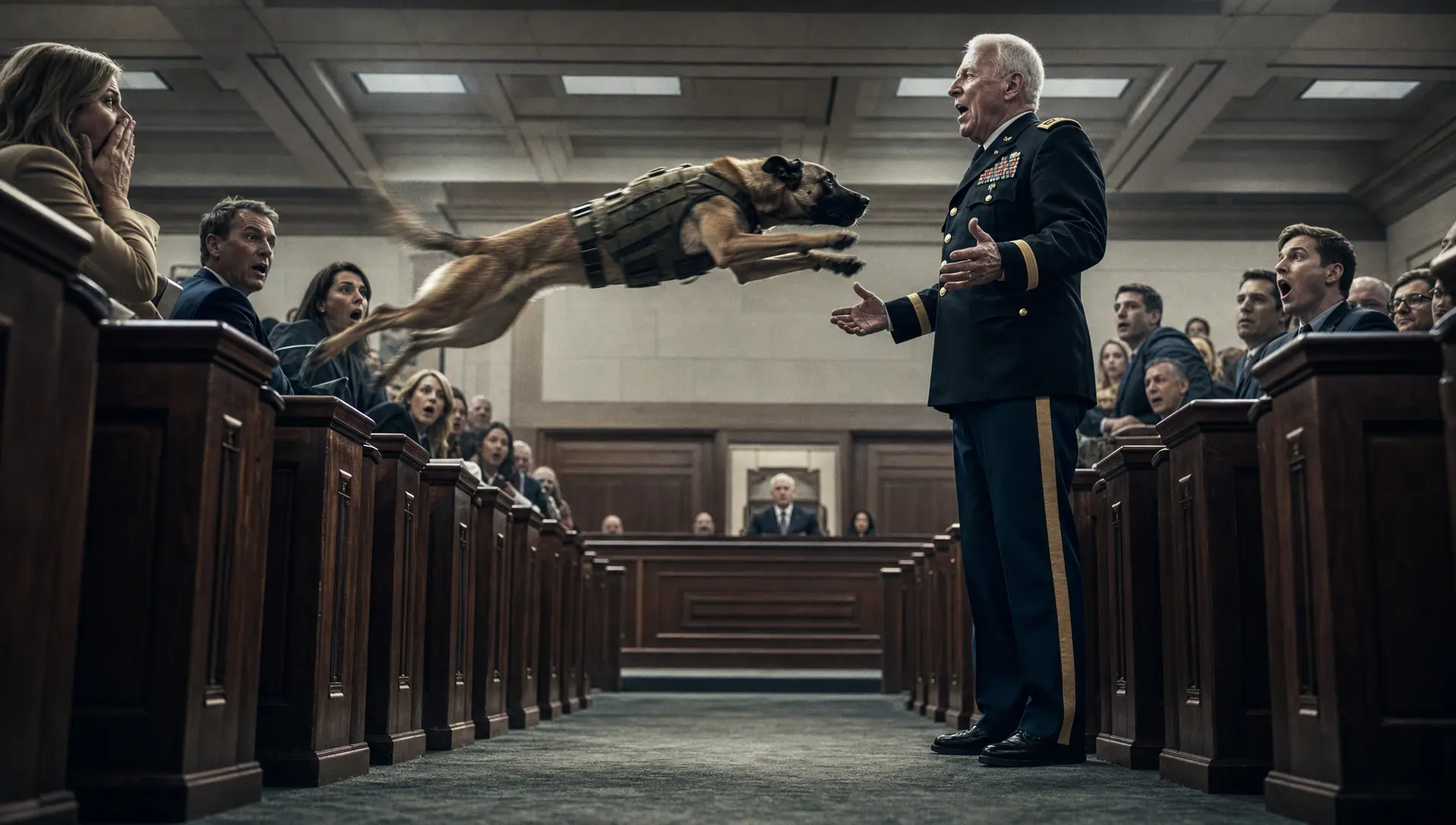
The leash snapped taut so fast that Reyes stumbled forward a full step, the handle yanked from her grip. Bella covered the length of the center aisle in four strides, her paws barely touching the floor, and launched herself from six feet out.
She hit Raymond Holt chest-high.
Both front paws on his shoulders. Seventy pounds of momentum. He rocked back half a step and caught her — his arms coming up and closing around her without hesitation, like a man catching something he’s been waiting to catch for a very long time.
The gallery erupted.
Someone shouted. A woman near the front grabbed the arm of the person beside her. Three people in the jury box were on their feet. A reporter in the back row had stopped writing entirely.
Bella was licking Raymond’s face. His jaw. His cheek. His ear. Her whole back end shaking with a wag that ran all the way up her spine. The frantic, specific, unmistakable greeting of a dog that has been separated from someone it belongs to.
Raymond pressed his face into her neck.
His shoulders shook once. Twice.
He made no sound.
Judge Marsh raised her gavel and then slowly set it back down without using it. She was watching Raymond Holt. So was everyone else.
Officer Reyes had crossed the room and was standing three feet away, staring. “Sir,” she said quietly. “Sir — has this dog met you before?”
Raymond pulled back just enough to look at the vest. His hand found the tag on Bella’s collar. He read it twice.
“MWD Bella,” he said. His voice was barely above a whisper. “3rd Special Forces Support Battalion.” A pause. “Bagram, 2009.”
Reyes went very still. “You were her first handler.”
“Fourteen months.” Raymond’s jaw worked. “I was told she was reassigned overseas. I filed three requests to find out where. Nobody ever wrote back.”
The gallery had gone completely silent.
Stuart Greaves was standing at the prosecution table with his mouth slightly open. He looked at the dog pressed against the chest of the man he had spent six weeks trying to destroy in the press, and something in his expression shifted — not remorse, exactly, but the specific discomfort of a man who has miscalculated badly in front of an audience.
Nina Carver stood up.
“Your Honor,” she said, and her voice was very calm, “I’d like to move for immediate dismissal.”
“On what grounds?” Greaves said, but his voice had lost something.
“On the grounds,” Nina said, “that the prosecution’s own witness just gave the most compelling character testimony this courtroom has seen in years.” She picked up a folder. “Additionally — Master Sergeant Holt has a documented medical history consistent with combat-related hypervigilance. The individual he struck approached him from his blind side, at night, moving fast. Three eyewitnesses, none of whom the prosecution contacted during discovery, have provided sworn statements confirming that the victim made first physical contact.” She set the folder on the judge’s bench. “My client spent thirty years protecting people. He came home. Someone grabbed him from behind in the dark. He reacted the way he was trained to react.” She paused. “That’s not a crime. That’s a reflex.”
Judge Marsh studied the folder.
The courtroom held its breath.
Bella let out a low, quiet sound — not quite a whine, not quite a groan — and put her head under Raymond’s chin.
“Mr. Greaves,” the judge said finally. “I’ll hear from you.”
Stuart Greaves straightened his jacket. He looked at the dog. He looked at the old soldier. He looked at the gallery full of people who were all looking back at him.
“The prosecution,” he said quietly, “withdraws all charges.”
The room broke open.
Raymond didn’t move right away. He stood in the middle of the noise with the dog in his arms, her chin on his shoulder, and said something to her that no one else could hear. Whatever it was, her tail slowed — from frantic to steady, like a metronome finding its rhythm.
Nina put her hand on his arm. “Raymond. It’s done.”
He looked up. His eyes were red and he did not apologize for it. “Yeah,” he said. “I know.”
He reached down and picked up Bella’s leash from the floor. Officer Reyes stepped forward, and Raymond looked at her, and she stepped back.
In the rear of the gallery, a man in his forties pushed through the crowd — Raymond’s son, who had driven eleven hours through the night without telling his father he was coming. He didn’t say anything. He just put his arms around the old man from behind and held on.
For a moment they stood like that. A son, a father, and the dog that had crossed fifteen years and two continents to be in the right place at exactly the right time.
The bailiff looked at Officer Reyes. “That really the same dog?”
Reyes watched Raymond walk slowly toward the exit, Bella pressed against his left leg, his son’s hand on his right shoulder. “She wouldn’t do that for anyone else in the world,” she said. “Not like that.”
Stuart Greaves did not seek re-election. The parking lot footage surfaced four days later and confirmed everything Nina Carver had argued. The man Raymond struck was quietly charged with the assault he had been concealing since the night of the incident.
The story ran nationally. Raymond declined every interview.
Six weeks after the hearing, Nina called him.
“How’s Bella?” she asked.
“Asleep on the couch,” Raymond said. “Took her three days to figure out she was allowed.”
“And now?”
“Now she knows.” A pause. “She sleeps on Margaret’s side.”
Nina didn’t say anything for a moment.
“Raymond,” she said finally. “I’m glad you’re okay.”
“Yeah,” he said. And then, quietly: “Me too.”
Original fictional stories. AI-assisted creative content.