The hallway at Fairmont Preparatory Academy went silent the moment Colonel Daniel Whitaker stepped through the double doors.
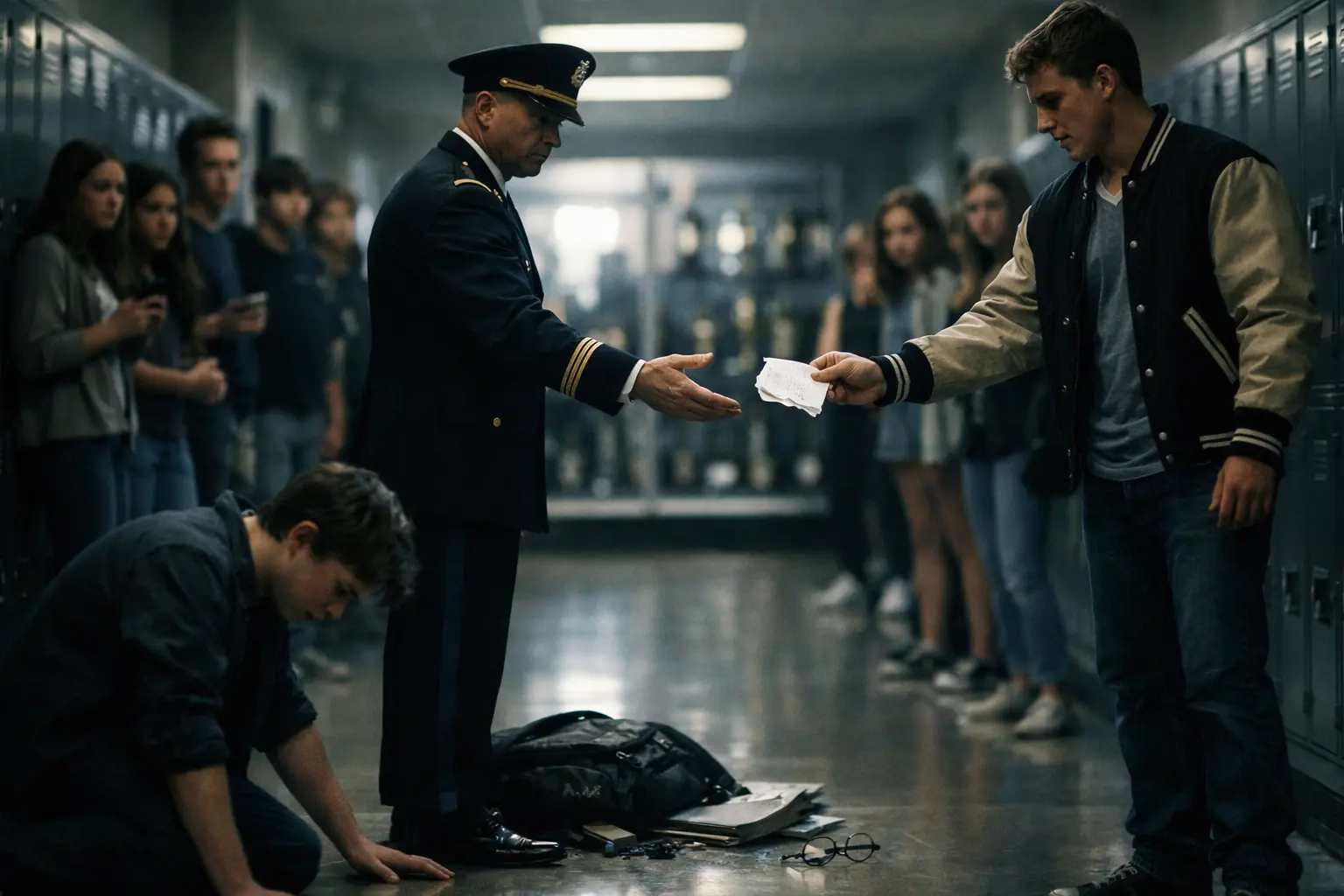
Jack was still on the floor.
His backpack was upside down. His notebooks were scattered. His glasses lay broken near a linebacker’s expensive sneaker. And in that linebacker’s hand — Brody Wallace’s hand — was Jack’s diary.
Torn open. Read out loud. Laughed at.
Jack had one word left in him when he’d tried to call his father five minutes earlier.
“Dad—”
Then the phone had hit the tile.
That was all the Colonel needed to hear.
Brody was the first to speak. He always was.
“Man, this is dramatic,” he muttered, giving the crowd a smirk. “It was just a joke.”
The Colonel didn’t move.
“The diary,” he said.
Chase, standing behind Brody with the torn pages in his fist, glanced sideways. Brody gave him a tiny shake of the head.
The Colonel didn’t repeat himself. He didn’t raise his voice. He simply looked at the security officer beside him, and the officer took one calm step forward.
Chase handed the diary over.
Jack closed his eyes.
He was eighteen. Old enough to know humiliation shouldn’t hurt this much. Young enough that it did anyway.
The Colonel unfolded the torn page in his hand. He read it once. Then again. His face didn’t change, but Jack knew that stillness. It was the stillness his father wore before difficult decisions.
Principal Elaine Morris pushed through the crowd, breathless.
“What is going on here?”
“My son was assaulted,” the Colonel said quietly. “His private property was destroyed. Several students appear to have withheld or destroyed evidence.”
Brody scoffed. “Assaulted? He tripped.”
Jack’s head snapped up. “I didn’t.”
Brody leaned down toward him. “You sure about that?”
The Colonel stepped between them.
Brody straightened instantly.
“Principal Morris,” Brody said, forcing a laugh, “my dad’s on the athletic board.”
“And mine commands soldiers,” Jack said.
Everyone turned.
Jack looked shocked at his own voice. So did Brody.
The Colonel glanced down at his son, and for the first time since entering the hallway, something softened in his face. Then he looked back at Brody.
“Step back.”
Brody didn’t move far enough.
The Colonel’s dress shoe came down beside Brody’s hand where it rested near Jack’s broken glasses. Not on it. Beside it.
Close enough.
Brody yanked his hand back like it burned.
“That is the last time your hand gets near anything that belongs to my son,” the Colonel said.
Brody’s face went red. “You can’t threaten me.”
“I did not threaten you,” the Colonel said. “I gave you a clear instruction.”
At both ends of the hallway, the security detail sealed the corridor. No one was leaving. No one was rushing forward. Phones stayed up, but no one dared delete anything.
One of the guards spoke into his radio. “Hallway secured. Preserve all student recordings as potential evidence.”
Several students lowered their phones halfway.
Another guard said, louder, “Do not delete anything you recorded.”
Brody’s eyes darted around.
That was when Jack saw it.
Brody wasn’t embarrassed anymore.
He was scared.
Principal Morris tried to take control. “Everyone not directly involved needs to return to class.”
“No,” the Colonel said.
She blinked. “Excuse me?”
“With respect, Principal, this hallway is a scene. Nobody moves until the school resource officer documents what happened.”
Brody laughed sharply. “Victim? He’s not a victim. He’s a snitch.”
The word cracked through the corridor.
The Colonel’s eyes narrowed.
“What did you call him?”
Brody realized too late what he’d said out loud. “I said he’s a—”
“Careful.”
Brody shut his mouth.
Principal Morris turned slowly to Jack. “Jack. What did you report?”
Jack hesitated.
His father crouched beside him. Just his father. The uniform stayed on, but the man underneath it was suddenly close enough that Jack could smell the familiar aftershave.
“You tell the truth,” the Colonel said quietly. “No more protecting people who used your silence against you.”
Jack took a shaky breath.
“Two weeks ago I was staying late for tutoring. I saw Brody, Chase, and Coach Miller’s assistant carrying boxes out of the athletic equipment cage. They were marked for the veterans’ scholarship fundraiser.”
The Colonel’s jaw shifted. Barely.
Jack kept going. “The next morning the school said donated tablets and sports watches were missing. I told Mr. Hanley in maintenance because he let me out through the side door that night.”
Principal Morris went pale. “Why wasn’t I told?”
“I don’t know.”
“Because it was garbage,” Brody snapped.
The Colonel stood.
“Then you won’t mind the cameras being reviewed.”
Brody’s mouth closed.
Twenty minutes later, they were in the security office.
Jack sat in a chair with his broken glasses in his lap. His father stood behind him, one hand resting lightly on his shoulder. Not squeezing. Not pushing. Just there.
Principal Morris stood beside Deputy Carla Reeves, the school resource officer. The security director cued the footage.
Dark hallway. Athletic wing after hours.
Brody appeared first. Chase followed. Then Evan Price, Coach Miller’s assistant, unlocked the equipment cage with a keycard.
Three boxes. Then two more. Then a sixth.
The labels were clear even on the grainy footage:
VETERANS’ SCHOLARSHIP FUNDRAISER — PROPERTY OF FAIRMONT PREP.
Then Jack appeared at the far end of the hallway, holding a backpack and a stack of books.
He stopped.
Brody turned.
Even without audio, the confrontation was obvious. Brody stepping close. Jack backing away. Chase laughing. Evan pointing a finger in Jack’s face.
Then Mr. Hanley emerged from a side door and walked Jack out.
Principal Morris whispered, “Oh my God.”
“Where is Evan Price right now?” Deputy Reeves asked.
“Football office,” the security director said.
The Colonel turned toward Brody. Brody’s face had gone flat and white.
“You targeted my son,” the Colonel said, “because he saw you stealing from a fundraiser for veterans.”
Brody exploded. “You don’t know anything!”
“I know enough.”
“He was going to ruin everything!”
The room went still.
Deputy Reeves said, calmly, “Brody. I strongly suggest you stop talking until your parents arrive.”
But Brody was too far gone.
“My dad paid for half that fundraiser anyway. Those boxes were nothing. We were borrowing them.”
“You were selling them,” Jack said.
Brody stared at him.
“I heard Chase say the watches were already listed online.”
Chase folded within ten minutes of being brought in separately.
Nolan followed.
Trent — the one who had read Jack’s diary aloud — broke down when Deputy Reeves suggested that publicly humiliating a witness might qualify as intimidation.
“It was Brody,” Trent said, sobbing into his hands. “He said Jack kept notes on everybody. He said if we read the diary out loud, nobody would take him seriously again.”
Jack looked down.
That was the cruelty he hadn’t been able to name until now.
They hadn’t wanted to embarrass him.
They wanted to make him unbelievable.
A joke. A sad kid with a diary. Someone adults could dismiss.
The Colonel’s hand tightened, just slightly, on his shoulder.
“You see it now?”
Jack nodded.
“They weren’t laughing because it was funny,” his father said. “They were laughing because they were afraid of what you knew.”
Brody’s parents arrived forty minutes later.
Richard and Helena Wallace walked into the conference room like they were showing up for a board meeting. Richard wore a navy suit. Helena clutched a leather purse and looked offended before anyone had said a word.
“My son has practice,” Richard said.
Principal Morris stared at him. “Your son is facing serious disciplinary and legal consequences.”
Richard turned to Brody. “What did you do?”
Brody looked away.
It was the first honest answer he had given all day.
They played the footage again. The hallway. The backpack. The diary. The foot beside the glasses. The equipment cage.
When it ended, Helena whispered, “Brody…”
Richard’s face hardened. “We can make restitution for the equipment.”
“That is not the only issue,” Deputy Reeves said.
Richard looked at the principal. “This is a school matter.”
“No,” the Colonel said. “It is not.”
Richard turned. “And you are?”
“Colonel Daniel Whitaker. Jack’s father.”
Richard’s eyes moved past him, to the security officers outside the glass. “You brought soldiers to a high school?”
“I brought a protective detail assigned to me during a transition briefing,” the Colonel said. “They arrived with me because I received a call from my son that disconnected while he was being attacked.”
Richard sat back. He tried a smaller weapon.
“Well, as a father, I understand emotions run high. Boys make mistakes.”
Jack lifted his head. “Reading my diary wasn’t a mistake.”
Richard ignored him.
The Colonel didn’t.
“Your son tried to destroy my son’s credibility because Jack witnessed theft.”
“Alleged theft.”
“Recorded theft,” Deputy Reeves said.
That ended the sentence.
By the end of the day, Brody Wallace was suspended pending expulsion.
Chase and Nolan were removed from the football team.
Trent was suspended and referred to the disciplinary board.
Evan Price was placed on administrative leave and arrested three days later, after investigators tied additional missing equipment to private resale accounts under his name.
The scandal hit Fairmont Prep hard. Parents demanded answers. Veterans’ groups demanded restitution. Alumni demanded to know how donated equipment for scholarships had disappeared under the football program’s nose.
The head coach claimed he knew nothing. Then emails surfaced.
He had known enough.
He resigned before the week ended.
The Wallace family fought.
They hired attorneys. They threatened the school. They blamed Jack. They suggested his diary “proved he was emotionally unstable.”
That was their worst mistake.
At the disciplinary hearing, Principal Morris placed Jack’s diary in a sealed folder and said, “This private journal was used as a weapon against a student who told the truth. Fairmont will not punish honesty because cruelty found a microphone.”
Then she made Trent stand in front of the entire school.
Not to be mocked. Not to be destroyed.
To take responsibility.
The auditorium was full. Jack sat in the third row beside his father, in dress uniform.
Trent walked to the podium with red eyes and shaking hands.
“My name is Trent Lawson,” he said. “I read Jack Whitaker’s private diary out loud in the hallway to humiliate him. I did it because Brody told us Jack needed to look unstable so no one would believe what he reported.”
The silence was total.
“I thought laughing with the stronger guy would make me safe. It didn’t. It made me cruel.”
He looked toward Jack.
“I’m sorry.”
Jack didn’t nod. He didn’t smile.
He just listened.
Some apologies are real. Some are required. Time would tell which one Trent’s was.
Brody never apologized.
He was expelled two weeks later after the investigation confirmed his role in the theft, harassment, and witness intimidation. His scholarship offers disappeared. His family paid restitution large enough to replace every stolen item and expand the veterans’ scholarship program they had tried to exploit.
Brody had also injured his own hand during the hallway incident, slamming it against the trophy case as he yanked away from security. The injury ended his football season before the school could.
Rumors exaggerated it, of course. People always prefer legends to facts.
Jack never corrected them.
He didn’t need to.
The truth was enough.
Before the Colonel returned to active duty, he took Jack back to the hallway.
Same lockers. Same trophy case. Same tile.
“I hate this place,” Jack said.
“I know.”
“I keep hearing them laughing.”
“That may happen for a while.”
Jack looked at him. “You always tell the truth even when it isn’t comforting.”
His father almost smiled. “Comforting lies don’t build strong men.”
“I felt weak.”
“You were outnumbered.”
“I still felt weak.”
The Colonel turned to face him fully.
“Jack. Courage is not winning the hallway fight. Courage is telling the truth when the hallway is full of people laughing at you.”
Jack blinked hard.
His father reached inside his overcoat and pulled out the diary. The cover was taped. The torn pages carefully reattached.
Jack took it like it was something sacred.
“I thought you’d tell me to stop writing in it,” he said.
“No,” his father said. “I bought you two more.”
Jack laughed through his tears.
A month later, Fairmont Prep created the Whitaker Integrity Award for students who reported wrongdoing under pressure.
Jack hated the name at first. He told Principal Morris it sounded too big.
She said, “So was what you did.”
The football team was rebuilt under a new coach, a former Marine who opened the first practice with one sentence:
“If your strength only works against people smaller than you, you are not strong.”
At senior assembly, Jack stood on the auditorium stage in new glasses.
Principal Morris said, “For integrity under pressure, and for reminding this institution that dignity is not negotiable.”
The room stood.
Students. Teachers. Even a few football players.
Jack looked out and saw his father in the back row, in uniform, standing perfectly still.
For a moment he was a little boy again, waiting at a window for his dad to come home.
Then he was eighteen again.
Older than he wanted to be. Stronger than he thought he was.
After the ceremony, the Colonel met him in the hallway.
“Proud of you.”
“I didn’t do much.”
“You told the truth. That’s never small.”
Brody’s locker was empty. His name was gone from the football board. Chase, Nolan, and Trent spent the summer packing donation boxes for the very foundation they had helped damage.
Every week, they walked past Jack’s name on the integrity board by the front office.
Not as a warning.
As a reminder.
Brody had wanted to turn Jack into a hallway joke.
Instead, he exposed a theft ring, ended a corrupt football culture, and forced an entire school to remember something quiet students already knew:
Arrogant people always assume no one is watching.
They are always wrong.
Original fictional stories. AI-assisted creative content.