The rain had stopped, but the street outside Carter’s Bakery still glistened. Inside, the ovens hummed and the last sourdough loaf sat cooling on brown paper.
Noah Carter, seventeen, wiped flour from his hands and checked the register clock. Ten minutes to close.
The bell rang.
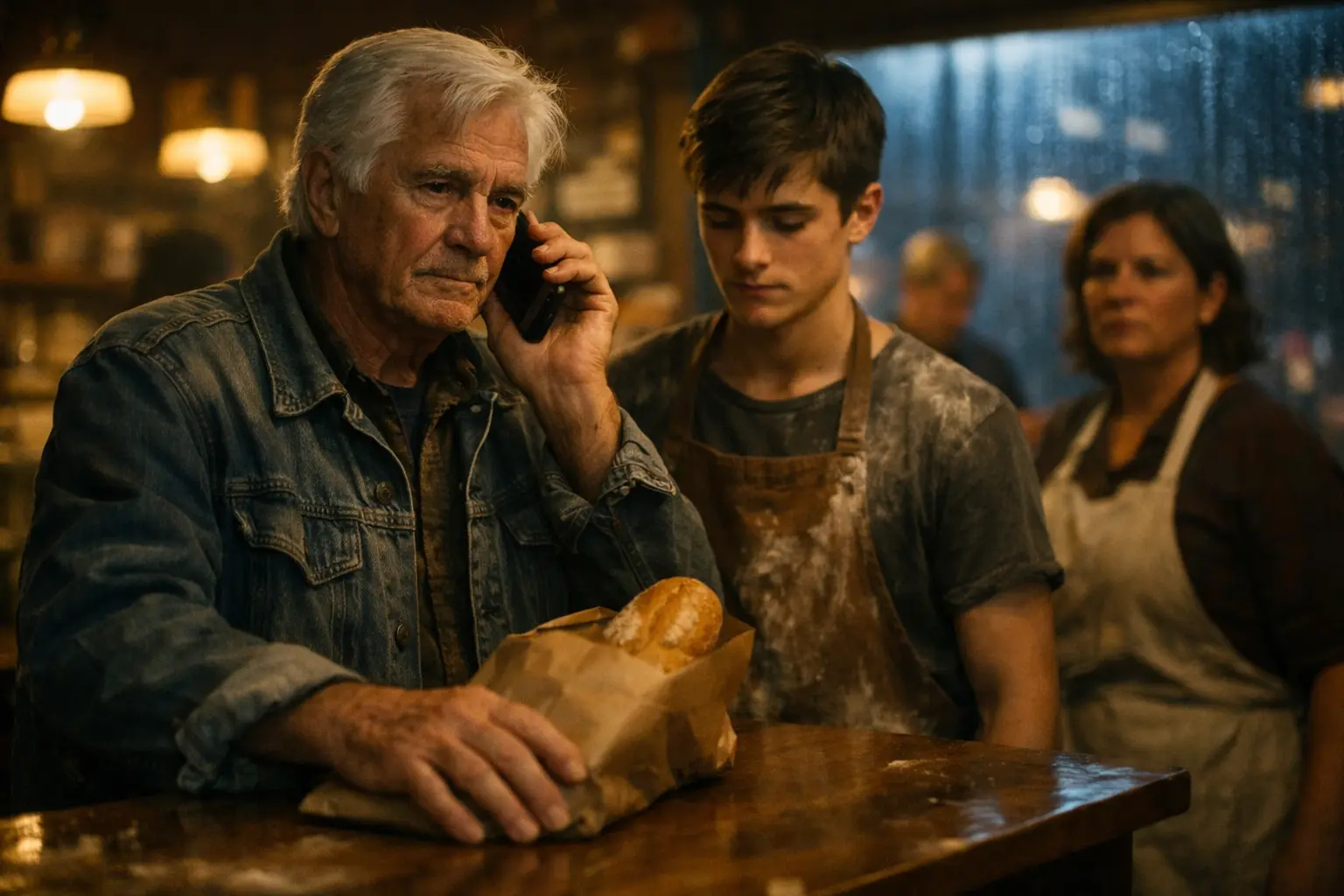
An old man in a worn denim jacket stepped inside. Silver hair. Cracked leather shoes. He walked slowly to the counter and looked at the last loaf like it was something precious.
“That one fresh?” he asked.
“Twenty minutes out of the oven, sir.”
“How much?”
Noah told him.
The old man opened his wallet. Noah saw it instantly. A few coins. A faded receipt. A small photograph behind cloudy plastic. Nothing else.
“I thought I had more,” the man said quietly.
Behind him, a woman shifted impatiently. Someone near the coffee station looked away.
“Sorry for the trouble.” The old man began to turn.
“Wait.”
Noah reached under the register and pulled out the small envelope where he kept his tips. Dinner money. His mother worked nights. His little sister ate school lunches. Every dollar had a place.
“Noah.” Mrs. Thompson’s voice cut through the room. She’d come out from the back, pencil behind her ear. “Don’t give away the food.”
“He needs it.”
“This is a business.”
“I know.”
“Then act like it.”
The old man raised a hand. “Son, don’t get yourself in trouble over me.”
Noah slid the loaf into a paper bag, folded the top clean, walked around the counter, and placed his tip money into the old man’s palm.
“Take it home.”
The old man closed his fingers around the bills. His eyes flickered — surprise, pain, gratitude.
“Thank you, son.”
Mrs. Thompson’s heels clicked hard across the tile.
“Noah.”
He turned.
“You’re fired.”
The customers stopped pretending not to listen.
“I understand,” Noah said.
“You can pick up your last check Friday.”
The old man lowered the bag. He looked at Mrs. Thompson calmly, then reached into his jacket and took out a phone. Not old. Not cheap.
His thumb moved once across the screen. He lifted it to his ear.
“Send the cars.”
A pause.
“Now.”
He put the phone away.
Mrs. Thompson crossed her arms. “You’ve made your point. If you’re trying to scare us, it won’t work.”
“I wasn’t trying to scare anyone.”
“So what — a limousine is coming for a loaf of bread?”
The old man didn’t answer. He looked toward the window.
Headlights swept across the glass. Not one pair. Three.
Three black SUVs rolled to the curb in perfect spacing. No horns. No flashers. Just quiet precision.
A young father lifted his daughter so she could see. Someone whispered, “What is that?”
Doors opened simultaneously. Six people in dark tailored suits stepped out, scanned the street, and walked toward the bakery.
The bell rang. Once. Twice. Three times.
A woman in a navy suit led the group directly to the old man. She lowered her head.
“Good evening, Mr. Brooks.”
Mrs. Thompson’s mouth opened. “You… know him?”
“We work for him.”
The old man sighed. “I told you not to bring everyone.”
“You said immediately, sir.”
“I did.”
One of the men held out a folded wool overcoat. Another offered an umbrella. A third held a leather document case.
Walter Brooks accepted none of them.
He held only the paper bag Noah had packed.
“Sir, would you like me to carry that?” the assistant asked.
“No.”
“It’s just bread.”
Walter smiled faintly. “No. It’s kindness.”
He turned to Mrs. Thompson.
“I’m sorry if there’s been a misunderstanding,” she said quickly. “I didn’t know who you were.”
“That’s exactly the misunderstanding.”
“If I’d known—”
“If you’d known, you would have treated me differently.” His voice stayed polite. “And that’s the problem.”
She couldn’t answer.
Walter turned to Noah.
“You gave away your dinner tonight.”
Noah blinked. “How did you—”
“You thought no one noticed. I did.”
Noah looked down. “My mom says if someone is hungrier than you are, then you’re probably richer than you think.”
“Your mother is a wise woman.”
Walter reached into his jacket and produced a second wallet — worn leather, thick with cards. He pulled out a single white business card.
Walter Brooks. Chairman. Brooks Foundation.
“I’d like to meet your family.”
Noah stared at the card. “My family?”
“I have a feeling your mother raised an extraordinary young man.”
He walked to the door, then looked back one last time — not at Mrs. Thompson, not at the customers. Only at Noah.
“This isn’t the end of your story. It’s the beginning of mine.”
The SUV door closed. The convoy pulled away into the wet streets.
Mrs. Thompson stood frozen behind the register.
She had just fired the kindest employee she’d ever hired.
Not for stealing. Not for lying. For compassion.
Noah walked home in the cool air with the card tucked in his backpack.
Their apartment sat above an old laundromat. Paint peeled from the hallway. The elevator hadn’t worked in months.
Emma ran to him. “Did you bring bread?”
“Not today.”
“That’s okay.”
Their mother stepped from the kitchen in her scrubs. Noah told her everything.
She listened. Then she squeezed his shoulder.
“Are you upset?”
“Just hoping I made the right choice.”
“You did.”
He handed her the card.
She read it twice. Her hand went to her mouth.
“Noah. Do you know who this is?”
“An old man in a denim jacket.”
“He built half the hospitals in this state.”
The phone rang at seven the next morning.
A calm voice on the other end. “Mr. Brooks would like to send a car for your family at ten. Would that be acceptable?”
Noah’s mother said yes before she could think.
The car was black, spotless, and silent. The driver held the door.
They rode through streets Noah had only ever seen from a bus. Iron gates opened without a word. The house at the end of the drive looked less like a home and more like a small museum.
Walter met them at the door in the same denim jacket.
“You came.”
“You asked,” Noah’s mother said.
He led them through a long hallway lined with photographs. Not of yachts. Not of celebrities. Photographs of schools. Clinics. Children holding diplomas. Families standing in front of new homes.
They sat in a warm room with a fireplace. Coffee for the adults. Hot chocolate for Emma.
“I have a proposal,” Walter said. “Two, actually.”
Noah’s mother waited.
“First — I’ve watched people my entire life. I can tell within a minute who’s been broken by hardship and who’s been sharpened by it. Your son is the second kind. I’d like to fund his education. Fully. Whatever school. Whatever direction.”
Noah’s mother pressed her lips together. “Mr. Brooks—”
“Walter.”
“Walter. We didn’t come here for charity.”
“Good. Because this isn’t charity.”
He set down his cup.
“It’s an investment.”
He turned to Noah.
“You made a decision last night that most grown men wouldn’t make. You chose a stranger’s dinner over your own. Do you know how rare that is?”
Noah didn’t answer.
“The second proposal is bigger.”
Walter looked at Noah’s mother.
“Mrs. Thompson’s bakery. I’ve had someone look at the books this morning. She’s three months behind on her lease. Six months behind on her supplier. Her business has been dying for a year — she just hides it well.”
Noah’s mother frowned. “How do you know that?”
“Because when someone humiliates a boy over a loaf of bread, I like to understand why.”
He turned back to Noah.
“I’d like to buy the bakery.”
“Buy it?”
“And give it to you.”
The room went quiet.
“I’m seventeen,” Noah said.
“You’ll have a manager for the first two years. Someone I trust. You’ll learn every part of the business. When you turn nineteen, the keys are yours. Legally, fully.”
Noah’s mother stared at him. “Walter. This is too much.”
“No. It’s the correct amount.”
He leaned forward.
“I was fourteen when I walked into a bakery in Pittsburgh with nothing in my pocket. The owner — a man named Miller — gave me a loaf of day-old bread and asked no questions. I ate it on the curb outside. I’ve spent forty-eight years trying to repay him. He died before I could.”
He looked at Noah.
“Last night, you fed a stranger with an empty wallet. You didn’t know who I was. You didn’t do it for a reward.”
“That’s why you’ll get one.”
Emma tugged on Noah’s sleeve. “Are we rich now?”
Noah laughed for the first time in a day. “No, Em.”
Walter smiled. “You’re something better than rich. You’re kind. Money is just what lets kindness reach further.”
Three weeks later, the papers were signed.
Mrs. Thompson sat across from Walter’s lawyer in a small conference room. Her hands shook as she read the offer.
It was generous. More generous than she deserved, and she knew it.
“Why?” she asked. “After what I did to him?”
The lawyer folded his hands.
“Mr. Brooks asked me to tell you something.”
“Okay.”
“He said: ‘If I only helped people who deserved it, I’d have helped no one, including myself.'”
Mrs. Thompson’s eyes filled.
She signed.
The sign came down on a Tuesday.
Carter’s Bakery became Miller’s Bakery — named after a man in Pittsburgh who once fed a hungry boy and never knew what he started.
Noah stood outside on opening morning in a new brown apron. His mother stood beside him, no longer in scrubs. Emma held a small bouquet of flowers she’d picked from the sidewalk cracks.
Walter arrived in the same denim jacket. He always wore it.
“Ready?” he asked.
“Terrified,” Noah said.
“Good. That means you’ll pay attention.”
The door opened. Customers walked in — some familiar, some strangers who had heard the story.
Mrs. Thompson came in around noon.
She stood in the doorway a long time before Noah noticed her.
He walked around the counter.
“Hi.”
“Hi.” Her voice cracked. “I wanted to see it. I didn’t know if I was allowed.”
“You’re allowed.”
She looked around the bakery she used to own. At the shelves. At the register. At the boy she had fired.
“I owe you an apology I don’t know how to give.”
“You just gave it.”
She shook her head. “Noah. I was wrong. About you. About all of it.”
He picked up a warm loaf from the case and slid it into a paper bag. He folded the top clean, the way she had taught him.
He handed it to her.
“On the house.”
“I can’t accept it.”
“You don’t have to earn every act of kindness.”
The tears she had been holding finally fell.
“I don’t deserve this.”
“Neither did Walter. Neither did I. That’s why it’s called grace.”
She took the bag with both hands.
Then she did something Noah didn’t expect.
She hugged him.
Not the hug of a boss. Not the hug of a stranger.
The hug of someone who had finally understood the cost of her own pride.
That evening, after closing, Noah placed one warm loaf on the highest shelf near the door.
No price tag. No questions.
A small handwritten card beneath it:
Reserved for the next person who needs hope.
He turned off the lights.
Outside, the rain had started again, silver in the streetlight. Somewhere across town, an old man in a denim jacket sat by his fireplace, reading a leather journal full of names.
Beside the newest entry, in careful ink:
Noah Carter. Fed a stranger. Now feeds a town.
Walter Brooks closed the journal and smiled.
The debt he had carried for forty-eight years was, at last, paid forward.
Original fictional stories. AI-assisted creative content.