Marcus had spent eight years describing the world to a daughter who couldn’t see it.
Every morning, the same routine. He buttoned Emily’s sweater. He guided her hand to the cereal bowl. He walked her to the park bench under the big oak.
“Tell me what the sky looks like today, Daddy.”
“Blue. Like glass. Not a cloud in it.”
Emily smiled behind her black sunglasses. “I wish I knew what blue looked like.”
“One day, sweetheart. Somehow. You will.”
Claire handled the medical side. Every appointment. Every pill bottle. Every specialist who shook their head and said the same thing: nothing more to do.
Marcus trusted her. She was Emily’s mother. Why wouldn’t he?
That Saturday, the park was warm and gold. Marcus was describing a squirrel when a voice cut in behind him.
“Your daughter is not blind.”
Marcus turned.
A boy. Maybe twelve. Dirty hoodie, torn sneakers, dust on his cheeks. But his eyes were calm. Too calm.
“Excuse me?”
“She isn’t sick.”
Marcus stood up slowly. “What did you just say?”
The boy pointed at Emily. “Someone made her this way.”
“That’s not funny, kid.”
“I’m not joking.”
“Get out of here before I call somebody.”
The boy didn’t move. He just lifted his finger again — slower this time — and pointed past Marcus.
“It’s your wife.”
Marcus’s stomach dropped.
“Marcus!”
Claire was running down the path. Not walking. Running. Her purse slapping against her hip.
“Don’t listen to him! Marcus, don’t —”
She reached them out of breath, her face pale. Not angry. Not confused.
Terrified.
“He’s lying,” she gasped. “Whatever he told you, he’s lying.”
“I didn’t tell him anything yet,” Marcus said quietly.
Claire’s mouth opened. Closed.
Then Emily moved.
Not toward Claire. Toward the boy.
Her head turned. Slowly. Deliberately.
Marcus stared. She had never done that before. Never tracked movement. Never turned toward a stranger.
“Daddy?” Emily’s voice was small.
“I’m here, honey.”
“I see light.”
The park went silent.
“What did you say?” Marcus knelt in front of her.
“I see light. Around him.” She lifted a shaking finger toward the boy. “He’s — he’s bright.”
Claire took a step back.
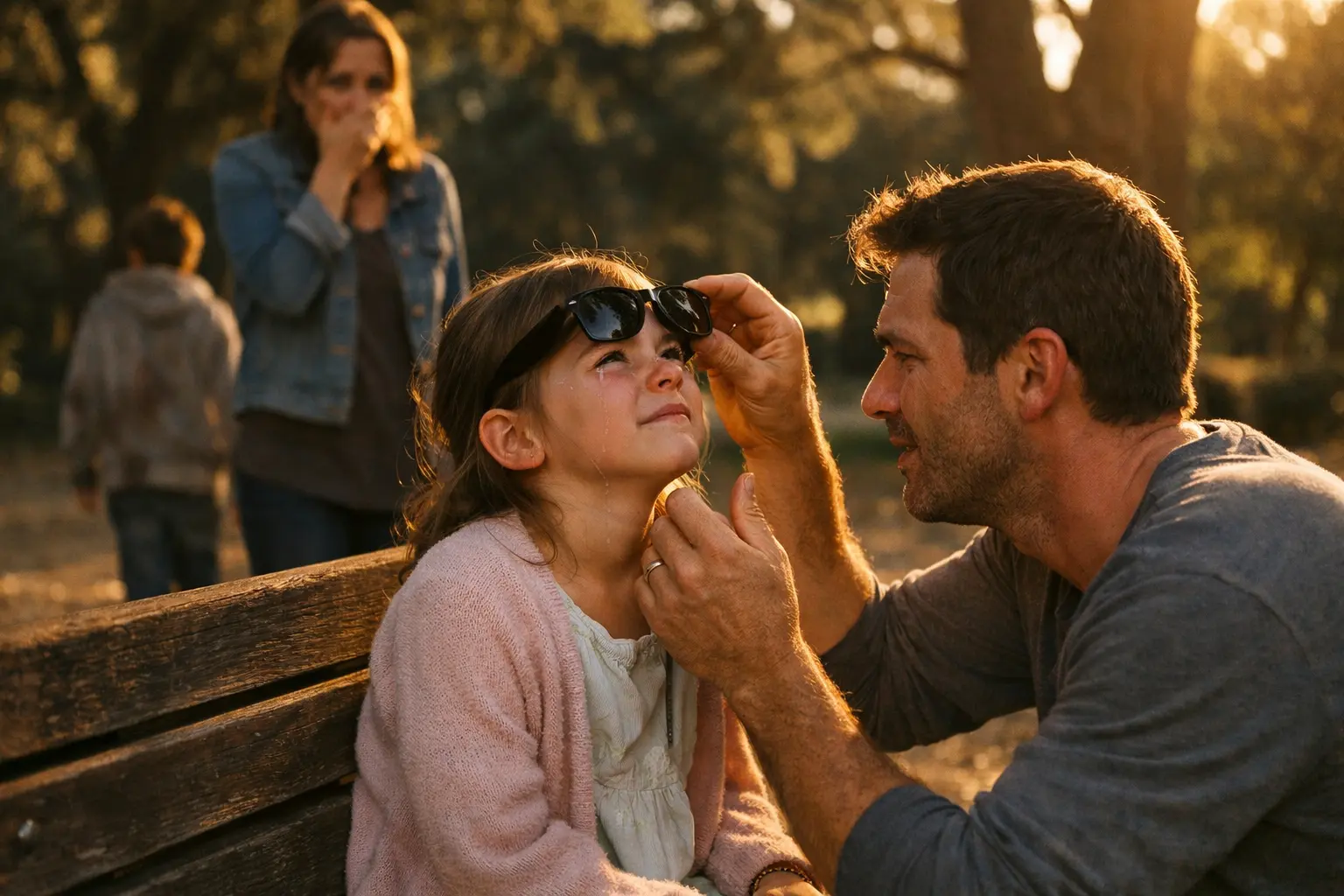
Marcus reached up and, gently, lifted the sunglasses off his daughter’s face.
Emily blinked. Squinted. Winced against the sun.
“It’s — it’s too much —”
“Take your time, baby.”
“Daddy, I can see something.”
Marcus’s hands were shaking. He turned to Claire.
“Claire. Look at me.”
Claire wouldn’t.
The dirty boy took a step backward. Then another. He was already fading into the crowd.
“Wait!” Marcus called. “Who are you?”
The boy paused. Looked back once.
“You’re too late,” he said. “But not for her.”
And then he was gone.
Marcus didn’t sleep that night.
He sat at the kitchen table with a shoebox full of Emily’s medical records. Bottles. Print-outs. Referral letters. Claire’s careful handwriting on every folder.
Claire stayed in the bedroom with the door closed.
At 3 a.m., Marcus made a call.
At 9 a.m., he was in Dr. Reyes’s office, an ophthalmologist he’d never seen before. He handed over the whole box.
Reyes went through it in silence. Page after page. Bottle after bottle.
Twenty minutes in, she stopped.
“Mr. Hollis. Who prescribed this one?”
“I don’t know. My wife handled all of it.”
“This medication isn’t for long-term pediatric use. This one either. And this combination…” She trailed off. “I need to run a full workup on your daughter. Today.”
“What are you telling me?”
Reyes chose her words carefully. “I’m telling you that some of what’s in this box could suppress visual response. Not damage the eye. Suppress the function.”
Marcus gripped the edge of the desk.
“You’re saying she’s not blind.”
“I’m saying I need to see her before I say anything else.”
The tests took six hours.
Emily sat through every one, quiet, brave, holding Marcus’s hand between machines.
At the end of the day, Reyes brought them into her office and closed the door.
“Her optic nerves are intact. There’s no structural damage. What we’re looking at is chemically induced suppression, sustained over years.”
“Can it be reversed?”
“I believe so. Gradually.”
Marcus couldn’t speak.
Emily could. “Daddy? Does that mean I get to see?”
“Yes, honey.” His voice cracked. “Yes.”
That night, Marcus walked into the bedroom.
Claire was sitting on the edge of the bed. Not crying. Just staring at the carpet.
“Reyes says she’s going to see, Claire.”
Claire nodded.
“You knew.”
She nodded again.
“Say it.”
“I knew.”
Marcus sat down in the chair across from her. He didn’t trust himself to stand.
“Why.”
Claire’s hands twisted in her lap. “After she got sick that first time — the fever — she started getting better. And every time she got better, I —”
“You what.”
“I panicked. I thought if she was fine, you wouldn’t need me. I thought you’d —”
“Stop.”
“I didn’t mean —”
“Stop.” Marcus’s voice was low. “You’re telling me you kept our daughter in the dark for eight years because you were scared I’d leave.”
Claire’s face crumpled. “It started small. One doctor said one thing. I found another who said something else. I kept looking until I found the answers I wanted. And then I couldn’t stop. Every year it got worse. I couldn’t take it back.”
“You could have. Every single day, you could have.”
“Marcus —”
“Every morning I described the sky to her.”
“I know.”
“Every night I told her one day she’d see it.”
“I know, Marcus.”
“And you sat there. And you smiled. And you handed her the next pill.”
Claire started to cry. Marcus didn’t move.
“I’m calling my lawyer in the morning,” he said. “And I’m calling the police.”
“Marcus, please —”
“Don’t ever say my name again.”
He walked out and shut the door behind him.
The investigation took four months.
Dr. Reyes testified. So did two pharmacists who had grown suspicious years earlier and been dismissed. So did a specialist Claire had gone to in another county under a different name.
The charges were formal. Aggravated child abuse. Endangerment. Fraud, for the insurance side of it. Claire’s lawyer tried for a plea. The judge — a woman with two kids of her own — didn’t take it.
Twelve years.
Claire didn’t look at Marcus when they read it out. She looked at Emily. Emily looked back — clearly, directly, with eyes that finally worked — and said nothing.
In the hallway afterward, Emily tugged Marcus’s sleeve.
“Daddy?”
“Yes, baby.”
“I don’t want to see her again.”
“You don’t have to.”
“Okay.”
The custody order was clean. Full to Marcus. No visitation. No contact.
He sold the house. Bought a smaller one across town, near a good school with a good nurse and a good counselor. Emily started third grade six months behind but caught up by winter break.
She learned to read fast. She learned to draw faster. She filled the refrigerator with pictures of skies — every shade of blue she’d been promised and finally got to keep.
A year later, Marcus sat on the same wooden bench in the same park.
Emily was chasing a butterfly between the oaks. No sunglasses. No cane. Just a red sweater and sneakers that lit up when she ran.
“Daddy!” she called. “What color are those?”
“You tell me.”
“Yellow!”
“And the sky?”
She stopped. Tilted her head all the way back. Held the pose for a long second.
“So blue.”
Marcus laughed until his eyes stung.
He looked down the path — the same path where the boy had stood a year ago. Nobody there. Just wind in the leaves and a paper cup rolling across the gravel.
He’d stopped looking for the boy months ago. He’d checked every shelter, every school, every missing persons report in three counties. Nothing. No one remembered him. The park cameras had caught Marcus, Claire, Emily, a jogger, a woman with a stroller — and one blur near the oak that could have been anyone.
Marcus didn’t need to find him anymore.
Whoever the boy was — runaway, stranger, something else — he’d said four words in a park on a Saturday afternoon and given Marcus back his daughter’s eyes.
“Daddy!” Emily was running back, breathless, holding something in both hands. “Look — look what I found!”
She opened her palms.
A blue jay feather.
“It matches the sky,” she said. “See?”
Marcus took it carefully. Turned it in the light.
“Yeah, baby,” he said. “I see it.”
He tucked the feather into his shirt pocket, took his daughter’s hand, and walked her home.
Original fictional stories. AI-assisted creative content.