My parents kicked me out three months after I turned eighteen.
Not for drinking. Not for getting arrested.
For telling them I didn’t want to be a surgeon.
Both of them cut people open for a living, and in our house medicine wasn’t a job. It was a bloodline. My father said it like scripture. “Our family saves lives, Michael. That’s what Carters do.”
I never wanted a scalpel. I wanted a guitar.
The night I told them, the dinner table went dead quiet. My mother set down her fork like it had turned to lead.
My father didn’t yell. He folded his napkin into a perfect square.
“If you won’t walk the path we built for you,” he said, “then you walk alone.”
“You don’t mean that.”
“Try your key tonight.”
I thought he was bluffing. By sunset the lock had been changed.
Three months later I lived in a camping tent under a bridge near an abandoned warehouse. It stayed dry when it rained. Nobody bothered me. That was the best I could say for it.
During the day I washed dishes at a café downtown. Wiped tables. Hauled trash. It bought cheap food and, once in a while, a new guitar string.
Most nights I ate leftover tips.
That afternoon the café was dead. My manager, Rosa, handed me a wrapped sandwich as she flipped the sign to CLOSED.
“Take it, Mike. It’s going in the garbage otherwise.”
I sat behind the building, back against the brick, making that sandwich last as long as I could.
From the alley I could see the sidewalk. That’s when I noticed the old man.
Worn coat, torn at both sleeves. Shoes barely holding together. He moved down the block, quiet, asking each person the same small question.
Nobody slowed down. A woman shook her head without looking up from her phone. A guy in a suit waved him off like a fly.
When the sidewalk gave him nothing, he turned toward the alley.
“Hey,” I called.
He looked up, careful, like he expected to be chased off.
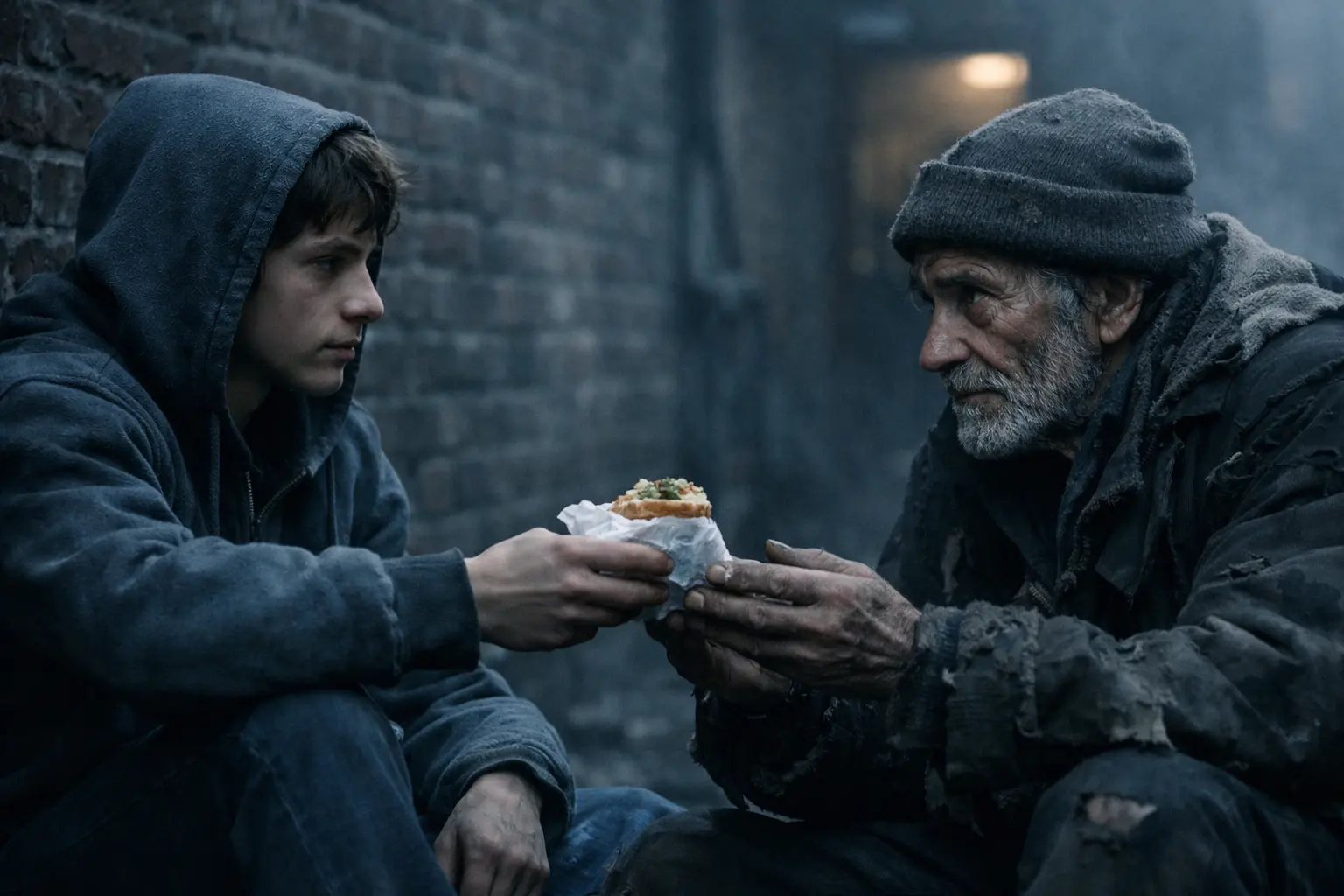
“You hungry?” I broke the sandwich in half and held out the bigger piece. “It’s not much. But it’s yours if you want it.”
He came over slowly and lowered himself onto the curb beside me.
“Thank you,” he said.
We ate without talking. He took small bites, spacing them out, like he didn’t want it to end.
“What’s your name, son?”
“Mike.”
“And where do you sleep, Mike?”
I shrugged. “Under the bridge. Got a tent.”
He studied my face a long moment. “You’re awful young to be living like that.”
“Long story.”
“They usually are.” He almost smiled. “Somebody put you out?”
“My parents.”
“For what?”
“For picking music over medical school.”
He was quiet. Then, softly, “And you’d do it again?”
I didn’t even have to think. “Every time.”
He nodded slowly, like I’d confirmed something. When the last bite was gone he stood, joints stiff.
“You shouldn’t live a life like this,” he said.
I almost laughed. “Neither should you.”
For a second he smiled. Not tired, not lost. Just present.
Then he walked away, and I figured that was the end of it.
I was wrong.
I woke the next morning to an engine idling close by. I thought it was a truck crossing the bridge. But the sound didn’t fade. It stayed.
I unzipped the tent and crawled out. And froze.
A long black limousine sat a few yards from my tent. The kind of car that never, ever came to this part of town. A driver in a dark suit stood beside it, hands folded.
When he saw me, he came over.
“Are you Michael Carter?”
I blinked. “Yeah. That’s me.”
He opened the rear door. “Mr. Whitmore would like a word.”
“Who?”
“Charles Whitmore.”
The name meant nothing. But I stepped closer and looked inside.
And my heart stopped.
The old man from the alley sat in the back seat. Except the torn coat was gone. Tailored suit. Polished shoes. Hair combed neat.
He looked like a different man entirely. He looked powerful.
“Good morning, Mike,” he said warmly.
“You… weren’t homeless.”
He chuckled. “No.”
“Then what were you doing yesterday?”
He patted the seat. “Sit. Please.”
I climbed in. The door shut with a soft, expensive sound.
“Why were you asking people for food?”
He folded his hands. “Once a year I like to remember what the world looks like from the ground.”
“That sounds like a test.”
“In some ways it is.” He glanced out the tinted window. “Yesterday I asked twenty-two people for help.”
“How many helped?”
“One.” He looked at me. “You.”
“It was half a sandwich.”
“It was everything you had. That matters more than you know.”
I shifted. “So why am I here?”
“My name is Charles Whitmore. I own Whitmore Development Group.”
The name still meant nothing to me. But the driver’s spine straightened when he heard it, and that told me plenty.
“I grew up poor,” Whitmore went on. “Slept in my car at nineteen. Built my first company out of nothing but stubbornness.” He leaned forward. “So when I meet someone young, struggling, and still kind — I pay attention.”
“What does that mean?”
“It means I’d like to help you. What do you want to do with your life?”
“Music,” I said. No hesitation.
“Instrument?”
“Guitar.”
He smiled. “Good.”
The limo pulled up outside a wide brick building downtown. A sign read WHITMORE ARTS FOUNDATION. Through the glass I could see practice rooms, recording gear, a small stage.
It felt like another planet.
“Do you have your guitar?” he asked.
“Back at the tent.”
“Then let’s go get it.”
An hour later I sat on that little stage with my beat-up guitar across my knee. Whitmore sat alone in the front row.
“Whenever you’re ready,” he said.
My hands shook as I started to play. The song was one I’d written under the bridge — about being lost, and angry, and reaching for hope when everything’s cracked down the middle.
The room filled with sound.
When the last chord faded, the silence sat heavy in the air.
Whitmore stood. Then he clapped, slow and certain.
“Well,” he said. “That answers my question.”
“Was it okay?”
He shook his head. “It was real.”
Then he handed me a folder. I opened it with careful fingers.
“What is this?”
“A full scholarship to the Whitmore Music Conservatory. Tuition, housing, lessons, instruments. All of it.”
I stared at the pages. My hands wouldn’t stop trembling.
“Why me?”
“Because when you had nothing,” he said, “you still chose kindness.” He rested a hand on my shoulder. “Talent grows. Skill improves. But character like yours — the world runs short on that.”
That should’ve been the ending. But it wasn’t.
Six months later I was living in conservatory housing, playing every day, my hands calloused in the good way. Then my phone rang. A number I hadn’t seen in almost a year.
My father.
I almost let it go. I picked up.
“Michael.” His voice was tight. “We need to talk. I don’t know how you did it, but people are talking. Whitmore’s foundation. Your name in the arts pages. Your mother saw it at the hospital.”
“So now you call.”
“We were protecting you. From a foolish choice.”
“You changed the locks. You let me sleep under a bridge.”
“We can put this behind us. Come home. There’s still time to transfer into a pre-med track. Whitmore clearly sees potential — imagine what a real career could —”
“Dad.” I stood up, walked to the window, looked out at the city that had taken me in when he wouldn’t. “The man who saved my life is the one you’d have waved off the sidewalk like a fly. He didn’t help me because I could be a surgeon. He helped me because I fed a stranger when I had nothing left.”
Silence on the line.
“I’m not coming home to be your second chance at a dream I never wanted,” I said. “I already found the life you tried to lock me out of.”
“Michael, if you hang up this phone —”
“You’ll what? Change the locks?” I let out a breath. “You already did. Best thing that ever happened to me.”
I hung up.
Two weeks later a letter came to the conservatory. My mother’s handwriting. Three lines. She’d heard a recording of my scholarship performance. She wrote that she cried in a hospital stairwell where nobody could see. She wrote that she was sorry, and that she was proud, and that she understood now.
I kept that letter. I never answered the demands. But I wrote her back.
At my first public showcase, two seats sat reserved in the front row. Whitmore took one, grinning like a proud father.
The other stayed empty until the lights went down — and then my mother slipped in, alone, no white coat, no husband, eyes already wet.
I played the song I wrote under the bridge.
For the first time in my life, the people watching me were only there because I’d chosen myself. And that was more than enough.
Original fictional stories. AI-assisted creative content.