Arthur Miller sat on a cardboard box at the edge of his own driveway.
A black trash bag rested against his leg.
Inside it: his socks, his razor, his wedding ring case.
Forty-five years in the steel mill had given him calloused hands.
Forty-five years in this house had given him a wife, two sons, and a maple tree he’d planted with his own shovel.
Now it was giving him nothing.
The block party noise had died down to a murmur. People stood frozen on lawns, paper plates forgotten in their hands.
Marcus Miller wiped his palms on his polo shirt like he’d touched something dirty.
“This is for the best, Dad.”
Arthur looked up at him.
“The best for who?”
Marcus didn’t answer.
David stood a few feet back, arms crossed, eyes on the pavement.
“David,” Arthur said quietly. “Look at me.”
David didn’t.
“You used to fall asleep on my shoulder during car rides,” Arthur said. “You remember that?”
“That was a long time ago,” David muttered.
“It was nineteen years ago,” Arthur said. “Not that long.”
Marcus stepped between them.
“We’re not doing this here. Everyone’s watching.”
“Good,” Arthur said. “Let them watch.”
A woman’s voice cut through the crowd.
“Marcus Miller, what is wrong with you?”
It was Carol Alvarez, two houses down, hands on her hips.
Marcus didn’t even turn his head.
“Family matter, Carol. Stay out of it.”
“Your father built that porch swing with his own hands,” Carol snapped.
“And I’m selling the house it’s attached to,” Marcus said. “Hard to do that with a tenant who doesn’t pay rent.”
A gasp rippled through the crowd.
Arthur’s throat tightened.
“I gave you that house,” he said. “I signed it over so you boys would never have to fight over it after I was gone.”
“Convenient,” Marcus said. “Now you’re acting like you didn’t know what you were signing.”
“I knew what I was signing,” Arthur said. “A trust. Not a eviction notice.”
Marcus crouched down so they were eye level, like talking to a child.
“The trust says the property reverts to me and David upon your… incapacity.”
“I’m not incapacitated.”
“You will be,” Marcus said. “Eventually. We’re just planning ahead.”
Arthur felt something break quietly inside his chest. Not loud. Not dramatic. Just a small, final crack.
“Where am I supposed to sleep tonight?”
Marcus straightened up and brushed off his knees.
“Not our problem.”
He turned and walked back toward the house Arthur had built thirty-one years of memories inside.
David lingered for one second.
“I’m sorry,” he whispered, so quiet only Arthur heard it.
Then he followed his brother inside.
The door closed.
The lock clicked.
Arthur sat alone on his cardboard box as the sun went down behind the maple tree he’d planted with Rose.
—
He didn’t know how long he sat there.
Long enough for the streetlights to come on.
Long enough for most of the neighbors to retreat indoors, ashamed, unwilling to be the one who got involved.
A black sedan pulled up to the curb. Quiet engine. New tires. The kind of car that didn’t belong on Elm Street.
A man stepped out. Mid-thirties, gray suit, no tie. He looked at the trash bags. Then at Arthur.
“Sir, are you alright?”
Arthur managed a tired smile.
“Depends on your definition.”
The man crouched down in front of him.
“My name is Thomas Sterling. I think… I think I might know you.”
Arthur squinted.
“I don’t believe we’ve met.”
“We haven’t,” Thomas said. “But you knew my father. Walter Sterling.”
The name hit Arthur like a small electric shock.
“Walter Sterling,” he repeated. “The mill foreman?”
“That’s him,” Thomas said. “He told me a story about a man who pulled him out of a collapsing furnace room in 1981. Saved his life. Burned his own hands doing it.”
Arthur looked down at his palms. The old scars were still there, pale and ropy, forty-three years later.
“That was a long time ago,” Arthur said.
“He never forgot it,” Thomas said. “He used to say, ‘If I ever find that man again, I’ll move the world for him.'”
“Your father passed three years ago,” Thomas continued. “He left me instructions. A name. Arthur Miller. Elm Street, Millbrook County.”
Arthur’s eyes filled.
“You’ve been looking for me?”
“I have a private investigator on retainer,” Thomas said. “Found your address two days ago. I was going to knock on your door tomorrow.”
He looked at the trash bags on the curb.
“Looks like I’m a day late.”
—
Thomas didn’t ask permission. He simply started loading bags into his trunk.
“You don’t have to do this,” Arthur said.
“My father’s dying wish was to repay a debt,” Thomas said. “I’m not leaving an old man on a curb while I figure out how.”
He opened the passenger door.
“Get in, Mr. Miller.”
Arthur hesitated, glancing back at the house. The porch light flicked on. Through the window, he saw Marcus watching, arms crossed, face unreadable.
Arthur got in the car.
—
Thomas’s house sat on eleven acres outside town. Not flashy. Quiet money, the kind that didn’t need to announce itself.
Over coffee at midnight, Arthur told him everything. The trust. The forged signature he suspected but couldn’t prove. The years of quiet manipulation that led to this moment.
Thomas listened without interrupting.
When Arthur finished, Thomas set down his cup.
“I run a law firm,” he said. “Sterling & Cross. We specialize in elder fraud and estate litigation.”
Arthur blinked.
“You’re a lawyer?”
“I’m the founding partner,” Thomas said. “And I’d like to represent you. No fee.”
“I can’t ask you to do that.”
“You’re not asking,” Thomas said. “I’m offering. There’s a difference.”
Arthur looked down at his scarred hands.
“Forty-three years,” he murmured. “I never thought it would come back around.”
“My father used to say kindness doesn’t disappear,” Thomas said. “It just takes the long way home.”
—
The next morning, Thomas’s investigator pulled property records.
The trust document had been amended eight months earlier. A new clause. A new signature.
Thomas held the page up to the light.
“This isn’t your signature, Mr. Miller.”
“I know,” Arthur said. “I never signed anything eight months ago.”
“Do you remember signing anything around that time at all?”
Arthur thought.
“Marcus brought over some insurance paperwork. Said it was for my Medicare supplement.”
Thomas’s jaw tightened.
“He had you sign blank pages, didn’t he.”
Arthur’s stomach dropped.
“I trusted him.”
“That’s what makes it work,” Thomas said quietly. “They count on the trust.”
—
Three days later, Arthur returned to Elm Street with Thomas and a process server.
Marcus answered the door in a bathrobe, coffee mug in hand.
His face went pale when he saw the documents.
“What is this?”
“A temporary restraining order,” Thomas said, “preventing the sale or transfer of the property at 214 Elm Street, pending investigation into fraudulent trust amendment and forgery.”
Marcus’s coffee mug shook.
“You can’t do this.”
“I already did it,” Thomas said. “Judge Reyes signed it this morning.”
David appeared behind Marcus, phone in hand, face draining of color.
“Marcus, what did you do?”
“Nothing,” Marcus snapped. “I didn’t do anything.”
“Then the handwriting analysis will confirm that,” Thomas said calmly. “We’ve already submitted the documents to a certified forensic examiner.”
Marcus’s eyes flicked to Arthur.
“Dad. We can talk about this.”
Arthur stepped forward.
“You had four days to talk, Marcus. You spent them throwing my life onto the curb.”
He turned and walked back to Thomas’s car.
He didn’t look back.
—
The forensic report came back twelve days later.
Ninety-four percent match probability — for forgery, not authenticity.
Thomas filed criminal fraud charges alongside the civil case.
The local news picked up the story within a week. “Elderly Steel Worker Allegedly Defrauded by Sons in Property Scheme.”
Neighbors who had stayed silent during the eviction suddenly had statements ready for reporters.
Carol Alvarez told Channel 9, “I watched it happen and I’ll regret not stepping in for the rest of my life.”
Marcus stopped answering his phone.
David, three weeks later, walked into Thomas’s office alone.
“I want to testify,” he told Thomas. “Against Marcus. Against myself, if I have to.”
“Why now?” Thomas asked.
David’s hands shook.
“Because every night I see him sitting on that box.”
—
The courtroom was full on the day of the hearing.
Marcus sat beside his lawyer, jaw clenched, eyes forward.
David sat on the opposite side, alone, having severed ties with his brother’s defense.
Judge Reyes reviewed the forensic report, the testimony, and David’s voluntary statement admitting he witnessed Marcus forge the amendment and pressured him into silence.
“Mr. Miller,” the judge said, addressing Marcus directly. “You orchestrated the forgery of a legal document to seize the assets of your seventy-one-year-old father, then evicted him onto the street in front of his neighbors.”
Marcus said nothing.
“This court finds sufficient evidence to refer this matter for criminal prosecution,” the judge continued. “Additionally, the trust amendment dated February of this year is declared void.”
She looked at Arthur.
“The farmhouse at 214 Elm Street is immediately returned to Arthur Miller, free and clear.”
A murmur swept the courtroom.
“Furthermore,” the judge added, “Marcus and David Miller are prohibited from entering or selling the property pending the outcome of criminal proceedings.”
The gavel cracked.
“So ordered.”
—
Outside the courthouse, reporters swarmed Marcus.
“Did you forge your father’s signature?”
“Why did you evict an elderly man onto the street?”
“Do you have any response to the judge’s ruling?”
Marcus pushed through them without a word.
David stood off to the side, watching his brother go, then turned to find Arthur.
“Dad.”
Arthur stopped.
“I’m sorry,” David said. “I should’ve stopped him. I should’ve stopped myself.”
Arthur studied his son’s face for a long moment.
“You told the truth when it cost you something,” Arthur said. “That matters. It doesn’t fix everything. But it matters.”
David’s eyes filled.
“Can I… is there any way back?”
“Not today,” Arthur said gently. “Maybe not for a long time. But I haven’t closed every door.”
It was the most David had been offered in weeks.
—
Thomas drove Arthur back to Elm Street that afternoon.
Workers were already replacing the broken front door.
New locks gleamed in the sunlight.
Carol Alvarez stood at the end of the driveway, along with a dozen other neighbors, the same people who had watched silently weeks earlier.
She walked up first.
“I’m sorry,” she said, eyes wet. “I should have helped you that day.”
Arthur took her hand.
“You were afraid. I understand that.”
“I was,” she admitted.
“I forgive you,” Arthur said simply.
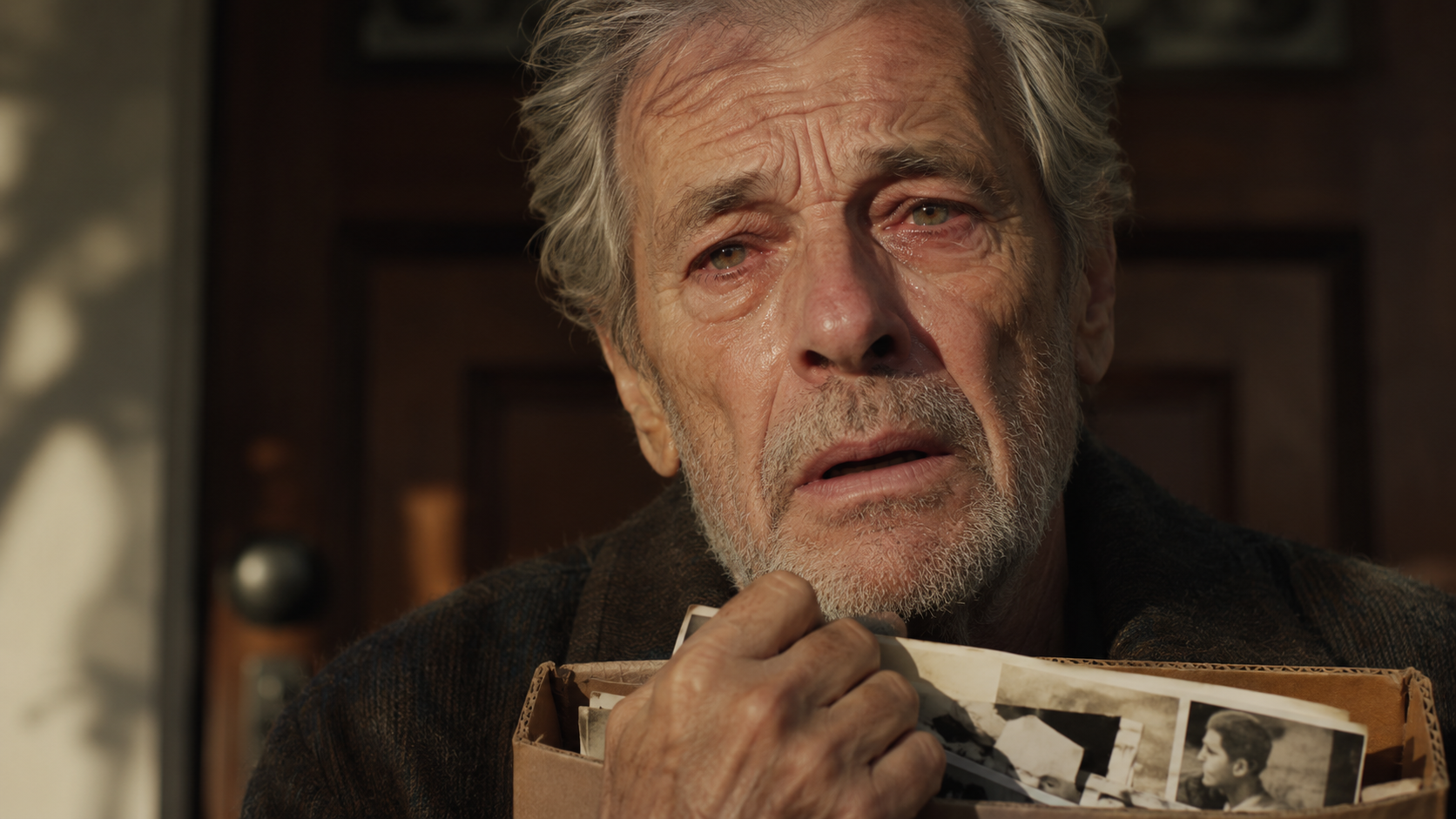
One by one, neighbors approached. Some apologized. Some just shook his hand. A few carried his belongings back inside without a word, setting the photo box gently on the kitchen table where it belonged.
Arthur lifted the lid and found the photograph on top.
Rose, smiling beside the maple sapling, decades younger, decades happier.
He pressed it to his chest.
“I’m home.”
—
Marcus showed up at the gate two days later.
No truck. The bank had already repossessed it.
He walked. David walked beside him, having reached out to his brother despite everything.
Arthur stepped onto the porch. Thomas stood in the doorway, watching, silent.
“Dad,” Marcus said.
Arthur said nothing.
“We made mistakes,” David offered.
“Yes,” Arthur said. “You did.”
Marcus took a step closer to the gate, no further.
“We can fix this.”
Arthur looked at both of them for a long, quiet moment.
“When I was sitting on that curb,” he said, “and you told me to figure it out myself — did either of you think about your mother, even once?”
Neither answered.
“Rose spent her whole life teaching you compassion,” Arthur said. “You buried her lessons long before you tried to bury me.”
Marcus’s eyes filled.
“Dad, please—”
“The day you threw me onto that curb,” Arthur said quietly, “you stopped being my sons. Not because I decided it. Because you did.”
David began crying.
Marcus looked like the words had taken the air out of him.
Arthur didn’t raise his voice. He didn’t curse. He simply turned, walked back inside, and closed the door behind him.
Not with anger.
With finality.
—
Six months later, the farmhouse looked alive again.
Fresh white paint. A repaired porch swing. Children from the neighborhood chasing each other beneath the maple tree, the way Arthur’s own boys once had.
Thomas had quietly funded a scholarship in Arthur’s name for the children of steelworkers across the county. A small bronze plaque now stood outside the old mill gate:
Arthur Miller — a man who risked his life to save another, and never asked for anything in return.
New hires stopped to read it every week. Most never met him. All of them knew his story now.
On a warm afternoon, Arthur sat on the porch holding his father’s old silver pocket watch, the one he’d carried into the mill the day of the fire.
Thomas joined him with two mugs of coffee and sat down on the step beside him.
“You know,” Arthur said, turning the watch over in his hands, “I used to think this was the reward. Carrying my father’s watch out of that fire alive.”
“It wasn’t?” Thomas asked.
Arthur closed the cover gently.
“No.”
He watched two kids race past the maple tree, laughing.
“The reward was finding out kindness doesn’t disappear,” he said. “It just takes longer than you’d like to find its way home.”
Thomas smiled into his coffee.
“My father would have liked that.”
Arthur looked up at the sky, eyes soft.
“So would Rose.”
The watch ticked quietly in his hand. Still keeping time. Still carrying a promise made forty-three years earlier inside a burning mill — a promise that had finally, after decades, found its way back to the man who made it.
And as the evening light settled gold over Elm Street, Arthur understood something no house, no deed, and no fortune could ever replace.
Family isn’t defined by the name you share.
It’s defined by who shows up when everything else is gone.
Original fictional stories. AI-assisted creative content.