There were twenty-four invitations.
Twenty-four little cards covered in purple stars, silver stickers, and crooked hearts drawn by a six-year-old hand.
“You’re invited to Madison’s birthday party!”
Madison Cole had spent three nights at the kitchen table making them. She pressed too hard with the glitter glue. She drew tiny motorcycles in the corners because her dad loved bikes. She added crowns because every birthday girl deserved to feel like a princess.
Her father, Owen Cole, had rented the shaded picnic shelter at Green Hollow Park in Bend, Oregon. He’d saved tips from weekend repair jobs for weeks so the day could feel special.
“You think they’ll like the motorcycle cake topper?” Madison asked, bouncing on her toes.
“They’re gonna love it, sweetheart,” Owen said.
By noon, the tablecloths were straight. The pink balloons were tied to the wooden posts. A homemade cake sat in the center, white frosting, purple sprinkles, a tiny toy motorcycle beside the princess candle.
At twelve-thirty, nobody had arrived.
“Maybe they’re getting ready,” Madison said.
“Probably,” Owen said.
At one o’clock, the parking spaces were still empty.
“Daddy, what time does Brooklyn usually come places?”
“I don’t know, sweetheart. Could be any minute.”
At one-thirty, Madison stopped asking if her friends were almost there. She sat on the bench, twisting the elastic of her party hat around one finger, watching the empty road.
Owen kept checking his phone. No texts. No calls. Just a clock ticking past the time printed on twenty-four invitations.
He was still in his city maintenance uniform — his morning shift had run late, and the decorations had taken longer than he planned. His boots were clean. His hair was combed. His hands still looked rough no matter how hard he scrubbed them.
He smiled for Madison anyway.
“Maybe their parents got caught up,” he said gently. “Saturdays get busy.”
Madison nodded, but her eyes kept drifting to the road.
After a long silence, she whispered, “Daddy, did they not come because of you?”
Owen froze. “Why would you say that?”
She looked down at her shoes. “Yesterday, Brooklyn’s mom looked at my invitation and said something about the kind of people who work with garbage trucks.”
Owen’s throat tightened.
“She said that?”
Madison nodded slowly. “I didn’t know what it meant.”
“It doesn’t mean anything, sweetheart. Not about you. Not about us.”
But the words sat in his chest like a stone. He worked early mornings for the city, afternoons at a storage warehouse, weekends fixing motorcycles in a friend’s garage. Every dollar went toward rent, school clothes, and a six-year-old’s little dreams.
He had believed effort would be enough.
The empty tables said otherwise.
Across the parking lot, a woman named Clara Jensen stood beside her small lemonade cart. She’d watched Owen all morning — fixing every balloon the wind moved, glancing at the road every few minutes, forcing a smile each time Madison looked up at him.
By two o’clock, Madison had slipped behind the picnic shelter.
Clara found her near a tree, wiping her cheeks with the sleeve of her jacket. On the back, stitched in silver thread: Dad’s Little Rider.
“Hey there,” Clara said softly. “You doing okay?”
Madison shook her head. “Nobody came.”
Clara crouched down. “That’s not your fault, you know that?”
“Then why didn’t they come?”
Clara didn’t have a good answer. She wasn’t going to lie to a six-year-old, and she wasn’t going to tell her the truth either.
“Stay right here a second,” Clara said.
She walked back to her cart, pulled out her phone, and took one photo — the untouched cake, the empty benches, the lonely balloons drifting in the breeze.
She posted it to a local motorcycle community group, three thousand members strong.
“A little girl’s sixth birthday party is sitting empty at Green Hollow Park. Her dad works hard for this town and rides when he can. Anyone close by?”
She expected a few kind comments.
She did not expect engines.
Fifteen minutes later, a dark green motorcycle rolled into the lot.
The rider parked, pulled off his helmet, and stepped down with a wrapped gift under one arm. Late fifties. Gray beard. A leather vest older than half the parents at Madison’s school.
His name was Russell Kane. He owned a tire shop on the edge of town and had seen Clara’s post while eating lunch at his desk.
He walked straight to Madison.
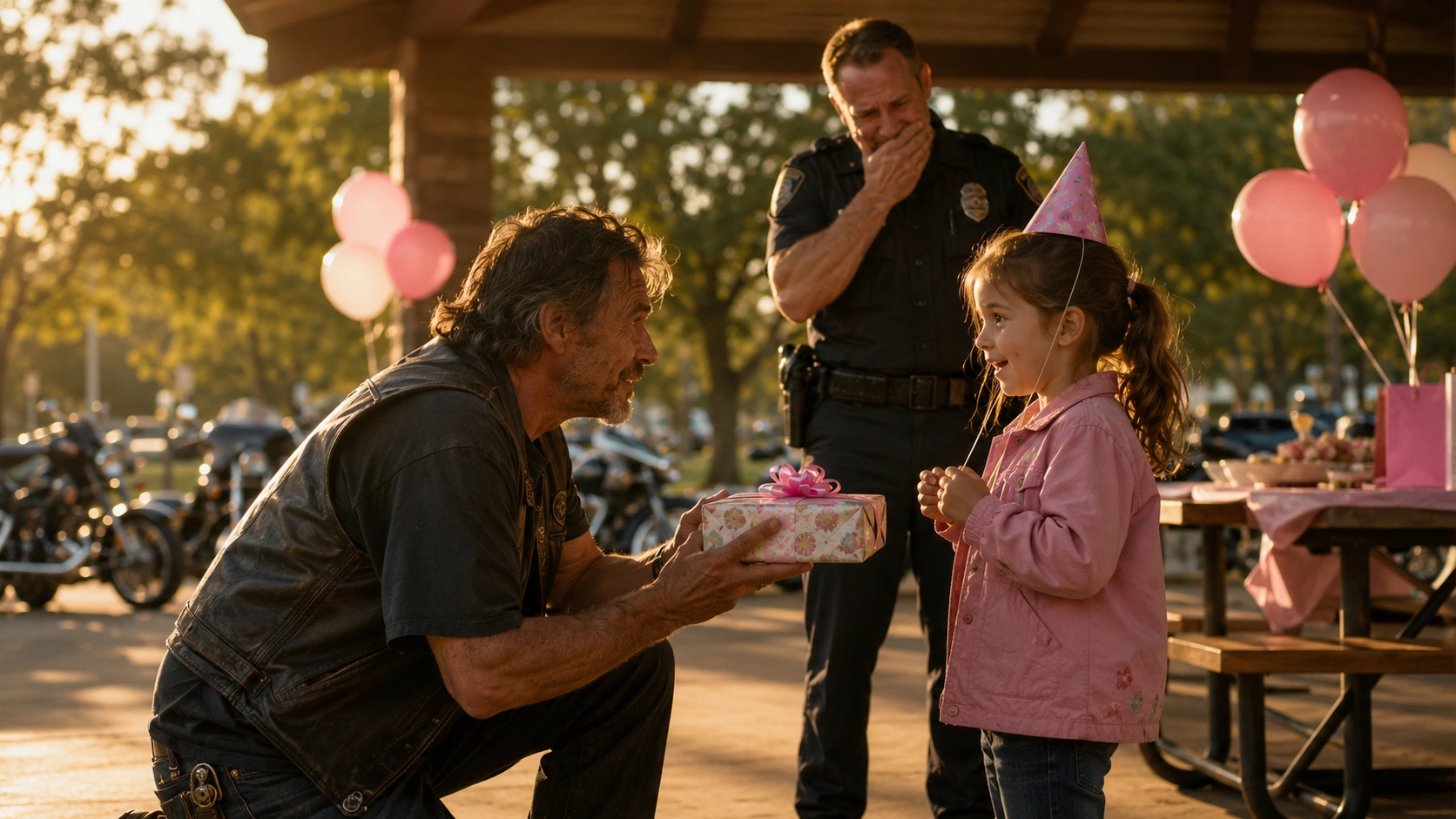
Then he lowered himself to one knee.
“Happy birthday, Miss Madison,” he said. “I heard there was a princess motorcycle party. Sounded too important to miss.”
Madison blinked. “You came for my birthday?”
“Of course I did.” He winked. “A party like this needs at least one motorcycle.”
For the first time in two hours, Madison smiled.
Owen stood behind her, unable to get a word out.
“Sir, you don’t have to—”
“Already did,” Russell said, standing back up. “Where do you want the gift?”
Then a second motorcycle pulled in.
Then three more.
Then ten.
Within the hour, the quiet park filled with riders of every kind. Leather jackets. Medical scrubs under riding coats. Office badges still clipped to belts. Some carried gifts. Some carried cupcakes. Some just carried their presence.
A women’s riding group brought a second cake shaped like a pink helmet. A retired teacher brought storybooks. A mechanic brought a small toy tool kit. Someone brought a child-sized helmet, painted lavender, Madison’s name lettered on the side.
“Where did all these people come from?” Owen asked, voice cracking.
Clara held up her phone. “You don’t have to say anything. Sometimes good people just need to know where to go.”
Madison, who had been hiding behind a tree an hour earlier, now stood in the middle of a circle of strangers who treated her like she mattered.
Then a bigger motorcycle pulled in near the edge of the lot.
The man who stepped off was impossible not to notice. Tall. Broad-shouldered. Old road tattoos climbing both forearms. His black leather jacket looked heavy. His boots hit the pavement with weight.
His name was Hank Mercer.
To people who judged quickly, Hank looked like someone to avoid.
To people who knew him, he was the man who fixed bicycles for neighborhood kids every summer and carried groceries to elderly neighbors when the snow came. He also worked for the city — different department, same early mornings, same tired hands.
He walked toward Madison carefully, like he didn’t want his size to scare her.
Then he knelt.
“Your dad told someone online you like princesses and motorcycles,” he said. “That’s a powerful combination.”
Madison giggled. “It is.”
Hank handed her a wrapped package. Inside was a handmade picture book — Madison’s Road to the Castle. Every page showed a girl in a pink jacket riding through mountains and bright skies, always brave, always loved, always heading home.
Madison touched the cover like it was treasure. “You made this?”
“My niece helped with the drawings,” Hank said. “She said every princess needs her own road.”
Madison stepped forward and hugged him.
Hank closed his eyes for a moment.
Owen looked away, trying to hold himself together.
“You okay?” Hank asked him quietly.
“I will be,” Owen said. “Just — nobody’s ever done anything like this for her. For us.”
“That’s about to change,” Hank said.
Near the tennis courts, several families from Madison’s school had gathered for a weekend match. They noticed the motorcycles first. Then the balloons. Then the children laughing around the picnic shelter.
One woman in a white tennis skirt stepped closer, two other parents behind her. Her name was Patricia Waverly, known at the school for talking like every room belonged to her.
She looked at Owen’s uniform, then at the motorcycles.
“What exactly is going on here?” she asked.
Before Owen could answer, Madison ran over, her lavender helmet tucked under one arm.
“It’s my birthday,” she said proudly. “They came because my friends couldn’t.”
The words landed harder than Madison understood.
A few parents looked away. One little boy pointed from behind his mother.
“Mom, that’s Madison’s party. Can I go say happy birthday?”
His mother hesitated.
Patricia lowered her voice — but not enough.
“I don’t think that is our kind of gathering.”
The air changed.
“Patricia,” one of the other mothers said quietly. “Maybe we should just—”
“I’m just saying what everyone’s thinking,” Patricia said.
Then a woman stepped forward from the riders.
She removed her helmet and shook out her pinned-up hair. Navy riding jacket over hospital scrubs.
Her name was Dr. Laurel Bennett, a pediatric heart specialist at Cascade Children’s Medical Center.
Several parents recognized her immediately.
“Dr. Bennett?” one father said, startled.
Laurel smiled politely.
“I’m here for a six-year-old who deserved kindness today,” she said. “So when you say this isn’t your kind of gathering, I hope you understand what you’re really saying.”
No one answered.
“You operate on my son,” the startled father said quietly. “Last spring.”
“I remember Tyler,” Laurel said. “How’s he doing?”
“Good. Really good.” He looked at the ground. “I didn’t realize—”
“That I ride a motorcycle on weekends?” Laurel finished. “I do. So does the man behind me, who happens to run the trauma unit. And the woman next to him, who teaches third grade two towns over.”
Patricia’s face had gone pale.
Around the shelter, the truth became plain. The riders weren’t a stereotype. They were nurses, teachers, mechanics, veterans, business owners, neighbors — people who had simply chosen to show up.
A little girl broke away from the group near the courts. Her name was Brooklyn. She stopped in front of Madison and held her hands together.
“I’m sorry I didn’t come earlier,” Brooklyn said. “Your party looks really fun.”
Madison studied her for a second.
Then she smiled. “You can still have cake.”
That was the thing about children. They often understood grace faster than adults did.
Soon, a few more kids drifted over. Shy birthday wishes. Questions about the motorcycles. Requests to touch the helmets. The riders were gentle and careful — no one made the children feel small, no one made the parents feel attacked. They simply made room.
Music played from a small speaker. Cupcakes were passed around. Madison laughed so hard her party hat slipped sideways.
Owen watched his daughter with one hand over his mouth. He’d spent the morning feeling judged. Now he was watching strangers repair a piece of his child’s heart.
Patricia stood at the edge of it all, arms crossed, watching her own daughter ask to hold a lavender helmet.
“Mom, can I?” the girl asked.
Patricia hesitated, then nodded once, stiffly.
It wasn’t an apology. But it was something.
Later, as the sun turned gold over the park, Madison opened her gifts. She sat between Owen and Hank, surrounded by people who had been strangers only hours before. Every gift was simple, thoughtful, full of care.
A book. A toy motorcycle. A set of glitter pens. A pink keychain shaped like a helmet. A small card that read: “You belong wherever kindness lives.”
Owen read that card twice.
Hank put a hand on his shoulder. “You’re doing right by her.”
Owen swallowed hard. “I just wanted her to feel like she belonged.”
Hank looked toward Madison, who was showing Brooklyn her new picture book.
“Then don’t teach her to shrink herself for people with small hearts,” he said. “Teach her the world is bigger than one empty table.”
Owen nodded slowly. For the first time that day, he stood a little straighter.
By the end of the afternoon, no one talked about the empty beginning. They remembered the engines arriving one by one. They remembered Madison’s smile coming back. They remembered a father who had been trying not to fall apart finally looking like he could breathe.
Before everyone left, the riders gathered around the shelter and sang “Happy Birthday” one more time.
It was loud. It was messy. It was beautiful.
Madison stood on the bench beside her cake, holding her father’s hand. When the song ended, she looked up at him and whispered, “Daddy, I think this was the best birthday ever.”
Owen bent down and kissed the top of her head.
“Me too, sweetheart.”
Then the motorcycles started, one by one. Not to scare anyone. Not to prove anything. But to celebrate a little girl who had almost believed she was forgotten.
And long after the riders left Green Hollow Park, the lesson stayed behind: a person’s worth is never measured by a uniform, a paycheck, or the opinion of people who never took the time to know them. Sometimes the most powerful rescue isn’t loud or dramatic — it’s a group of strangers refusing to let one child feel unwanted.
Original fictional stories. AI-assisted creative content.