For three weeks, every call I made to my daughter went straight to voicemail.
I told myself it was grief. Space. The kind of quiet that settles over a house after a loss.
James had died — that’s what Rachel told me — so I tried to be the mother she needed. Gentle texts. No pressure.
“Just checking in.”
“Love you.”
“I’m here whenever you’re ready.”
I was a social worker for thirty-seven years before I retired. I’d explained grief to strangers in hospitals and courtrooms a thousand times. Knowing it in theory didn’t help now that it was my own child.
On day twelve, James’s mother called from Michigan. Helen didn’t do quiet grief. Hers came out like steel.
“Have you heard from her?” she asked.
“Not lately,” I admitted.
“She won’t take my calls either,” Helen said. “She blocked Tom. Who does that after a death?”
“A woman who can’t handle more noise,” I offered.
Helen didn’t buy it. “That funeral wasn’t right. Closed casket. No viewing. Margaret, something’s wrong.”
I wanted to defend Rachel the way a mother’s heart does by reflex. Instead, I found myself staring at the spare key she’d given me years ago. “Just in case,” she’d said.
The next morning, Mrs. Chen called — Rachel’s neighbor in Riverside.
“I don’t want to worry you,” she began. The words people use right before bad news.
“There have been strange cars,” she said. “Coming and going. Not like family. They park down the street. Like they don’t want to be seen.”
“How long?” I asked.
“Two weeks. And Rachel’s SUV — I haven’t seen it in days.”
I called Rachel one more time. Straight to voicemail.
I grabbed my purse. My hands were already shaking.
The drive to Riverside took forty minutes. When I turned onto Maple Drive, my heart was hammering.
The lawn was tired. The driveway empty. James’s old pickup sat crooked, dusted with pollen. Mail bulged from the box. No curtains moved.
I knocked twice. “Rachel? It’s Mom.”
Nothing.
I used the spare key.
Inside, the air was stale. The living room looked normal — until I saw the dust. A thick, undisturbed layer over the wedding photo. Rachel would never let that sit.
The refrigerator was stocked but the dates were wrong. Milk, two weeks expired. A bowl of cereal hardened to plaster in the sink.
Someone had been living here. Then suddenly stopped.
Then I heard it.
A scratching sound. Rhythmic. Coming from below my feet.
Not an animal. Drag-scratch-drag. A person, trying to be quiet.
The basement door had a padlock on it — industrial, new, the screws fresh in pale wood.
Why would anyone padlock a basement door from the outside?
The scratching came again. Louder. Then a voice, barely there.
“Please.”
I knew that voice.
“James?” I whispered. “Is that you?”
A pause. Then, so faint I almost missed it: “Margaret.”
My knees nearly gave out. We’d had a funeral. A closed casket. A man in the ground.
And he was whispering my name through a locked door.
I dialed 911. “I need police at 847 Maple Drive. I think someone’s trapped in a basement.”
I pressed my face to the door. “Hold on, sweetheart. They’re coming.”
I didn’t wait. I ran for James’s toolbox in the garage and came back swinging a hammer at the padlock. It didn’t budge. I swung again, arms burning, until I heard sirens.
Officer Valdez took one look at the fresh screws and his face went tight. “Get bolt cutters.”
The lock snapped. The door swung open.
The smell hit first — not blood, but unwashed air, the smell of a place never meant to hold a living person.
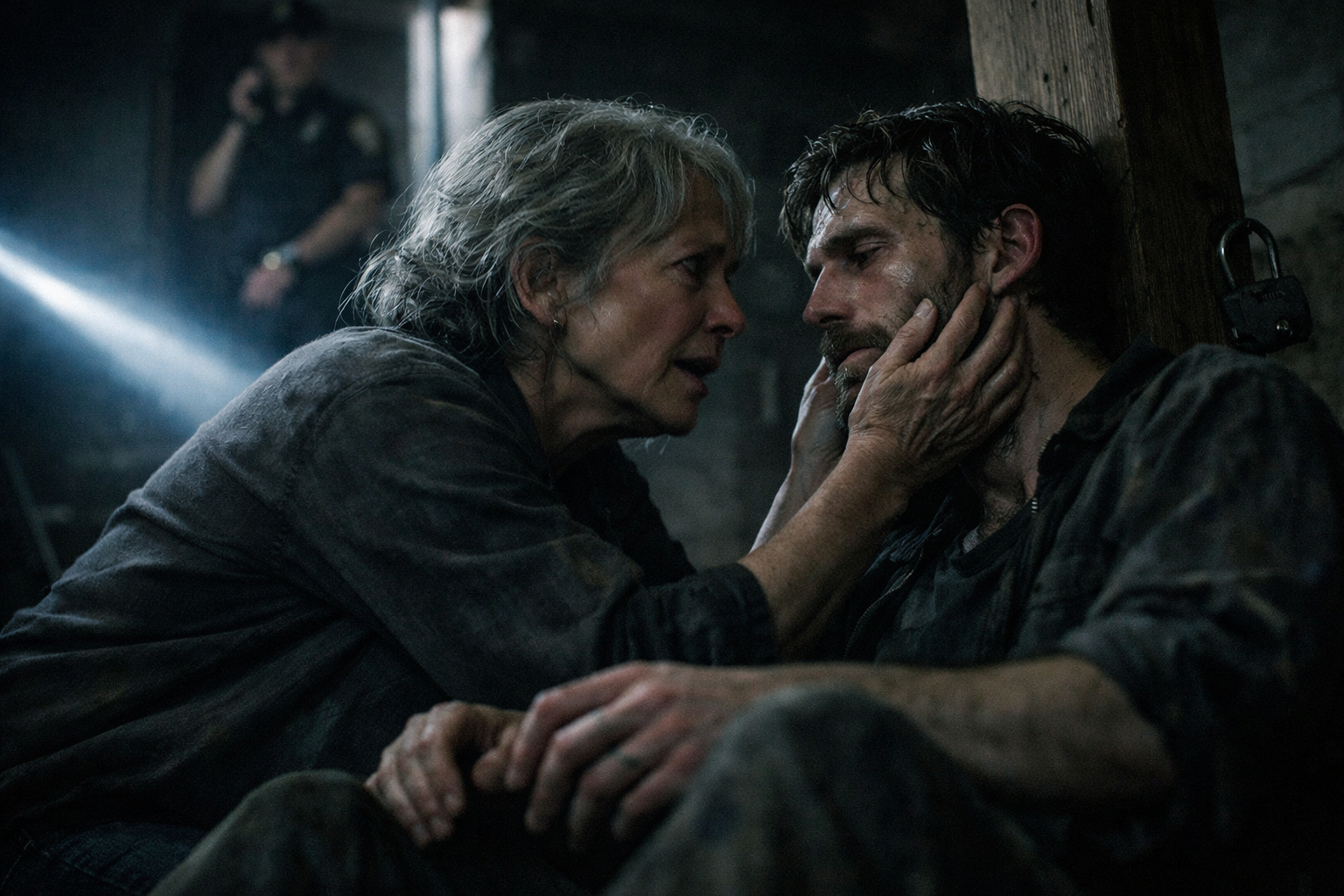
Valdez went down first, flashlight cutting the dark. He stopped halfway.
“Jesus Christ.”
I pushed past him. The beam landed in the corner.
James — chained to a support beam. Twenty years older in three weeks. A mattress on concrete. An empty water bottle. A bucket.
That was all he’d had.
“James,” I choked. “Oh my God.”
His lips moved, barely a breath. Valdez was already on the radio. “Ambulance. Now. Severely—”
I didn’t hear the rest. All I could see were his wrists, raw from the chains.
“Margaret,” he rasped, and the relief in that word shattered me.
“The funeral,” I said. “We had a funeral. Rachel said you were—”
He shook his head. “No.”
Paramedics crowded the basement. They started an IV, wrapped him in a blanket. When they lifted him onto the stretcher, he gripped my hand with pure willpower.
“Rachel,” he whispered. “She did this.”
“I know, sweetheart,” I said, even though my mind still refused it. “I know.”
At the hospital, the doctor said James was lucky to be alive. “Severely dehydrated. Malnourished. Infections from the restraints. If he’d been down there much longer—”
He didn’t finish.
They estimated three weeks. Maybe four. The exact timeline of the “death.”
Helen arrived that night, not looking like a woman who’d come to mourn, but one who’d come to fight. She crossed the waiting room and wrapped her arms around me.
“Thank you,” she said into my shoulder. “Thank you for finding him.”
Detective Morrison arrived after, calm-eyed, notebook open. “Mrs. Hartley, walk me through the day you were told your son-in-law had died.”
“Rachel called me. Hysterical. Said she found him in the garage. A note.”
“Did you see the body?”
“No. She said it was too traumatic. Closed casket.”
“And you didn’t think that was suspicious?”
The question landed like a slap. “James had been depressed. Lost his job. I thought—”
I heard how weak it sounded even as I said it.
“Did your daughter have a financial motive?” Morrison asked.
I forced myself to be honest. “Life insurance. Half a million. Rachel was the beneficiary. There’s a thirty-day waiting period. It ends in two days.”
Morrison closed her notebook. “Then we’re on a clock.”
She slid an evidence bag across the table. A hardware store receipt — padlock, chain, screws, dated three weeks back. On the reverse, measurements in sharp, neat handwriting.
“Do you recognize this?” Morrison asked.
My stomach dropped. “Rachel always wrote like that.”
“We also have a name,” Morrison said. “Derek Moss.”
“Her personal trainer,” I murmured, nausea rising.
Two days later, police arrested Rachel at a hotel in Los Angeles. With Derek. Insurance claim forms in her luggage, already filled out. A burner phone with a written plan. A laptop holding a fabricated suicide note.
“It was all planned,” I whispered into the phone.
“Yes,” Morrison said. “And we’re still untangling how many people were involved. There’s a doctor. A funeral home.”
When James was stable, detectives interviewed him gently, a small recorder between them.
Rachel had been having an affair with Derek for months. James confronted her. She didn’t cry. She didn’t deny it.
“She said she deserved more,” James whispered. “She said I was dragging her down.”
The day it happened, she’d offered him coffee. Like normal. He drank it. His body went heavy. The room tilted.
“She was on the phone,” he said. “I heard her say — ‘Now.'”
He woke in the basement, wrists restrained. Rachel stood over him holding a small cooler.
“Don’t make this harder,” she’d told him, voice flat.
She brought paperwork down some days. A deed. Account forms. If he refused to sign, she left him in the dark longer.
Derek came too, sometimes. “Man, you could’ve had it all,” he told James once, like it was a missed business deal.
“I kept thinking someone will notice,” James said. “Someone will come.”
He scratched the underside of the door when he had the strength. Rationed his energy. Waited.
“Then I heard you,” he told Morrison. “Calling Rachel’s name. And I thought — this is my last chance.”
The trial lasted three weeks. Mrs. Chen testified about the strange cars. Derek testified, paler now, no gym-confidence left. “She had it planned,” he admitted. “Down to the dates.”
When I took the stand, the defense lawyer tried to rattle me. “Isn’t it possible your daughter was in crisis? That she believed she was protecting him?”
“I worked in crisis for decades,” I said. “I know what panic looks like. I know what planning looks like. Fresh screws. A new padlock. Chains. That wasn’t protective. That was deliberate.”
The jury deliberated six hours.
Guilty. Guilty. Guilty. Attempted murder. Fraud. Forgery. Kidnapping. Conspiracy.
Rachel didn’t react. I waited for some crack of humanity. It never came.
Thirty-five years. Derek got fifteen. The doctor who forged the death certificate lost his license and got ten. The funeral director who helped stage the substitution got five, and his business was shut down.
In the car after sentencing, James stared out the window.
“Do you hate her?” he asked.
“I hate what she did,” I said. “I don’t know if that’s the same thing.”
He nodded once. “I dream about that basement sometimes. Wondering if anyone would ever find me.”
“You saved my life, Margaret,” he said. “She was only giving me enough water to last until the claim went through.”
I squeezed his hand. “You’re not alone anymore.”
James moved into my guest room. I bought new sheets, set a lamp by the bed so he’d never wake in darkness again. We built routines — breakfast, short walks, therapy twice a week. On good days he pulled weeds in my yard. On bad days he sat on the back steps with his head in his hands, and I sat beside him, saying nothing, because silence can be comfort too.
I sold Rachel’s house. No one wanted a place where a padlock had been used like a weapon. The money went into a trust for James.
“I don’t want anything from her,” he said.
“It’s not from her,” I told him. “It’s compensation for the life you were supposed to have. Take it.”
He found a new job. A support group. He met Sarah there — kind in a quiet way, with her own scars and her own understanding of clawing back from something that tried to erase you.
I went back to work too. Not paid. A volunteer at a shelter, helping people take their first steps out of unsafe situations.
I’d learned the hardest lesson of my career too late: evil doesn’t always announce itself. Sometimes it wears the face of someone you love. Sometimes it uses grief as camouflage. Sometimes it puts a padlock on a door and expects the world to look away.
I didn’t look away anymore.
Two years after the trial, James and Sarah married in my backyard under a string of white lights. Helen made the cake. Tom stood as best man.
When James kissed his new wife, I felt something close to relief — not because the story had a neat ending, but because it had a living one.
Afterward, James found me. “Thank you,” he said. “Not just for saving me. For not giving up on me even when you thought I was dead. For using that spare key.”
My throat closed. “I’ll always listen,” I told him.
He smiled — the gentle man from the wedding photo, finally back. “I know. That’s why I’m still here.”
I still have the spare key to that house on Maple Drive. I keep it in my desk drawer. Not because I plan to use it again.
Because it’s a reminder.
That sometimes the people who need saving are right in front of us. That a mother’s love can’t excuse evil — but it can help heal its victims. That when you hear something scratching in the basement, when you see a padlock that shouldn’t be there, when your instincts scream that something is wrong —
You listen. You act.
Because someone’s life might depend on it.
Rachel’s real punishment was never the sentence. It was knowing that despite everything, she didn’t win.
James lived. He healed. He moved on.
That’s our victory. That’s our justice. That’s how we win.
Original fictional stories. AI-assisted creative content.