The gas station smelled like hot asphalt and old gasoline. The sign above the store had been missing letters for so long that nobody bothered to read it anymore.
Victor Reyes stood at pump three, one hand on the nozzle, the other resting on a small wooden box he’d set on the concrete island beside him. The box was beautiful. Hand-carved. Vines and flowers wound around the lid in tight, patient lines that only a person with real love in their fingers could have made.
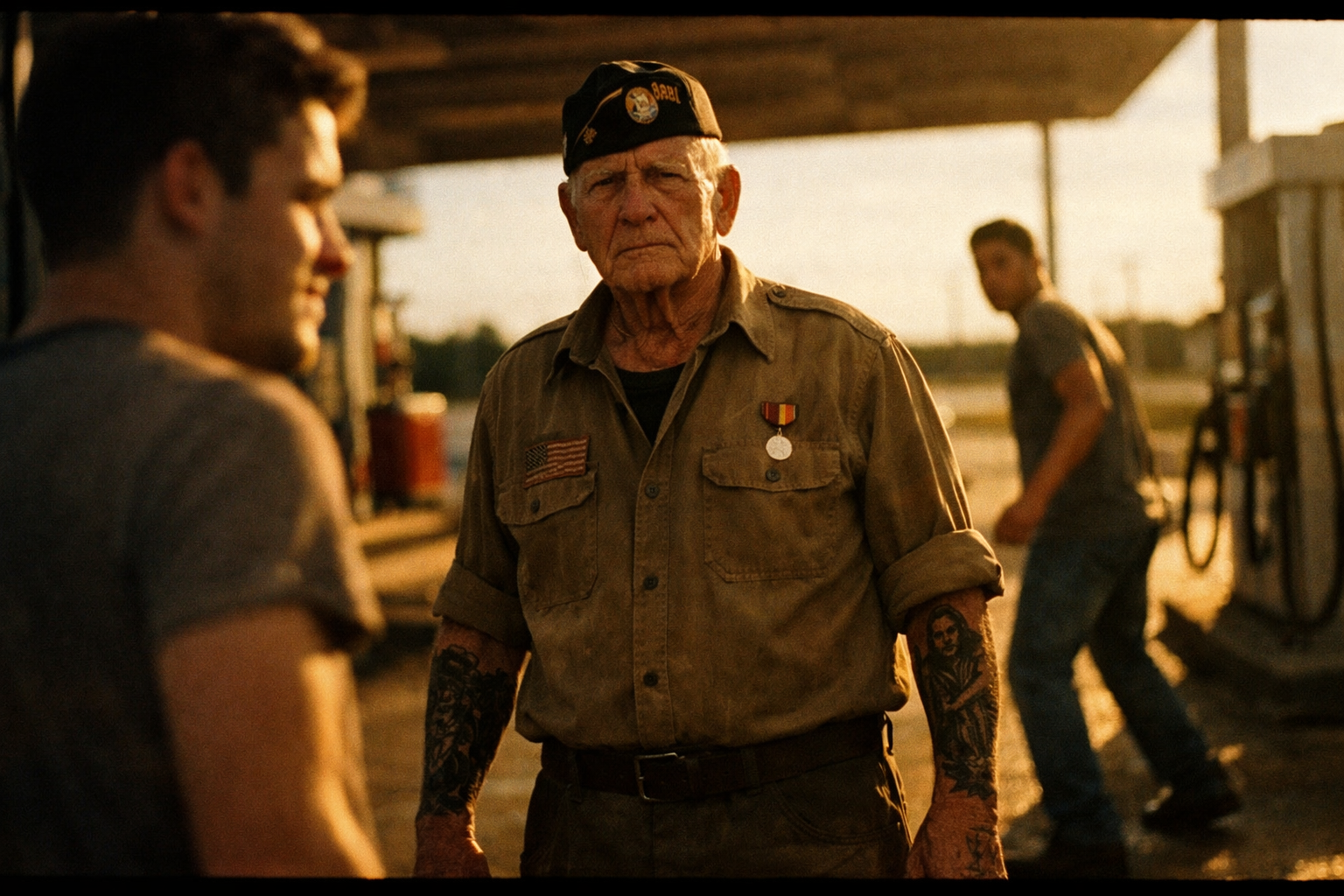
He was seventy-nine. He wore a faded veteran’s cap with a small unit patch stitched above the brim, and a khaki button-up shirt with a service patch on the chest and a single small medal pinned just above the pocket. The cap had been washed so many times the color had gone soft and pale. He didn’t look like much to a stranger passing through. Just an old man in worn clothes, the kind you look past without meaning to.
He was almost done pumping when the truck pulled in.
Two young men climbed out, laughing about something from the radio. Mid-twenties. Jeans, casual T-shirts, the easy confidence of guys who had never once been told no and believed it.
The taller one’s eyes landed on Victor. Then on the box.
“Hey, pops.” His voice carried across the lot. “You gonna move that or just stand there hogging the pump?”
Victor twisted the gas cap back on. Slow. Careful. “Just finishing up. Won’t be a minute.”
“Didn’t ask how long it’d take.” The young man ambled closer, his friend trailing behind with a smirk already forming. “Asked if you were gonna move.”
Victor looked up. His voice stayed quiet. “I’ll be out of your way. Promise.”
The taller one glanced down at the box, something careless crossing his face. “What’s in there, old man? Your meds?”
“It’s something my daughter made for me. Please. I’ll be gone in thirty seconds.”
“Your daughter.” He laughed, short and ugly, glancing at his friend. “Sweet.”
He lifted his boot.
The sound when it came down was like a small gunshot. Wood cracked and flew. The carved lid split inward and sideways across the asphalt. The box collapsed under the sole. Something small and rectangular shot free and landed face-up in a shallow puddle of oily water three feet away.
His friend cracked up. “Bro, you just stomped his little treasure chest!”
Victor stood very still. The word that came out was so quiet it barely existed.
“No.”
The young man planted his foot on the biggest remaining piece and ground it once, slow, for the audience. Then he grabbed the front of Victor’s shirt in one fist and yanked him forward.
“Pick it up. Every piece. Don’t leave your trash on my pavement.”
Victor didn’t fight the grip. He looked down at the ruined wood. At the photograph lying in the dirty water. His daughter on her wedding day, the mud already soaking into the paper.
“Please,” he said, voice cracking. “She carved that box for me. It’s all I have left of her.”
The young man shoved him back a step. “Then she should’ve carved it out of steel. On your knees, old man.”
Victor looked around once. The lot was empty except for the clerk watching through the glass and a trucker pretending not to see.
Victor lowered himself to the ground. His knees hit the asphalt hard. He’d learned to ignore pain a long time ago, in places he didn’t talk about. He shuffled forward on his knees toward the puddle, the fabric of his trousers soaking through, cold and slicked with oil.
He gathered the broken wood first, then reached for the photograph. The mud had streaked across his daughter’s face. He tried to wipe it with his thumb and only smeared it deeper. His hands were shaking.
“Look at him shake.” The young man laughed, loud, for the lot. “You crying, pops?”
His friend did a mocking imitation of the tremble. They both laughed harder.
Victor didn’t answer. He gathered another piece. His breath came in short pulls. Inside his chest, something old tried to rise — something he’d kept buried for decades of quiet civilian life. He pushed it down. His fingers kept moving. Trembling.
Then the trembling stopped.
It didn’t slow. It didn’t fade. It simply stopped, all at once, like a machine switched off. His hands went still in the oily water. His breathing leveled and went quiet.
He lifted his head.
The fear was gone from his face. So was the sorrow. What remained was empty and still, the way deep water goes still right before something rises.
The nearer young man took a half-step back without meaning to.
Victor gathered the last splinter. He rose — not the way an old man rises, wobbling, catching his breath, but in one smooth, even motion until he stood straight, his knees and back unlocking together. No stumble. No pause.
The laughing thinned out. The taller one was still smiling, but his eyes weren’t in it anymore.
“Yeah?” he said, trying to recover his swagger, shoving Victor once more, harder this time, square in the chest. “What are you gonna do about it, old man?”
Victor held his eyes for a long, quiet beat.
Then, slowly and deliberately, he reached up with both hands and began unbuttoning his shirt cuffs — one, then the other — and rolled each sleeve to the elbow.
The arms beneath were not what anyone expected. Thick with old muscle, scarred along both forearms — thin lines from shrapnel, a puckered ridge where something had torn through and been stitched in a field, not a hospital. And the ink: dense, dark, deliberate, climbing from wrist toward elbow. A unit insignia. A set of jump wings. Numbers that meant nothing to a stranger and everything to anyone who’d worn the same patch.
“Teach you a lesson,” Victor said. Quiet. Flat. No anger in it.
The grin died on the taller man’s face. His friend went rigid, eyes locked on the ink, then on the faded patch stitched above Victor’s shirt pocket, then on the small medal pinned beside it. Something in his memory clicked into place — a grandfather’s stories, maybe, or a documentary half-watched at two in the morning — and his stomach dropped.
“That’s—” His voice cracked. “That’s a Combat Infantryman’s patch. That’s—” He grabbed his friend’s arm. “We need to go. Right now.”
“Relax, he’s like eighty.” But the taller one’s bravado had gone thin and unconvincing even to himself. He glanced at the tattoo again, at the calm, flat stillness in Victor’s face, and something cold moved through him.
He shoved Victor a third time — a last, desperate assertion of the dominance he could feel slipping away. “I’m not scared of some old—”
Victor’s hand caught his wrist before the shove landed fully, redirecting it instead of stopping it cold, the way a man does who has spent a lifetime turning force back on whoever sent it. The young man’s balance broke. He stumbled past Victor and caught himself hard against the side of his own truck, the metal booming once under the impact.
He spun around, fists up, more out of panic than plan. Victor didn’t close the distance. He didn’t need to. He simply stood, arms loose, watching, the way a much younger soldier might have once watched a recruit flail through his first real scare.
“Stop,” the friend said, both hands raised now, backing toward the truck. “Man, just stop. We’re done. We’re sorry. We’ll fix the box, we’ll pay for it, just — stop.”
The taller one’s chest heaved. He looked at Victor’s tattoo one more time, at the medal, at the steady unblinking calm in the old man’s eyes, and something in him gave way completely.
“We’re leaving,” he said, voice unsteady. “We’re leaving right now.”
They didn’t wait for an answer. They scrambled into the truck. The engine caught rough and loud, and the tires barked once against the asphalt as they peeled out of the lot and onto the highway, gone within seconds, leaving nothing behind but the smell of burnt rubber and the broken pieces of a carved wooden box.
Victor stood alone in the quiet that followed.
He walked back to the puddle near pump three and lowered himself to one knee — the same motion he’d made minutes earlier under different circumstances — and lifted the photograph free with both hands. Mud clung to the paper in streaks across his daughter’s face.
He took a clean handkerchief from his pocket and wiped it clean in slow, careful strokes, the same patient care his daughter had once put into every line of that carved box. When the mud was gone, her smile came back into view, a little creased at one corner, the colors slightly blurred where the water had soaked in.
He slipped the photograph into his shirt pocket, against his chest, beside the medal.
He left the broken wood where it had fallen. He did not look back at it.
He never reported what happened. He didn’t need to. The clerk had already called it in, more out of nerves than concern, and a deputy rolled through twenty minutes later to find an old man calmly finishing the last of his errands at the store counter, two coffees and a newspaper, like nothing at all had happened.
“Everything all right out here, sir?” the deputy asked. “Got a call about some trouble.”
Victor looked at him evenly. “No trouble. Couple of young men got a little excited. They’ve moved on.”
The deputy glanced at the shattered wood still scattered by pump three, at the dried mud and the oil-slicked puddle, and decided not to push it. Something about the old man’s calm made him not want to know more.
Victor walked out to where his truck was parked at the edge of the lot. He set the two coffees on the bench seat and climbed in slowly, his knees protesting the same way they always did these days. He pulled the visor down against the afternoon sun and looked once at the gas station in the mirror before pulling out onto the road.
That evening, his granddaughter came by with a length of cedar and a small set of carving tools laid out on the kitchen table.
“I heard what happened, Grandpa.” She nodded at the bandage on his palm, a small cut from the splintered wood. “You should’ve called me. I would’ve come.”
“Wasn’t anything I couldn’t handle.” He set his cap on the table beside the cedar, the patch facing up. “Forty years in, you learn a few things stick with you.”
She smiled, half worry, half pride, and began sketching the outline of vines along the new block of wood — the same pattern her mother had once carved, learned from old photographs and patient practice.
“I’ll have it done by next week,” she said.
Victor nodded, and reached into his shirt pocket, and set the cleaned, careful photograph on the table between them so she could see exactly what she was building toward.
Outside, the evening light came through the window at a low angle and lay warm across the table, across the cedar, across the medal still pinned to the cap, and Victor sat with his hand resting near the photograph and let the quiet be enough.
Original fictional stories. AI-assisted creative content.