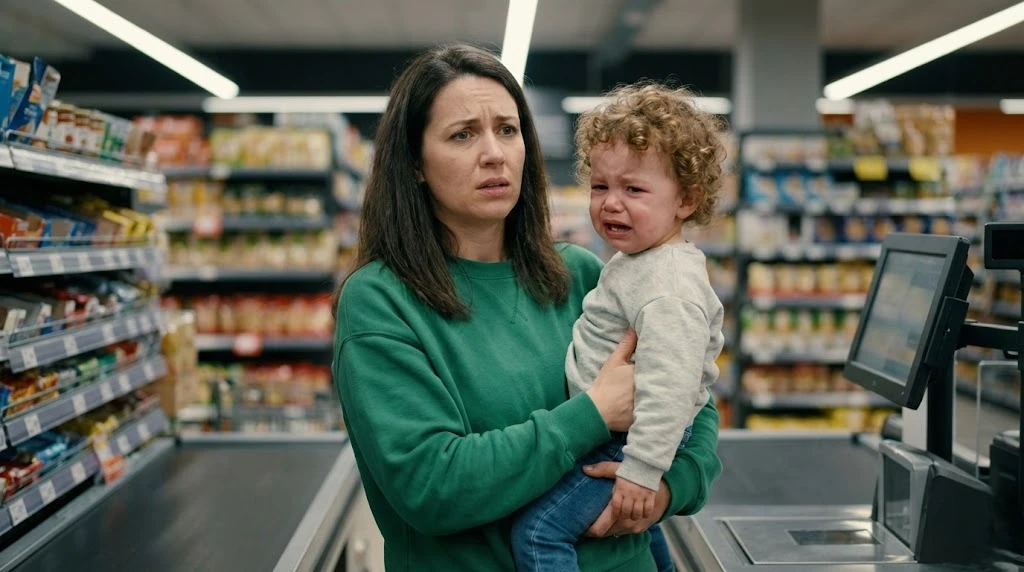
Maya stood frozen at the register, her two-year-old daughter squirming in her arms.
“Declined again,” the cashier said flatly.
The line behind her grew restless. Someone sighed loudly. Maya’s face burned as she stared at the pack of diapers on the counter—the last pack in her size.
“I—I can try another card,” she whispered.
Her daughter whimpered. Maya bounced her gently, fighting back tears. She’d already skipped meals this week. The car payment was late. Her ex hadn’t sent child support in three months.
“Ma’am, there’s a line,” someone muttered behind her.
Maya fumbled through her wallet with shaking hands. Every card she owned was maxed out. The baby needed diapers. Tomorrow. Tonight, even.
“I’m sorry,” she said, voice cracking. “Just—give me one second.”
“Step aside, please,” the cashier said.
That’s when a hand reached past her shoulder.
A twenty-dollar bill landed on the counter.
“I’ve got it,” a deep voice said calmly.
Maya turned. A man in his sixties stood behind her—weathered face, Navy cap pulled low, eyes steady and kind.
“No, I can’t—” Maya started.
“Already done,” he said simply.
The cashier scanned the diapers without a word. The veteran added two more packs to the belt.
“Wait—” Maya’s voice broke completely.
“You need these,” he said. “Don’t argue with me.”
Her daughter reached toward him, babbling. He smiled slightly and tapped her tiny hand.
“How did you—why would you—” Maya couldn’t finish a sentence.
“Because someone did it for me once,” he said. “When my wife and I had nothing. When our son was born and we were living paycheck to paycheck.”
He handed her the bags.
“Pass it forward someday. That’s all I ask.”
Maya’s tears fell freely now. “Thank you. God, thank you so much.”
“You’re doing fine, ma’am,” he said quietly. “Better than fine. Keep going.”
He nodded once and walked away before she could say anything else.
The cashier’s eyes were wet. The woman behind Maya in line stepped forward.
“Here,” she said, pressing a folded twenty into Maya’s hand. “For formula. Or whatever you need.”
“I don’t—”
“Pass it forward,” the woman said, echoing the veteran’s words.
By the time Maya reached her car, three more people had slipped cash into her diaper bag. A man gave her a gift card. A teenage girl handed her a bag of baby clothes.
Maya sat in the driver’s seat, her daughter asleep in the car seat, and sobbed.
Not from shame this time.
From relief. From gratitude. From the overwhelming realization that kindness still existed in the world—and that she wasn’t as alone as she’d felt.
She looked down at the diapers on the passenger seat. At the cash in her hand. At her sleeping daughter’s peaceful face.
“We’re going to be okay,” she whispered.
And for the first time in months, she believed it.
That night, Maya posted about what happened. The story spread. People donated. A local church reached out with resources. Her ex’s wages were finally garnished after someone connected her with a free legal clinic.
But what stayed with her most wasn’t the help that followed.
It was the veteran’s eyes. The certainty in his voice.
You’re doing fine.
She’d needed to hear that more than she needed the money.
Three months later, Maya stood in the same store. She saw a young father counting change at the register, a baby crying in his arms.
She didn’t hesitate.
“I’ve got it,” she said, stepping forward.
His eyes widened. “No, you don’t have to—”
“Someone did it for me once,” Maya said, smiling through tears. “Pass it forward.”
The cycle continued.
Because one Navy veteran understood something most people forget: dignity matters as much as diapers. And sometimes, the smallest act of generosity can rewrite someone’s entire story.
Maya never saw that veteran again.
But she thought of him every single day.
Original fictional stories. AI-assisted creative content.