The lobby of the Grand Meridian was the kind of place where everything gleamed on purpose.
Marble floors. Crystal chandeliers. Staff who smiled like they were paid to mean it.
Daniel Rowe moved through it like he owned the room—because in some ways, he almost did. He was booked in the penthouse. He had a lunch meeting with two investors and a board call after that. His day was mapped to the minute.
Then a small hand tugged the back of his jacket.
He turned, already impatient.
And stopped.
A boy stood behind him. Nine, maybe ten. Dark circles under his eyes. Clothes that were clean but worn. Sneakers with the sole starting to peel back on one side.
The boy wasn’t afraid. That was the first thing Daniel noticed. He was nervous—his hands were balled tight at his sides—but he looked up with steady brown eyes and said:
“Sorry to bother you, sir. But where did you get that watch?”
Daniel blinked. “Excuse me?”
“Your watch.” The boy pointed. “My dad had the same one.”
The words didn’t register immediately.
Then they did.
And Daniel felt the floor tilt.
He looked down at the silver watch on his wrist. The polished face. The worn leather band he’d replaced three times over the years but never the watch itself. The faint scratch near the four o’clock position—from the day Scott had dropped it on the concrete floor of his shop and laughed about it for a week.
“What did you say?” Daniel asked, and his voice came out wrong. Too quiet. Too careful.
“My dad wore the same watch. Every day. He called it his good luck charm.” The boy hesitated. “He passed away. Three years ago.”
A hotel staffer was hovering nearby now, eyeing the boy with polite suspicion.
Daniel held up one hand without looking at her. Don’t.
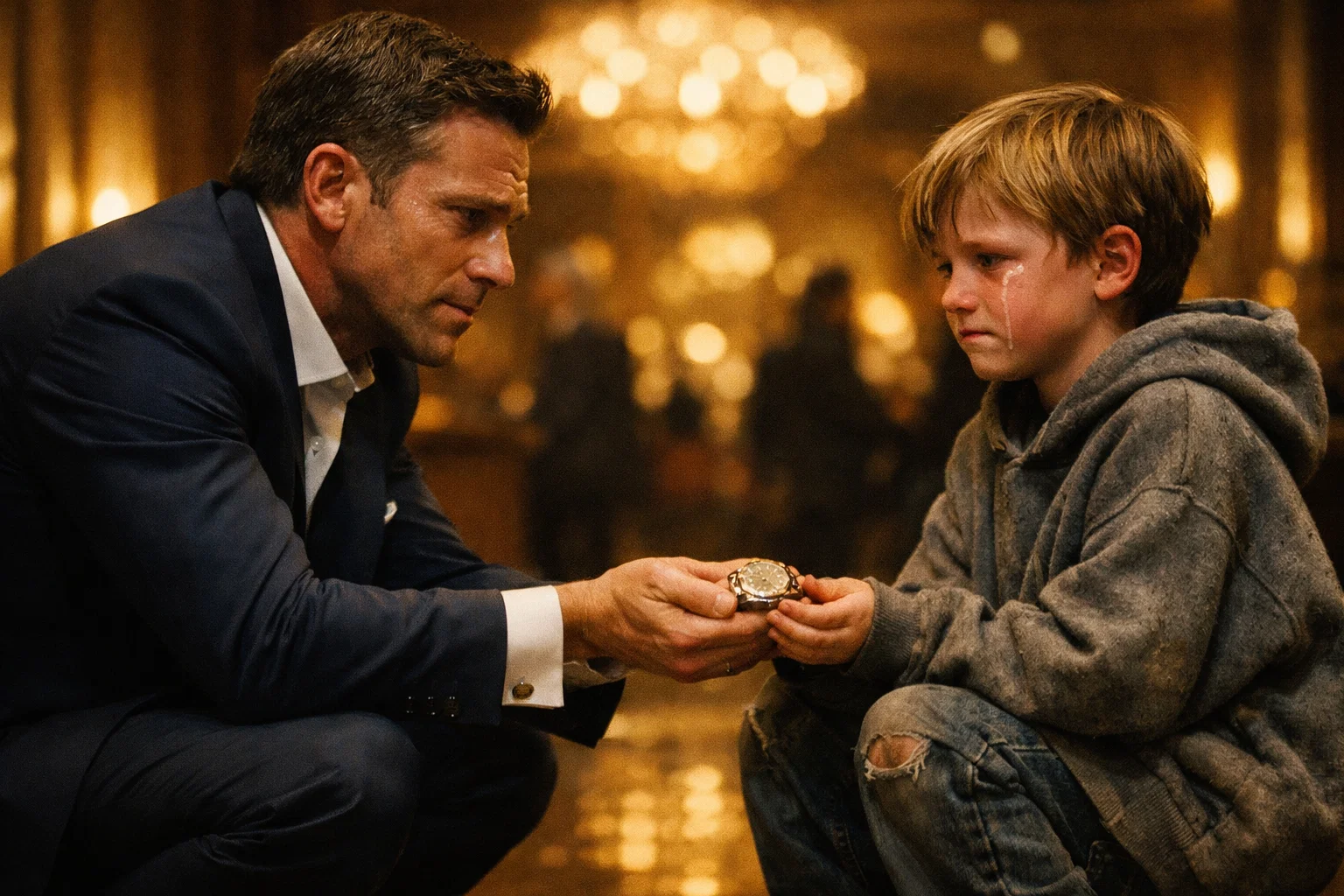
He crouched down until he was eye level with the child.
“What’s your name?”
“Ethan.”
“Ethan.” The name sat in Daniel’s chest like a stone. “What was your dad’s name?”
The boy looked at him strangely. “Why?”
“Please. Tell me his name.”
A pause. Then: “Scott. Scott Merritt.”
Daniel closed his eyes.
The lobby noise collapsed into nothing.
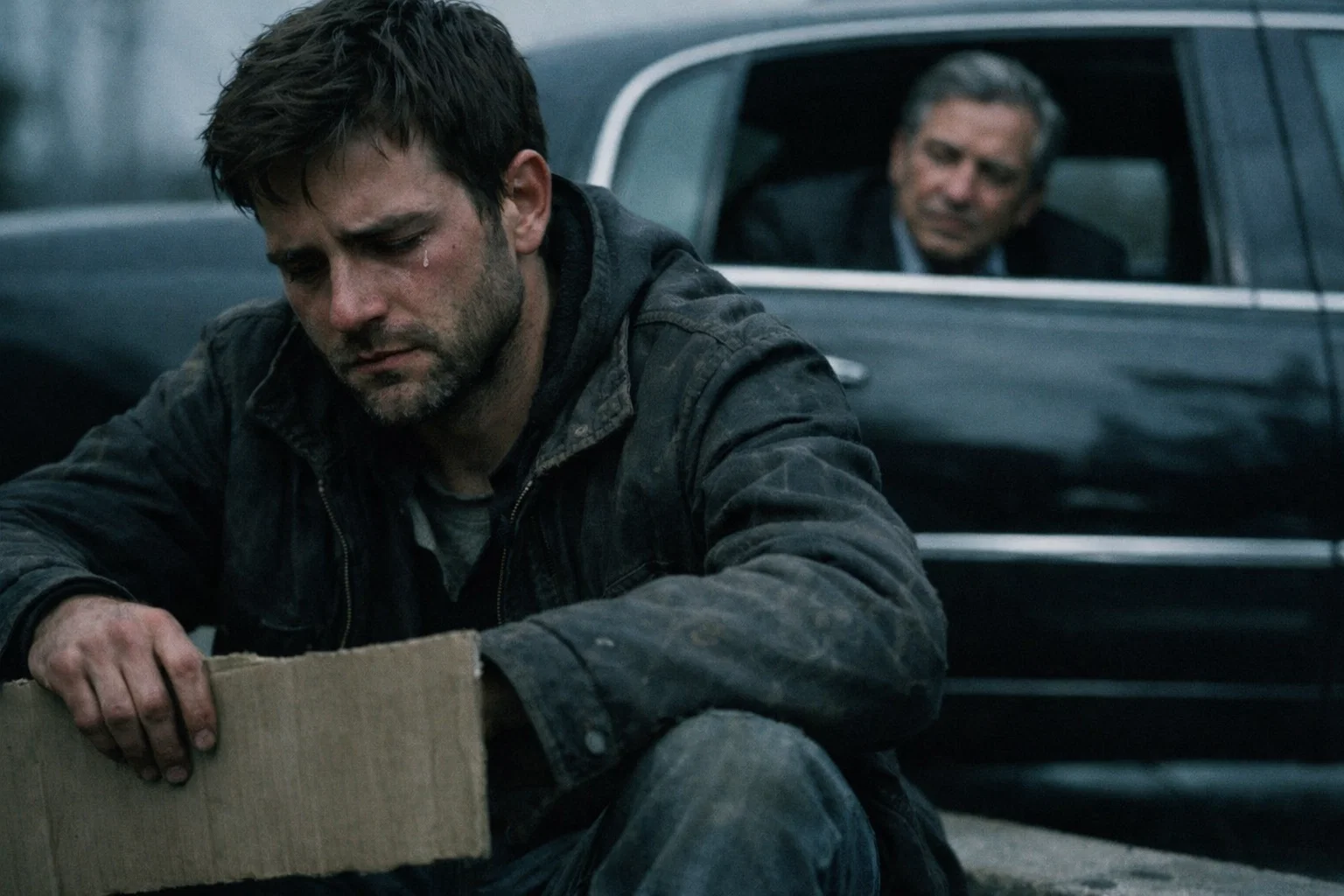
He was back in a rainy parking lot. Seventeen years old. Soaked through. Sitting against the chain-link fence outside a small auto repair shop on the east side of Columbus, Ohio, because he had nowhere else to go. Because there was nowhere else.
He remembered the door opening. A man stepping out with a flashlight. Mid-forties. Work shirt. Callused hands.
“Hey. You okay?”
Daniel had said nothing.
Scott had stood there a moment. Then he went back inside. Daniel thought that was that.
Two minutes later Scott returned with a sandwich and a cup of coffee in a paper cup and sat down on the wet asphalt right next to him like it was nothing.
Like it was just something you did.
“You don’t have to tell me anything,” Scott had said that night. “But you look like someone who could use a meal and a dry place to sleep. I’ve got a cot in the back office. You’re welcome to it.”
Daniel had been so wrecked with hunger and distrust that he’d barely managed to say thank you.
He’d stayed four months.
In that time Scott had given him work—real work, not charity dressed up as work. Sweeping, sorting, eventually oil changes and tire rotations. He’d paid him in cash, kept the amounts fair, and asked for nothing in return except honesty and effort.
He’d taught Daniel that dignity wasn’t something you were handed. It was something you practiced, day after day, until it stuck.
“You’re not what happened to you,” Scott said once, wiping his hands on a rag, not even looking up. “You’re what you decide to do next. That’s the only thing any of us actually are.”
On the day Daniel left for a job opportunity in Pittsburgh—his first real shot—Scott had pressed the silver watch into his hand.
“Time is the only thing that can’t be borrowed,” he’d said. “Use yours right.”
Daniel had worn it every single day since.
When Scott died—a phone call from someone named Carla who said she was his wife, that his number had been in Scott’s things—Daniel had been three months into his first successful exit. He’d been about to book a flight back to Columbus. About to finally show Scott what had grown from what he’d planted.
He never got the chance.
He’d sent flowers to the funeral he couldn’t get to in time. He’d tried to find the family afterward. But Carla had moved, the shop had closed, and Daniel had let the guilt settle into the back of his chest like an old injury—always there, never unbearable, never healed.
Now.
Now Scott’s son was standing right in front of him.
Daniel opened his eyes.
Ethan was watching him carefully, the way kids watch adults when they suspect something real is happening.
“Your dad and I knew each other,” Daniel said slowly. “A long time ago. He helped me when I had nothing. I mean—absolutely nothing, Ethan. I was sleeping outside.”
Ethan’s brow furrowed. “You?”
“Me.” Daniel managed something like a smile. “I know. Hard to picture.”
“Dad helped a lot of people,” Ethan said. Not proudly. Just factually. Like he was reporting something he’d known his whole life.
“I know he did.” Daniel’s voice was barely holding. “He changed my life. And I never got to tell him.”
Ethan was quiet for a moment.
Then: “He knew.”
Daniel looked at him.
“He used to say—” Ethan stopped. Swallowed. Tried again. “He used to say that you don’t help people so they’ll remember you. You help them so they’ll help someone else. He said that’s how it works.”
Something broke loose in Daniel’s chest.
He sat down on the marble floor of the five-star hotel in his fourteen-hundred-dollar suit and put his face in his hands for exactly three seconds.
Then he pulled himself together.
“Ethan.” He stood. “Where’s your mom?”
“At work. She works mornings at a diner and afternoons at a laundromat.”
“Both today?”
“Every day.”
“And you’re here because—”
“I saw your picture.” Ethan reached into the front pocket of his hoodie and pulled out a small folded piece of paper. A printed screenshot. “From a business article. I found it doing research for school. You’re Daniel Rowe. You started a company. And you were wearing Dad’s watch in the photo.”
Daniel took the paper. Unfolded it. It was a press photo from four years ago—him at a ribbon-cutting ceremony. The watch on his wrist was clearly visible.
“I looked up where you were staying,” Ethan said, a little sheepish now. “It took me a while. I told the man at the front desk I was delivering something.”
Despite everything, Daniel almost laughed.
“You came here alone?”
“Mom doesn’t know.” Ethan looked away. “She’d freak out.”
“She’d be right to.” But Daniel wasn’t angry. Not even close. “How’d you get here?”
“Bus. It’s six stops.”
Six bus stops. Alone. To walk into a hotel lobby and confront a stranger about a watch.
Scott’s kid, all right.
“Okay,” Daniel said. “Here’s what’s going to happen. First, we’re going to call your mom and tell her where you are, because she shouldn’t spend the day not knowing. Second, you’re going to sit with me and eat lunch. I have some very boring investors I was supposed to meet, but they can wait.”
Ethan blinked. “You’d cancel a meeting for me?”
“Ethan. Your dad once cancelled a whole week of work to drive me to Pittsburgh because my bus broke down and I didn’t have money for another ticket. A lunch meeting is nothing.”
Ethan stared at him.
Then, quietly: “He never told me that.”
“He wouldn’t have.” Daniel put a hand briefly on the boy’s shoulder. “Come on. Let’s find somewhere to sit.”
Carla Merritt arrived at the hotel forty minutes later.
She’d left her afternoon shift early—her manager had taken one look at her face when she took the call and told her to go.
She walked through the revolving glass doors expecting to be angry.
She was. A little.
But when she saw her son sitting across from a man in a suit, the two of them eating club sandwiches and talking like they’d known each other for years—
She stopped.
Ethan spotted her first. “Mom.”
She walked over. Daniel stood.
“Mrs. Merritt.” He extended his hand. “Daniel Rowe. I’m sorry for the circumstances. Your son is extraordinary.”
Carla shook his hand slowly. “He had no business coming here alone.”
“No,” Daniel agreed. “He also had no business being brave enough to do it. He gets both those things from his father.”
Carla’s jaw tightened.
“You knew Scott.”
“He saved my life. That’s not an exaggeration.”
She sat down. Ethan pushed his plate slightly toward her—an old reflex, like he did it without thinking.
She looked at her son and felt something pull in her throat.
“He never mentioned you by name,” she said to Daniel.
“That also sounds like him.”
A short silence.
“We lost the house,” Carla said finally. Not asking for anything. Just—saying it. Like she’d grown used to carrying it out loud. “Eight months after Scott passed. I’ve been keeping us in an apartment since. It’s fine. It’s small but it’s fine.”
“Mom,” Ethan said quietly.
“What? It’s true. I’m not ashamed.” She looked at Daniel steadily. “I don’t know why you’re telling me this matters to you. You’re a successful man. Scott’s been gone three years. You don’t owe us anything.”
“That’s not entirely accurate,” Daniel said.
She waited.
“Scott gave me something that compounded. I don’t know if you understand finance—”
“I manage a household budget on two minimum-wage jobs,” Carla said flatly. “I understand compounding.”
Daniel paused. Then: “Right. Fair. Then you understand that what Scott invested in me didn’t stay at face value. It multiplied. And some percentage of everything I’ve built—” he chose his words carefully— “is his. Whether he knew that or not.”
“He didn’t want repayment,” Carla said.
“I know. I’m not offering repayment. I’m offering continuation.”
She frowned. “Meaning what?”
“Meaning I’d like to pay off whatever debt you’re carrying. Housing, medical, anything. Not as charity—as a correction. A balance that should have been settled before he died and wasn’t, because I didn’t find you in time.” He paused. “And I’d like to fund Ethan’s education. All of it. School, college, graduate school if he wants it. Whatever door he wants to walk through.”
The table went very quiet.
Ethan had stopped eating.
Carla looked at her son. Then back at Daniel.
“Why?” she asked. Not suspiciously. Not gratefully. Just—actually wanting to know.
“Because Ethan got on six buses alone to ask a stranger about a watch,” Daniel said. “That kind of person shouldn’t have to fight uphill his whole life just because the world didn’t treat his father fairly.”
Carla’s eyes filled.
She didn’t let them spill. She blinked once, hard, and pressed her lips together.
“Scott would hate this conversation,” she said.
“He’d hate me talking about money, yes,” Daniel agreed. “He’d probably also respect that I waited fifteen years and didn’t lead with a check.”
That surprised a short laugh out of her.
Ethan looked between them. “So—is that a yes?”
“Ethan—”
“Mom. He knew Dad. He wore Dad’s watch every day for fifteen years. He cancelled a lunch meeting with investors to eat a sandwich with me.” Ethan was very serious. “I think he’s okay.”
Carla wiped one eye quickly.
“You sound exactly like your father right now,” she said.
“Is that a yes?” Ethan repeated.
She exhaled.
“Yes,” she said. “Okay. Yes.”
It took three weeks to arrange everything.
Daniel worked with his attorney to establish an irrevocable education trust for Ethan. Full funding through graduate school. No strings, no conditions beyond enrollment.
He cleared the remaining debt on the Merritt family’s outstanding medical bills—over forty thousand dollars—and covered six months of rent on a larger apartment in a better school district.
He did all of it without announcements. Without press. Without sending a word to any of the business reporters who regularly covered his name.
Carla called him once during those three weeks.
“This is too much,” she said.
“It isn’t enough,” he said. “But it’s a start.”
“Scott would still hate it.”
“I know. I’ve made peace with that.”
A pause.
“Thank you, Daniel.”
“Thank you for raising a kid who got on a bus and walked into a lobby and stood his ground.” He meant it. “You’ve been doing that alone for three years. Don’t minimize it.”
She didn’t respond right away.
When she did, her voice was steadier. “He used to say you were the one who got away. The one he always wondered about.”
Daniel felt that one all the way through.
“Tell me something he said,” he said. “Something specific. I want to hear it.”
Carla thought for a moment.
“He said—and I’m quoting now—’That kid is going to do something so big one day that nobody will be able to explain where he came from. And I’ll know. And that’ll be enough.'”
Daniel didn’t say anything for a long time.
“Yeah,” he finally managed. “That’s him.”
A year later, Ethan started at one of the best middle schools in the state.
He was placed in advanced math and made the debate team in his first semester.
He called Daniel to tell him.
“I won my first round,” Ethan said. “The topic was whether corporations have a moral obligation to invest in the communities they came from.”
Daniel laughed—a real one. “What side did you argue?”
“That they do. I won.”
“Of course you did.”
“My coach said I was unusually good at making people feel like their opposition was already wrong before I even started talking.” A pause. “Is that a compliment?”
“In debate? Absolutely.”
“Daniel.” His voice shifted—more careful. “Can I ask you something?”
“Always.”
“When you were seventeen. Sleeping outside the shop. Were you scared?”
Daniel thought about it honestly.
“Terrified,” he said. “I thought my life was already finished before it started.”
“What made you stay? When Dad offered?”
“He sat down next to me on wet asphalt in the rain,” Daniel said. “He didn’t stand over me. He sat down. At the time I didn’t know why that mattered so much. Now I do.”
Ethan was quiet.
“I’m going to do that,” he said finally. “When I’m older. I’m going to sit down.”
Daniel had to press his mouth closed for a second.
“I know you will,” he said.
On Ethan’s eighteenth birthday, Daniel flew to Columbus.
Carla had made dinner. Real food—the kind that took all afternoon, that smelled like a home that had been through hard things and survived them.
After dinner, Daniel reached into his jacket pocket and set a small velvet box on the table.
Ethan looked at it. Then at Daniel.
“Open it,” Daniel said.
Ethan lifted the lid.
The silver watch.
He picked it up carefully. Turned it over. Found the engraving on the back, the one Daniel had traced with his thumb ten thousand times over fifteen years.
To Scott. For always being on time. – Dad
“This is his,” Ethan said.
“It always was.”
“You wore it for fifteen years.”
“Until the person who should have it was old enough to wear it.” Daniel nodded at the watch. “Your grandfather gave it to him. Your dad gave it to me. Now I’m giving it to you. That’s not a gift. That’s a relay.”
Ethan held it for a long moment.
Carla had her hand over her mouth.
Then Ethan looked up—and he looked so much like Scott in that moment that Daniel had to look away for a second.
“Would he be proud?” Ethan asked.
“Of which of us?”
“Both.”
Daniel looked back.
“Your dad had one talent above everything else,” he said. “He could see what people were going to become before they became it. He saw it in me when I had nothing to show for it.” He paused. “I think he saw it in you from the start. And yes. He would be proud. I’m certain of it.”
Ethan fastened the watch around his wrist.
He looked at it.
He didn’t say anything else.
He didn’t need to.
The watch had been in three hands now.
A grandfather who believed in his son. A mechanic who believed in a stranger. A boy who believed enough to get on a bus.
Somewhere in that chain was the whole argument for why kindness wasn’t soft.
It was the longest investment anyone could make.
It didn’t show up on a balance sheet.
It didn’t earn interest you could see.
But it compounded.
Quietly. Slowly.
Across years. Across lives.
Until one day a boy in worn shoes walks into a lobby and the whole thing comes full circle and you realize—
It was never really about the watch.
It was about what it meant to be seen.
To be believed in.
Before you’d done a single thing to deserve it.
That’s the only inheritance that actually lasts.
Original fictional stories. AI-assisted creative content.