
The Grand Meridian Hotel sat in the heart of Manhattan like it owned the block — which, technically, it did.
Forty-two floors of glass and steel. A lobby that smelled like fresh flowers and quiet money. Guests who never had to ask the price of anything.
Ryan Caldwell stood near the front desk with his arms loose at his sides, the way a man stands when he knows he’s being watched. His suit was charcoal gray. His cufflinks caught the light from the chandelier above him.
He was thirty minutes into his morning rounds.
“Maya,” he said to the receptionist, “the Hargrove party checking in at noon — make sure they get the penthouse welcome package. Champagne, fresh fruit, the monogrammed robes.”
Maya Chen looked up from her screen. She was twenty-six, polite to everyone, and had already worked three doubles that week.
“Already set, Mr. Caldwell.”
“And the Mitchells in 2204 complained about the pillow firmness.”
“I sent up four alternates last night.”
Ryan gave a short nod. Not a thank-you. Just a nod that said acceptable and moved on.
He turned toward the lobby entrance, scanning the space the way he always did — looking not for problems, but for things to criticize before they became problems.
The marble floors were clean. The flower arrangements were fresh. A suited businessman sat near the fireplace reading on a tablet. Two women in designer coats waited near the elevator bank.
Everything was correct.
Ryan liked correct.
The revolving door turned.
A man stepped inside.
Ryan noticed him before anyone else did — maybe because contrast was something the eye found automatically, like a wrong note in a chord.
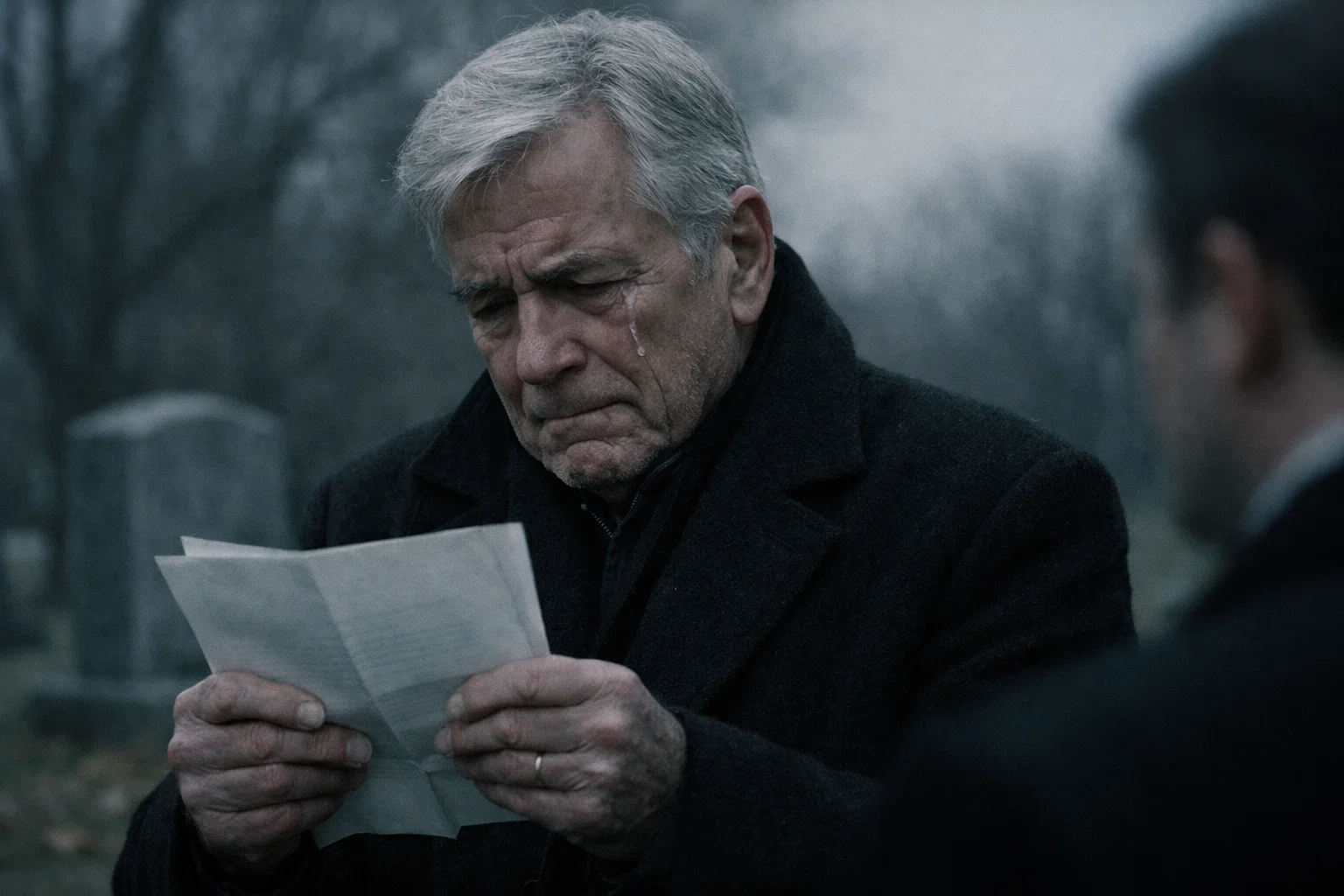
The man was old. Seventy, maybe older. His gray hair was uncombed, swept slightly sideways from the wind outside. His coat was brown and heavy and clearly had not been expensive even when it was new. The collar was frayed. One button hung by a thread.
He carried a small leather bag, dark and soft with age, worn at the corners where the hide had rubbed through.
His shoes were dusty.
He walked slowly across the marble floor, looking up at the chandelier, then at the walls, then at the fireplace at the far end. Not like a man who was lost. Like a man reading something he had not read in a long time.
The businessman near the fireplace glanced up, then looked back at his tablet.
The two women near the elevator said nothing but moved slightly closer together.
Maya watched from behind the desk.
Ryan was already walking.
“Excuse me.”
His voice was loud enough to carry.
The old man stopped.
Ryan reached him in six steps. He looked him up and down once — a full, deliberate inspection — and let the silence sit there for a moment before speaking again.
“Can I help you with something?”
“Yes.” The man’s voice was even. Not nervous. “I’d like to go upstairs.”
Ryan tilted his head slightly.
“Upstairs.”
“That’s right.”
“This is a private hotel.”
“I know.”
Ryan smiled — not a warm one. The kind that told you the conversation was almost over.
“Then you’re aware we have a guest policy. Are you registered here?”
The old man reached into his coat pocket and pulled out a small plastic key card. It was old — the kind the hotel hadn’t used in at least a decade, flat white with a magnetic strip and a small gold Meridian logo that had mostly worn off.
He held it out.
Ryan looked at it without taking it.
“That card hasn’t worked in this system since we updated the locks in 2015.”
“I know,” the man said again. “I just wanted to see if I still had it.”
“Sir.” Ryan’s tone shifted. Harder now. Quieter in the way that carried farther. “You’re not a guest. I’m going to ask you to leave.”
“I’m not causing any trouble.”
“You’re disturbing the atmosphere.”
The old man looked around — at the marble, at the flowers, at the guests who had started watching — and then looked back at Ryan.
“What atmosphere?”
Ryan signaled without turning his head.
Two guards appeared from the side corridor like they had been waiting for the gesture. They probably had been.
“Sir,” the taller one said, “we’re going to need to escort you out.”
The old man looked at the guard. Then at Ryan.
“I only came to see something.”
“You can see the front door from outside,” Ryan said. “Move along.”
The guards stepped to either side of him.
The old man didn’t resist. He let them take his arms. But he moved slowly — not stiff, not struggling, just walking at his own pace, looking at things as he passed.
He looked at the fireplace.
He looked at the ceiling.
He looked at the photograph.
Maya had been watching from the desk.
She stepped out from behind the counter. She didn’t make a scene — she kept her voice low, walking quickly to close the distance.
“Mr. Caldwell.”
Ryan turned.
“He’s not doing anything wrong. He just walked in.”
Ryan looked at her the way he looked at things that needed correcting.
“He’s not a guest.”
“A lot of people walk through lobbies. Tourists, people meeting friends—”
“Maya.” One word. A full stop. “Go back to the desk.”
She stood still for one moment — just one — then went back.
The guards had the old man near the center of the lobby now, halfway between the fireplace and the exit.
The businessman near the fire had put down his tablet.
A woman in a red coat had stopped walking entirely and was watching openly.
Ryan didn’t notice any of them. Or if he did, it didn’t register as important.
“Sir,” he said loudly, addressing the old man’s back, “I’m sure there are places that can assist you. This isn’t one of them. We don’t allow people to wander in off the street regardless of—”
“I built this hotel.”
The guards stopped.
Ryan stopped.
A few guests close enough to hear stopped.
Ryan’s jaw shifted slightly. He crossed his arms.
“Excuse me?”
The old man wasn’t looking at him. He was looking at the photograph on the wall above the fireplace. It was large — framed in dark wood, lit from beneath by a small brass lamp. A crowd of people stood in front of the hotel’s entrance. A ribbon stretched across the doorway. A man at the center held a pair of scissors and was caught mid-smile, looking directly at the camera like he knew the photo would last.
“That’s me,” the old man said.
Ryan walked toward the photo. He looked at it. He looked at the old man.
He laughed.
Not a small laugh. A real one, the kind you use to invite the room in on a joke.
“That’s a picture from thirty years ago.”
“Thirty-one.”
“Sure.” Ryan gestured to the guards. “He’s confused. Let’s get him outside.”
“Look at the plaque,” the man said.
Ryan glanced down.
Beneath the photograph, mounted in the same dark wood frame, was a small brass plate.
Grand Meridian Hotel — Opening Ceremony. Founded by Arthur W. Whitmore.
The room was quiet.
Ryan read it twice.
Then he looked at the old man.
“Arthur Whitmore.”
The man nodded once.
“That’s me.”
The silence in the lobby was different now.
The businessman stood up from his chair. The two women near the elevator had not moved. Three guests who had been heading toward the restaurant had stopped in the archway.
Maya was standing behind the desk with both hands flat on the surface.
Ryan took a slow breath.
“Mr. Whitmore sold his interest in this hotel years ago.”
“I sold a portion.”
“You—” Ryan paused. “What portion?”
Arthur Whitmore reached into the old leather bag.
He drew out a manila folder. Ordinary. No ribbons, no embossing. Just a folder, slightly creased at the top corner.
He held it out.
Ryan took it.
He opened it. His eyes moved across the first page quickly, then slowed, then stopped.
He went to the second page.
Then the third.
His hands had begun to move differently — not trembling exactly, but careful now, deliberate, the way hands move when what they’re holding has gotten heavier.
The documents were formal. Notarized. Multiple signatures, multiple pages of chain-of-ownership clauses, trust structure, transfer restrictions.
Arthur Whitmore had sold portions of the hotel over the years. He had sold 49 percent.
He had retained 51 percent through a holding trust — a trust that had never been dissolved, never been transferred, never been sold.
Ryan closed the folder.
He looked up.
“These would need to be verified.”
“They’ve already been verified.” Arthur’s voice was patient. “By three attorneys and two title companies. The most recent review was four months ago.”
Ryan set the folder down on the lobby table next to him.
He straightened. He put his hands in his pockets. He looked at the marble floor for a moment.
“Mr. Whitmore.” His voice was different now. Lower. Measured. “If I had known who you were—”
“That’s exactly the point.”
Ryan looked up.
Arthur was watching him calmly. No anger in his face. No satisfaction, either. Just a very clear kind of attention — the kind that had been gathering evidence for the last fifteen minutes.
“I come here once every few years,” Arthur said. “I don’t call ahead. I don’t wear a suit. I just walk in and see how the place is being run.”
The woman in the red coat had not moved.
“And today?” Ryan asked.
“Today I saw a manager instruct his security team to remove an elderly man from a hotel lobby for the crime of having an old coat.” Arthur looked at him steadily. “In front of twenty witnesses. Loudly.”
Ryan opened his mouth.
“I also watched a young woman at your front desk try to intervene,” Arthur continued, “and watched you shut her down with one word.”
Maya looked at the floor.
“That young woman,” Arthur said, “showed more judgment in five seconds than you showed in fifteen minutes.”
Ryan said nothing.
Arthur picked up his bag.
He reached back into it and took out a phone. An ordinary phone, no case, a small crack across the bottom corner of the screen.
He dialed.
It rang twice.
“James,” he said. “I’m at the Meridian. I need you here by two.” A pause. “No, bring the full board. And call Patricia.”
He ended the call and put the phone in his pocket.
Ryan watched him.
“Mr. Whitmore. Whatever you’re planning — can we sit down first? I’d like to—”
“You’d like to explain yourself.”
“Yes.”
“You had the opportunity to explain yourself,” Arthur said quietly, “when you had a man you didn’t recognize escorted toward the door and told him he was disturbing the atmosphere.” He looked at Ryan without hostility, just plainness. “What would you have said then?”
Ryan had no answer.
Arthur buttoned the top button of his old coat.
“I’m going to get a coffee,” he said. “I’ll be back at two.”
He walked across the marble floor toward the exit.
The revolving door turned.
He was gone.
The lobby did not immediately return to normal.
People moved — the businessman sat back down, the guests in the archway resumed walking — but there was still a quality in the air that hadn’t been there before. Like the temperature had dropped a degree and no one was quite willing to admit it.
Ryan stood next to the lobby table with the folder still sitting on it.
Maya came out from behind the desk.
She picked up the folder carefully and held it with both hands.
“Should I make copies?” she asked.
He looked at her.
“Yes,” he said. “And call legal.”
James Whitmore arrived at 1:48 p.m. He was Arthur’s son — fifty years old, calm in the way of someone who had watched his father handle situations like this for decades. He wore a good suit and carried a slim briefcase.
He introduced himself to the front desk.
“My father is on his way up,” he said. “We’ll need the boardroom on twelve.”
Maya made the call.
The board members arrived over the next twenty minutes. Six of them, ranging from a silver-haired woman in her sixties who had been on the Whitmore Holdings board for eighteen years, to a younger man who had joined eighteen months ago and had never met Arthur in person.
Ryan stood in the boardroom when Arthur walked in.
Arthur sat down at the head of the table.
He did not acknowledge Ryan first. He greeted the board members by name — each one, from memory — and shook James’s hand and accepted a glass of water.
Then he looked at Ryan.
“Sit down,” he said.
Ryan sat.
The meeting lasted forty minutes.
Arthur did not raise his voice once.
He laid out what he had observed. He noted the time of each event with precision — Ryan’s initial approach, the instruction to security, the dismissal of Maya, the comments made loudly enough for guests to hear.
“I’ve reviewed the financial performance,” Arthur said, sliding a sheet across the table. “Revenue is up. Occupancy is steady. The renovations on the east wing were handled well.”
Ryan looked at the sheet.
“But a hotel is not a spreadsheet.” Arthur folded his hands. “The people who work here are not furniture. And the guests — all of them — deserve to be treated with dignity. Even if they walk in with a worn coat.”
The silver-haired board member, whose name was Patricia Holt, looked at Ryan without expression.
“What Mr. Whitmore is describing,” she said, “constitutes a pattern we’ve been made aware of.”
Ryan looked up sharply.
“What pattern?”
James opened his briefcase and removed three pages.
“Three formal complaints filed by staff members in the past fourteen months,” he said. “A sous chef dismissed without documentation. A housekeeper verbally reprimanded in front of guests. A concierge who reported being told to apply ‘visual judgment’ when deciding which visitors to assist.”
Ryan stared at the pages.
“Those were operational decisions—”
“They were dignity failures,” Arthur said. Simply. Flatly.
The room was quiet.
“The Meridian was built as a place where excellence was not contingent on appearance,” Arthur said. “That was the founding principle. It is written in the original charter.” He paused. “You can grow revenue. You can fill rooms. But if the culture of this place becomes one where people are sorted by how they look, then what you’ve built is something I don’t want my name on.”
Ryan set his hands flat on the table.
“Mr. Whitmore. I have done everything asked of me. The hotel is performing at record—”
“Performance is not the issue.”
“Then what is the issue?”
Arthur looked at him.
“Character,” he said. “Yours.”
The board voted.
It was not close.
Ryan was offered a structured transition — six weeks, full severance, clean departure. No public statement, no messy exit. Just a handshake and a door.
He took it.
He didn’t have much choice.
The next morning, Arthur arrived at the hotel at seven-fifteen.
He wore the same coat.
He walked through the revolving door and crossed the marble floor and stopped at the front desk.
Maya was there.
She had been called in early. She didn’t know why yet.
“Good morning,” Arthur said.
“Good morning, Mr. Whitmore.” She kept her voice steady. “How can I help you?”
“You tried to stop something yesterday that you had no official authority to stop.” He looked at her directly. “Do you know why you did that?”
She thought for a moment.
“Because it was wrong,” she said. “What was happening to him. To you.”
Arthur nodded slowly.
“And when Caldwell told you to go back to the desk?”
“I went back to the desk.” She paused. “I didn’t like it. But I went.”
“You picked your moment.”
“I didn’t have a better one.”
Arthur studied her for a second.
“I’m appointing an interim general manager while we conduct a full search,” he said. “James will be overseeing operations. But we need someone on the floor who knows how this building actually runs.”
Maya was very still.
“We’re creating a Director of Guest Experience role,” he said. “Effective immediately. It reports directly to James.” He set a card on the desk between them. “If you want it.”
She looked at the card.
Then she looked at him.
“Yes,” she said. “I want it.”
Arthur picked up his bag.
“Good.” He glanced toward the elevator. “I’d like a coffee in the lobby. And then I want to take a look at the east wing.”
“Of course.” She was already reaching for the phone. “I’ll have it waiting.”
He nodded and walked toward the fireplace.
He looked up at the photograph.
The man in the picture was younger, mid-ceremony, scissors in hand, the whole thing ahead of him still.
Arthur looked at it for a long moment.
Then he sat down.
He set his old leather bag beside the chair.
And he waited for his coffee.
Ryan Caldwell cleared out his office on a Tuesday. He took his personal items — a framed degree, a desktop organizer, a small succulent someone had given him at the company holiday party two years ago.
He passed the front desk on his way out.
The woman standing there was not the usual receptionist.
She had a new badge. Director of Guest Experience. Her name was Maya Chen.
She looked up as he passed.
She did not say anything.
She didn’t need to.
Ryan walked through the revolving door.
And the door kept turning after him, and the hotel kept going, and nobody stopped to watch him leave.
The Grand Meridian Hotel had stood in Manhattan for thirty-one years.
It had been built by a man who believed that excellence had nothing to do with appearance.
He had just reminded it of that fact.
And the building, for the first time in a long time, felt like itself again.
Original fictional stories. AI-assisted creative content.