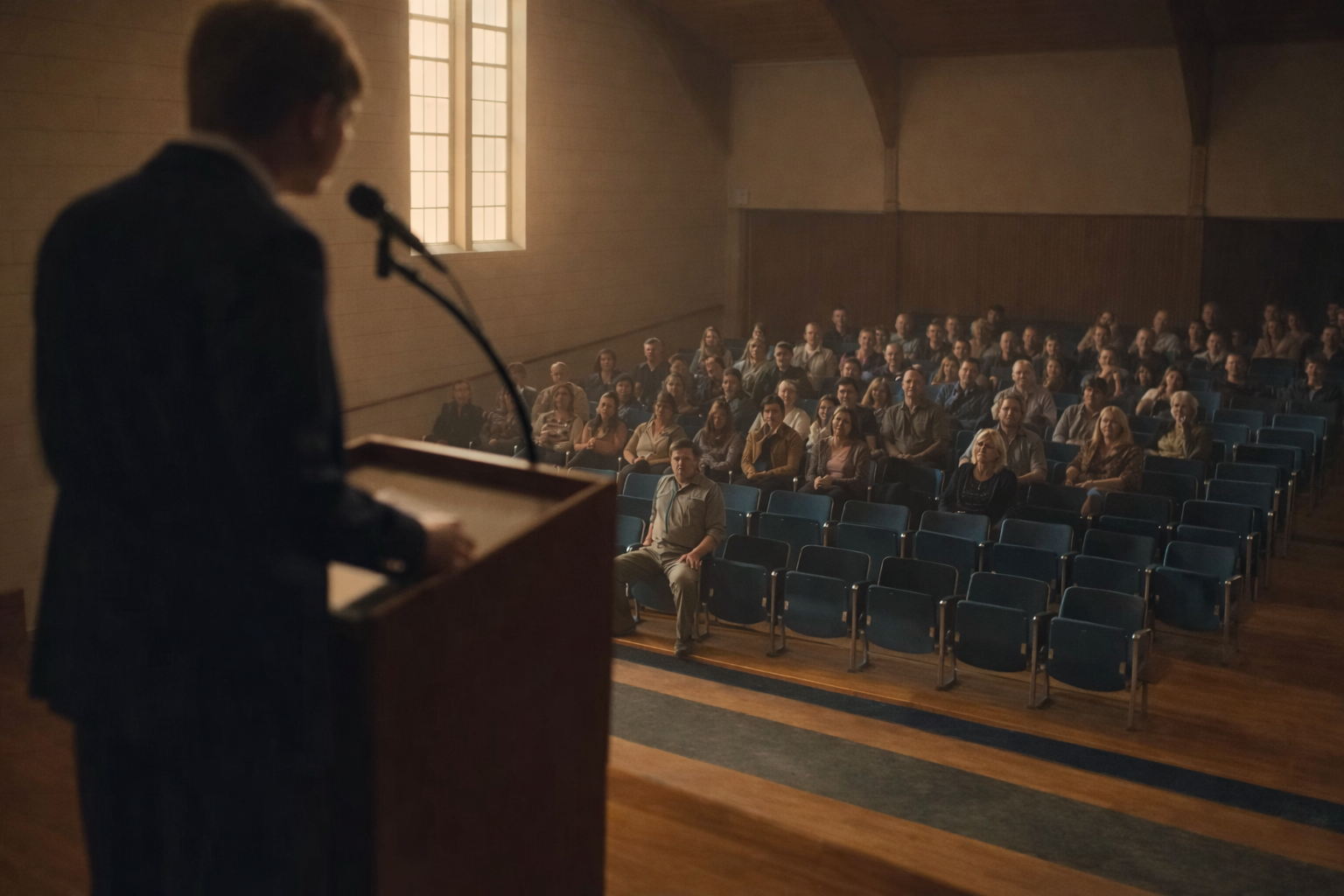
The auditorium smelled like floor wax and cheap coffee. Every folding chair was taken. Parents sat with phones half-raised, ready to capture their kid’s moment. Teachers in the side rows wore the practiced look of people who’d done this fifteen times.
Evan Carter stood at the edge of the stage, waiting to be called.
He was seventeen. His blazer was borrowed from Mr. Hensley in the drama department — half a size too big, the sleeves dropping past his wrists. He’d tried rolling them, but they kept falling back down.
“And our Academic Excellence Award goes to…” Principal Marsh paused, savoring it. “Evan Carter.”
Applause. Polite. Scattered.
A girl in the second row leaned to her friend and whispered, “Isn’t his dad, like, the janitor here?”
Her friend didn’t answer. Just watched.
Evan walked to the podium. The microphone stood too high; he adjusted it down. That small mechanical sound — the click of metal — was the loudest thing in the room for a moment.
He looked out at the crowd.
Three hundred faces. Parents in their business casual. Teachers in their cardigans. His classmates in the rows up front, some curious, most already scrolling.
In the third row, slightly apart from the other parents, sat a man in a gray uniform. His name was Robert Carter. His hands rested on his knees. He wore the same clothes he’d worn since four that morning.
Evan saw him.
Robert shook his head slightly — you don’t have to do this — a message sent without words across fifty feet of auditorium.
Evan turned back to the microphone.
“My name is Evan Carter,” he said. His voice came out steadier than he expected. “And before I say anything else, I want to talk about my dad.”
A shift moved through the room. Not loud. Subtle. The kind of shift that happens when something veers off script.
Principal Marsh, seated behind the podium, crossed his arms.
A woman in the fourth row — silk blouse, highlighted hair, the mother of someone on the honor roll — tilted her head with polite confusion.
“My dad cleans this school,” Evan said. “He’s been here for seventeen years.”
No one moved.
“His name is Robert Carter. And before any of you heard his last name just now, most of you probably just knew him as the guy who mops the hallways.”
Robert’s jaw tightened. He looked at his hands.
“I know what some of you are thinking,” Evan continued. “Because I used to think it too.”
He paused.
In the front row, Tyler Marsh — the principal’s son — pulled out his phone. His mother put a hand on his arm. He put it away.
“When I was in sixth grade, career day came around. My teacher asked everyone to bring in a parent to talk about their job. My dad wanted to come.”
Evan’s voice changed. Just slightly. Something underneath the steadiness showed through.
“I told him not to.”
Silence.
“I told him that nobody wanted to hear about janitorial work. That it would be embarrassing. That I didn’t need him there.”
He stopped. Swallowed.
“He still came. He stood in the back of the room. He never said a word. He just… watched. And when it was over, he was waiting outside the classroom door.”
Robert’s shoulders dropped forward, just slightly.
“He said, ‘I’m proud of you, son.’ And I asked why, because I hadn’t done anything. And he said, ‘Because you stood up there and answered questions in front of everyone, and you didn’t look scared.'”
A teacher in the side row pressed her lips together.
“I didn’t understand then how much that took from him. To stand at the back of that room. To not be invited. To watch his kid not want him there — and to come anyway.”
Evan reached into the pocket of his oversized blazer and pulled out a folded square of paper. The edges were soft from years of handling. He set it on the podium but didn’t unfold it.
“This is a math test,” he said. “From when I was seven. I got a thirty-two.”
A few quiet laughs. Surprised ones.
“I cried in the janitor’s closet because I thought I was stupid. I actually thought — I’m seven years old and I’m already broken. I remember the feeling exactly. Like something in me was already decided.”
He glanced down at his father.
Robert was looking at the floor.
“My dad sat down next to me on the tile. Still in his uniform. Mop parked outside the door. And he didn’t tell me I was smart, because he knew I wouldn’t believe it. He said, ‘You’re tired. And you’re hungry. And you’re scared. None of that means you can’t do this.'”
The woman with the silk blouse had stopped fidgeting.
“He had five dollars in his wallet. He gave it all to the vending machine down the hall and came back with a granola bar and a bottle of water. Then we went through every single wrong answer on that test. On the floor. Next to a mop bucket.”
Evan unfolded the paper carefully. Held it up briefly. Put it down.
“That night, he worked a double shift. He came home at two in the morning and I was asleep at the kitchen table with a workbook open. He covered me with his jacket. I didn’t wake up.”
Somewhere in the back, someone exhaled quietly. The sound of a person trying not to be heard crying.
“The next test, I got an eighty-seven.”
Nobody laughed this time.
“People ask me sometimes why I work so hard. Teachers call it drive. My guidance counselor put it in my college recommendation letter as ‘exceptional internal motivation.'” He said it carefully, mimicking the formal phrasing. “What it actually is — what it has always been — is that I watched my father work a job that nobody respects for seventeen years, without complaint, without bitterness, and without ever once making me feel like his exhaustion was my fault.”
His voice didn’t break. It got quieter instead — which was somehow harder to listen to.
“He taught me how to read a room by watching him do it. I know when someone looks past you instead of at you. I know the face people make when they don’t think you can hear them. I know the way a hallway sounds when you’re the only one in it at four in the morning.”
Robert lifted his head. His eyes were red.
“Once, when I was maybe nine, I asked him if he wished he had a different job. A better one. He thought about it for a long time. And then he said, ‘I wish you never had to see me tired. That’s the only thing I’d change.'”
The principal uncrossed his arms.
“He never said he was ashamed of the work. He was ashamed of his exhaustion. He protected me from that distinction for years, and I didn’t know enough to appreciate it.”
Evan looked out at the crowd with an expression that wasn’t quite anger and wasn’t quite forgiveness. Something in between. Something earned.
“I heard one of you — I won’t say who — call me ‘the janitor’s kid’ when they announced my name.”
The room went very still.
Tyler Marsh stared at the floor.
“I’m not going to pretend I didn’t hear it. I’m not going to pretend it didn’t land.”
He straightened.
“But I want you to understand something. My father has cleaned your kids’ messes in this building for seventeen years. He’s mopped up after the fundraiser dinners and the homecoming afterparties and whatever else happens when the adults go home and the cameras are off. He has never complained about it to me. Not once.”
A long beat.
“I’ve sat in the back of enough honor roll ceremonies to know which parents look through him when he holds the door. I’ve watched the way people hand back trash instead of finding a bin when he’s nearby. I know exactly what it feels like to watch someone you love treated like part of the architecture.”
He picked up the paper from the podium.
“I’m not standing up here for sympathy. I’m standing up here because I won this award, and I want you to know who made that possible — and it’s not drive, and it’s not internal motivation.”
He held up the test.
“It’s a man who spent his lunch breaks quizzing me on vocabulary. It’s a man who bought me SAT prep books with his overtime pay and left them on my pillow without saying anything about it. It’s a man who has never — not once — asked me to be grateful.”
His voice dropped.
“Which is the only reason I know how to be.”
In the third row, Robert Carter bent forward with his elbows on his knees and covered his face with both hands.
Evan folded the paper back up. Tucked it into his pocket.
“That’s all I wanted to say.”
He stepped back from the microphone.
The auditorium held its breath for one full second.
Then a teacher stood. Just one, at first — Ms. Okafor, from AP English, in the far left aisle. She started clapping, and it wasn’t the polite scattered kind from earlier. It was deliberate. Intentional.
Then the parent behind her stood. Then two more.
Then the back row rose like a wave rolling forward.
By the time it reached the front, even the students were standing. Some of them looked surprised at themselves. Tyler Marsh stayed seated for a moment longer than everyone else — and then slowly got to his feet.
Principal Marsh stood. He wasn’t performing this time. He looked like a man recalculating something he’d gotten wrong.
Robert Carter raised his head. His face was wet. He looked at his son on the stage.
Evan looked back at him.
He came down the steps. Not triumphant. Just walking. He crossed the auditorium floor to the third row, and the applause built around that walk like something physical, like walls being rebuilt.
He reached his father. Neither of them spoke. They just stood there for a moment, the way people do when words would be too small.
Then Evan put his arms around him.
Robert gripped the back of his son’s blazer — the borrowed one, half a size too big — and held on.
“You didn’t have to do that,” he said into Evan’s shoulder.
“Yeah,” Evan said. “I know.”
The applause didn’t stop.
Later, after the crowd cleared and the folding chairs were being stacked, Robert Carter returned to his cart in the corner of the lobby. He picked up his mop. Out of habit, out of routine, out of seventeen years of muscle memory.
He straightened a chair someone had knocked sideways on their way out.
Evan appeared at the auditorium doors with his award — a plaque, heavy and cold — tucked under his arm.
“Ready?” he asked.
Robert looked at his son. At the plaque. At the borrowed blazer, sleeves falling over his hands again.
“Hold on,” he said.
He reached over and folded back the cuffs, once, twice, until Evan’s hands were visible.
“There,” he said. “Now you look like it fits.”
Evan looked down at his hands. Then up at his father.
“It does,” he said.
They walked out together through the main doors. A few parents still lingering in the parking lot stopped talking when they passed.
This time, nobody looked through him.
This time, every single one of them saw the man pushing the cart — and looked away first.
Three days later, the school board received a formal request, signed by forty-seven parents and eleven faculty members, to recognize Robert Carter at the district’s annual staff appreciation ceremony. The letter specifically named his seventeen years of service. It specifically named his son.
Principal Marsh signed it himself.
He delivered it to Robert personally, in the hallway, on a Tuesday morning, before the students arrived.
“I owe you an apology,” the principal said. “More than one.”
Robert took the letter. Read it carefully.
“Thank you,” he said.
He folded it. Tucked it into the front pocket of his uniform.
And went back to work.
Original fictional stories. AI-assisted creative content.