The charity gala was in full swing.
Five hundred dollars a plate. Crystal flutes. Silk drapes that probably cost more than most people’s cars.
Rachel Whitmore, the event coordinator, had spent six months pulling this evening together, and she wasn’t about to let anything ruin it.
“Keep the line moving,” she murmured into her headset. “I want the Gibson lot up before nine.”
“Copy,” said her assistant.
The auctioneer’s voice filled the hall, smooth and practiced. “And now, ladies and gentlemen — a vintage 1952 Gibson acoustic, authenticated by three independent—”
A door banged open.
Not the main entrance. The side service door, the one marked STAFF ONLY.
Every head in the room turned.
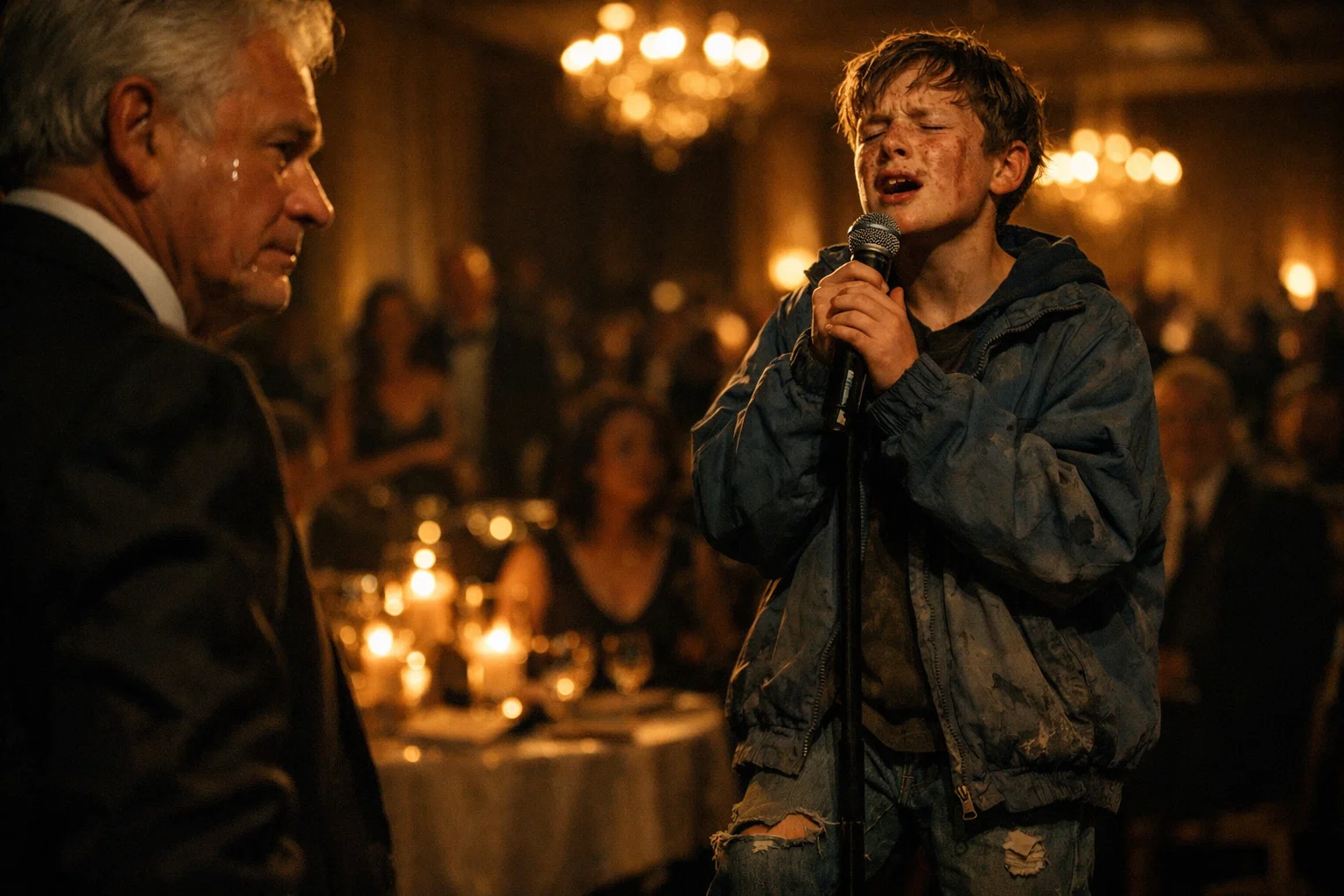
A boy stood in the doorway. Thirteen, maybe fourteen. His jacket was enormous on him — a man’s windbreaker, faded blue, three sizes too big. His jeans were ripped at both knees, not fashionably, but from use. His sneakers were wrapped in duct tape at the toe.
His face was smudged with dirt. His eyes were enormous.
He looked at the room full of tuxedos and gowns and chandeliers, and for one second, his expression flickered — shame, maybe, or something older than that.
Then he squared his shoulders.
“I’m sorry,” he said, his voice cracking. “I didn’t — I just — ” He swallowed hard. “I can sing. I’m good. I’ll sing for food. That’s all I’m asking.”
The silence lasted exactly two seconds.
Then everyone started talking at once.
“Security—”
“How did he even get in—”
“Oh, for heaven’s sake—”
A woman in pearls grabbed her husband’s arm. “Someone call the manager.”
Another guest already had her phone out, recording with a little smile playing at her lips, the kind of smile that meant she was composing a caption in her head.
Two security guards were already moving, their earpieces crackling.
The larger one reached the boy in four strides and clamped a hand on his shoulder. Hard. “Kid. You need to come with me.”
“Please.” The boy’s voice didn’t waver. “Five minutes. That’s all.”
“Now.”
“Let him try.”
The voice came from the front row, and it was quiet — but it landed like a stone thrown into still water.
Marcus Chen stood up slowly.
He was sixty-three years old. Gray at the temples, a suit that fit the way only bespoke suits fit. He had founded two companies and sold them both. He had his name on three hospital wings. He was the reason tonight’s gala had a million-dollar floor.
And right now, he was looking at the boy in the duct-tape sneakers with an expression no one in the room could quite read.
“Give him the microphone,” Marcus said.
The auctioneer blinked. “Mr. Chen—”
“The microphone. Please.”
The room held its breath. The security guard’s hand loosened on the boy’s shoulder — not all the way, but enough.
Rachel pressed her fingers to her earpiece. “Hold,” she said quietly. Then, after a beat: “Everyone hold.”
The microphone passed through four sets of hands until it reached the boy’s shaking fingers.
He looked down at it like he’d never held one before.
“What’s your name?” Marcus asked.
“Elijah.”
“Elijah.” Marcus’s voice was gentle in a way that didn’t match his reputation at all. “Sing whatever you want.”
The boy — Elijah — closed his eyes.
Nothing happened for three full seconds.
A man in the back row started to shift. Someone near the stage exhaled.
Then Elijah opened his mouth.
And every single sound in the room died.
His voice was not polished. It had no technique, no training, no control in the formal sense. What it had instead was something that no conservatory on earth could teach. It was the sound of a person who had lived inside a body that the world had tried to break — and had not broken.
He sang a hymn. Old gospel. The kind that doesn’t require accompaniment because it carries its own gravity.
Amazing grace, how sweet the sound…
The woman near the stage pressed both hands over her mouth.
The man recording on his phone lowered it slowly, without realizing he’d done it.
Rachel Whitmore, who had not cried at her own wedding, felt something crack behind her sternum.
Marcus Chen stood completely still, his jaw tight, his eyes too bright.
I once was lost, but now am found…
The boy’s voice broke on the last word. Not from nerves. From something else.
When he finished, the silence was so complete you could hear the candles.
Then Marcus started walking. Slowly. Across the entire length of the hall, past the stage, past the tables with their untouched desserts, all the way to the back door where Elijah stood with the microphone at his side.
He stopped in front of the boy.
He didn’t say anything for a moment. He just looked at him.
Then he pulled Elijah into his arms.
The boy went rigid — startled, defensive — and then something in him just gave way, and he grabbed two fistfuls of Marcus Chen’s bespoke jacket and held on.
“My son,” Marcus said, his voice barely above a whisper. “My son sang like that.”
He pulled back. His eyes were wet, and he didn’t bother hiding it.
“His name was Daniel. He died two years ago. Car accident. He was fourteen years old.” Marcus’s voice was steady and wrecked at the same time. “He used to sing that same hymn. That exact one. His grandmother taught him.”
Elijah stared at him. “I’m sorry.”
“Don’t be.” Marcus gripped the boy’s shoulder gently. “You just gave me something I didn’t think I’d ever have again.”
He turned to face the room.
Five hundred people stared back at him.
“This gala raises money for youth programs,” Marcus said, his voice carrying without effort. “Music education. Housing. Resources for kids who need a path forward.” He paused. “I was going to write my usual check tonight. Seven hundred fifty thousand. That was the plan.”
The auctioneer nodded, relieved to have something to do.
“I’m changing the number,” Marcus said. “One and a half million. Tonight. Wired before midnight.”
The room exhaled.
“On one condition.” Marcus looked back at Elijah. “This boy gets a full ride. Music school. Housing. Whatever he needs. That’s not a donation — that’s a line item. His name on it.”
Rachel was already on her phone, pulling up accounts, her hands moving fast.
“Mr. Chen,” said a man at the center table — Gerald Holt, whose family had a box at the Met — “that’s very generous, but we don’t actually have a scholarship structure in place for individual—”
“Then build one.” Marcus didn’t look at him. “Tonight.”
Gerald Holt closed his mouth.
Something shifted in the room then. The way air shifts before a storm, but in reverse — like a pressure releasing.
A woman in the second row stood up. Diane Ashworth. She owned a recording studio on the West Side, the kind that launched careers.
“Elijah.” She walked forward, holding out a card. “My studio. Monday morning. I want to hear you again when you’re not shaking.”
The boy looked at the card. Then at her. “I’m shaking now?”
“Like a leaf,” she said. “It didn’t matter.”
He took the card with two hands.
A man near the bar — stocky, loud suit, a restaurant owner named Pete Garza who had sponsored the event’s catering — pressed a folded stack of bills into the boy’s free hand. “You eat tonight. Real food. Bring anybody you want. My place on 54th, just show up.”
“I don’t—” Elijah started.
“You don’t have to say anything.” Pete’s hand was gentle. “Just go eat.”
A woman Elijah didn’t know handed him a piece of paper with an address. “Clothing. My store. Tomorrow, whenever you wake up. Walk in and ask for Carmen. Everything’s covered.”
Elijah stood in the middle of all of it — the cards and the cash and the faces turned toward him like he was something real, something worth looking at — and his face completely fell apart.
Not in a bad way.
In the way that happens when someone has been braced for so long that when the bracing finally stops, the body doesn’t know what to do with itself.
Marcus stood beside him and didn’t rush him. Didn’t try to make it neat.
“Where have you been sleeping?” Marcus asked, quietly.
Elijah wiped his face with his sleeve. “The parking structure on Ninth. The third level. Security doesn’t check until six.”
Marcus nodded once. “Not tonight.”
“You don’t have to—”
“I’m not asking permission,” Marcus said. “I’m telling you. Not tonight.”
Rachel Whitmore found them both forty minutes later in a small side room off the main hall.
Marcus was on the phone, his voice flat and authoritative, making arrangements that were clearly going to cost someone a great deal of effort on a Friday night. Elijah was sitting at a table with a plate of food — real food, from the gala kitchen — eating with a focus that made Rachel’s throat tighten.
She had a folder under her arm. The preliminary paperwork for an emergency scholarship provision, drafted in the last half hour by the foundation’s legal team via text and email chain.
“He needs a guardian signature,” she said quietly when Marcus stepped off the phone.
“Working on it.” Marcus looked at Elijah. “Is there anyone? Parents, relatives—”
“My mom’s in the hospital.” Elijah didn’t look up from his plate. “She’s been there four months. I’ve been trying to save enough to—” He stopped. “It doesn’t matter.”
“What’s her name?” Marcus asked.
Elijah looked up. “Why?”
“Because I’d like to call the hospital in the morning and make sure her bills aren’t a problem anymore.” Marcus’s voice was matter-of-fact. Businesslike. “What’s her name, Elijah?”
The boy stared at him for a long moment.
“Sandra,” he said. “Sandra Wells.”
Marcus typed the name into his phone. “Which hospital?”
“Mount Sinai. Eighth floor.”
He typed that too. Then he put his phone in his pocket and looked at Elijah directly. “You’re not going back to the parking structure. There’s a hotel two blocks from here. I’ll have a room ready in twenty minutes. And tomorrow we figure out the rest.”
“Why?” Elijah’s voice was raw. “I’m nobody to you.”
Marcus was quiet for a moment.
“My son would have been twenty years old this spring,” he said. “He wanted to study music. I kept telling him to think about something practical. Something with a future.” His jaw moved. “We argued about it the week before the accident.”
Elijah was very still.
“I never got to tell him I was wrong.” Marcus looked at the boy. “You’re not nobody. You’re a kid who deserved better than a parking structure, and I have the ability to do something about that. So I’m going to.” He paused. “You don’t owe me anything for it. That’s not how this works.”
Elijah nodded very slowly.
Then he said: “He would’ve been a good musician.”
Marcus blinked.
“Your son,” Elijah said. “The way you listened to me. You knew what you were hearing. That means somebody taught you to listen. That was probably him.”
Marcus pressed his hand over his mouth for a moment.
Then he said, “Yeah. It probably was.”
Rachel stepped out of the room and leaned against the hallway wall.
Gerald Holt appeared beside her, straightening his cufflinks. “Quite the evening.”
“Yes.”
“Chen’s going to regret committing that kind of money to an individual case. There are liability issues. Legal complexities around—”
“Gerald.” Rachel looked at him. “Go back to your table.”
He opened his mouth. Closed it. Walked away.
She looked back through the small window in the side-room door.
Marcus was showing Elijah something on his phone — a photo, probably. The boy was leaning in close, his face open and careful, the way a person looks when they’re being trusted with something that matters.
Rachel had organized forty-seven charity galas in her career.
She had never watched the thing actually work before.
She put her folder under her arm and walked back toward the hall.
Six months later, Elijah Wells stood on the stage at Carnegie Hall.
Not as a curiosity. Not as a feel-good story.
As a performer.
He had spent six months at a conservatory in Manhattan, where the teachers had done what good teachers do — they had gotten out of the way of what was already there and helped him build the architecture around it. His voice had gained control without losing its core. It was, his instructor said privately, the most uncommon thing she had encountered in thirty years of teaching.
The hall was full.
Marcus sat in the front row.
Beside him was a framed photograph of a young man with a wide smile and his father’s eyes.
Behind Marcus, in a wheelchair in the accessible aisle, was Sandra Wells. Four weeks out of the hospital. A color in her face that hadn’t been there in months.
Elijah walked onto the stage, and the house went quiet the way only Carnegie Hall goes quiet — the kind of silence that is itself a form of attention.
He found his mother first.
She pressed one hand to her heart.
He found Marcus second.
Marcus nodded once. Steady. Certain.
Elijah stepped to the microphone.
And he sang.
Not a hymn this time. Something new. Something he had written himself, at a desk in a real room, in a real building, in the months since a parking structure had been his ceiling.
It began quietly. Built slowly. And somewhere in the third verse, a woman in the fourth row started crying, and she wasn’t alone, and nobody was ashamed of it.
When it ended, the hall did not erupt immediately.
There was that silence again — the one that means the audience needs a moment before they can make noise.
Then they rose.
All of them.
Elijah stood at the microphone, and for a moment he looked very young — the boy in the duct-tape sneakers, standing at the wrong door, asking for five minutes and a chance.
Then he turned to the front row.
He pointed to the photograph first.
Then to Marcus.
He mouthed two words.
Thank you.
Marcus nodded. Brought his fist to his chest. Held it there.
In the wheelchair beside him, Sandra Wells was already on her feet — unsteady, leaning on the arm of her seat, but on her feet.
“That’s my son,” she said, to no one in particular and everyone at once.
The woman beside her started clapping harder.
Marcus sat down.
He looked at the photograph of Daniel.
“You’d have liked him,” he said quietly.
Then he looked back at the stage, where Elijah was taking his bow, and for the first time in two years, Marcus Chen smiled — not the tight, deliberate smile he used for boardrooms and galas.
The real one.
The one that had nothing to do with strategy and everything to do with the fact that the world, sometimes, despite every reason not to, chooses to be generous.
It was enough.
It was more than enough.
Gerald Holt, who had raised liability objections on the night of the gala, sent a formal letter of commendation to the foundation three weeks after the Carnegie Hall performance. He also quietly doubled his annual pledge.
He never mentioned either thing publicly.
No one asked him to.
Original fictional stories. AI-assisted creative content.