
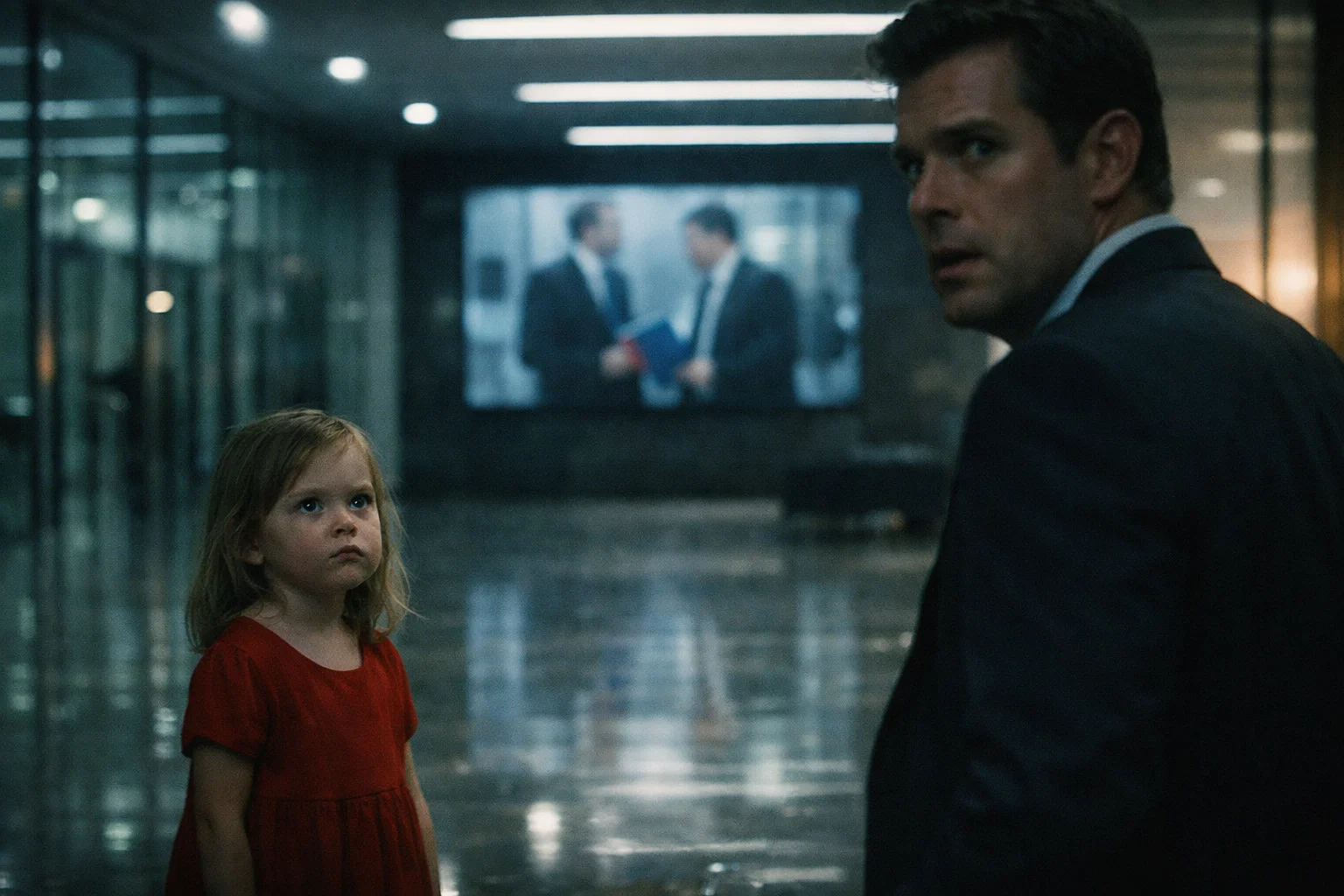
Scene 1: The Art of Being Invisible
The hallways of Richardson Global didn’t echo. That was by design.
Forty-two floors of marble and climate-controlled silence, rising above Chicago’s lakefront like a monument to people who had stopped needing to raise their voices. Every surface reflected light at the exact right angle. Every door closed with a sound that cost money to engineer.
Grace Harper had learned to work inside that silence without disturbing it.
She moved through the building the way water moves through stone—not forcing anything, just finding the path that wouldn’t get her noticed. Night shifts. Buffing floors. Emptying bins lined with documents worth more than her car. Three years at Richardson Global, and not one executive had ever used her name.
That was the job. That was the point.
She had three jobs total. This was the one with health insurance. She didn’t complain about it.
Her daughter Emma was five. She had Grace’s stubbornness and her late father’s laugh—big and unguarded and entirely inappropriate for corporate lobbies. Emma understood two things about her mother’s work: it happened at night, and it was important enough that Grace came home with her feet aching and her voice quieter than usual.
There was one rule Emma had heard so many times it had become part of her heartbeat.
“Always tell the truth, sweetheart. No matter what.”
Emma had asked once why that rule mattered so much.
Grace had looked at her for a long moment before answering.
“Because the truth is the one thing nobody can take from you. Even when everything else goes wrong.”
Scene 2: The Girl in the Red Dress
The babysitter called at 4:47 p.m.
Her voice was thin through the phone, apologetic and miserable. Stomach flu. Couldn’t move. So sorry.
Grace stood in her kitchen with her uniform half-ironed, doing the math she’d done a hundred times before. Missing the shift meant a write-up. Two write-ups meant probation. Probation meant losing the insurance. Losing the insurance meant the inhaler Emma needed cost two hundred dollars out of pocket.
She couldn’t miss the shift.
She looked at Emma, already dressed in her red dress—the one with the small white buttons and the slightly crooked hem Grace had sewn herself at midnight. Emma looked back at her with the calm, serious expression she wore when she understood something was wrong and was deciding not to make it worse.
“Can I come?” Emma asked.
Grace closed her eyes for exactly three seconds.
“You have to be completely invisible,” she said.
“I know.”
“Not mostly invisible. Completely.”
Emma stood up straighter. “I know, Mommy.”
They took two buses. Emma held Grace’s hand the whole way and asked no questions.
On the 15th floor, Grace found a stretch of hallway that saw almost no foot traffic after six—a carpeted alcove beside the elevator bank, near a wide decorative column. She settled Emma there with the small canvas bag that held her coloring book, two juice boxes, and the granola bars Emma called “the serious ones” because they had no chocolate.
Grace crouched in front of her.
“You stay exactly here. You don’t wander. You don’t talk to anyone.” She searched Emma’s face. “If someone asks why you’re here, you say you’re waiting for your mom.”
“I won’t wander.”
“Promise me.”
Emma smoothed the red fabric over her knees, her legs dangling several inches from the floor.
“I promise, Mommy.”
Grace kissed her forehead and walked away without looking back, because looking back would have broken something in her chest that she couldn’t afford to break on a work night.
Emma opened her coloring book to page seven—a princess in a tower—and began to color the sky purple. Her feet swung. The elevator hummed. The hallway stretched out around her, empty and polished and enormous.
She watched.
Scene 3: Two Men Who Moved Like Secrets
Thirty-four minutes later, Emma heard footsteps.
Not the soft, unhurried steps of people who belonged here—the purposeful click of someone who owned the carpet. These were different. Faster than they should have been. Quiet in the wrong way, like the footsteps were trying to take up less space than feet normally do.
Two men came around the far corner. Emma looked up from her coloring book.
The tall one was sweating despite the cold air. He pressed a white handkerchief to his forehead every few seconds, like the building itself was disagreeing with him. His eyes kept moving to the elevator numbers above the doors.
The shorter one held a blue folder with a thick red stripe down the side. He walked like someone who had talked himself into believing he was smarter than everyone around him—chin slightly forward, shoulders relaxed, mouth set in something that wasn’t quite a smile but wanted to be.
They stopped directly in front of Emma’s alcove. Not because they saw her. Because they didn’t.
She sat perfectly still. She had promised.
The tall man’s voice came through clenched teeth, barely above a whisper.
“Hurry up. Richardson will be back from lunch any minute.”
The shorter man didn’t look at him.
“I know. I know.” He said it twice, like the first time was for the other man and the second time was for himself.
“We have maybe six minutes.”
“I said I know, Trevor.”
Emma’s feet stopped swinging.
She wasn’t sure why. Her body decided before her brain did—something about the way the shorter man said Trevor, fast and annoyed, like a name being used as a warning. Something about the handkerchief and the red-striped folder and the fact that neither of them had looked left or right when they walked in.
She pressed herself slightly further back against the column.
She watched.
Scene 4: The Switch
The shorter man set the blue folder flat against the wall and opened it.
Inside were pages—white, crisp, the kind of paper that made a clean sound when you handled it. He lifted them out carefully, both hands, the way you’d handle something that mattered. He folded them once, then tucked them into the inside breast pocket of his jacket with the practiced ease of someone who had rehearsed this moment.
Then he reached into a different pocket—his left side—and produced another set of pages. These ones were slightly off-white. Older-looking. Like they’d been copied from something, or kept somewhere warm for too long.
He slid the new pages into the folder. Aligned the edges. Closed it.
He exhaled—long, slow—like he’d been holding his breath since morning.
“Done.”
The tall man wiped his forehead again.
“You’re sure they match?”
“Close enough.” The shorter man’s voice was almost amused now. Comfortable in a way that made Emma’s stomach feel wrong. “He’ll never look twice. These people sign whatever’s in the folder. That’s what assistants are for.”
“What about Reyes? She’s detail-oriented.”
“Reyes is on maternity leave until March.” The shorter man tucked the folder under his arm. “We have a twelve-week window. This is week three.”
The tall man made a sound that wasn’t quite agreement and wasn’t quite protest.
“Let’s go.”
They disappeared around the corner. Their footsteps faded fast, like they were already putting distance between themselves and what they’d done.
The hallway went quiet again.
Emma sat with her coloring book open to page seven, the purple sky still half-finished, the crayon loose in her hand. She stared at the empty space where the two men had been.
She replayed it. The white papers going in the jacket. The different papers going in the folder. The name Trevor. The red stripe.
Her mother’s rule pressed against the inside of her ribs.
Always tell the truth, sweetheart. No matter what.
She put down the purple crayon and picked up the gray one. Then she put that one down too.
She waited.
Scene 5: The Elevator Chime
The elevator made a sound like a single piano key—refined and brief, the kind of sound that costs more to install than Grace made in a month.
William Richardson stepped out with his phone in one hand and his jacket draped over the other arm, already reading something on the screen that apparently required his full attention and most of his expression. He was taller than he looked in the photos Emma had seen framed on the hallway walls—photos of him at charity galas and groundbreaking ceremonies, always with that controlled half-smile that said I am pleased by exactly the appropriate amount.
In real life he looked older. And tired. The kind of tired that sleep doesn’t fix.
He walked quickly, already oriented toward his office, eyes on his phone.
Then he heard it—a small sound, barely a sound at all. A swallowed something. The edge of a breath held too long.
He stopped.
His eyes dropped from the phone screen.
He looked left. He looked right. He almost kept walking.
Then he looked down.
Emma sat in the alcove with her coloring book closed on her lap, her hands folded on top of it, her feet very still. She was looking up at him with wide eyes that had decided, sometime in the last five minutes, not to cry.
William Richardson—CEO, chairman of the board, Forbes cover in 2019—blinked.
He lowered himself slowly, one knee almost to the floor, so that he wasn’t standing over her. His phone disappeared into his pocket.
“Hey,” he said. His voice was different from the one in speeches. Quieter. Less rehearsed. “Are you okay?”
Emma’s throat tightened.
She thought about her mother. She thought about the write-up. She thought about the insurance.
She thought about the white pages folded into a jacket.
She thought about her mother’s rule.
Scene 6: Five-Year-Old Courage
Emma curled her fingers into fists in her lap.
“I saw them change the folder,” she said.
Her voice came out smaller than she’d intended—a sound designed for bedrooms and kitchen tables, not forty-two-story buildings.
William didn’t move. Only his eyes changed—something in them sharpened, the way a camera lens adjusts without the camera moving.
“What did you say?”
Emma looked at his face. She searched it the way children search adult faces, looking for the thing behind the expression, trying to figure out whether the truth was safe here.
She decided.
“The one with the red stripe.” She pressed her hands flat against her knees. “Two men stopped right there.” She pointed to the space in front of the column. “One was tall and he kept wiping his face. One was shorter and he had the folder.”
William stayed exactly where he was. Still crouched. Still listening.
The words came out in a rush after that, like a door opened and everything behind it spilled through at once.
“The shorter one took out the white papers and put them in his jacket. And then he put different papers in—gray ones, not as nice. And he closed the folder like that was the normal thing. And the tall one said to hurry because you were coming back. And the shorter one called the tall one Trevor.”
She ran out of breath.
She pulled in more air.
“I promised my mommy I’d be invisible,” she said. “But I heard it. I’m sorry.”
William Richardson was quiet for a moment. The kind of quiet that isn’t empty—the kind that’s working very hard.
“How long ago?” he asked. His voice was careful, like he was handling something fragile.
“I don’t know.” Emma looked at the hallway. “The elevator went up and down four times.”
He stood in one motion. Smooth. Decided.
Scene 7: The Office Door
He touched the small earpiece Emma hadn’t noticed until now.
“Security.” One word. No preamble. “My office. Now.”
A pause.
“And find Grace Harper from the night cleaning crew. Wherever she is in this building. Bring her to me immediately.”
He looked down at Emma.
“Can you walk with me?”
Emma picked up her canvas bag and stood.
“Okay,” she said.
The hallway felt different at his pace—purposeful and accelerating. People moved out of the way without being asked. An assistant by the glass doors looked up and then down again without a word.
They went into a corner office large enough to have its own weather. Emma had never been in a room with this much glass. Chicago spread out below them in every direction, enormous and glittering, and Emma moved to the window for exactly one second before remembering she was supposed to be invisible.
She stepped back.
The security chief—a wide-shouldered man named Kellner who moved like someone trained to fill doorways—appeared within ninety seconds. Two officers with him.
“Pull every camera in the East Hallway,” Richardson said. “Fifteenth floor. I want footage from the last forty minutes.”
“Sir—”
“Now, Kellner.”
Kellner left. Richardson stood at his desk without sitting. He was very still, the way large things go still right before something breaks.
Grace arrived four minutes later.
She came through the door already apologizing—voice cracking, hands together, eyes moving from Richardson to Emma and back like she couldn’t process seeing both of them in the same room.
“Mr. Richardson, I’m so sorry, I know she’s not supposed to be here, my sitter was sick and I couldn’t miss the shift, please don’t fire her—” She caught herself. “Me. Please don’t fire me. Emma didn’t do anything wrong. She’s a good girl, she stayed where I put her, I—”
“Mrs. Harper.”
Grace stopped.
William’s hand raised once—flat, brief, a signal rather than a command.
“Your daughter isn’t in trouble.”
Grace blinked.
Her mouth stayed open for a moment, still loaded with apology.
“Your daughter,” William said again, more slowly, “is the reason I came back from lunch when I did.”
He looked at Emma, who was standing with her canvas bag over one shoulder, watching the exchange with the focused attention of someone cataloging details.
“I believe she just stopped something very serious.”
Scene 8: The Camera Doesn’t Lie
The wall screen lit up.
Kellner had pulled four angles—two from opposite ends of the hallway, one from directly above the elevator bank, one wide shot from the corner where the two men had appeared.
Every angle caught it. Clean. Unambiguous.
The blue folder with the red stripe. Two men in suits. The quick exchange—white pages out, gray pages in. The folder closed. The exhale.
The room was silent in a way that felt pressed down.
Grace stood with her hand over her mouth, watching the screen. Emma sat in the large chair Richardson had pointed her to, her feet dangling the same way they’d dangled in the hallway alcove, watching everyone else watch the screen.
Richardson’s jaw was set.
“Banks and Pierce.” He said the names like he’d carried them in his mouth for a while and had finally found somewhere to put them. “Trevor Banks. Daniel Pierce.”
No one said anything.
“Banks is VP of Acquisitions,” Richardson said, still facing the screen. “Pierce is outside counsel on the Harmon deal.” He let a moment pass. “The Harmon deal closes in eighteen days.”
Kellner spoke carefully.
“Sir, what was in the original folder?”
“The actual terms.” Richardson turned from the screen. “The terms we negotiated for fourteen months.” His voice stayed level, but level the way a road goes level right before a cliff. “What’s in that folder now, I can guarantee you, is not those terms.”
He looked at Kellner.
“Call the police.” A pause. “And have Banks and Pierce detained before they leave the building.”
Kellner moved immediately.
Richardson looked at the chair where Emma sat, feet swinging again now that the tension had shifted into something being handled.
He walked to her. Crouched down.
Emma looked at him.
“Did I do the right thing?” she asked.
He didn’t answer right away. He looked at her face—the question in it, the uncertainty still lingering behind the steadiness.
“Yes,” he said. “You did exactly the right thing.”
Emma nodded slowly.
“My mommy says the truth matters.”
Something moved across William Richardson’s face—quick and unguarded, there and then gone.
“Your mommy,” he said quietly, “is right.”
Scene 9: What the Truth Costs and What It Earns
Trevor Banks and Daniel Pierce were detained in the lobby at 6:18 p.m.
Banks cried. Pierce asked for a lawyer and then kept asking even after the answer was yes, you can have one. The replacement documents were recovered from Banks’s jacket. The original pages were photographed, verified, and secured by Richardson’s legal team within the hour. The Harmon deal was paused. Fraud counsel was retained before the building had finished emptying for the night.
The Chicago Tribune would cover it four days later, under the headline: “Richardson Global VP Arrested in Contract Fraud—Scheme Uncovered by Whistleblower.”
The whistleblower was not named.
The whistleblower was five years old and had spent the evening finishing page seven of her coloring book in a large leather chair while adults moved urgently around her.
That night, after Grace had given her statement to Richardson’s security team and signed two documents she read three times before touching, Richardson walked them to the lobby himself. A car was already waiting—he’d arranged it without mentioning it.
Grace thanked him in the elevator. She thanked him the way people thank someone when they’ve run out of the right words and are just moving sound through the air because silence feels worse.
William said: “Don’t thank me.”
She looked at him.
“Come see me tomorrow,” he said. “Alone. We need to talk.”
The elevator opened. The lobby stretched out ahead of them, high-ceilinged and quiet.
Emma took her mother’s hand.
The next morning, Grace sat across from William Richardson at a conference table for the first time in three years of employment. She’d put on the blazer she wore to parent-teacher conferences.
Richardson had a single sheet of paper in front of him. He slid it across the table.
She looked at it. Then she looked at him. Then she looked at it again.
“This is—” Her voice stopped.
“Your new position,” he said. “Facilities Management Coordinator. Effective immediately.”
“I don’t—I’m not qualified—”
“You’re organized, you’re reliable, and you know this building better than anyone who currently has the title.” He tapped the paper once. “Nine to five. Monday through Friday. Benefits carry over.”
Grace was quiet.
“Your current salary,” he said, “will be tripled.”
The sound Grace made was something between a sob and a sharp exhale, the kind of sound a person makes when they’ve been holding something heavy for years and someone just lifted it without warning.
She pressed her fingers to her mouth.
Richardson leaned forward slightly.
“Mrs. Harper. There’s one more thing.”
He turned the paper over. Another document, already signed by him. A scholarship agreement with Richardson Global’s foundation letterhead.
“Emma will receive full funding—tuition, housing, books—from kindergarten through university. The scholarship is hers regardless of what school she chooses and regardless of any future changes to your employment.”
Grace looked up.
Her eyes were bright. She couldn’t find words anywhere.
William watched her quietly.
“You raised a child who didn’t hesitate,” he said. “When she saw something wrong, she found the person who could fix it and she told them the truth. She was five years old, she was alone, and she didn’t hesitate.”
He let that sit for a moment.
“That doesn’t happen by accident,” he said. “That’s you. That’s what you gave her.”
Grace pressed the back of her hand to her eyes.
She didn’t apologize for the tears. She’d earned the right to them.
Scene 10: May Sky, Swings, and What Changed
Six months later, Chicago remembered how to be warm.
Richardson Global felt different now—not because the floors gleamed differently, but because something in the atmosphere had shifted. People held elevator doors longer. Meetings started on time and ended when they were supposed to. Three executives who had “always planned to move on” moved on. The Harmon deal was renegotiated on the original terms and closed two weeks ahead of schedule.
Banks and Pierce pled guilty in March.
On a Saturday in early May, William Richardson hosted the company’s first outdoor employee picnic—no tie, sleeves rolled up, a plate of food in one hand, attempting without complete success to look like a man who knew how to attend a casual event.
He spotted Emma on the swings before he reached the lawn.
She was laughing. It was the unguarded, rhythmic laugh of a child who has temporarily forgotten gravity, legs pumping, red sneakers pointed at the sky. She saw him cross the grass and waved with her whole arm.
“Mr. William! Look! I’m flying!”
He raised a hand back. He was smiling before he knew he was smiling.
She jumped down from the swing at the height of its arc, landed with both feet, stumbled once, and immediately looked up to confirm he’d seen it.
“Did you see?”
“I saw,” he said. “You stuck the landing.”
She stood in front of him with her hands clasped behind her back—a posture so unconsciously adult that it caught him off guard.
“You don’t look sad anymore,” she announced.
He paused. “Is that right.”
“You used to have a lonely face.” She said it without malice, the way children report facts. “Every photo in the hallway, you have it. I noticed.”
He was quiet for a moment.
Then he crouched down to her level—the way he had the first day, in the hallway, when she’d been sitting very still with her feet not quite reaching the floor.
“You know what I figured out?” he said.
She waited.
“I spent a long time building things.” He glanced back at the tower behind the park, forty-two floors catching the afternoon light. “And I forgot that building things is only useful if you pay attention to what’s actually in them.”
Emma considered this with the gravity of someone doing real arithmetic.
“Like the folder,” she said.
He looked at her.
She nodded, decisive. “You didn’t look at what was in the folder.”
He almost laughed. He let it out—quiet, genuine.
“Exactly like the folder.”
He reached into the inside pocket of his jacket and produced a small box—dark blue, hinged, the kind a jeweler uses. He held it out.
Emma looked at the box. Then at him.
“What is it?”
“Open it.”
She took it carefully in both hands. The hinge clicked. Inside, on a small pillow of cream satin, sat a silver necklace—a thin chain with a tiny star pendant, five-pointed, simple. Not flashy. The kind of thing made to be worn every day and eventually forgotten, the way the most important things become part of you.
Emma touched it with one finger.
“So you remember,” William said, “that even a small voice can stop a very big mistake.”
She picked up the necklace and held it up. The star caught the May sunlight and threw a point of brightness across the back of her hand.
“My mommy will put it on me,” she said.
“I thought she might.”
Emma looked at him—serious, settled, the assessment of someone who has decided something permanent.
“You’re a good listener now,” she said. “For a grownup.”
He stayed crouched on the grass, jacket creasing, not caring.
“I had a good teacher,” he said.
Emma smiled. She turned and ran back toward the swings, necklace clutched tight in one hand, calling out for Grace to come see what she had.
William Richardson—who had built an empire inside walls designed to make people invisible—sat back on his heels in the warm May grass and watched her go.
He stayed there for a long time. Not because he had nowhere to be.
Because for the first time in longer than he could account for, exactly where he was felt like enough.
Trevor Banks was sentenced to four years. Daniel Pierce received three and lost his law license. The Harmon deal, signed under the original terms, became the most profitable acquisition in Richardson Global’s thirty-year history. Grace Harper was promoted to Director of Facilities Operations eighteen months later. Emma started first grade in September, wearing a red backpack and a tiny silver star.
She still colors the sky purple.
Original fictional stories. AI-assisted creative content.