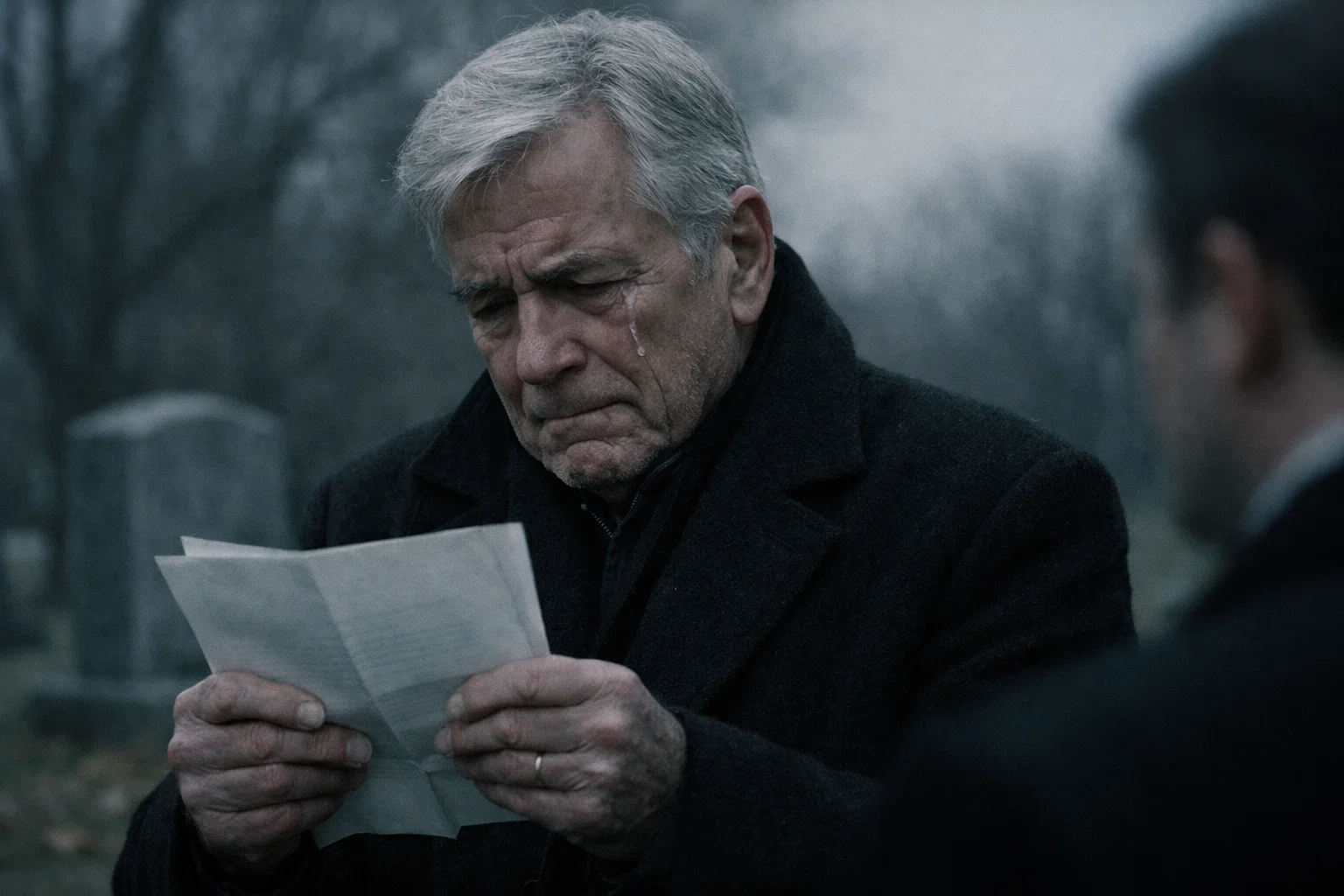
Daniel Harper had built half of Chicago’s skyline. Steel towers, luxury high-rises, contracts worth nine figures. He understood leverage. He understood power. He did not understand why, on a gray Wednesday afternoon, a little girl in a faded pink sweater was crying at his dead son’s grave.
For four years, every Sunday had been the same. Thomas drove him to Evergreen Memorial Park without being asked. Past the towers with Daniel’s name on them. Past the North Shore estates. Past everything that used to matter.
Daniel always walked the gravel path alone.
Today was a Wednesday. He had driven himself. He didn’t know why.
He spotted her from fifty feet away.
She was small — nine, maybe ten. Dark hair in a loose braid. One hand pressed flat against the granite like she was trying to hold it in place.
She wasn’t performing grief. She was deep inside it.
Daniel’s first instinct was possessive. This is mine.
“Why are you here?” he said. His boardroom voice. Hard at the edges.
She spun around. A white hospital bracelet slipped from her fingers. She snatched it off the grass before he could read it.
“I’m sorry,” she whispered.
“Where are your parents?”
The word landed wrong. Her face cracked open — just for a second — then she turned and ran between the trees.
Daniel stood at the headstone alone.
Ethan Harper. 1989–2021. Doctor. Son. Friend.
Then he saw what she’d left behind.
A photograph, face-down in the grass. He picked it up.
Ethan in his white coat. Smiling wide. Holding a small girl in his arms.
The same girl.
Daniel called Paul Ramirez from the parking lot, engine running.
“Maria Alvarez. Worked in my house about three years ago. Left six months after Ethan died. I need everything on her — and her daughter.”
“How fast?”
“Yesterday.”
He drove home through streets lined with his own buildings and felt nothing but hollow.
The box of Ethan’s belongings had been sitting in the study closet since the hospital released it. Daniel had never opened it past the first layer.
Tonight he went deeper.
Another photograph. Ethan, Maria, and the little girl — five years old, wearing a toy stethoscope around her neck. On the back, in Ethan’s handwriting:
“My girls. June 2020.”
Daniel sat down on the floor. His legs just stopped working.
He found the journal underneath.
The first entry: “Met someone today at Hope Community Clinic. Maria Alvarez. Seven months pregnant. Undocumented. Terrified to be there.”
He read for three hours.
Page after page, a life he’d never seen. Ethan had treated Maria when she had no insurance and no legal status and no one else. He stayed late. He helped when the baby came. He paid rent when Maria fell behind. He read the little girl stories. Rocked her when she was sick.
Eventually, he arranged for Maria to work in Daniel’s own house — without telling his father who she really was.
The final entry was dated three days before the accident on I-90.
“Finalizing Isabella’s adoption papers. It’s time to make official what’s always been true. I’ll tell Dad on Friday.”
He never made it to Friday.
Daniel pressed both hands over his face and shook.
Not the controlled grief of four years of cemetery visits. Something older and uglier and long overdue.
He had spent four years building a monument to loss, and the entire time his son had left him a door — a daughter — and he hadn’t known to open it.
Paul called at eight the next morning.
“They were at a shelter on the South Side for about six weeks. Left two weeks ago. Moved fast — like they were scared of someone.”
“Scared of who?”
Silence on the line.
“Paul.”
“Of you, Mr. Harper. Word got around that you were asking questions.”
Daniel put the phone down. Stood at the window of the fifty-third floor, looking at the city he owned, and understood for the first time how he must look from the outside.
He drove himself to Hope Community Clinic. Parked on a cracked street he’d never walked before.
Inside smelled like antiseptic and old coffee. Plastic chairs. A hand-painted mural on the wall — faces of every color, painted by kids.
Ethan’s photo was framed near the front desk.
A woman in scrubs noticed Daniel staring.
“You knew him?” she asked.
“He was my son.”
She studied him. Then she said, “He treated my mother for free for two years. Never once made her feel like a charity case.” She paused. “He talked about you, you know.”
“What did he say?”
“That you were the hardest person to love and the most worth loving.” She turned back to her desk. “He said it like it was a fact, not a complaint.”
Daniel found Michael Grant — Ethan’s attorney — that afternoon.
The adoption papers were complete, notarized, waiting only to be filed. Ethan had created a $400,000 trust for Isabella. And in the guardianship section, in Ethan’s own handwriting:
“I name my father, Daniel Harper, as guardian. He loves deeply, even when he can’t show it. If something happens to me, I trust he will see what I see in Maria and Isabella.”
“He filed this three weeks before he died,” Grant said quietly.
Daniel couldn’t speak for a long time.
“He trusted me,” he finally said. “Even after everything.”
“Apparently so.”
Paul traced them to a small town outside Milwaukee. A cousin named Javier. A modest apartment building with chipped paint and children’s bikes in the courtyard.
Daniel drove there alone. No Thomas. No security.
Javier opened the door. Big guy, careful eyes.
“I’m not here to threaten anyone,” Daniel said before Javier could speak. “I’m here because my son loved your family.”
A long pause. Then the door opened wider.
Maria sat at the kitchen table. Tired. Watchful. Isabella stood beside her, one hand gripping the back of her mother’s chair. Still wearing the hospital bracelet.
Daniel set the journal on the table. The adoption papers. The trust documents.
Nobody spoke.
Then Isabella said, “What does that say?”
“It says your father loved you more than anything,” Daniel said. “And that he wanted me to take care of both of you.”
Maria pressed her hand to her mouth. She read slowly, lips moving. She stopped at the line about bedtime stories. She stopped at the line about Isabella calling Ethan Dad.
She looked up. “He wrote all of this?”
“Every word.”
“He never told you about us?”
“No.” Daniel held that honestly. “I think he was afraid I’d ruin it.”
Maria was quiet for a moment. “Would you have?”
Daniel didn’t flinch. “Probably. Back then — yes. Probably.”
Isabella was watching him with Ethan’s eyes. He hadn’t noticed that before. Same shape. Same stillness.
“I was wrong,” Daniel said, “about what matters. I spent forty years building things I could put my name on. My son spent his life building things that actually lasted.” He looked at Isabella. “You. Your mom. That clinic.”
He didn’t offer money first. He didn’t offer control.
“I’d like to know my granddaughter,” he said. “If you’ll let me.”
“Granddaughter?” Isabella said the word carefully, like she was weighing it.
“Your father chose you. Legally, formally, completely. That makes you family. If you want to be.”
She looked at her mother. Maria gave the smallest nod.
Isabella crossed the kitchen and wrapped both arms around Daniel’s waist.
He hadn’t been held by anyone in four years. He stood very still, then put one hand on her back.
“Hi,” she said into his coat.
“Hi,” he managed.
Two weeks later, they stood together at Evergreen Memorial Park. The maple tree, the small pond, the simple headstone.
Maria placed daisies below Ethan’s name. Isabella held Daniel’s hand.
“Hi, Dad,” Isabella whispered to the stone. “We’re okay. We found each other.”
Daniel crouched down.
“I’m sorry, son,” he said. “I finally understand what you were building.” He paused. “It’s the best thing you ever made.”
Isabella set the hospital bracelet at the base of the headstone — the one she’d dropped in the grass the first day. She’d been carrying it since the accident. She didn’t need to carry it alone anymore.
Three months later, the adoption was finalized in a Cook County courtroom.
Isabella Maria Harper.
She wore a yellow dress. Daniel wore the first tie Ethan had ever given him — a ridiculous blue plaid one he’d kept in a drawer for years and never put on because he thought it was ugly.
“Your dad gave me this,” he told her, straightening it.
She looked at it. “It’s really ugly.”
“I know.”
“I love it,” she said.
The judge signed. The clerk stamped. Maria grabbed Daniel’s arm and laughed and cried at the same time.
In the parking lot, Isabella ran ahead to the car, arms out, spinning once in the autumn sun.
Daniel watched her.
He had lost his son on a Tuesday in October four years ago on Interstate 90 — a man who was driving home from a free clinic, a man who was three days away from introducing him to his family, a man who, even in death, had trusted him with the most important thing he’d ever built.
He understood now what Ethan had meant.
I am building something real, Dad.
He had been. The whole time. And it was still standing.
Original fictional stories. AI-assisted creative content.