The emergency room was chaos. Saturday night. Every bed full. Nurses running between patients. Doctors shouting orders.
Trauma bay one: car accident victim. Critical.
Trauma bay two: heart attack. Coding.
Waiting room: forty people. Some bleeding. Some crying. All waiting.
Then the doors burst open.
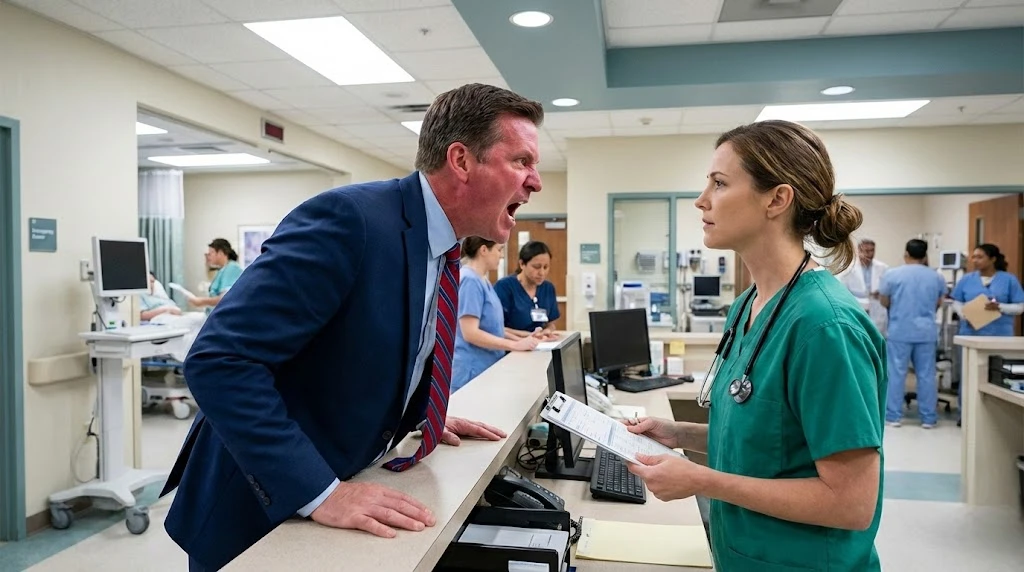
Congressman David Palmer strode in. Fifty-two. Tailored suit. American flag pin on his lapel. His son trailing behind him.
The boy was seventeen. Sniffling. Red nose. Walking just fine.
Palmer marched straight to the nurses’ station. Slammed his hand on the counter.
“I need a doctor. Now.”
The triage nurse looked up. Exhausted. “Sir, please sign in and—”
“Do you know who I am?”
“Sir, everyone needs to—”
“I’m Congressman David Palmer. My son needs immediate care.”
The nurse glanced at the boy. “What are his symptoms?”
“He has a fever. Cough. He’s very sick.”
She checked the waiting list. “We’re experiencing high volume tonight. Wait time is approximately two hours for non-critical—”
“Two hours?” Palmer’s voice rose. “That’s unacceptable!”
“Sir, we have to prioritize based on severity—”
“My son IS severe! He could have pneumonia!”
The nurse stayed calm. “Has he had difficulty breathing? Chest pain? Confusion?”
“He has a fever!”
“What temperature?”
Palmer hesitated. “I don’t know exactly. But he feels warm.”
“Sir, I understand your concern, but we have patients with life-threatening conditions—”
“I don’t care about other patients! I care about MY son!”
The waiting room went quiet. Everyone watching.
Dr. Sarah Chen appeared from the trauma bay. Scrubs covered in blood. Mask hanging around her neck. She’d been working for sixteen hours straight.
“Is there a problem?”
Palmer turned on her. “Yes, there’s a problem! My son has been waiting for twenty minutes and nobody’s helping him!”
Dr. Chen looked at the boy. Then at the triage notes. “Your son has cold symptoms. We’ll see him as soon as possible, but right now we have—”
“I know who you are,” Palmer interrupted. “Dr. Chen. I’ve seen your name on the hospital board reports.”
“Then you know we run an efficient department—”
“I know you’re wasting taxpayer money!” His face was red now. “I sit on the appropriations committee! I decide your funding!”
Dr. Chen’s jaw tightened. “Sir, threatening me won’t change medical triage protocols.”
“I’m not threatening. I’m informing.” He stepped closer. “You will see my son right now, or I will make sure this hospital loses every federal grant you have.”
“Mr. Palmer—”
“It’s Congressman Palmer!”
“Congressman Palmer, I have a nineteen-year-old girl in there who was hit by a drunk driver. Her spleen is ruptured. I have a sixty-year-old man who’s having his third heart attack. And I have a seven-year-old boy who fell off a roof.” Her voice stayed level. “Your son has a runny nose.”
Palmer’s eyes went wide. “How dare you minimize his condition!”
“I’m not minimizing. I’m prioritizing. That’s my job.”
“Your job is to serve the public! I AM the public!”
“No, Congressman. You’re one person. And right now, there are people dying.”
Palmer grabbed a pen from the counter. Threw it. Hard.
It hit Dr. Chen’s shoulder.
The room gasped.
She looked at the pen on the floor. Then at him. Her expression didn’t change.
“You just assaulted a healthcare worker.”
“That was an accident—”
“There are forty witnesses and three security cameras.”
Palmer’s aide appeared, phone in hand. “Sir, maybe we should—”
“Shut up!” Palmer turned back to Dr. Chen. “I want my son seen immediately, or I will personally ensure you never work in this state again!”
Dr. Chen pulled off her gloves. Slowly. Deliberately.
“What are you doing?” Palmer demanded.
She reached up. Unpinned her ID badge. Placed it on the counter.
“I quit.”
Silence crashed over the ER.
“You what?”
“I quit. Effective immediately.” She looked around at the other doctors and nurses. “I’m sorry to leave you all short-staffed. But I will not be threatened. And I will not be assaulted.”
Palmer laughed. Nervous. “You can’t quit. You’re in the middle of a shift!”
“Watch me.” She turned to the head nurse. “Call Dr. Martinez to cover my patients. Tell him I’ll brief him before I go.”
“Sarah, wait—” the nurse started.
“I’m done, Michelle.” Dr. Chen’s voice cracked slightly. “I’ve given this place twelve years. I’ve worked through COVID. Through budget cuts. Through staff shortages. But I will not stand here and be abused by someone who thinks a campaign contribution makes him more important than a dying child.”
She looked at Palmer. “You want your son treated? Fine. Treat him yourself.”
She walked toward the staff room.
Palmer’s face turned purple. “You can’t do this! I’ll have your medical license!”
Dr. Chen stopped. Turned back.
“Go ahead. Try. But before you do, you should know something.” She pulled out her phone. Opened the camera app. “I’ve been recording since you threw that pen.”
Palmer went white.
“I have you on video assaulting me. Threatening federal funding. Using your political position to demand special treatment.” She smiled. Cold. “How do you think that’ll play with your constituents?”
“Delete that.”
“No.”
“I said delete it!”
“Or what? You’ll throw another pen?”
Palmer lunged forward.
Security grabbed him. Two guards. Professional. Firm.
“Sir, you need to leave.”
“Get your hands off me! Do you know who I am?!”
“Yes, sir. And you’re being escorted out.”
They walked him toward the exit. His son following, embarrassed, face buried in his phone.
Palmer fought every step. “This isn’t over! I’ll sue this hospital! I’ll destroy all of you!”
The doors closed behind him.
The ER exhaled collectively.
Dr. Chen stood there. Shaking. The adrenaline finally hitting.
Michelle, the head nurse, approached. “You really quitting?”
“Yeah. I am.”
“Where will you go?”
“I don’t know. But anywhere is better than this.”
A patient in the waiting room started clapping.
Then another.
Then the entire waiting room erupted in applause.
Dr. Chen’s eyes filled with tears.
She didn’t go to the staff room. She went straight to trauma bay one. Finished stabilizing the car accident victim. Then went to bay two. Helped with the heart attack patient.
She worked for three more hours.
Then she left.
By morning, the video was viral.
Dr. Chen had posted it on her personal social media. With a simple caption: “12 years of service. This is why healthcare workers are leaving.”
Ten million views in six hours.
Twenty million by noon.
The comments were ruthless.
“Fire that congressman.”
“Disgusting behavior.”
“She’s a hero.”
“Imagine throwing things at a doctor covered in someone else’s blood.”
News outlets picked it up. Local first. Then national.
CNN. MSNBC. Fox News. Everyone.
Palmer’s office released a statement. “The Congressman was understandably concerned about his son’s health and regrets any misunderstanding.”
The internet destroyed him.
“Misunderstanding? We saw the video.”
“He threw a pen at her!”
“His son had a COLD.”
Palmer tried to do damage control. Press conference. Scripted apology.
“I was stressed. I acted inappropriately. I apologize to Dr. Chen and the hospital staff.”
Too late.
His opponent in the upcoming election used the video in campaign ads.
“David Palmer thinks he’s above everyone else. Even when people are dying.”
Palmer lost by eighteen points.
Biggest defeat in state history.
Dr. Chen got job offers from thirty hospitals. She chose one three states away. Better pay. Better hours. Supportive administration.
The hospital where it happened implemented new security protocols. Zero tolerance for patient or visitor abuse.
They named the policy after her.
Six months later, Palmer’s son was interviewed by a local paper.
“I was embarrassed,” he admitted. “I had a cold. I knew it wasn’t serious. But my dad doesn’t listen. He never does.”
He was asked if he’d seen Dr. Chen’s video.
“Yeah. I watch it sometimes. To remind myself not to be like my father.”
Palmer tried to rebuild his image. Volunteered at food banks. Posted about supporting healthcare workers.
The comments were always the same.
“Remember when you threw a pen at a doctor?”
“Remember when you threatened to defund a hospital?”
“Remember when you lost your election?”
He eventually deleted all his social media.
Dr. Chen never spoke about him publicly again.
She was too busy saving lives.
At her new hospital, she started a program. Free mental health support for healthcare workers. Burnout prevention. Mandatory breaks.
It became a model for hospitals nationwide.
On the one-year anniversary of the incident, a reporter asked her: “Do you regret quitting that night?”
She thought for a moment. “I regret that I had to. But I don’t regret standing up for myself.”
“What would you say to other healthcare workers facing abuse?”
“Document everything. Report everything. And know your worth.” She paused. “You don’t owe anyone your dignity. Not even if they’re dying. And definitely not if their son has a runny nose.”
The interview got five million views.
Palmer saw it. In his apartment. Alone. Career over. Reputation destroyed.
He picked up his phone. Started to type a message. An apology. A justification. Something.
Then he deleted it.
What was the point?
The internet never forgets.
And Dr. Sarah Chen made sure of that.
Original fictional stories. AI-assisted creative content.