Three days earlier, I was just another stray in Blackwood. No name. No home. Just a ribs-showing mutt scrounging behind the Silver Slipper Diner.
Then the boy disappeared.
Leo Martinez. Eight years old. The Mayor’s grandson. His face was on every lamppost, every storefront window.
I watched the search parties form in the town square. Watched Sheriff Miller organize volunteers with his clipboard and his confident voice. Watched parents hold their children closer.
Nobody looked at me. Why would they? I was invisible. Useful only for kicking when someone had a bad day.
But I noticed things invisible dogs notice.
Like how Miller’s boots smelled wrong the day Leo vanished. Like expensive cologne near the old lighthouse—the one the town council wanted demolished. Like Miller’s hands shaking when he poured his morning coffee, even though he told everyone to “stay calm and trust the process.”
Now, day three. The search was dying. Hope was dying.
Sheriff Miller’s boot sent my water bowl skidding across the gravel. The last drops soaked into the dirt.
“Get moving, you useless stray,” Miller sneered. “We don’t need a mangy mutt tripping up the search party.”
The volunteers looked away. Nobody wanted trouble with Miller.
But my nose told me something Miller didn’t want anyone to know. Past the coffee on his breath and the sweat of fear, I caught it—the scent trail leading to the old lighthouse. A child’s terror. Fresh mortar dust. And Miller’s cologne, all over it.
I limped toward the cliff path as the afternoon sun struggled through grey clouds.
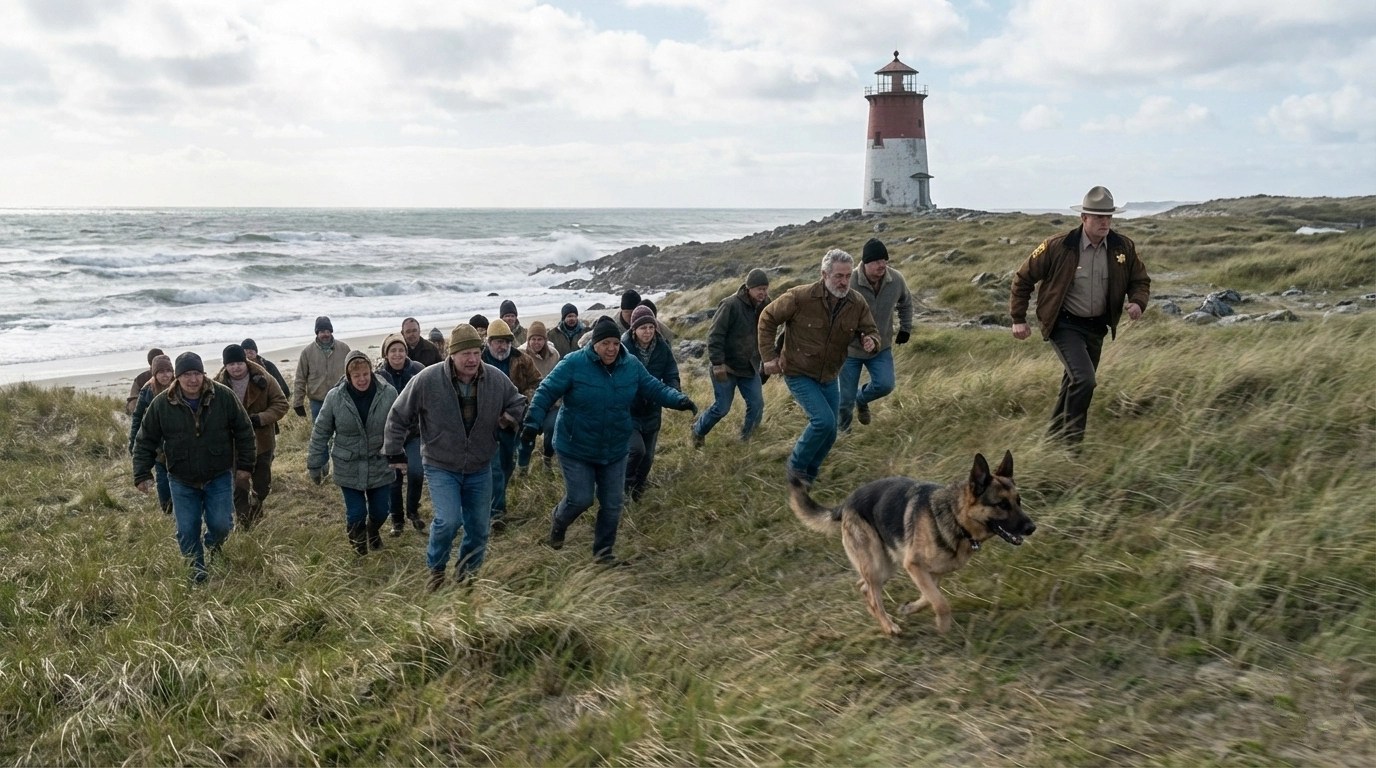
The crowd was gathering near the lighthouse parking area. Fifty people, maybe more. Exhausted faces. Desperate hope turning to resignation.
I moved through them slowly, nose to the ground. The scent was stronger here. Leo had been on this path. Recently.
“We’re wasting time on a stray,” Miller’s voice cut through the murmurs. He gestured at me dismissively. “Get it out of here.”
I ignored him. Kept working the scent. Gravel. Dirt. Salt air. Then—there. Stronger. The boy’s fear, sharp and clear.
I froze mid-sniff.
“Wait.” A weathered man in his fifties stepped forward, his voice firm. “Look at him—he’s picked up something.”
Every eye turned to me.
My head snapped up. Ears forward. The lighthouse stood a hundred meters away, its paint peeling, its door boarded shut. But the scent led directly to it.
I bolted.
Behind me, the crowd erupted. Footsteps. Shouts. “He’s got the scent!” “Follow him!”
And one quiet voice, barely audible: “Oh shit.”
Miller. Frozen for just a heartbeat longer than everyone else before he started running.
I didn’t stop. My paws hit the rocky path hard, pain forgotten. The lighthouse door was ahead—boards nailed across it, “CONDEMNED” stamped in red letters.
I threw myself at the gap between the boards. Once. Twice. Wood splintered.
“Cooper, wait!”
The weathered man—Elias, I’d heard someone call him—reached the door first. He grabbed a board and pulled. The nails shrieked.
The crowd arrived. Hands grabbed boards. The door gave way.
“Everyone stay back,” Miller ordered, pushing through. “This is official police business. I’ll handle—”
“Shut up, Miller.” Catherine Martinez, the Mayor, her face hollow from three sleepless nights. “If that dog thinks my grandson is in there, we’re going in.”
The spiral staircase stretched upward into darkness. My paws scraped on rusted metal. Each step sent echoes bouncing off stone walls.
“Leo!” Catherine’s voice cracked. “Leo, baby, are you here?”
Nothing. Just my panting. The crowd’s footsteps below.
At the gallery level, I stopped. The scent was overwhelming here. I pawed at the wall. The mortar was fresh—days old, not decades.
“What’s he doing?” someone whispered.
I dug my claws into the fresh mortar. It crumbled easier than the old stuff. One block loosened. Then another.
“Jesus Christ,” Elias breathed. “Someone bricked up part of this wall. Recently.”
I dug harder. My paws bled. The crowd pressed in behind me, flashlights cutting through the gloom.
“Stop!” Miller’s voice, sharp with panic. “You’re going to bring the whole structure down. Everyone out. Now.”
“No.” Catherine’s voice was steel. “Keep going.”
The wall gave way. A child’s pale face appeared in the gap—streaked with tears, dust, terror.
“Grandma?”
“LEO!”
Catherine pulled him through the opening, clutching him so tight they both shook. The boy was filthy, dehydrated, but alive.
“He locked me in there,” Leo sobbed into her shoulder. “Sheriff Miller. He said he was showing me the boats. Then he pushed me inside and bricked up the wall. He said—he said nobody would ever find me.”
The silence that followed was absolute.
Miller’s hand moved toward his holster. “The kid’s confused. Traumatized. He doesn’t know what he’s—”
“Liar!” Leo’s voice echoed off stone. “You told me the developers would pay you when Grandma finally sold the lighthouse. You said a dead kid would make her sign anything.”
Elias stepped between Miller and the boy. “Don’t even think about it, Sheriff.”
Miller’s eyes darted—to the stairs, to the crowd blocking them, to the broken railing at the edge of the gallery. He was trapped.
“You’re all believing a hysterical child and a stray dog?” Miller’s laugh was brittle. “I’ve been leading this search for three days. I organized every volunteer shift. I—”
“You organized it to fail,” Catherine said quietly. Her eyes were red, but her voice was cold clarity. “You made sure nobody searched the lighthouse. You sent teams everywhere except here.”
“That’s insane—”
“Your cologne is all over that wall,” Elias said, kneeling beside the broken mortar. “Fresh cement. Your boot prints in the dust. You want to explain that?”
Miller backed toward the railing. His hand was definitely on his gun now.
“Everyone stay calm,” he said. “Nobody needs to—”
I growled. Low. Continuous. Positioned myself between Miller and Leo.
“Move, dog.” Miller’s voice cracked.
I didn’t move.
The gun came up. The shot rang out, deafening in the enclosed space. Fire tore across my shoulder. I charged anyway—sixty pounds of street-survival fury.
I hit his knees low. He stumbled backward.
The railing was already broken. Rusted through. It gave way like rotted wood.
Miller’s scream cut off sharp against the rocks below.
I collapsed on the stone floor, blood spreading dark across the dusty ground.
“Cooper!” Leo dropped beside me, his small hands pressing against the wound. “Please don’t die. Please.”
Elias stripped off his jacket, wrapping it around me. “Hang on, buddy. Hang on.”
The paramedics arrived. Young guy, older woman, professional efficiency.
“We’ve got a gunshot victim,” the older one said, looking at Miller’s gun on the floor. Then at me. “And a dog. Critical condition.”
“Focus on the kid,” she told her partner.
Elias stood. “You treat that dog first, or you don’t leave this lighthouse.”
Catherine’s hand rested on Leo’s head. “That dog saved my grandson’s life. He took a bullet for him. You treat him like the hero he is, or this town will remember you refused.”
The young medic knelt beside me. “Alright. Let’s get him stabilized.”
I woke three days later in a bright, clean room that smelled of antiseptic.
Elias was there. Clean-shaven. Reading a book he wasn’t actually reading.
“Hey, Cooper,” he said softly when my eyes opened. “You had us worried.”
I tried to lift my head. The IV tugged.
“Easy. The vet said your heart stopped twice on the table. But you’re stubborn. That’s probably why you lived on these streets as long as you did.”
He scratched behind my ears, finding that perfect spot.
“They found Miller’s phone. Text messages with developers from Portland. They were paying him twenty grand to condemn the lighthouse and force the sale. Catherine wouldn’t budge, so Miller decided a family tragedy would change her mind.”
Elias paused, his voice dropping. “The whole town knows now. You’re a hero, Cooper. Leo won’t stop asking about you.”
I licked his hand weakly.
“I need to tell you something,” Elias continued. “I lost my wife and daughter two years ago. Car accident. I’ve been driving since then, just… existing. Looking for a reason to care about anything.”
His eyes were wet. “Then I saw you. This beat-up old dog who had every reason to hate everyone in that town, but you went after that boy anyway. You reminded me that pain doesn’t excuse us from doing the right thing.”
He leaned down, forehead against mine. “I bought a house. The cottage on South Ridge. Three acres, big porch. It needs work, but… it could be home. For both of us. If you want.”
My tail thumped once against the bed.
A month later, Blackwood’s town square had transformed.
The “Missing” posters were gone. In their place stood a hand-carved wooden sign:
TO COOPER: THE WATCHMAN OF NORTHERN POINT. MAY NO STRAY EVER GO HUNGRY IN THIS TOWN AGAIN.
Beside it, a stone fountain—at dog height—filled with fresh water that never ran dry.
I sat by the fountain in my new leather collar. My limp remained, but the hunger was gone. The fear was gone.
“Cooper! Look what I found!”
Leo ran over with blue sea glass, dropping to his knees to hug me.
“Grandma says the lighthouse is a museum now. They’re putting your picture in the lobby. Right next to the big lens.”
I licked his ear. He giggled.
Elias approached with two ice cream cones. Handed one to Leo, held the other out for me.
“Don’t tell the vet,” he winked.
As I licked the sweet cream, I looked toward Northern Point. The lighthouse stood tall against grey sky—no longer a tomb, but a monument. A reminder that the discarded can save the world.
I watched Elias laugh as Leo explained the “science” of sea glass. Watched townspeople stop to pat my head instead of looking away.
I wasn’t a useless stray anymore.
I was Cooper. Friend. Survivor. Home.
The lighthouse beam flickered on as dusk approached, cutting through the gathering dark—a beacon for the lost, a promise to the found.
Miller was gone. The corruption exposed. Leo was safe. Justice served.
I rested my head on Elias’s boot. The wind was cold, but I wasn’t shivering.
The broken dog and the broken man had both found what they needed—someone worth protecting, and someone who believed they were worth saving.
I was home.
Original fictional stories. AI-assisted creative content.