The sound of a chair scraping backward across polished hardwood is not normally the kind of thing that stops a room cold.
But this one did.
Every conversation, every clink of crystal, every polished laugh — gone. Like a switch had been thrown.
I was posted by the ballroom doors, hand near my radio, sweat already forming at the back of my collar. Eleanor Vance had been building to this moment for ten minutes. The wine was just the excuse.
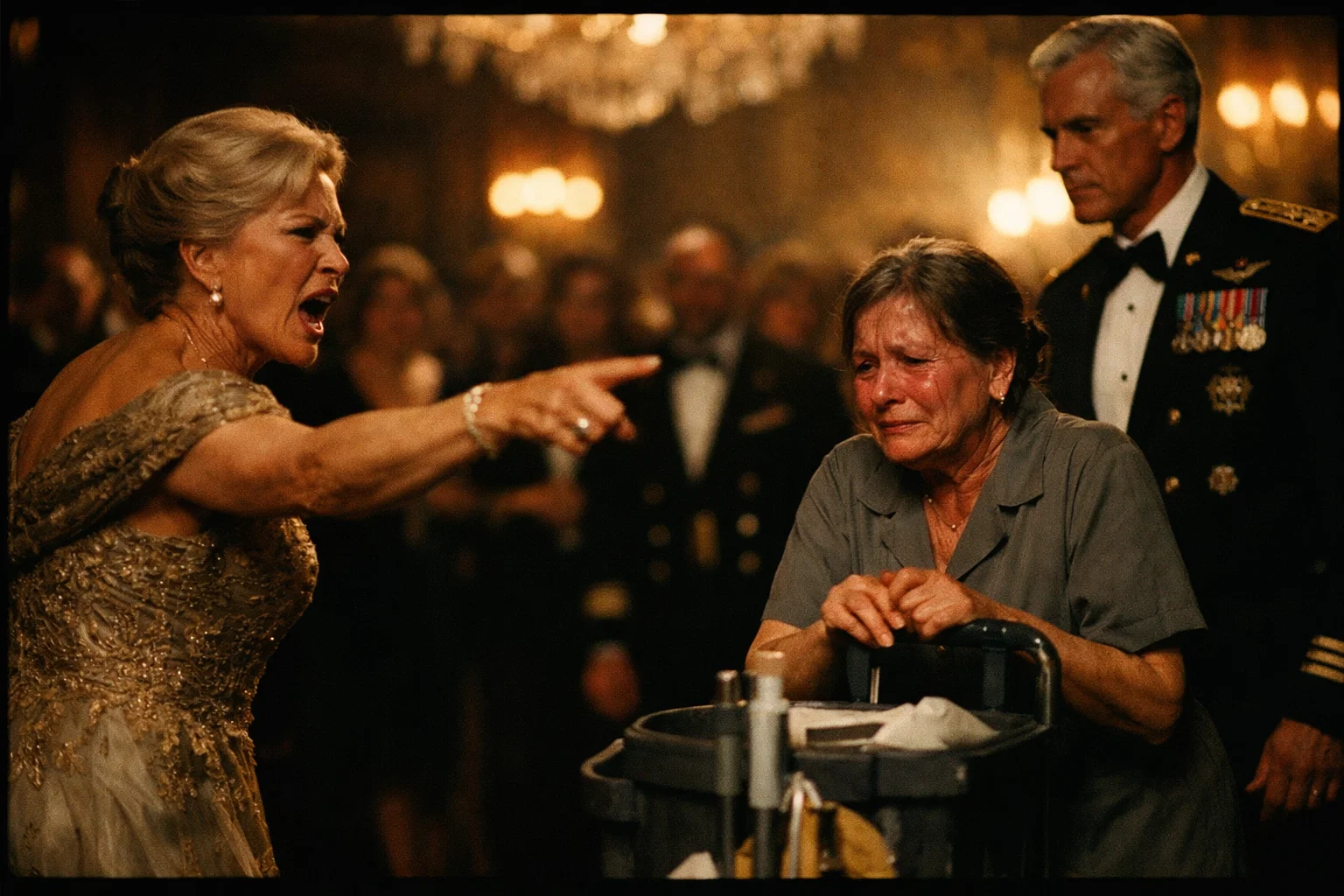
“I said get out.” Eleanor’s voice cut across the ballroom like a signal flare. “Do you understand English? Get. Out.”
Martha Hayes kept her head down. She gripped the handle of her cleaning cart with both hands, knuckles bone-white. “I’m leaving,” she whispered. “I’m sorry. Please don’t call security. I need this job.”
The room sat perfectly still. Two hundred officers, spouses, and VIPs in their finest. Nobody moved.
Nobody except the man at Table 4.
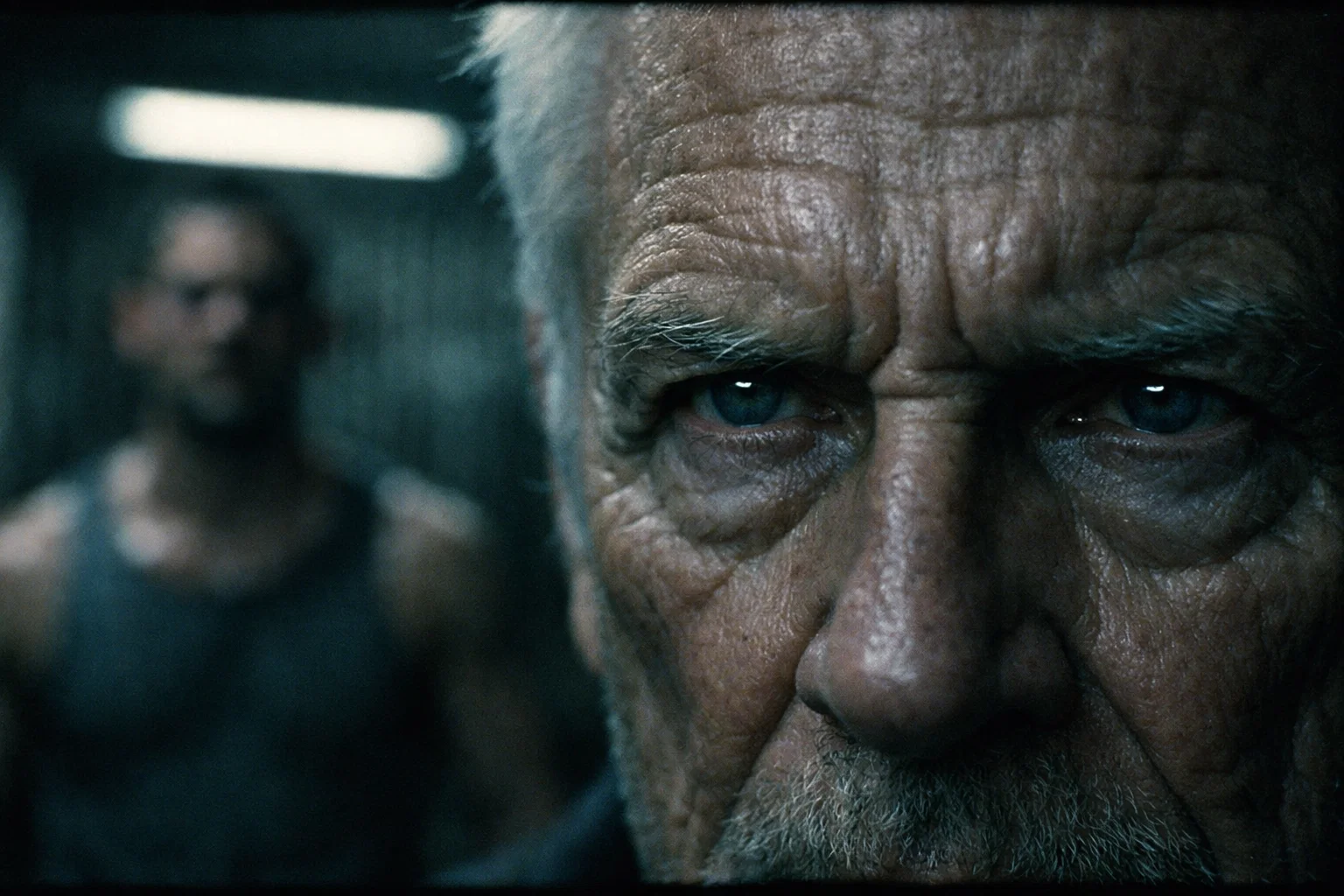
He didn’t stand fast. He didn’t make a scene. He just rose to his full height — enormous, gray-haired, built like a century of hard choices — and walked.
Behind him, five more men stood.
They didn’t speak. They didn’t have to. They moved in perfect synchronization across the empty floor, their dress uniforms heavy with ribbons and stars, parting the crowd the way a ship’s prow splits open the sea.
Eleanor turned. She blinked.
“Excuse me,” she said, her tone dripping with the kind of authority you inherit rather than earn. “We are handling a staff matter. Return to your seats.”
The lead man walked right past her.
Not around her. Past her. So close the buttons of his uniform nearly grazed her silk gown. He didn’t lower his eyes. He didn’t even acknowledge she existed.
He stopped in front of Martha.
“Ma’am,” he said.
His voice was low. But in that silence, it reached every corner of the room.
Martha flinched. “I’m leaving. I’m sorry. Please—”
“Look at me,” he said. “Please.”
Martha took a breath that seemed to cost her everything. Slowly, she raised her head.
The light caught her face. The deep lines around her eyes. The pale, exhausted skin. The trembling jaw of a woman who had spent twenty years waiting to be thrown away.
She looked at his chest first. At the medals. At the Combat Infantryman Badge with its two stars.
Then she looked at his face.
The broom dropped from her hands and cracked against the hardwood floor.
“John…?” she breathed.
One word. Barely a sound. Like a woman speaking across thirty years of silence.
The man — Command Sergeant Major John Miller, retired, one of the most decorated Green Berets of his generation — closed his eyes for one half-second.
When he opened them, there was a single tear tracking down the deep lines of his cheek.
“It’s me, Doc,” he said. “It’s me.”
And then this massive, scarred, decorated soldier dropped to his knees.
Not respectfully. Hard. His kneecaps hit the polished floor with a crack that echoed off the high ceiling. He stayed there, in the spilled wine and the broken glass, looking up at the woman in the grey janitor’s uniform.
Behind him, the five other veterans snapped to attention in perfect unison.
Boots together. Spines rigid. Right hands at their brows.
Saluting a janitor.
Eleanor Vance made a sound that was half gasp, half shriek. “What— what is the meaning of this? General! They are making a mockery—”
“Eleanor.” The two-star General, her husband, said it quietly. Just the one word. But something in his voice made her stop.
He was staring at Martha. His brow was creased. His mouth was slightly open. He was reaching back through years of buried files and sealed reports, and something was surfacing.
“Hayes,” he said. “Martha Hayes.”
A murmur moved through the older officers in the room. A name. A legend. A ghost.
John was still on his knees. He reached up and covered Martha’s trembling, chemical-burned hands with his own.
“We looked for you,” he said. “Thirty years, Doc. We spent thirty years trying to find you.”
Martha was shaking. Tears were falling freely now, tracking through the years of invisible armor she wore every day. “I didn’t want to be found,” she whispered. “I couldn’t… I couldn’t carry it anymore. Not after.”
“You are exactly who you always were,” John said fiercely. “You are our angel. You are the only reason any of us are standing in this room breathing air tonight.”
Eleanor tried one more time.
“I don’t care about your ‘war stories!'” she snapped. “This woman is a base employee. She is insubordinate. She damaged my gown and she—”
“Shut your mouth.”
John said it over his shoulder. Quiet. Final. Like closing a door.
Eleanor gasped.
Her husband said nothing.
John stood up. He smoothed the front of his uniform. He turned around to face the room — not just Eleanor, but every officer, every spouse, every VIP who was watching from behind their champagne glasses.
“Thirty-two years ago,” John began, his voice filling the room like a broadcast, “six men were dying in a valley that didn’t exist on any official map. We’d been ambushed. Our medic was dead in the first five minutes. We had three men bleeding out and no extraction coming.”
The room didn’t breathe.
“Command issued a No-Fly. They told us to hold our position and wait for weather. What that meant, in plain terms, was: die quietly and don’t embarrass anyone.”
He paused. Let that land.
“But someone was listening on the radio at the FOB. A civilian surgeon. A contractor. A woman who had left a high-paying practice in Boston because she believed a life was worth saving regardless of the zip code or the uniform.”
He pointed at Martha.
Martha stood still, tears running silently down her face, eyes fixed somewhere past the crowd.
“Your predecessors told her to stay put,” John said, looking directly at the two-star General. “They threatened to court-martial the pilot. She didn’t care. She found a Huey on the tarmac, put a pistol on the co-pilot’s seat, and told the kid flying it that she’d take the controls herself if he didn’t lift off. She flew straight into a valley full of anti-aircraft fire.”
Another murmur. This one carried weight.
“She jumped out of that chopper into a firefight,” John said. “She dragged my men through the mud while bullets were cutting the ground apart around her feet. She operated in the dirt, under mortar fire, with electrical tape and a flashlight clenched in her teeth. She kept every single one of us alive.”
He stopped.
The silence that followed was the loudest thing I had ever heard.
“An RPG hit the tail rotor on extraction,” John said, his voice dropping to a near-whisper. “The shrapnel tore through the fuselage.”
Every eye in the room went to Martha’s left leg. The limp that Eleanor Vance had mocked her for forty-five minutes ago.
“Her spine was damaged. Her leg was shattered.” John’s jaw tightened. “And because the mission was black, because the military couldn’t acknowledge she was ever there without admitting they’d abandoned us, they buried the whole incident. They handed her a stack of NDAs and a threat. Speak one word of this and we will destroy you. Lose your license. Spend your life in a federal cell.”
He looked at Eleanor.
“This woman saved the lives of six men and then was handed a career-ending threat for doing it. She spent two years in a hospital that couldn’t officially acknowledge she’d been hurt. And then she spent the next twenty years—right here. On this base. Scrubbing your floors. Cleaning your ballrooms. Because even after everything this institution did to her, she still needed to be near the sound of boots on concrete. Near the people she’d given everything for.”
He turned back to Martha. His voice broke.
“You look at her and you see a nobody. A servant.” John looked at Eleanor, his eyes empty of anger now — just cold, final clarity. “You are not fit to stand in her shadow.”
Eleanor Vance burst into tears.
Not the performative kind. The humiliated kind. She turned and pushed her way through the crowd toward the exit doors, heels catching on her gown, nobody reaching out to steady her.
Her husband, the General, stood frozen for a moment. He looked at John. He looked at Martha. Very slowly, he reached up and removed his cover. He held it over his heart.
He bowed his head.
Then he turned and walked out.
I knew, right then, his wife’s access to this base was over. Socially, she was dead. And by the look on his face, he knew it too.
The man with the eye patch — Elias, they called him, a retired Master Sergeant built like a vault — stepped forward. He reached into the inside breast pocket of his uniform and pulled out a folded sheet of paper.
“Sixty days ago,” Elias said, “the files from Operation Ivory Shadow were partially declassified. We found her employment record. Name. Address. Job title.” He paused. “Custodial Services, Fort Bragg. Grade: GS-2.”
A few people in the back of the room had to look away.
“We drove through the night,” Elias said simply.
John reached up to his chest. His thick, scarred hands moved to the very top of his medal rack. He unpinned a small silver star.
The room went absolutely still.
Everyone present understood what that meant. A Silver Star is not a participation ribbon. It is earned in blood, in the worst moments of a person’s life. You don’t just hand it to someone.
John took Martha’s hands. He turned them over, palms up. Her skin was rough, ravaged by years of industrial cleaners and cold water. He placed the medal in the center of her palm and closed her fingers around it.
“This was always yours, Doc,” John whispered. “I just held it for you until we found you.”
The sob that came out of Martha Hayes was the sound of thirty years of held breath finally released. She collapsed against John’s chest, her small, grey-uniformed frame disappearing into the solid mass of his dress blues.
He held her. He stood there and held her in front of every general, every decorated officer, every VIP on the base and he did not move and he did not apologize and he did not stop crying.
Nobody in that room made a sound.
The man with the eye patch — Elias — squared his shoulders.
“Room,” he said, in the kind of voice that carves itself into stone. “ATTEN-HUT.”
The response was immediate and total.
Every officer. Every Colonel. Every General. Every man and woman in uniform in that ballroom stood up in one single motion, chairs crashing back, boots slamming together, spines snapping rigid.
And they saluted.
Not the flag. Not a superior officer.
A woman in a grey janitor’s uniform. With a bad leg. And a Silver Star in her fist.
I was posted at the door when they started walking toward the exit. John’s arm around Martha’s shoulders, the five other veterans flanking them in a tight formation. When they reached me, Martha stopped.
She looked at me. She remembered me — the Corporal who always opened the door for her at 0400, who always gave her a nod even when she kept her head down.
She looked at my face. At the tears I’d given up trying to control.
She smiled.
Small. Fragile. But real. Like a light coming on in a house that had been dark for decades.
She gave me a slow, deliberate nod.
Then she turned back to John, took his arm, and walked out.
The doors closed.
Nobody went back to the party. The music didn’t start again. Two hundred of the most powerful people in the U.S. military quietly got their coats and filed out, talking in the kind of hushed voices people use at funerals and at the birth of something new.
By 0300 hours, the base was electrically silent. I pulled the graveyard shift at the main gate, still turning the night over in my head, when a friend from Records materialized out of the dark and slipped me a tablet.
“Operation Ivory Shadow,” he said. “1994. Black Level. You didn’t get this from me.”
He was gone before I could answer.
I read the file under the dim light of the guard shack. It read like the outline of a nightmare.
October 12, 1994. An Lao Valley.
John Miller, then a Staff Sergeant, was leading OD-Alpha deep in denied territory — tracking a nerve agent shipment that officially did not exist. They walked into a horseshoe ambush. Medic dead in the opening volley. Three men down and bleeding. No extraction available. Command: Hold position. Total loss authorized.
At the FOB twenty miles out, Dr. Martha Hayes was prepping for her fourth surgery of the day when the radio crackled alive with John Miller’s voice.
“Mamba Six, we are pinned. Three red-tags. We need Medevac NOW.”
The radio operator told her: No-Fly. The valley’s a furnace. Command says leave them.
Martha peeled off her surgical gloves.
She went to the flight line.
A lone Huey sat idling. The pilot — a kid called Spanky, barely fifty combat hours — stared at the distant flashes in the mountains.
Martha climbed into the co-pilot’s seat. “Get us in the air.”
“Doc, we’ll be court-martialed before we clear the tree line—”
“There are six men out there dying for a country that’s currently pretending they don’t exist.” She picked up a M1911 from a wounded soldier’s gear left in the cockpit. Didn’t point it. Just held it. “If you don’t fly this bird, I will. I don’t know how to land it. But I know I’m not sitting here.”
Spanky looked at her eyes. He engaged the rotors.
The flight in was chaos. Green tracers stitched the dark. The Huey shuddered as rounds punched through the fuselage. When they crested the ridge, the ravine below looked like the bottom of a furnace.
“I can’t land!” Spanky yelled. “Slope’s too steep! I’ll clip the rotors!”
“Then hover! I’m going down the skid!”
She hit the mud hard. Left shoulder, a root. She didn’t stop. She crawled through blood-soaked earth dragging a sixty-pound medical pack.
“Miller! Where are the reds?”
A hand grabbed her collar and hauled her behind a boulder. John Miller. Face scorched. Left arm hanging wrong.
“Doc? What the hell are you doing here? Get out — we’re done!”
“Shut up and stay low, Sergeant. Who’s worst?”
For the next two hours, Martha Hayes kept men alive in the dirt. She sealed a sucking chest wound on Elias with electrical tape. She performed an emergency tracheotomy on a private using a combat knife and a flashlight clenched in her teeth. When bullets chipped the rock above her head she leaned lower over her patient and kept stitching.
When Spanky finally returned with two more birds — commandeered by lying over the comms — Martha loaded the last man herself.
She was reaching for the door handle when the RPG hit.
The blast threw her out of the open bay.
John Miller, his arm shattered, lunged across the floor and caught her collar.
“I’ve got you, Doc! Hold on!”
They flew out of the valley as the sun came up. Martha’s blood tracing a line down through the dark below.
When she woke in the hospital, two men in dark suits were standing at the foot of her bed.
“Dr. Hayes,” one of them said. “If you speak a single word of this, you will be prosecuted for theft of military property and endangering national security. You will lose your license. You will spend the rest of your life in a federal cage.”
Martha looked at them. “But I saved them. They’re alive.”
“In this world, Doctor, lives are statistics. And your statistics don’t fit the narrative.”
They kept their word. Her medical license was buried under a fabricated psychiatric evaluation. Every major hospital in the country closed its doors. She drifted for years.
And then, eventually, she found herself back at Fort Bragg. She applied for the custodial position.
I understood why, finally.
She needed to be near the sound of boots on concrete. Near the smell of gun oil and jet exhaust. Near the world that had broken her, because it was also the only world where she had ever truly lived.
So she became the Ghost of Bragg. Invisible. Quietly emptying trash cans in the briefing rooms where men planned the kind of missions she once flew into without a second thought.
I was still reading at 0500 when black SUVs rolled through the main gate. D.C. plates. High-level security details. And out of the lead vehicle stepped a man with hair like winter frost and more stars on his shoulders than I had seen in one place in my entire career.
General Silas Halloway. Chairman of the Joint Chiefs.
He looked at me. A Corporal. Red-rimmed eyes. A tablet full of secrets.
“Son,” he said. His voice was the sound of an institution with something to answer for. “I hear a thirty-year-old debt was called in tonight. Where is Dr. Hayes?”
I snapped to the sharpest salute of my life. “Sir — she left with the men from Table 4. But if you want to find her, follow the sound of the truth.”
A grim smile touched the corner of his mouth. “We’re here to rewrite the history books, Corporal. And I think this base is going to need a new janitor. Because as of today, our Doctor is never picking up a mop again.”
What happened two hours later, someone livestreamed. It was shared ten thousand times in the first five minutes.
Every soldier on the base who wasn’t on essential duty was standing on the main parade field. Thousands of men and women in camouflage, in perfect silent rows under the North Carolina sun. The base band was quiet. The only sound was the wind through the flagpoles.
A black sedan pulled up to the edge of the grass.
Martha stepped out.
Not in grey. The base tailor had worked two hours to put her in a dark navy suit — professional, clean, timeless. Her hair was no longer in a strained bun. She still had the limp. She still leaned on John Miller’s arm.
But as she stepped onto the grass, she wasn’t the cleaning lady. She was a titan.
General Halloway met her at the halfway point. As they passed the spot where General Vance and Eleanor stood behind a security cordon — Eleanor pale and blotchy, the General’s eyes fixed at the ground — Martha didn’t even look at them.
They were small people.
At the podium, Halloway turned to the microphone.
“For thirty years,” his voice carried over thousands of soldiers, “this nation carried a debt it refused to acknowledge. We are here today to balance the books.”
He reached into a velvet box. Not a Silver Star.
The Distinguished Service Cross. Second highest military decoration for extraordinary heroism in combat.
“Dr. Martha Hayes. For gallantry that exceeds the limits of human endurance. For choosing the lives of others over her own safety, her own career, and her own future. You are the best of us.”
As he pinned the medal to her lapel, the silence broke.
It started low. A rumble. It grew into a sound I had never heard on a parade field — ten thousand voices. The Hooah of ten thousand soldiers. Not rehearsed. Not commanded. An explosion of respect that seemed to come from somewhere in the chest of every single person on that field.
Then the order came.
“PRESENT — ARMS!”
Ten thousand hands snapped to ten thousand brows. The Long Gray Line. Every defender of the nation. All of them saluting the woman who had been scrubbing their floors twenty-four hours ago.
Martha stood there, the cross gleaming on her chest, tears running free. She wasn’t looking at the generals. She was looking at the young privates in the front row. Boys who reminded her of the ones she had saved in the mud of An Lao.
She raised her hand. Not a military salute — she’d never been trained for that. She placed her hand over her heart and nodded.
That night, the grey utility cart was removed from the Officers’ Club.
It was placed in the Base Museum, in a glass case, next to the declassified files of Operation Ivory Shadow. A small plaque beneath it read:
The tools of a hero. May we never again fail to see the greatness in the person beside us.
Martha didn’t stay for the interviews. She didn’t want the spotlight.
She climbed into a rugged SUV with John, Elias, and the rest of Table 4. A farmhouse in the Virginia countryside. Quiet roads. A porch with a view of the hills.
As the vehicle reached the main gate on its way out, I was there.
I didn’t wait for a command. I snapped to attention.
The SUV slowed. The window came down just a few inches.
Her eyes found mine. Peaceful. The ghosts of the valley finally at rest.
“Thank you, Corporal,” she said softly.
“No, Ma’am,” I replied, my voice barely holding. “Thank you.”
They drove off. Six old wolves finally bringing their shepherd home.
Martha Hayes taught us that rank is something you wear on your shoulder. Honor is something you carry in your soul. And sometimes, the person you think is a servant is the only one in the room who knows how to save your life.
Original fictional stories. AI-assisted creative content.