I bought my house in 2019. A cute suburban place with a long driveway that I shared with my neighbor, Patricia.
Or so I thought.
Patricia was in her early sixties, retired, and had lived there for thirty years. From day one, she made it clear she owned the neighborhood.
“That’s my rosebush you’re near,” she’d say when I mowed the lawn.
“Your mail is blocking my view,” she’d complain when I checked the mailbox.
But I kept things civil. Smiled. Waved. Ignored the passive-aggressive comments.
Then I bought a truck.
Nothing fancy. A used Ford F-150 for work. I parked it on the right side of our shared driveway, the same side I’d always parked my sedan.
The next morning, there was a note on my windshield.
“Move your truck. You’re taking up MY space.”
I knocked on Patricia’s door. “Hey, I got your note. I’m parked in the same spot I always park.”
She crossed her arms. “That truck is too big. It’s an eyesore. Park it on the street.”
“There’s plenty of room on the driveway,” I said calmly.
“Not on my half,” she snapped.
I blinked. “Your half?”
“This driveway has always been split down the middle. You stay on your side, I stay on mine.”
I looked at the driveway. There was no line. No paint. No markers. Just asphalt.
“Patricia, we’ve never had a problem before.”
“Because you drove a small car,” she said coldly. “Now you have that monstrosity. Move it or I’ll have it towed.”
She slammed the door in my face.
I was furious but I let it go. I parked on the street that night.
But Patricia didn’t stop.
Two days later, she put orange cones down the center of the driveway.
A week after that, she painted a white line.
“This is my side,” she announced when I confronted her. “Don’t cross it.”
I stared at the crooked white line running down the middle of the driveway. “You can’t just paint property lines.”
“I can do whatever I want on my property,” she said smugly.
That night, I called a surveyor.
“I need to know exactly where my property line is,” I told him.
“No problem,” he said. “I’ll have the results in a week.”
When the survey came back, I sat at my kitchen table staring at the document for a full ten minutes.
Then I started laughing.
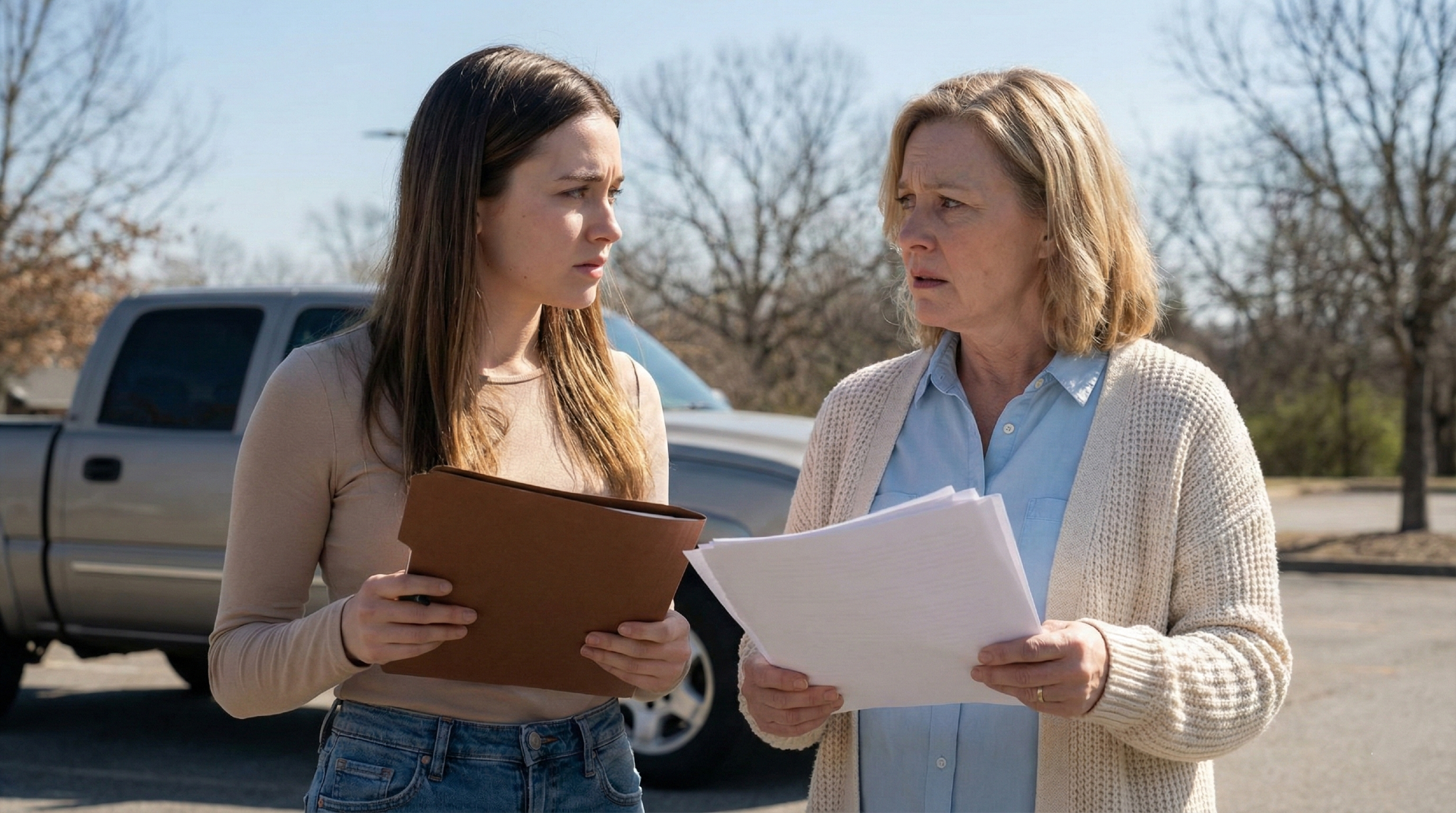
The next day, Patricia was outside watering her flowers. I grabbed the survey folder and walked over.
She saw me coming and straightened up. “If you’re here to apologize—”
“I’m not.” I held up the folder. “I got a property survey done.”
Her eyes narrowed. “So?”
“So I wanted to make sure I knew where my property ended and yours began.” I opened the folder and pulled out the map. “Turns out, the driveway isn’t split down the middle.”
Patricia’s smirk faltered. “What are you talking about?”
I pointed at the survey map. “See this line? That’s the actual property boundary.”
She leaned in, squinting at the paper.
“The entire driveway,” I said slowly, “is on my property.”
Her face went white.
“That’s impossible,” she whispered.
“It’s not.” I handed her the survey. “When your house was built in 1989, the driveway was poured entirely on this lot—my lot. Your property line ends three feet before the driveway even starts.”
Patricia stared at the document, her hands shaking as she flipped through the pages. Legal descriptions. Measurements. Official stamps.
“This can’t be right,” she said, her voice cracking.
“I had it verified twice,” I said calmly. “The driveway you’ve been using for thirty years? It’s mine.”
She looked up at me, her eyes wide with panic. “You can’t—”
“I can.” I crossed my arms. “Technically, you’ve been trespassing on my property for three decades.”
“I’ve lived here longer than you!”
“Doesn’t matter,” I said. “Property lines don’t change based on who got here first.”
Patricia’s mouth opened and closed. No words came out.
“Here’s the thing, Patricia,” I continued. “I don’t care that you’ve been using my driveway. I was happy to share it. But you decided to be petty. You harassed me. You painted lines. You threatened to tow my truck.”
She looked down, her face flushed with anger and humiliation.
“So here’s what’s going to happen,” I said firmly. “You’re going to remove those cones. You’re going to scrub off that painted line. And you’re never going to complain about where I park again.”
“Or what?” she spat.
“Or I’ll put up a fence,” I said simply. “Right along the property line. You’ll have to rip up your landscaping to build a new driveway on your actual property. That’ll cost you, what, fifteen thousand? Twenty?”
Patricia’s hands trembled as she gripped the survey papers.
“Your choice,” I said.
She didn’t say a word. She turned and walked back into her house, slamming the door behind her.
The next morning, the cones were gone.
By that afternoon, Patricia was on her hands and knees scrubbing the white paint off the driveway with a brush and a bucket of solvent.
I watched from my porch, sipping coffee.
She never looked up.
For the next two weeks, Patricia avoided me completely. If she saw me outside, she’d retreat into her house. If I pulled into the driveway, she’d close her curtains.
Then one evening, there was a knock on my door.
It was Patricia.
She looked tired. Defeated.
“I owe you an apology,” she said quietly.
I didn’t say anything. I just waited.
“I was wrong,” she continued. “I thought because I’d been here longer, I had more claim to things. I thought I could control how the neighborhood looked. How people parked. What kind of cars they drove.”
She looked down at her hands. “I was a bully.”
I nodded slowly. “Yeah. You were.”
“I’m sorry,” she said. “I won’t bother you again.”
“Good,” I said.
She turned to leave, then hesitated. “Can I still use the driveway?”
I almost laughed. “Patricia, I never wanted to stop you from using it. I just wanted you to stop treating me like I was the problem.”
She nodded, her eyes glassy. “Thank you.”
After that, things changed.
Patricia stopped micromanaging the neighborhood. She stopped leaving notes. She stopped complaining about every little thing.
We weren’t friends. But we were civil.
One day, about six months later, I saw her struggling to carry groceries from her car. I walked over and grabbed a few bags.
“Thanks,” she said quietly.
“No problem,” I replied.
As I set the bags on her porch, she said, “You know, I spent thirty years thinking I was protecting this neighborhood. Keeping standards high.”
“And?” I asked.
“And I was just making everyone miserable,” she admitted. “Including myself.”
I didn’t know what to say to that, so I just nodded.
She smiled—small, but genuine. “Your truck’s not even that ugly.”
I laughed. “Thanks, Patricia.”
A year later, Patricia decided to downsize. She sold her house and moved into a condo closer to her daughter.
Before she left, she knocked on my door one last time.
“I wanted to give you this,” she said, handing me an envelope.
Inside was a handwritten note and a check for five hundred dollars.
The note said: “For the surveyor. I should have paid for half. Thank you for teaching me a lesson I needed to learn.”
I looked up at her. “Patricia, you don’t have to—”
“I do,” she said firmly. “You were right. I was wrong. And I’m grateful you handled it the way you did.”
We shook hands.
She moved out the next week.
The new neighbors are a young couple with a golden retriever. They park wherever there’s space. They wave when they see me. They don’t measure property lines or worry about who owns what.
And every time I pull my truck into the driveway—the driveway that’s entirely on my property—I think about Patricia.
Not with anger. Not with resentment.
But with a strange kind of gratitude.
Because sometimes the best lessons come from the worst neighbors.
And sometimes, standing your ground is the kindest thing you can do.
For both of you.
Original fictional stories. AI-assisted creative content.