I wasn’t supposed to be at La Mesa Grill that Tuesday.
My errands had finished early — dry cleaning picked up, dentist done, parking meter paid with twelve minutes to spare. On impulse, I texted Evan. In your area. Lunch? He didn’t reply.
So I went anyway.
The hostess barely glanced up. “Just one?”
“I’m meeting someone. I’ll find them.”
I scanned the room. Corner booths, bar seats, the little two-top by the window where Evan and I used to sit when we were dating and thought Tuesday lunches were romantic. That table was empty now.
I found him in the far corner booth, leaning toward a woman in a red blazer. Her dark hair was pulled back, lipstick perfect, posture easy and confident. Her hand rested on Evan’s wrist the way you touch something you’re not afraid of losing.
My stomach dropped before my brain caught up.
“Evan?”
He looked up. No flinch, no guilt, no color rising in his face. Just irritation, like I’d walked into a boardroom without knocking.
The woman turned and smiled. It was a careful smile — not cruel, just contained. “You must be Claire,” she said. “Evan’s mentioned you.”
“Has he.” It wasn’t a question. My voice came out flatter than I intended.
Evan set down his fork. “This is Renata. She’s a consultant. We were finishing a conversation.”
“A consultant.” I looked at their two plates, the bottle of wine between them, his hand that hadn’t moved from beneath hers. “Right.”
“Claire—”
“Don’t.”
Something shifted in the air between us. Renata withdrew her hand and lifted her glass, watching without expression. She’d seen this before. That’s what told me everything.
My palm cracked across his face before I could think. The sound rang out through the restaurant like a gunshot. Silverware stopped. Conversations died. Someone’s glass hit the table.
Evan’s expression changed.
Not embarrassment. Not regret. Something colder and more precise, like a door swinging shut.
He rose from the booth slowly. His hand closed around my arm, fingers pressing into flesh until I felt bone. “Get,” he said, voice low, “in the car.”
I thought we’d fight in the parking lot. Scream at each other in the summer heat the way every couple does at least once, because it’s safer outside, because strangers make witnesses. I thought I’d cry in the passenger seat. Thought he’d apologize by dinnertime.
I was wrong about all of it.
Our front door hadn’t finished closing behind us before he shoved me. Both hands, flat against my shoulder blades, into the hallway wall. My shoulder hit the corner molding. White pain cracked down my spine.
“You embarrassed me,” he said. His voice was perfectly even. That was the worst part.
“Evan—” I tried to step around him.
He hit me.
Not a slap. Not an open hand or even a push. A punch, right side of my torso, knuckles against ribs.
I heard the crack. My lungs seized. The air simply left — not rushed out, just gone. I stood there with my mouth open, grabbing at nothing, trying to remember how breathing worked.
He hit me again, same spot.
I went down. My knees hit the hardwood and then I was on my side, gasping, each attempt at air like pulling glass through a straw. Three ribs, I’d find out later. Three fractures from the man who held my hand at the airport and said I’ve got you the night my mother died.
“Get up.” He said it like he was talking to a dog.
I couldn’t get up. I could barely open my eyes.
Evan grabbed my wrist. He dragged me across the floor, past the kitchen, to the basement door. My hip caught the threshold. My elbow scraped down the first step. He didn’t slow down. My body bumped on each stair, one at a time, a countdown, and I couldn’t scream because screaming requires air and I had none.
The basement smelled like concrete and old moisture. There was a metal shelf along one wall, a water heater in the corner, a single bulb overhead that he didn’t turn on.
He dropped my wrist. My phone skidded out of my pocket and he kicked it — not hard, but deliberate — under the metal shelf. I watched it disappear into the shadow.
“Reflect,” Evan said. He was already at the stairs. “On what happens when you humiliate me in front of people who matter.”
The door shut. The lock clicked from outside.
Total dark. No light at all, not even under the door.
I lay on the cold concrete and focused on breathing. One. Don’t move. Two. Don’t panic. Three. Count again. Four.
Every inhale felt like a lit match inside my chest. I catalogued what I could move — arms, legs, hands. Nothing seemed broken except the ribs. I told myself that like it was comforting. At least it’s just the ribs.
Time stopped being a real thing. Maybe thirty minutes. Maybe two hours. My eyes adjusted enough to make out the shelf, the water heater’s standby glow, the faint rectangle where the door met the frame.
Then I remembered the phone.
I stretched my left leg slowly, inch by inch, across the floor toward the shelf. My foot bumped something. I pressed it, edged it forward, pulled it back. My fingers closed around shattered glass.
The screen was cracked in three directions. But it lit up.
One bar of signal.
My hands were shaking badly enough that I dialed the wrong number the first time. I took a breath — just one, just enough — and tried again.
The line connected on the second ring.
“Dad.” My voice came out barely above a whisper, broken at the edges. “It’s Claire. Evan — he broke my ribs. He locked me in the basement.”
Silence on the line. Not the surprised kind. The kind that comes before something.
Then Dad’s voice. Completely calm. Completely level. “Where are you exactly?”
I gave him the address. My hands were shaking so badly I pressed the phone against my ear with both of them.
“Listen carefully,” he said. “Do not hang up. Stay awake. Stay still. I’m coming.”
“How long—”
“Doesn’t matter. I’m coming. And Claire?”
“Yeah?”
“I’m doing this the right way.”
I didn’t know what that meant. Not then.
Upstairs, something moved. Footsteps crossed from the kitchen toward the back of the house. I heard the refrigerator open and close. The sound of a cabinet. Then the footsteps came closer.
The deadbolt scraped.
I pressed myself back against the wall and held my breath, which cost me. My vision went white at the edges from the pain.
The door opened. Light spilled down the stairs, silhouetting him.
Evan descended slowly. He had a bottle of water in one hand. His other hand was behind his back.
That’s when I understood. Not anger. Not punishment. Control. This was about making absolutely certain I would never challenge him again.
Before his foot hit the bottom step, someone knocked on the front door upstairs. Hard. Not a neighbor. Not a delivery. An authority knock, the kind that means the person on the other side isn’t asking.
Evan stopped.
Three more knocks. Then a voice: “Police! Open the door!”
He looked at me. In the half-light from the open doorway I saw his face recalculate. Everything shifting. Eyes moving from me to the stairs and back.
“Claire—” he started.
Dad’s voice was a breath in my ear. “Say nothing.”
Evan turned, took the stairs two at a time, slammed the basement door behind him. The lock turned again. Then I heard him running — drawers yanking open, something metallic clattering, footsteps pounding toward the back of the house.
“Claire.” Dad’s voice sharpened. “Officers are outside. Real officers. I called them, gave them everything — your address, the situation, your name. You tell them exactly what happened. Every word. You hear me?”
My throat tightened. “You called the cops?”
“I’m not risking you,” he said. “Not for pride. Not for anything else. Those days are done for me.”
Upstairs, wood splintered. Boots thundered across the floor. Evan shouted something I couldn’t make out. Then nothing from him anymore.
The basement door shook under one impact. Then another. On the third, the lock gave way with a sound like a bone snapping.
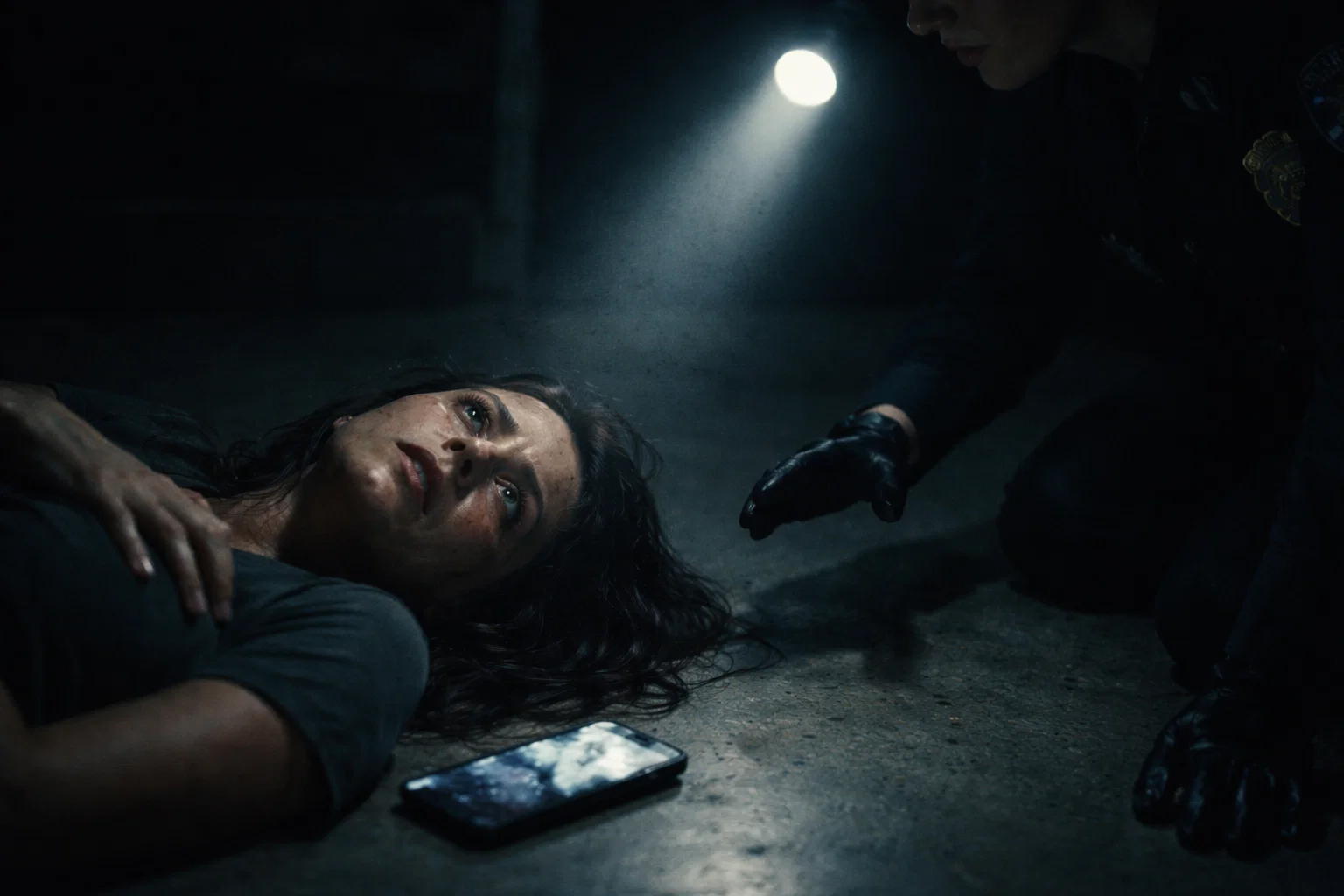
Light flooded in. Flashlight beam, cutting straight through the dark.
“Ma’am? Claire Donnelly?”
A female officer knelt beside me. Behind her, a paramedic appeared in the doorway, already pulling on gloves.
“Possible rib fractures,” the medic said into her radio. “Responsive. Requesting transport.”
“I’m okay,” I said. The words came out absurd even to me.
“Let’s let us decide that,” she said, not unkindly.
They moved me to a stair chair, one paramedic above and one below. Every bump on the stairs sent pain through my whole right side, electric and absolute. But I didn’t care. I was moving. I was going up, not down.
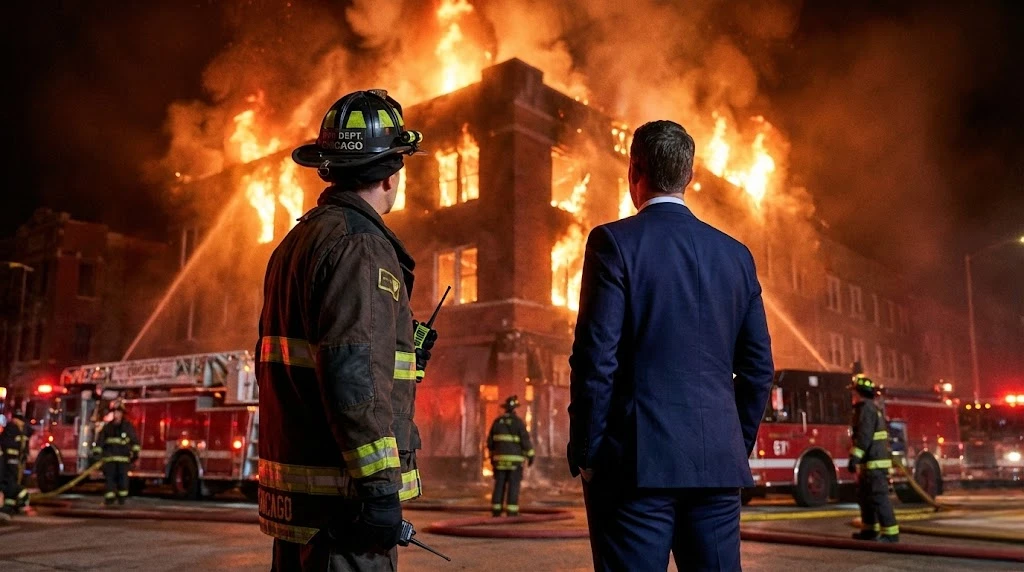
The living room was full of uniforms. Near the front door, my father stood in a dark coat, gray hair, face carved out of patience. Two men from family gatherings stood behind him — men whose last names I’d never known and had learned not to ask about. But none of them were in charge here. The police were. That had never happened before in my memory.
An officer stepped toward me as they wheeled me through. “Your husband exited through the back before we breached. We’re setting a perimeter now.”
“He had something behind his back,” I said. “When he came downstairs. His hand was behind his back.”
The officer’s expression didn’t change but he nodded and moved away, speaking into his radio.
Outside, the night air hit me. Cold, clean. Red and blue lights swept across the street in patterns. Neighbors stood on porches, some with phones raised. I didn’t feel exposed. I felt — witnessed. Like the street itself was taking note.
As the paramedics loaded the stretcher into the ambulance, my father leaned close. Not touching me. He knew better.
“There’s something you need to know,” he said quietly. “Evan wasn’t just cheating. He’s been running paper — using your name on documents, your address, your signature on at least two agreements you didn’t sign.”
I stared at him. Things were falling into place, clicking into positions they’d been moving toward for a long time.
“Whose documents?”
“People who don’t send letters,” Dad said.
My phone buzzed in the paramedic’s supply tray where I’d set it. The shattered screen lit up. Unknown number.
One line: YOU JUST STARTED A WAR.
Dad saw it. He didn’t react. “That’s mostly bluff,” he said. “But we’re taking it seriously regardless.”
At the ER, they cut off my shirt and confirmed three fractured ribs — fourth, fifth, and sixth, right side. No lung puncture, which the doctor said twice like I should feel grateful. They wrapped my torso in a compression bandage and told me not to sneeze if I could avoid it, which wasn’t advice they’d normally have to give a patient.
A nurse brought pamphlets. A victim advocate appeared — a woman named Sandra, no-nonsense shoes, calm eyes. She sat beside me while an officer took my statement and I told the whole thing. The restaurant. The parking lot. The hallway wall. Each stair on the way down to the basement. The sound the lock made.
“And when he came back down,” the officer said, “you said his hand was behind his back?”
“Yes.”
“You didn’t see what he was holding?”
“No.” I paused. “But I knew.”
The officer wrote something. “We found a length of rope in the kitchen. Near the back door where he ran.”
Sandra put her hand on my arm without saying anything.
I nodded. I’d already understood it by the time he was halfway down those stairs. This hadn’t been a fit of rage. It had been a plan.
My father waited in the hallway through all of it. When they finally let him in, he walked to the chair beside my bed and sat down. He didn’t try to hug me, which was exactly right. He just put his hands together on his knees and looked at the floor.
“I’m sorry,” he said. “For the world I built. For the kind of men it attracts to people close to me.”
I looked at him for a long moment. “This was Evan. Evan chose this.”
“I know. But I spent thirty years not making it harder for men like him.”
I didn’t have an answer for that. Neither did he.
He slid a business card onto my hospital tray. Crisp card stock, minimal text — a name and a number. “She’s the best in the state,” he said. “Emergency protective order tonight. Tomorrow morning, we begin the divorce. You’re not setting foot in that house again.”
“What about the text? The war message?”
He exhaled. “Evan’s debts are his own. The people he owes will find out soon enough that your name was used without your knowledge. That changes the math for them.” He paused. “I’m going to help make sure they understand that clearly.”
“How?”
“The right way,” he said again.
Over the next three days, my father did something I had genuinely never seen him do in my entire life.
He cooperated with law enforcement.
He met with detectives twice. He turned over records — names, dates, transactions, everything he had on Evan’s deals and the people Evan had been leveraging. It wasn’t a clean thing. There were parts of it that would take years to untangle. But it came with an agreement: protection for me, a clear statement that my name and signature had been forged, and the beginning of a path for my father to finally, quietly, step back from the life that had shadowed our family since before I was born.
“You’re really done?” I asked him, from my couch where I was healing, ribs wrapped, ice pack tucked against my side.
“I should’ve been done a long time ago,” he said. “I kept telling myself one more year. I ran out of years.”
Three days after the ER, they found Evan at a motel off I-75. He’d used a credit card — his own, not mine — for a room under a fake name, which was almost impressive in how little it worked. He was trying to negotiate with a federal contact, trading names he thought were valuable in exchange for immunity.
He didn’t get it.
The DA’s office filed: unlawful imprisonment, domestic assault with bodily injury, fraud, forgery. When the booking photo appeared on the local news, I was sitting at my new kitchen table in the small apartment I’d rented across town, eating cereal for dinner and watching the window go dark.
I waited for triumph. For the rush of vindication I’d seen people describe — that moment when justice arrives and the world makes sense.
What I felt instead was clarity.
Like fog lifting. Like the end of weather.
I pressed charges. I showed up to every court date in the compression wrap, which I needed for longer than they initially said. I met with the victim advocate every week. I started therapy — a woman named Dr. Parris who had no patience for me minimizing things, which I appreciated more than I expected. I went to physical therapy for the ribs on Tuesdays and Thursdays, and on Wednesdays I had a standing coffee call with my sister, who’d flown in for two weeks after the hospital and cried more than I did.
“You’re not crying enough,” she told me once.
“I’m crying plenty,” I said. “Just when you’re not watching.”
She accepted this, eventually.
My days became a rhythm. Court dates, therapy, PT. Grocery shopping in the middle of the day when nobody I knew was likely to be there. Building something small and mine.
Dad checked in regularly. Not hovering — he’d learned what that did to me — just present. He’d text in the morning and sometimes stop by with food he’d picked up from places he knew I liked. We were figuring out how to be in each other’s lives differently. It was slow. It was worth it.
The first morning I slept through the night without waking up at 3 a.m. reaching across the bed to check if someone was there, I lay very still and let myself feel it.
Not triumph. Not relief exactly.
Peace. A small, quiet thing. The kind you don’t notice arriving.
Six months after the arrest, Evan’s attorney called mine with a plea offer. Evan would plead guilty to avoid trial. Four years on the domestic assault and unlawful imprisonment charges. Restitution to the fraud victims, whose list turned out to be longer than anyone initially knew. A permanent protective order.
My lawyer called me the evening it was finalized.
“He signed,” she said. “It’s done.”
“Okay,” I said.
“Claire. He’s going to prison. Four years. The order is permanent.”
“I know. Thank you.”
I set the phone down on the counter. The apartment was quiet — my apartment, my quiet, nothing in it that hadn’t been chosen. A print on the wall I’d bought at a street market. A coffee maker that was mine. A blanket that no one else had ever touched.
The divorce had finalized two weeks after sentencing. A clean line, drawn in a courthouse I’d walked out of alone and into cold sunlight and felt nothing except the wind and the certainty that I was not going back.
No dramatic ending. No movie moment. No confrontation scene where I got to say all the things I’d written in my journal at 2 a.m. and never sent.
Just paperwork. And then just me.
And for the first time in years, that was exactly enough.
I called my sister that evening. She picked up on the first ring.
“Well?” she said.
“Four years,” I said. “It’s over.”
She exhaled for a long time. Then: “Come visit. Next month. I’ll make the guest room up for two weeks.”
“Maybe,” I said.
“Claire.”
“Yeah.”
“Make the reservation.”
I smiled. The first real one in a while — not performed, not reassuring, not the kind I’d worn at PT and at court and at the grocery store in the middle of the day. Just a smile, in my quiet kitchen, with no one watching.
“Okay,” I said. “I’ll make the reservation.”
Original fictional stories. AI-assisted creative content.