
Thomas Chen’s Rolls-Royce idled at pump seven like it owned the entire station.
He didn’t need gas. The tank was three-quarters full. But his driver had stepped away for coffee, and Thomas—seventy-two, childless, and worth close to half a billion—had nowhere urgent to be.
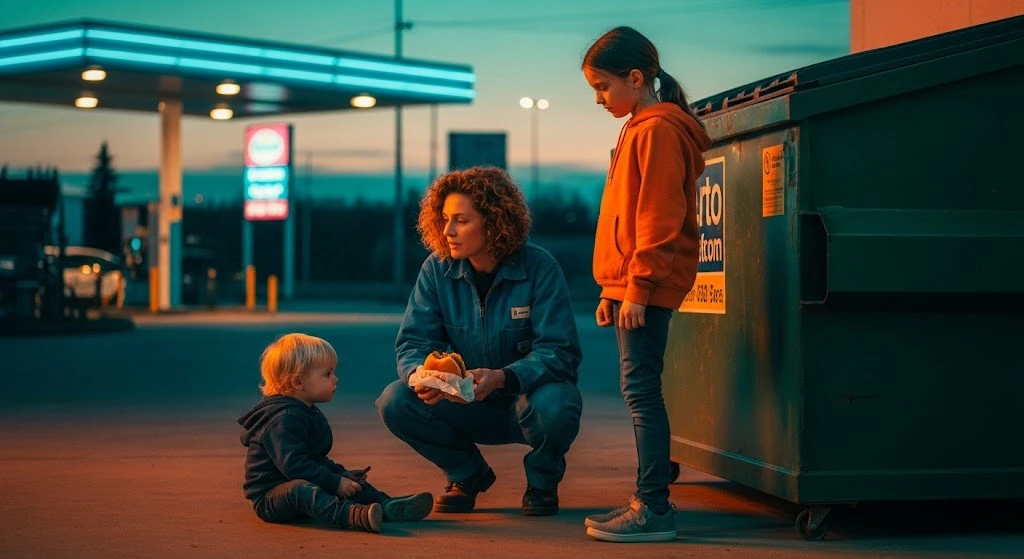
Through the tinted window, he watched a woman in a faded custodian uniform kneel beside three kids in the shade of a dumpster enclosure.
She was breaking a single burger into pieces.
The oldest girl, maybe ten, got the smallest portion. The middle boy got slightly more. The youngest—a toddler in a stained shirt—got the patty and most of the bun.
The woman ate nothing.
Thomas rolled down the window.
“Excuse me.”
The woman startled. Her name tag read Angela.
“We’re not loitering, sir,” she said quickly. “I work here. Night shift. Just feeding them before my next break.”
Thomas stepped out of the car.
“I wasn’t going to ask you to leave.”
Angela stood, instinctively moving between him and her children.
“Then what do you want?”
Thomas looked at the three kids. The girl held her little brother’s hand. The middle boy watched Thomas with suspicion.
“How old are they?”
“Ten, seven, and three.”
“And their father?”
Angela’s jaw tightened. “Dead. Overdose. Two years ago.”
Thomas nodded slowly. “You work here full-time?”
“Two jobs. Days at the hospital. Nights here. My neighbor watches them when she can.”
“And when she can’t?”
Angela didn’t answer. She didn’t need to.
Thomas reached into his jacket. Angela flinched.
He pulled out a checkbook.
“What’s your full name?”
“Why?”
“Because I’d like to write you a check. And I need a name.”
Angela stared. “I don’t need charity.”
“Good. Because I’m not offering charity. I’m offering an investment.”
“In what?”
“In the kind of person who gives her kids the meat and eats nothing herself.”
Angela’s eyes filled. “I can’t accept—”
“You can. And you will. Because those kids deserve better than parking lot meals.”
He wrote quickly. Tore the check free. Held it out.
Angela looked at the number.
Twenty-five thousand dollars.
She gasped.
“That’s… I can’t…”
“You can. Consider it a loan if it helps. Pay me back when you’re on your feet. Or don’t. Either way, take it.”
Her hands shook as she accepted the paper.
“I don’t understand. Why?”
Thomas looked past her, at the dumpster, the cracked asphalt, the flickering neon sign.
“Because I’ve spent fifty years building an empire. And I just realized I’ve never built anything that mattered.”
Three days later, Angela called the number on the business card Thomas had left.
“Mr. Chen? It’s Angela Martinez. From the gas station.”
“I remember.”
“The check cleared.”
“Good.”
“I… I wanted to thank you. And ask… you said it was an investment. In what, exactly?”
Thomas leaned back in his leather chair, thirty floors above the city.
“Come to my office tomorrow. Tenth floor, Chen Holdings. Bring your résumé.”
“I don’t have a résumé.”
“Then bring yourself. Two o’clock.”
Angela arrived twenty minutes early, overdressed in a borrowed blazer, her kids in the lobby daycare Thomas had quietly arranged.
She expected an interview.
Instead, Thomas handed her a folder.
“You’re hired.”
“As what?”
“Executive assistant to the VP of Operations. Sixty thousand a year. Health insurance. Retirement matching. Tuition assistance for the kids.”
Angela stared at the contract like it might vanish.
“I clean toilets, Mr. Chen. I don’t know anything about operations.”
“You’ll learn. I’m putting you through night classes. Business administration. Paid for.”
“Why are you doing this?”
Thomas met her eyes.
“Because I’m tired of people who want things handed to them. And you’re the first person I’ve met in decades who didn’t ask for a damn thing.”
Angela worked harder than anyone in the building.
She arrived first. Left last. Took notes in meetings she barely understood, then stayed up past midnight studying terms she’d never heard.
Within six months, she was fluent in contracts.
Within a year, she was leading presentations.
Within three years, she was running entire projects.
Thomas watched it all.
Not from a distance—from the desk beside hers.
They began sharing coffee breaks. Then strategy sessions. Then doubts, fears, late-night regrets.
Angela told him about her husband’s decline, the helplessness, the shame.
Thomas told her about his brother’s betrayal, the lawsuit that fractured his family, the nieces and nephews who only called when they needed money.
“They’re waiting for me to die,” he said one evening.
Angela didn’t sugarcoat it. “Then don’t give them the satisfaction.”
When Thomas collapsed during a board meeting, it was Angela who rode in the ambulance.
The nieces and nephews appeared within hours, suddenly concerned, suddenly present.
“We’ve been worried sick, Uncle Thomas,” said Rebecca, his oldest niece, a woman who hadn’t visited in four years.
“You should rest. We’ll handle everything,” said Marcus, his nephew, eyeing the medical charts like they were quarterly reports.
Angela stood in the corner, silent.
Thomas saw her. Reached for her hand.
“Get them out.”
Rebecca’s smile faltered. “Uncle Thomas—”
“Out. Now.”
They left.
Thomas squeezed Angela’s hand.
“Call my lawyer.”
The will was updated that week.
Sixty percent of the estate went to Angela Martinez.
Twenty percent to a trust for her three children.
Ten percent to charities Angela would manage.
Ten percent, split among the relatives—enough to avoid a total contest, too little to matter.
When the lawyer read the terms aloud, Rebecca screamed.
“She manipulated him! She’s a gold digger!”
The lawyer, unmoved, slid a sealed envelope across the table.
“Mr. Chen anticipated this. He asked me to play this if anyone objected.”
A video began.
Thomas, propped up in his hospital bed, looked directly into the camera.
“If you’re watching this, I’m gone. And if you’re angry, good. You should be. Because I gave fifty years of my life to people who saw me as a bank account. Angela saw me as a human being. She earned nothing from me except respect. And that’s worth more than all of you combined.”
The video ended.
Rebecca tried to sue.
The case was dismissed in six weeks.
Angela didn’t buy a mansion.
She bought a four-bedroom house in a good school district.
She set up scholarships for kids whose parents worked two jobs.
She opened a childcare center for night-shift workers.
And every year, on the anniversary of the day Thomas stopped at that gas station, she bought a cheap fast-food burger, broke it into pieces, and set it on her kitchen counter.
Her daughter, now in college, asked her once why she did that.
Angela smiled.
“To remember that sometimes the richest people in the world are the ones who have nothing left to give but still do.”
Thomas had been gone for five years.
But his lesson lived in every scholarship check.
Every family housed.
Every kid fed.
Because he hadn’t left Angela his fortune.
He’d left her his purpose.
And she carried it like a crown.
Original fictional stories. AI-assisted creative content.