The wine glasses clinked. The men talked low. Elena Parker moved around the table filling glasses and trying not to exist.
She’d been doing this for three weeks — catering private events, dodging hands, counting tips. Tonight the black SUVs at the service entrance should’ve told her to run. By the time the man with the gun checked her ID, it was too late.
She just needed to finish the shift. Two hundred dollars. Grandma Ruth’s oxygen tank wasn’t going to fill itself.
“Double the crew Thursday,” said the man at the head of the table. Victor Romano. Square jaw, cold eyes, the kind of stillness that meant everyone else in the room was afraid. “I don’t want surprises.”
“Done,” said the one they called Nico.
Elena kept pouring.
She almost made it past the little girl.
The child sat in the middle of the table surrounded by killers. Six years old, pearl necklace, hands folded. She hadn’t said a word. Not one. Victor’s only child — doctors called it selective mutism, developmental delay, something clinical. Nobody cracked it. Six years of silence.
Then Elena came within three feet of her, and the girl’s whole body changed.
The small hands gripped the edge of the table. Her lips parted. Her dark eyes locked onto Elena with an intensity that stopped the blood in Elena’s veins.
Elena kept pouring. Kept breathing. Tried to move on.
The chair scraped back.
“Sophia,” Victor said. “Sit.”
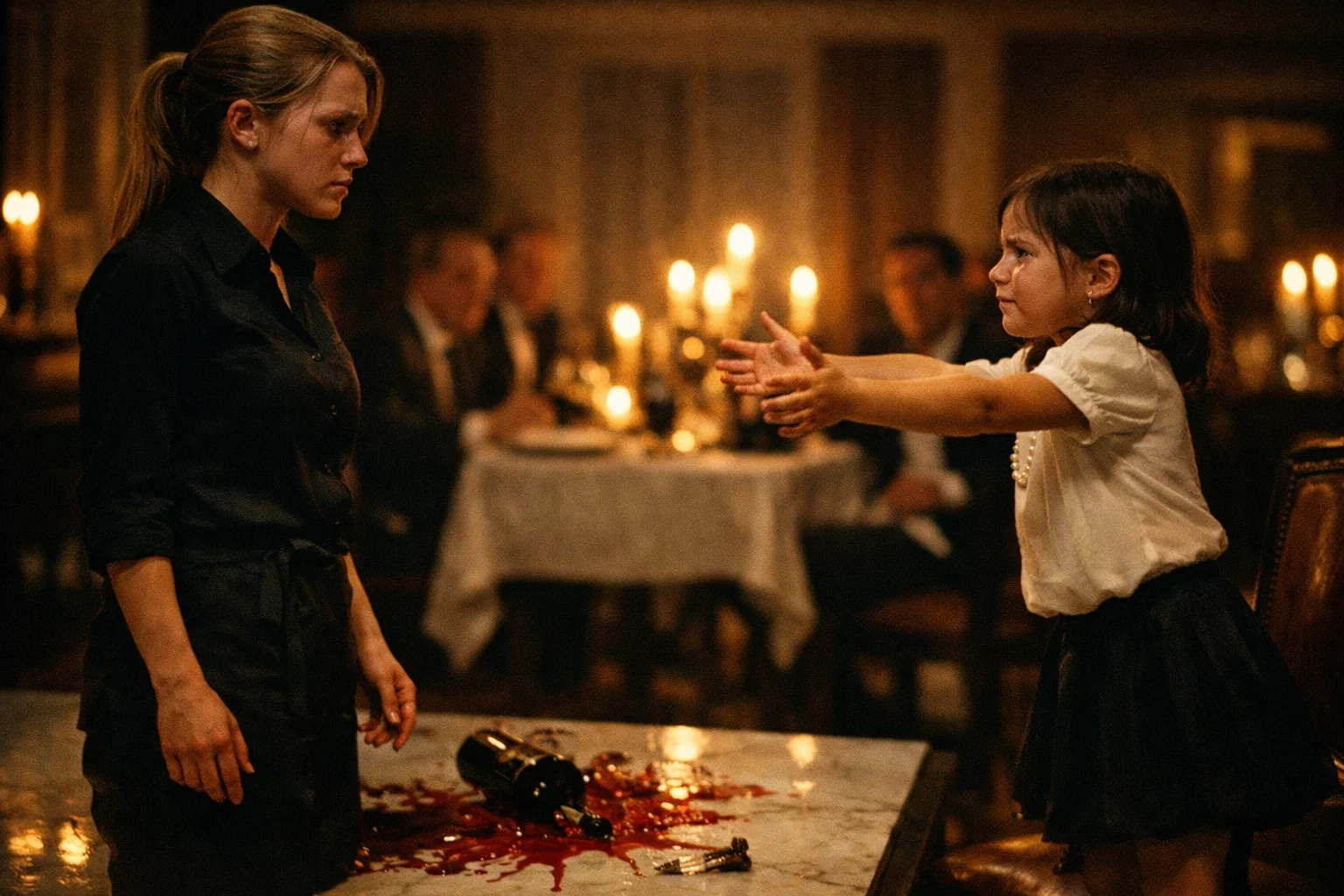
The girl didn’t sit. She stood — barely tall enough to see over the table — and pointed directly at Elena.
Every man at the table reached for something under his jacket.
Elena froze. The bottle shook.
The girl opened her mouth.
One word. Cracked. Raw. Like a door opening in a house that had been sealed for years.
“Mom.”
The bottle hit the marble and exploded. Red spread across white stone like a crime scene.
Elena stumbled back against the sideboard, her hands braced behind her, staring at the child’s face. Something in her chest cracked open — an old wound, a wound she’d stitched shut with sheer survival — and the pain was so sudden and so bright it nearly took her knees.
“Mom,” Sophia said again, louder. Certain.
“Get her out,” Victor said. Quiet. Controlled.
“Wait—” Elena gasped. “I don’t—I haven’t—”
“Basement. Now.”
They grabbed her arms and dragged her through the kitchen, down a staircase, into a concrete room with a swinging bulb. Metal chair. Locked door.
Elena sat there shaking in the cold, tears running down her face, telling herself she was wrong. She was wrong. This wasn’t possible.
But she’d named the baby Sophia.
Twenty minutes later, Victor walked in alone. He sat three feet from her, elbows on his knees, and studied her face like a map he was trying to read.
“Who are you?” he said.
“Elena Parker. I’m with the catering company. I’m nobody.”
“My daughter hasn’t spoken since she was an infant. She looked at you and said ‘Mom.'” He leaned forward. “So I’ll ask you one more time. Who are you?”
Elena pressed her hands flat against her thighs to stop the shaking. “I used to work here,” she whispered.
“When.”
“Seven years ago. I was a housemaid. I was nineteen.”
The silence filled the room like water.
Victor stood up. Walked to the wall. Pressed both palms flat against the concrete and stayed there, back to her, shoulders like a wall.
“Keep talking,” he said.
“You know what happened.”
“I said keep talking.”
Elena lifted her chin. Her voice broke in the middle but she didn’t stop. “You came to my room. I said no. You didn’t stop.”
His fingers curled against the wall.
“I found out I was pregnant three weeks later. I ran before anyone could know. I had her in Pennsylvania, in a clinic that didn’t ask questions.” She was crying now — not quietly, not the kind of crying that stays inside. The loud kind. The kind that’s been held for years. “I named her Sophia.”
Victor turned around. His face was still a mask. But the mask had cracks.
“She was one month old when your men came,” Elena said. “They told me she was sick. They said they were taking her to a hospital. They told me she died.”
Victor said nothing.
“But she’s not dead. She’s upstairs. Sitting at your table. Wearing pearls. And she hasn’t said a word since you took her from me.” Her voice rose. “Because the only word she wanted to say was the one that wasn’t allowed to be true.”
Victor sat back down. He clasped his hands. “Margaret couldn’t have children. She wanted a baby more than she wanted anything in her life.”
“So you took mine.”
“I provided for her. She had the best—”
“She had nothing!” Elena stood up. She was half his size and shaking but she looked him dead in the eye. “She’s been screaming in silence for six years. You call that providing?”
Victor’s jaw hardened. “You’re going to walk out of this house. Five hundred thousand dollars. You disappear. That’s my offer.”
“No.”
“That wasn’t an offer.”
“I don’t want your money. I want my daughter.”
He stood. Towered over her. “I will bury you so far down no one will remember your name.”
Elena didn’t flinch. “Then bury me. But I’m not leaving without her.”
Victor stared at her for a long beat. Then he walked out and slammed the door.
Elena sat back down, pressed her face into her hands, and made a decision.
She didn’t sleep. The room was cold and dark and the concrete held no warmth. Around three in the morning she heard a child crying through the floor above her — muffled, small, insistent.
She pressed her palm to the ceiling.
“I’m here, baby,” she whispered. “I’m right here.”
At dawn, the lock clicked. Not Victor.
Nico.
He dropped a fast food bag on the floor and leaned in the doorway, arms crossed, looking like a man working through something he hadn’t resolved yet.
“Eat,” he said.
“Where is she?”
“Upstairs. Asleep. She said your name four more times before she passed out.”
Elena’s breath caught. “She said it again?”
“Keeps saying ‘Mom.’ Just ‘Mom.’ Over and over.” He rubbed the back of his neck. “I’ve got a daughter. Four years old. She said ‘Daddy’ for the first time last week.”
Elena waited.
“I can get you out,” Nico said.
“I’m not leaving without—”
“I know that. I mean both of you.”
Silence. Elena stared at him. “He’ll kill you.”
“Maybe. But I can’t watch this anymore.” He crouched down to her eye level. “There’s a lawyer. Daniel Morales, out of Newark. Clean. Victor hasn’t bought him — believe me, he tried. I’ll get you to him. But we move tonight.”
“Why are you doing this?”
Nico stood up. Walked to the door. Paused. “Because I keep thinking about what it would sound like if my daughter said ‘Daddy’ to a stranger.”
He closed the door behind him.
At two in the morning, Nico unlocked the basement. Elena’s legs were stiff after eighteen hours on concrete. She stumbled on the first step and he caught her arm.
“Quiet,” he said. “Two guards front, two east wing. We go through the service corridor to the nursery. I looped the camera feed twenty minutes ago. Six-minute window before the system resets.”
“And if we don’t make it in six minutes?”
“We make it in six minutes.”
They moved through the dark — past the kitchen where Elena had been just another waitress a day ago, past the pantry, up the back staircase. Nico checked his watch at the top.
“Four minutes.”
He opened Sophia’s door slowly.
The little girl was awake. Sitting straight up in bed, both arms already extended, as if she’d known someone was coming. Her dark eyes found Elena in the doorway and the fear on her face simply dissolved.
Elena crossed the room in three steps. Scooped her up. Held her so tight she could feel the child’s heartbeat against her own chest.
“Mom,” Sophia breathed into her neck. Her fingers curled around Elena’s collar and gripped.
Elena didn’t speak. She couldn’t. She pressed her lips against the top of her daughter’s head and held on.
“Promise you won’t go?” Sophia whispered.
Elena pulled back and looked at her daughter’s face. Six years old. Six years of silence. A child who couldn’t say a single word because the only word that mattered was the one her whole reality had made impossible.
“No one,” Elena said, “is ever taking you from me again.”
They made it out through the service entrance. An unmarked sedan behind the gardener’s shed. No headlights for the first half mile, then the main road, the dark highway, the distance growing between them and the lights of the Romano estate.
Nobody spoke for ten minutes.
Then Sophia said, softly, from the backseat: “The house was always cold.”
Elena kissed the top of her head. “You’ll never be cold again.”
Nico dropped them at a motel in Elizabeth — flickering vacancy sign, no-questions clerk. He handed Elena a burner phone and a card.
“Call him first thing,” he said. “Don’t go outside. Don’t use your real name. Victor will have people looking by sunrise.”
“Nico—”
“Don’t.” He looked at Sophia, sitting on the bed with her stuffed rabbit. “Hey, kid.”
Sophia looked up.
“You were brave tonight.”
“You too,” Sophia said.
Nico’s jaw went tight. He nodded once and walked out into the dark.
At seven in the morning, Elena called Daniel Morales.
“Who gave you this number?” he answered.
“Someone who wants to do the right thing.”
“That’s rare in my line of work. Talk to me.”
She talked for forty-five minutes. The assault. The pregnancy. The men who came and took the baby and said she died. Six years of silence. One word that broke it open.
When she finished, there was a long pause.
“Ms. Parker,” Daniel said slowly, “if half of what you’re telling me is true, Victor Romano is going to prison for the rest of his life.”
“I need proof. He’ll deny everything.”
“We’ll get proof. First: DNA. I know a lab that can fast-track results in twenty-four hours. Can you get a sample from the child?”
“She’s right next to me.”
“Good. I’m sending a courier. Don’t open the door for anyone else.”
The results came back the next day.
99.97% match.
Elena Parker was Sophia Romano’s biological mother.
Daniel filed Tuesday morning. Kidnapping. Fraud. Illegal custody. Sexual assault. The documents hit Bergen County like a bomb.
By Tuesday afternoon, every news van in the tri-state area was parked outside Victor Romano’s gates.
Victor’s lawyers scrambled — motions to seal, leaks to tabloids, a PR firm, a story about a disgruntled former employee with a vendetta. One headline read: Waitress Claims Crime Boss Stole Her Baby — Experts Skeptical.
None of it stuck.
Because Nico walked into the FBI field office in Newark on Wednesday morning carrying a cardboard box.
He set it on the agent’s desk. “Everything’s in here.”
Phone logs. Financial records. Internal memos. Text messages from seven years ago that included phrases like “the girl is secured” and “tell the mother it didn’t survive.”
The lead agent, Torres, flipped through the documents for twenty minutes without speaking. Then she looked up.
“You understand what this means for you?”
“Yeah,” Nico said. “It means I can sleep at night.”
“You’ll need to testify.”
“I know.”
“Romano will try to have you killed.”
“He’ll try. But he’s running out of people willing to do it.”
The investigation moved fast after that. Warrants. Frozen accounts. Three of Victor’s men arrested in the first week. Two of them cooperating within forty-eight hours.
Three months from filing to verdict.
The judge, Patricia Gaines, had spent twenty years putting organized crime figures behind bars. She took this one personally.
Victor arrived every day in a custom suit, four lawyers flanking him. He looked untouchable.
Until Sophia took the stand.
The courtroom went silent when the six-year-old climbed into the witness chair. Her feet didn’t reach the floor. She held a stuffed rabbit in her lap.
Judge Gaines leaned forward. “Sophia, do you know why you’re here today?”
Sophia nodded.
“Can you tell us, in your own words?”
The girl scanned the courtroom. She found Elena in the gallery — hands clasped, tears already falling.
Then she looked at Victor. He stared back. Something in his face moved between anger and fear.
Sophia turned back to the judge.
“She’s my mom.” Her voice was small and rough from years of disuse, but it carried through the silent room like a bell. She touched her chest with her small hand. “I feel it here. I always did. That’s why I couldn’t talk. Because the only word I wanted to say was the one I wasn’t allowed to.”
Victor’s lead attorney dropped his pen.
Daniel Morales stood. “Your Honor, the DNA evidence confirms what this child already knows. Elena Parker is Sophia’s biological mother. The child was taken from her by force. Mr. Romano falsified adoption documents to conceal a kidnapping. We request full custody be returned to Ms. Parker immediately.”
Judge Gaines turned to Victor. “Mr. Romano. Do you wish to respond?”
His lawyer leaned in and whispered. Victor pushed him aside.
“She was better off with me,” Victor said. “I gave her everything.”
Judge Gaines removed her glasses. Set them on the bench. “You gave her everything except her mother, her voice, and her freedom. That’s not everything, Mr. Romano. That’s nothing.”
She ruled in Elena’s favor.
Full custody. Immediate transfer. Criminal referral to the U.S. Attorney’s office.
Victor stood in the courtroom as Sophia crossed the aisle — walked away from him, past his lawyers, past his four-hundred-dollar-a-day PR team — and pressed herself into Elena’s arms.
She whispered into her mother’s shoulder: “We’re going home.”
Victor didn’t move. Didn’t speak. For the first time in his life, he had nothing left to say.
The RICO indictment was sixty-seven pages long. Money laundering. Kidnapping. Sexual assault. Witness tampering. His associates flipped one by one. Accounts frozen. Properties seized.
The headlines ran for weeks.
Crime Boss Built Empire on a Stolen Child. The Silent Heir Was Never His. Romano Guilty on All Counts.
Forty-five years. No parole.
Nico received full immunity. He moved his family to North Carolina and opened a garage. He never spoke Victor’s name again.
Daniel Morales became one of the most in-demand attorneys in New Jersey. When reporters asked why he took Elena’s case pro bono, he said, “Because some things are worth more than a billable hour.”
Elena and Sophia moved to a cottage on the coast of Maine. Blue shutters. A garden Sophia helped plant. No marble floors. No bodyguards.
On the first morning, Elena made pancakes. Sophia sat at the kitchen table with her rabbit and watched the sunrise through the window.
“Mom?”
Elena turned from the stove. “Yeah, baby?”
“I like it here.”
“Me too.”
“Mom?”
“Yeah?”
“I’m never going to stop talking now. You know that, right?”
Elena laughed — really laughed, the kind that comes up from somewhere deep and hasn’t been let out in years — and crossed the kitchen and pulled her daughter into her arms.
“Good,” she said. “I’ve been waiting to hear your voice for a very long time.”
Outside, the ocean rolled in steady and calm.
No empire. No fear. No silence.
Just a mother and her daughter, finally home.
Original fictional stories. AI-assisted creative content.