The morning rush at Riverstone National Bank was just beginning.
Sebastian Rojas straightened his designer tie in the reflection of the glass-walled office. Branch manager for three years. Not a single customer complaint that made it to corporate. He ran a tight ship.
That’s when the man walked in.
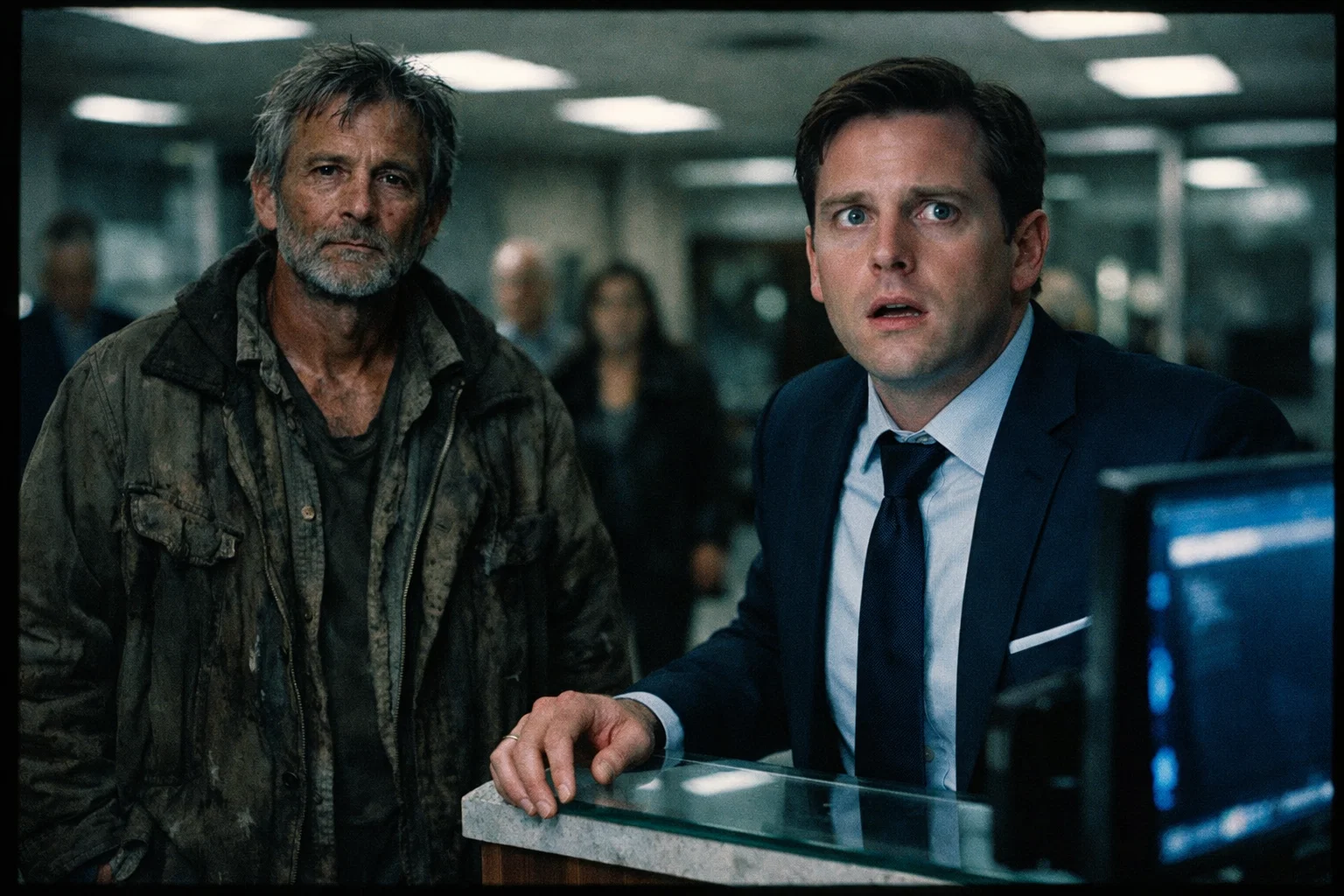
Worn shoes. Faded shirt. Hair combed but clearly cut at home. Sebastian’s lip curled.
“Can I help you?” The teller’s voice was flat.
“I need to make a withdrawal.” The man’s voice was steady.
Sebastian stepped out of his office, positioning himself where everyone could see. “Sir, are you sure you have an account here?”
A few customers glanced up. Someone snickered.
“I do.”
“Really.” Sebastian’s smile was sharp. “Because frankly, you don’t look like our typical clientele.”
The man didn’t flinch. “I’d like to access my account.”
Sebastian leaned against the counter, performing for the lobby. “Tell you what—if you actually have a balance worth withdrawing, I’ll personally double it. How’s that?”
Laughter rippled through the waiting area.
The teller shifted uncomfortably. “Sir, I can just check—”
“No need.” Sebastian waved her off. “I think we all know how this ends.”
The man reached into his pocket slowly. Not for a wallet. Not for cash.
He pulled out a metal badge and slid it across the counter.
The teller scanned it. Her face went white.
“What?” Sebastian grabbed the monitor, twisting it toward himself.
The screen read: ARTURO MEDINA – OWNER & EXECUTIVE DIRECTOR
The lobby went silent.
“That’s… that’s not possible.” Sebastian’s voice cracked. “This has to be a mistake.”
“It’s not.” The teller’s hands were shaking.
Arturo Medina stood perfectly still, letting the moment settle. Then he spoke, his voice carrying across the marble floor.
“I dressed this way for a reason. To see how you treat people who don’t look wealthy.”
Sebastian’s face drained. “Mr. Medina, I didn’t realize—”
“That’s the problem.” Arturo cut him off. “You should treat everyone with respect. Not just the people you think matter.”
An elderly woman near the entrance started crying softly. A man in work clothes clenched his fists, staring at the floor.
“How many others have you embarrassed?” Arturo asked quietly. “How many people walked out of here feeling smaller than when they came in?”
Sebastian tried to recover. “Sir, I apologize. If I had known who you were—”
“It shouldn’t matter who I am.”
The words hung in the air like a verdict.
Arturo turned to the teller. “Pull up customer service records for this branch. Last six months.”
She hesitated, glancing at Sebastian.
“Do it,” Arturo said firmly.
The records told the story Sebastian tried to hide. Seventeen formal complaints. Forty-two informal notes. Elderly customers spoken to dismissively. Working-class families rushed through transactions. One woman described being “made to feel like garbage” for asking about a loan.
“My office. Now.” Arturo’s voice was steel.
Sebastian followed him upstairs, his polished shoes clicking against marble that suddenly felt like a courtroom floor.
Behind closed doors, Arturo didn’t yell. He simply asked questions.
“Why did you mock me?”
“I… I don’t know. You just didn’t look like—”
“Like someone who matters?”
Sebastian swallowed hard. “I made a mistake.”
“No. You revealed yourself.” Arturo leaned forward. “This bank serves people. All people. Not just the ones who dress like you think they should.”
“I can change. Give me another chance.”
Arturo shook his head slowly. “I’ve seen your record. This isn’t one mistake. It’s a pattern.”
“Please. I need this job. I have bills, a mortgage—”
“The people you humiliated have bills too. Did you think about that when you made them feel worthless?”
Sebastian had no answer.
“You’re fired. Security will escort you out.”
Twenty minutes later, Sebastian walked through the lobby with a cardboard box, past the same customers who’d witnessed his performance. No one met his eyes.
Arturo stood at the entrance, watching him leave.
Then he turned to the staff. “Everyone, gather around.”
Tellers, security guards, loan officers—they circled nervously.
“I started this bank thirty years ago in a building smaller than this office,” Arturo said. “Back then, I wore shirts like this every day. I ate lunch from a paper bag. I knew what it felt like to be invisible.”
He paused, making eye contact with each person.
“That’s why I came here today. To remind all of us—including myself—why we exist. Not to judge. Not to exclude. To serve.”
A young teller raised her hand tentatively. “Mr. Medina… some of us tried to say something about Sebastian. But we were scared.”
“I know. And I’m sorry you were put in that position.” He looked at her directly. “From now on, you have my direct number. Any of you see this behavior again, you call me.”
The elderly woman from earlier approached, clutching her purse. “Thank you. My grandson wanted me to switch banks after last time. But maybe… maybe I won’t have to.”
Arturo took her hand gently. “You never have to feel small in here again. I promise.”
She smiled through tears.
That evening, Arturo sat in his real office across town—mahogany desk, leather chairs, floor-to-ceiling windows. But he kept the worn shirt on.
His assistant knocked. “The board wants a statement about today.”
Arturo thought for a moment. “Tell them this: Respect isn’t a luxury. It’s the foundation of everything we do. Without it, we’re just a building full of money. With it, we’re a place where people’s dignity matters.”
“And the new branch manager position?”
“Promote the teller who pulled those records. She had the courage to show me the truth.”
His assistant nodded, smiling. “She’s going to be shocked.”
“Good. Let’s shock her with opportunity instead of humiliation.”
After she left, Arturo looked at his reflection in the darkening window. Not at the expensive office behind him. At the modest shirt that had revealed everything.
Sebastian would find another job eventually. But he’d carry this day forever—the moment he learned that dignity costs nothing but reveals everything.
And Arturo? He’d return to that branch every few months. Same shirt. Same shoes. Not to test anyone.
To remember.
Because the richest man in the building should never forget what it feels like to be treated like the poorest.
Original fictional stories. AI-assisted creative content.