The Carter family’s Sunday dinners always started the same way — crystal glasses, pressed tablecloths, and a very specific kind of silence that meant someone was about to say something unforgivable.
I’d learned to read that silence in the two years since I married Daniel.
Tonight it was louder than usual.
“You’re late,” Linda said the moment I stepped inside, not looking up from the centerpiece she was adjusting. “Again.”
“I came straight from base,” I said. “I couldn’t change.”
That was my mistake. Mentioning the base.
Linda’s eyes traveled slowly from my boots to my collar, taking in the dress uniform the way a person looks at something they’ve decided to throw away.
“Must you always wear that thing to family dinners?”
“Mom,” Daniel said from the kitchen doorway. A warning.
But Daniel’s warnings had never stopped Linda Carter before.
“It’s a question,” she said sweetly. “I’m just asking.”
Dinner started at seven. By seven-fifteen, I knew how the night would end.
It wasn’t one thing. It was the accumulation. The way Linda talked over me every time I opened my mouth. The way Megan — Daniel’s younger sister — kept making small comments that weren’t quite insults, the kind designed to create plausible deniability.
“I just think it must be so hard, being married and deployed at the same time. Don’t you feel guilty leaving him alone so much?”
“Megan,” Daniel said.
“I’m just saying what everyone’s thinking.”
Jason, Megan’s husband, had his phone out. He’d had it out since I arrived, and I’d been telling myself it was nothing — he was always on his phone — but I caught the angle of it twice, and both times it was pointed at me.
“Put it away,” Daniel said.
Jason shrugged. “Relax, man. I’m just—”
“Put. It. Away.”
Jason lowered it. For approximately three minutes.
The blowup happened before the main course.
I don’t even remember what triggered it — something about the house, about money, about the fact that Daniel had put my name on his accounts before our wedding. Linda brought it up like she’d been saving it. Carefully. For exactly the right moment.
“You should know,” she said, setting down her fork, “that we’ve spoken to a lawyer.”
The table went quiet.
Daniel looked up slowly. “About what.”
“About protecting the family assets.” Linda folded her hands. “There are documents Daniel signed before the wedding that we believe were signed under pressure. The kind of pressure a certain type of woman applies when she wants to secure her financial future.”
The room seemed to tilt slightly.
I heard Daniel’s chair scrape back.
“Don’t,” I said quietly. I put my hand on his arm. “Let her finish.”
Linda smiled. The smile she wore when she thought she’d already won.
“We’re not saying you’re a bad person,” she continued. “We’re saying you’re a strategic one. And that the Carter family has certain assets that need to be protected from —”
“From me,” I said.
“From people who marry into money they didn’t earn.”
The word earn hit like a match striking.
I kept my face still. I’d learned that in basic. Don’t give them the reaction they’re building toward.
“I think,” I said carefully, “that this conversation should wait until Daniel and I can speak to our own lawyer.”
Linda tilted her head. “Oh, I don’t think that’s necessary. I think we can settle this here, like adults, over dinner.”
“You just said you already spoke to a lawyer.”
“And?”
“That’s not settling something like adults,” I said. “That’s an ambush.”
Megan laughed first.
It was short and sharp, like the sound a whip makes.
“An ambush,” she repeated. “That’s rich. You want to talk about ambush? You ambushed my brother. Two months of dating and suddenly there’s a ring? He didn’t even —”
“Megan.” Daniel’s voice went flat.
“—tell us he was serious about her. And now she’s on the accounts, she’s listed on the property, she’s got more access to this family’s money than people who actually built it—”
“Megan. Stop.”
“Why?” She set down her napkin. The pretense of civility was evaporating fast now, like fog burning off. “Everyone is thinking it. I’m just the only one saying it.”
“You’re not saying anything true,” Daniel said.
“I’m saying she married you for the money. I’m saying it plainly. She’s military trash with good posture and you—”
I stood up.
I didn’t plan to. My chair scraped back and I was upright before I’d made a conscious decision.
“Excuse me?” I said.
Megan blinked. Like she was surprised I had a voice.
“You heard me,” she said.
“I heard you.” I kept my voice even. “I want to make sure you meant it.”
“Oh, I meant it.”
And then Linda was standing too, and the thing I’d felt building under the surface of this dinner like pressure under ice finally broke through.
What happened next took maybe ninety seconds.
It felt much longer.
Linda crossed the room in four steps. Her hand came up fast — faster than I expected from a sixty-year-old woman in a blazer — and connected with my jaw hard enough to knock my head sideways.
The shock of it froze me more than the pain did.
“You will not speak to my daughter that way in my house,” she said. Her voice was perfectly controlled. Like she’d done this before. Like she knew exactly what words to say over the top of hitting someone.
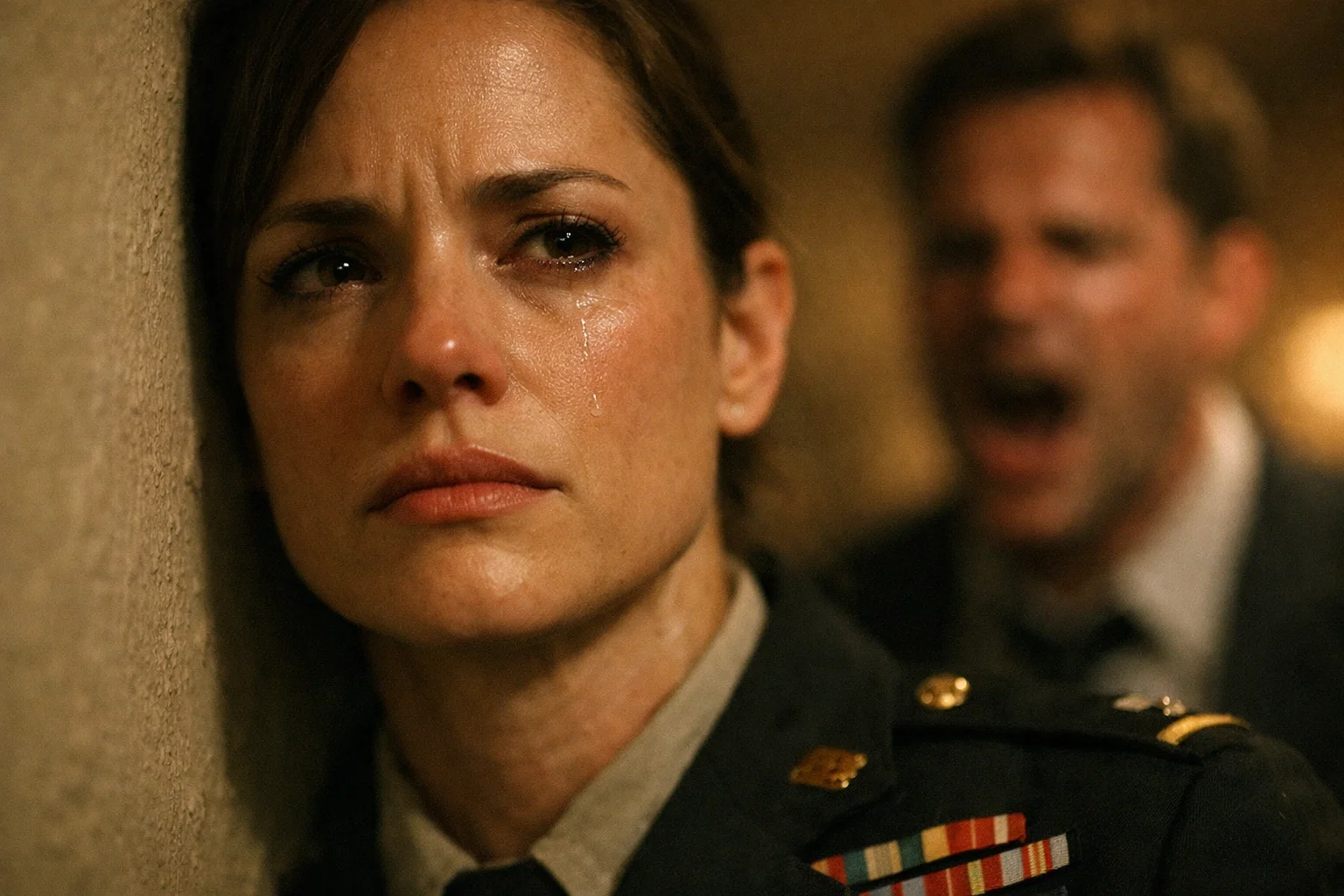
I touched the corner of my mouth. Blood.
“Linda,” I said. I kept my voice level. “That was a mistake.”
“Was it.”
Megan moved to my left side. I registered the movement too late.
The spit landed on the front of my uniform — precisely, deliberately, on the row of ribbons on my chest.
“Oops,” she said.
I heard Jason’s phone click up again. Recording.
The room had gone very quiet.
The wrong kind of quiet. The kind where everyone present is deciding who to be.
I pressed my back against the wall, not because I was afraid, but because I needed a second to assess the situation. Three people. One recording. A dining room with one exit.
I’d been in worse. Considerably worse.
But this was Daniel’s family.
I looked at him.
Daniel was standing at the head of the table, and the expression on his face was something I had never seen there before. It wasn’t anger. It was worse than anger.
It was grief.
He’d trusted these people. For thirty-four years he’d trusted these people, and in the space of ninety seconds they had shown him exactly who they were.
“Get out of my way,” he said quietly.
He was talking to Jason, who stood between him and the door.
“Dan, come on—”
“Get. Out. Of. My. Way.”
Jason stepped aside.
Daniel walked to the front door. He opened it.
Then he pulled out his phone.
I didn’t know who he was calling.
I found out later.
Linda was talking at me, something about lawyers again, something about how I needed to leave now and how this had gone far enough, but her voice had become distant and underwater and the only thing I could hear was my own breathing and the sound of Daniel on the phone in the hallway, speaking low and deliberate.
Megan crossed her arms. “She’s not even upset,” she said to her mother, like that was further evidence of something wrong with me. “Look at her. She doesn’t even care.”
“She’s in shock,” Linda said. Clinically. Like a diagnosis.
“I’m not in shock,” I said.
They both looked at me.
“I’m assessing,” I said. “There’s a difference.”
Linda made a small sound of contempt.
I watched Megan move toward the hallway.
I watched Jason lower his phone for a moment, check the screen, lift it back up.
And then — the sound of wood splintering.
The words cut through the room like a blade.
“Get away from my wife.”
Every head snapped toward the doorway.
The Carter family’s massive oak door hung crooked on its hinges, splintered where it had been forced open. Cold night air rushed into the dining room, fluttering the edge of the tablecloth.
Daniel stood in the frame.
His broad frame blocked the hall lights behind him, casting his face in shadow — but I didn’t need to see his expression to feel the change in the room. The laughter died instantly. The phones lowered. Even Linda Carter took a half-step back.
Daniel Carter was not a man who raised his voice often.
But when he did, people listened.
His eyes moved once across the room.
First to Jason’s phone.
Then to Megan standing inches from me.
Then finally to me — pressed against the wall, blood at the corner of my mouth, spit still sliding slowly down the front of my uniform.
The air turned heavy.
Dangerously quiet.
Jason tried to recover first, forcing out a laugh that sounded thin even to his own ears.
“Relax, man. We were just—”
“Turn it off.”
Daniel didn’t shout.
He didn’t need to.
Jason froze. After a second too long, he tapped the screen and lowered the phone completely.
Daniel stepped inside.
The floorboards creaked under the slow, deliberate weight of his boots.
He passed the broken door without looking at it, his focus locked on the circle that had formed around me. The family that had once welcomed him like a golden son now looked suddenly unsure where to stand.
Linda tried to reclaim control.
“You had no right to break into this house,” she snapped, chin lifting. “This is a private family matter.”
Daniel stopped walking.
For a moment he simply stared at her.
Then he said quietly, “You laid hands on my wife.”
The room held its breath.
Linda scoffed. “Don’t exaggerate. She—”
“Did you hit her?”
The question landed like a hammer.
Linda’s mouth opened. Closed.
Daniel turned his head slightly toward Megan.
“Did you spit on her?”
Megan’s perfect smile faltered. “Oh please, it was a joke—”
His gaze moved to Jason.
“And you filmed it.”
Jason shifted uncomfortably. “Look, man, you’re blowing this out of proportion—”
Daniel crossed the room in three strides.
The circle broke apart as people stepped away.
He stopped directly in front of me. His hands hovered carefully — like he was approaching a wounded animal he didn’t want to startle.
“Did they hurt you?” he asked.
The question was so soft. So different from the tension burning through the room that my throat tightened unexpectedly.
“I’m fine,” I said. Automatic.
Daniel’s eyes flicked to the bruise forming along my jaw. Then to the stain on my uniform. Then back to me.
“You’re bleeding.”
“It’s nothing.”
He didn’t argue.
Instead, he slowly reached up and wiped the blood from the corner of my lip with the edge of his sleeve.
Behind him, Linda’s voice came sharp with irritation.
“Oh for heaven’s sake. You’re acting like she’s fragile. She signed up for the military, didn’t she? If she can’t handle a little criticism—”
Daniel turned around.
The look on his face stopped her mid-sentence.
“You hit a decorated U.S. soldier,” he said quietly.
Linda laughed. Actually laughed.
“Decorated?” Megan chimed in. “Those ribbons? Please. Half the time they hand those things out for paperwork.”
Jason smirked. “Yeah, man. She’s probably a desk hero.”
Daniel didn’t react immediately.
Instead, he reached out slowly and took the edge of my jacket between two fingers, lifting it just enough to look at the row of ribbons Megan had mocked. The spit had nearly reached the bottom one.
Daniel’s thumb brushed the fabric once.
Then he turned back toward them.
“You have no idea what those mean,” he said.
Megan rolled her eyes. “Enlighten us.”
Daniel’s voice dropped lower.
“That one,” he said, pointing to the top ribbon, “is for pulling two wounded soldiers out of an armored vehicle after an IED detonated under it.”
The room went silent.
Megan’s smirk flickered.
Daniel pointed to the next one.
“That one is for staying behind during an evacuation to cover a medic team under live fire.”
Jason shifted his weight.
Linda crossed her arms, but she wasn’t speaking anymore.
“And that one,” Daniel continued, tapping the ribbon where the spit had nearly touched, “is the Silver Star nomination she hasn’t even told you about yet.”
My head turned sharply. “Daniel—”
He didn’t look at me.
He was staring at them.
“You called her scum,” he said. “You slapped her. You humiliated her in your dining room.”
Linda’s voice returned, brittle. “She married into this family. That doesn’t mean we have to respect—”
“No,” Daniel said calmly.
“It means you married into hers.”
Confusion rippled across their faces.
Linda frowned. “What are you talking about?”
Daniel reached into his jacket.
For a second, the entire room tensed.
Then he pulled out his phone.
He tapped the screen once. Held it up.
“Because right now,” he said quietly, “the people who trained her… the people who serve with her… and the people who command her…”
His thumb pressed the speaker icon.
“…are already on their way.”
From the phone came a calm, authoritative voice.
“This is Colonel Hayes. We are five minutes out.”
Jason blinked.
Megan’s confidence cracked.
Linda’s face drained of color.
Daniel lowered the phone.
And finally looked at them the way a man looks at something he has already decided to remove from his life.
“You wanted witnesses,” he said.
Outside, in the distance — sirens began to echo up the street.
Nobody moved for a full thirty seconds.
I counted.
Old habit.
Then Jason did the thing guilty people always do when they’re cornered — he tried to explain.
“Look, we never meant for this to—” he started.
“Jason.” Daniel’s voice was perfectly flat. “Do not talk.”
“I’m just saying it was a family argument, nobody was actually—”
“You filmed a woman being physically assaulted.” Daniel turned to look at him. “You filmed a soldier in uniform being struck and spat on. And it is all still sitting on your phone.”
Jason looked down at the phone in his hand like he’d forgotten it existed.
“Give it to me,” Daniel said.
“Dan—”
“That phone,” Daniel said carefully, “is about to become evidence. The only question is whether you hand it to me, or whether you hand it to Colonel Hayes when he walks through that door. Your choice. You have about four minutes.”
Megan grabbed Jason’s arm. “Don’t you dare—”
But Jason was already holding it out.
The sirens got louder.
Linda had moved to the window. She was watching the street, and I watched her watch it, and I saw the exact moment she registered the vehicles — not one, not two, but four — turning onto the block.
“This is ridiculous,” she said. But her voice had lost its architecture. The certainty had gone out of it, like air from a punctured tire.
“Linda,” I said.
She turned.
“I want you to think carefully about the next ten minutes,” I said. “Because right now you still have options. Colonel Hayes is coming because Daniel called him when he found out what happened. He’s coming as a colleague, not in an official capacity. If you choose to handle this like adults—”
“Handle what like adults?” She stepped forward. “You are the problem here. You walked into my home, you’ve taken my son, you’ve—”
“She’s been in three combat deployments,” Daniel said. He wasn’t raising his voice, but there was something final in it. “She has lost people she served with. She has done things under fire that you cannot imagine. And you stood in your dining room and you hit her and you let your daughter spit on her and you called it a family matter.”
Linda opened her mouth.
Daniel shook his head.
“Don’t,” he said. “Whatever you’re about to say — don’t.”
Headlights swept across the front window.
Car doors opened.
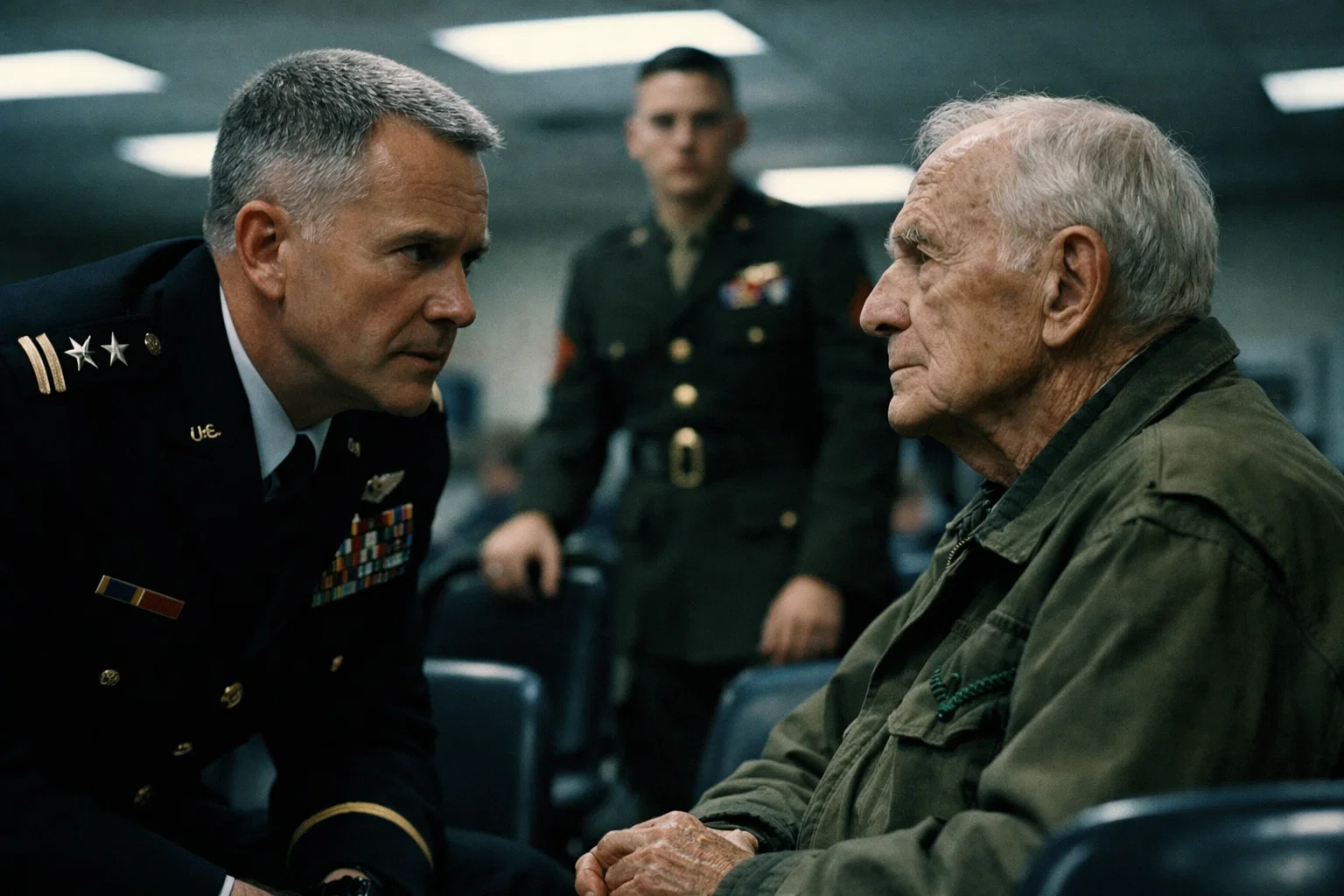
Colonel Hayes was fifty-two years old, built like a man who had never stopped doing PT, and walked with the specific kind of authority that came from decades of making difficult decisions and living with them.
He knocked once on the broken door frame before stepping inside.
Behind him came two MPs in uniform and a man in plain clothes I recognized from the JAG office on base.
Linda stared at them.
The JAG officer — Captain Reyes — scanned the room with the practiced efficiency of someone who had walked into a hundred of these situations.
“Sergeant Carter,” he said, looking at me. “Are you all right?”
“Yes, sir,” I said.
His eyes moved to the bruise on my jaw. Then to the uniform.
“We’d like to document the injuries,” he said, careful and professional. “For the record.”
“The record of what?” Megan said from across the room. Her voice was too loud. Off-key. The voice of someone running out of ways to sound calm. “Nothing happened here that requires—”
“Ma’am,” Colonel Hayes said.
Megan stopped.
He looked at her for a long moment.
“I’ve been doing this for twenty-six years,” he said. “I’ve seen what nothing looks like. This is not it.”
The next forty minutes were methodical.
Captain Reyes photographed my injuries. He collected statements. He took possession of Jason’s phone with a latex-gloved hand and sealed it in an evidence bag with the practiced ease of someone who had done it a hundred times.
Jason watched the bag and said nothing.
Daniel sat next to me on the couch the entire time. His shoulder pressed against mine. He didn’t make speeches. He didn’t pace. He was just there, steady and quiet, and sometimes that is the only thing that matters.
Linda tried twice to redirect the conversation toward the property documents, the lawyer she’d spoken to, the assets that needed protecting.
Captain Reyes let her talk.
Then he said, calmly, “Ma’am, those are civil matters. What we’re documenting tonight is a criminal matter. The two are separate. Your attorney will be able to explain the distinction.”
“Criminal,” Linda repeated. Like the word was in a language she didn’t speak.
“Assault on a military servicemember,” he said. “Battery. Possible charges related to the recording and distribution of an assault. We’ll assess the phone.”
Linda looked at Megan.
Megan looked at the floor.
Colonel Hayes sat across from me while the MPs finished their work.
“You should have called,” he said. Not an accusation. Just a fact.
“I didn’t want to escalate it,” I said.
“I know.” He looked at Daniel briefly. “He made the right call.”
Daniel nodded once.
Hayes leaned forward. “The Silver Star comes through next week. Formal ceremony, full brigade present.” He paused. “I want you to understand — what you did on that tour, what you risked — there are people walking around today because of you. I want that to mean something to you. Not to them.” He tilted his head slightly toward the corner of the room where Linda still stood. “To you.”
I looked at my hands.
“It does,” I said.
“Good.”
He stood up.
“We’re done here for tonight,” he said to the room. “Criminal proceedings are at the discretion of Sergeant Carter. The documentation will be filed. The phone will be analyzed.” He looked at Linda, then Megan, then Jason. “I’d suggest you find your own attorney before morning. Not for the property documents. For this.”
Nobody spoke.
Hayes buttoned his jacket.
“Sergeant Carter,” he said at the door. “Outstanding service. Carry on.”
The house emptied slowly.
The MPs left. Captain Reyes left. Hayes was the last out, pausing to shake Daniel’s hand in the doorway.
The four of us — me, Daniel, Linda, and Megan, Jason standing uselessly in the corner — were left in the ruin of the dinner.
The crystal glasses still caught the chandelier light.
The tablecloth was still pressed.
Only everything else had changed.
Daniel looked at his mother.
“I’m going to say this once,” he said.
Linda pressed her lips together.
“I loved you,” he said. “I defended you for years. Every time Claire came home and said something felt off, I said you just needed time. I told her you were difficult but not cruel.” He stopped. “I was wrong.”
“Daniel—”
“I’m not finished.” His voice didn’t waver. “You hit my wife. In your home. In front of witnesses. In front of a phone recording everything.” A pause. “There is no version of this that ends with me forgiving that. Not tonight. Not in a year. Not after a conversation or a mediator or a letter of apology.”
Megan made a small sound.
“You did this,” Daniel said. “You built this exact moment, piece by piece, over two years, and tonight you decided to finish it. So it’s finished.” He turned toward me. “Come on. Let’s go.”
I stood up.
I smoothed the front of my uniform — a reflex, pure muscle memory — and I looked at the row of ribbons Megan had mocked.
The spit had dried.
I’d get the uniform cleaned. Or I’d retire it. Either way.
I looked at Linda one last time.
She stood very straight. Very still. The posture of a woman who had built her entire self-image around being untouchable, and had just discovered — in the worst possible way — that she was not.
“I hope,” I said, “that it was worth it.”
She didn’t answer.
I didn’t need her to.
Outside, the night air was cold and clean and completely indifferent to the Carter family and their dinner and their assets and their plans.
Daniel took my hand.
We walked down the driveway without looking back.
“The Silver Star,” I said, after a moment.
“Yeah.”
“You could have told me.”
“Hayes called me yesterday. I wanted to be the one to tell you properly.” A pause. “I had a whole plan. Dinner somewhere nice. No family drama.”
Despite everything, I almost laughed.
“You have terrible timing,” I said.
“I really do.”
He held the car door open for me.
I got in.
He walked around to the driver’s side, and we sat there for a moment in the parked car in the quiet street, and I let myself feel the weight of the evening — really feel it, not the soldier’s way of cataloging and containing, but actually feel it.
It hurt.
Of course it hurt.
But it was also, finally, over.
“What happens now?” I said.
Daniel started the car.
“Now,” he said, “we press charges. We let Hayes and Reyes do their jobs. We let a judge see that phone.” He checked his mirror. “And then we go home.”
“And them?”
“They hired a lawyer to protect the family assets,” Daniel said. “They’re going to need a better one for this.”
Three days later, Jason was formally charged with obstruction and evidence of battery. Megan was charged with assault. Linda’s attorney called Daniel’s phone six times in the first twenty-four hours.
Daniel didn’t answer any of them.
He was at the hospital with me — nothing serious, precautionary — and then at a very quiet dinner at a restaurant where nobody knew our names, and then home, the two of us, the door locked.
A week later, in front of a full brigade, Colonel Hayes pinned the Silver Star to a fresh uniform.
He said my name.
The room came to attention.
For the first time in years, standing straight in the sunlight with the medal cool against my chest, I didn’t have to perform composure.
I just had it.
Because the people who mattered were there.
And the people who didn’t — weren’t.
Original fictional stories. AI-assisted creative content.