I bought the house in 2019.
Nothing spectacular—a three-bedroom ranch on a quiet street in suburban Ohio with a long concrete driveway that ran down the left side of the lot. The listing called it a “shared driveway,” and my realtor waved it off like it was nothing.
“You’ll work it out with the neighbor,” she said.
She didn’t know Patricia.
Patricia Holt had lived next door for thirty years. She was sixty-two, retired from the county assessor’s office, and she moved through the neighborhood like she’d been elected to run it. She knew everyone’s garbage schedule. She tracked who watered their lawn and when. She had opinions about mailbox colors and flag placement and the exact height at which hedges should be trimmed.
She introduced herself to me the week I moved in.
“I keep this block looking nice,” she said at the door, no smile, arms crossed. “I hope you’re planning to do the same.”
“Nice to meet you too,” I said.
She didn’t laugh.
For the first few months, I gave her nothing to complain about. I kept my lawn edged. I put my trash bins away by noon. I waved when she was outside. She didn’t wave back, but she didn’t bother me either, and I called that a win.
Then I bought the truck.
It was a used 2017 Ford F-150. Work gray, a few dings in the rear bumper. I did field inspections for an engineering firm and needed something I could throw equipment into. Nothing glamorous. I drove it home on a Thursday evening and parked it in the same spot I always parked—right side of the driveway, tucked close to the property line.
The next morning, there was a note under the wiper blade.
“Move your truck. It’s too large. You are taking up MY space. — P.H.”
I stood there for a moment, reading it twice.
Then I knocked on Patricia’s door.
She answered in a housecoat, coffee mug in hand, like she’d been waiting.
“I got your note,” I said.
“Good.”
“I’m parked where I always park.”
“That was fine when you had a small car.” She looked past me at the truck like it was a crime scene. “That thing is enormous. It’s blocking my view of the street.”
“Patricia, you can still see the street.”
“Barely. Park it somewhere else.”
“There’s plenty of room on the driveway.”
“Not on my half,” she said.
I paused. “Your half?”
“The driveway is split down the middle. You use your side. I use mine.”
I looked back at the driveway. Clean gray asphalt. No line. No paint. No markers of any kind. Just thirty feet of concrete stretching toward the street.
“There’s no line,” I said.
“There doesn’t need to be. It’s always been understood.”
“Understood by who?”
She set her coffee mug down on the side table inside the door. “By everyone who lived here before you.” She said it the way you’d explain something to a slow child. “Move the truck or I’ll have it towed.”
She closed the door.
I stood on her porch for a moment, genuinely unsure if this was real.
I let it go that day. I parked the truck on the street. I told myself she’d calm down.
She did not calm down.
Two days later, I came home to find four orange traffic cones arranged down the center of the driveway.
Four cones. Evenly spaced. Orange as construction zones, official as a court order.
I walked next door and knocked.
Patricia came to the window first, looked at me, then opened the door with a satisfied expression.
“What’s this?” I asked, gesturing toward the cones.
“Division of space,” she said simply.
“You put cones on a shared driveway.”
“My cones, on my side, marking the boundary.”
“Patricia—”
“Stay on your side,” she said, “and we won’t have a problem.”
She closed the door again.
I talked to my neighbor across the street, Dave, a contractor in his forties who’d lived on the block for eight years. He watched me from his garage with the look of a man who’d seen this before.
“Patricia put cones on your driveway?” he said.
“Four of them.”
He let out a long breath. “She tried to claim half my garage door once. Said the angle it opened was encroaching on her visual line or something. I told her to go pound sand.” He shook his head. “She’s done this with every new neighbor. She always backs down eventually.”
“What if she doesn’t?”
He shrugged. “She always has. Just don’t let her get in your head.”
I tried. But a week later, Patricia showed up in the driveway with a bucket of white paint and a wide brush.
I was watching from my kitchen window when she started. She bent down, set the bucket on the asphalt, and began painting a line straight down the center of the driveway.
A property line. Drawn in house paint. On my asphalt.
I went outside.
“Patricia. Stop.”
She didn’t stop. She dragged the brush in a long, slow stroke.
“Patricia.”
She stood up and wiped her hands on her jeans. “There. Now it’s official.”
I stared at the white line. It was crooked. It wobbled slightly to the right near the middle, like she’d lost her concentration. It was also, I noticed, positioned slightly in my favor—she’d painted it about two feet past the actual center.
“You can’t paint property lines on a driveway,” I said.
“I can do whatever I want on my half of the property.”
“This isn’t your half.”
“Half of the driveway has always been mine. I’m simply making it visible.”
“You need a surveyor to determine property lines. Not a bucket of house paint.”
She smiled. “Then get a surveyor.”
She picked up her bucket and walked inside.
And here’s the thing about that moment: she said it like it was a threat. Like “get a surveyor” was the equivalent of “go ahead, call the cops.” Like she was absolutely certain she’d win.
It was the most confident she’d ever looked.
Which is why I called the surveyor that same evening.
His name was Dan Kramer. He ran a one-man operation out of a van, had thirty years of experience, and answered his phone on the second ring. I told him the situation.
“Shared driveway dispute,” he said. “Got it. I can get out there early next week. Should have preliminary results within a few days, certified report in about ten.”
“How much?”
“Call it four-fifty.”
“Done,” I said.
I hung up and sat at my kitchen table feeling good about things for the first time in weeks.
Dan came on a Tuesday morning. He was thorough. He spent almost three hours with his equipment out front, measuring from the street to the back of the lots, cross-referencing with the county plat maps he’d pulled in advance. He took photos. He drove stakes.
Patricia watched from her front window the entire time.
I saw her curtain move twice.
After he finished, Dan came to my door. He had his tablet out and showed me a rough sketch of the lot boundaries.
“Okay,” he said, “here’s what I’ve got. You want the headline first or the details?”
“Headline.”
He tapped the screen. “The driveway’s on your lot.”
I blinked. “Say that again.”
“The entire driveway—all of it—sits inside your property boundary.” He zoomed in on the map. “When the subdivision was developed in 1989, your lot was platted with this configuration. The lot line here runs about three feet east of the driveway’s edge.” He pointed. “Your neighbor’s property doesn’t begin until here. She’s never had legal ownership of any part of that driveway.”
“For thirty years,” I said.
“For thirty years,” he confirmed.
“She’s been treating it like it was half hers for thirty years.”
“A lot of people assume shared driveways are split equally. Doesn’t make it true.” He handed me the tablet. “I’ll have the certified report in about a week. Two stamps, official seal, legally defensible.”
“Get me two copies,” I said.
I closed the door and sat down at the kitchen table.
I sat there for ten minutes without moving.
Then I started laughing. Not angry laughter. Not mean laughter. Just the kind of laugh that comes when something is so precisely, perfectly ironic that your body doesn’t know how else to respond.
She told me to get a surveyor.
She said it like a dare.
I waited for the certified report before I did anything. I wanted it in my hands, stamped and signed, official and undeniable. When it arrived on a Friday morning I read every page twice, traced every measurement with my finger, and made sure I understood exactly what I was holding.
Then I went to see Patricia.
She was in her front yard with a watering can, tending to a row of yellow mums along the front walk. She saw me coming and set the can down.
“If you’re here to complain about the line—”
“I’m not complaining,” I said. I held up the folder. “I got that property survey done.”
Her eyes moved to the folder. “And?”
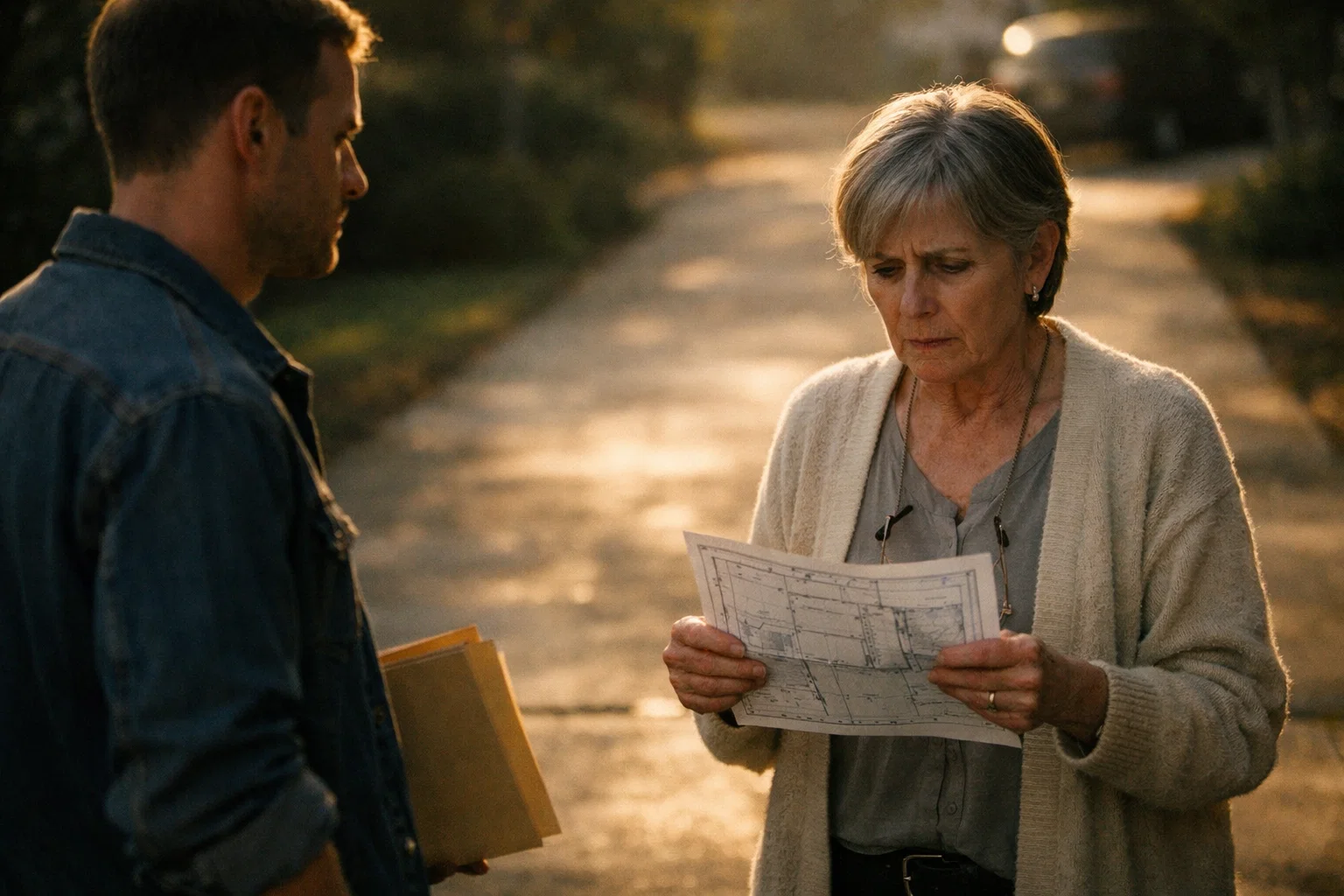
“I thought you’d want to see the results.” I opened it and pulled out the certified map. “You told me to get a surveyor. So I did.”
She made a short, dismissive sound. “It’ll show exactly what I said. Half mine, half yours.”
“Actually,” I said, “it doesn’t.”
I turned the map toward her and pointed to the lot line.
She leaned forward, squinting. Her reading glasses were inside. She came closer.
“This is the boundary line,” I said. “Right here. Your property ends here, approximately three feet east of the driveway edge.”
“That’s wrong.”
“It’s certified. Two engineers verified it. Official county seal.”
She snatched the map from me. I let her have it.
She stood there studying it for almost a full minute. I watched her face. It went from skeptical to confused to something I can only describe as a slow collapse—the expression of someone watching a version of reality they’d held for decades quietly come apart.
“This can’t be right,” she said. Her voice had gone quiet. “I’ve been here thirty years. The driveway has always—”
“The driveway has always been on my lot,” I said. “Your lot was never platted to include it. When the houses were built in 1989, the driveway was poured entirely on this parcel. Your property line ends before it even starts.”
She looked up at me. “I’ve used that driveway for thirty years.”
“You have. Without permission, technically. Which, depending on how you want to look at it, might be an issue.”
Her face went pale. “You can’t—you wouldn’t—”
“I wouldn’t,” I said. “I don’t care that you’ve been using it. I was never going to stop you from using it. I was happy to share it. I’ve always been happy to share it.”
She swallowed.
“But you decided to escalate. You left me notes. You threatened to tow my truck off my own property. You put cones on my driveway. You painted a line on my driveway.” I let that land. “You spent two months treating me like a trespasser on property that has legally been mine since 2019.”
“I didn’t know—”
“You didn’t check,” I said. “Because you didn’t think you needed to. You assumed.”
She looked down at the map in her hands. Her jaw was tight.
“Here’s what’s going to happen,” I said. “You’re going to remove the cones. You’re going to clean that painted line off my driveway. And you are never going to threaten my vehicle, leave notes on my property, or tell me where to park again.”
“And if I don’t?” she said. The defiance in her voice was thin now. Brittle.
“Then I hire a fence contractor. I put a six-foot privacy fence right along the property line—which, as you can now see, runs approximately three feet from your front walk. You’ll have no driveway access at all. You’ll need to apply for a curb cut permit with the city to build a new driveway on your actual property. That’s going to cost you, conservatively, fifteen to twenty thousand dollars. And it’ll require tearing up your landscaping.”
Patricia’s hands were shaking.
Not with anger. With something else entirely.
“Your choice,” I said. “I’m not trying to hurt you. I just want you to leave me alone.”
She didn’t answer.
She handed the map back to me. She walked back to her house without looking up. The door shut behind her. Not slammed this time. Just closed.
The next morning, the cones were gone.
By noon, Patricia was on her hands and knees on the driveway with a wire brush, a bottle of solvent, and a bucket of water. She worked in silence for two hours. I sat on my porch and drank coffee and watched her scrub away thirty feet of crooked white paint, stroke by stroke.
She never looked up.
She never spoke.
She just scrubbed.
When she finished, she gathered her supplies, stood up slowly with the effort of someone whose knees weren’t what they used to be, and walked back into her house.
The driveway was clean. Cleaner than it had been before, actually.
I finished my coffee.
For the next two weeks, Patricia was invisible. If I pulled into the driveway, her curtains closed. If I walked to the mailbox, she was suddenly not outside anymore. The neighborhood felt different—quieter, maybe, but not in a bad way.
Dave from across the street came over one afternoon and raised his eyebrows at me.
“She scrubbed the line?”
“Herself. With a wire brush.”
He stared for a moment. “Man.” He shook his head slowly. “I’ve lived here eight years. I’ve never seen her back down from anything.”
“She didn’t have much of a choice.”
“What changed?”
“Facts,” I said.
He laughed and went back to his garage.
I’d almost settled into thinking it was over when, three weeks after the survey confrontation, I found a note in my mailbox.
Not on my windshield this time. In my mailbox. Which was somehow more deliberate.
It was typed. Printed on plain white paper.
“I have consulted with an attorney regarding adverse possession and long-term driveway use rights. You may wish to do the same before you make any further threats.”
No signature. But I knew.
I went inside, poured a glass of water, and thought about it for a few minutes.
Then I called my own attorney—a real estate lawyer named Gabrielle Torres who’d handled my closing in 2019. I explained the situation.
“She’s citing adverse possession?” Gabrielle said.
“That’s what the note implies.”
“Does she have legal counsel, or is she just using the words?”
“I genuinely have no idea.”
Gabrielle was quiet for a moment. “Adverse possession in Ohio requires open, continuous, exclusive, and hostile use for twenty-one years. The use also has to be hostile to the owner’s interest—meaning without permission. But here’s the problem for her: a shared driveway, by its nature, implies permission. If she was using it under the assumption it was shared, that’s not hostile use. It’s permissive use.” She paused. “Also, her use wasn’t exclusive. You were using it too.”
“So the adverse possession argument fails.”
“It almost certainly fails. She’d need to demonstrate she used it exclusively and without the owner’s permission for over two decades. Hard to argue when she’s been splitting it with successive owners.” Another pause. “I can send her a letter if you want. Something official. Shut this down quickly.”
“Do it,” I said.
Gabrielle’s letter arrived at Patricia’s door via certified mail four days later. I didn’t see the full text, but Gabrielle had described it to me: a clear, formal statement of my ownership of the full driveway, a refutation of any adverse possession claim, and a statement that any further interference with my use of my property—including notes, threats, signage, or physical markers—would result in legal action.
Patricia signed for it herself.
I know because the mail carrier told Dave, who told me.
After that, silence.
Complete silence.
No notes. No cones. No paint. No curtain movements. No sideways comments about my truck.
Just silence.
About six weeks later, I was leaving for work when I nearly ran into Patricia at the end of the driveway. She was heading to her car. We both stopped.
We hadn’t spoken since the survey confrontation.
She looked at me for a moment. She looked tired in a way she hadn’t before—not physically tired, but the kind of tired that comes from carrying something heavy for a long time and finally putting it down.
“I owe you an apology,” she said.
I hadn’t expected that. I didn’t say anything.
“I’ve been thinking about it,” she continued. “I thought because I’d been here longer, because I’d watched this block for thirty years, I had more right to things than you did. I thought I was protecting the neighborhood.” She stopped. “I wasn’t. I was just controlling people.”
She looked down at her hands. “I looked up the plat map myself after your lawyer sent the letter. I went to the county records office.” A short pause. “She was right. You were right. The driveway has never been mine.”
“I know,” I said.
“I put a line on your property. I told you to move a vehicle off your own property.” She shook her head slowly. “I’m embarrassed.”
I didn’t let her off easy. “You should be.”
She looked up, startled by the directness. But she nodded.
“I’m sorry,” she said. “Genuinely.”
I thought about it for a moment.
“You can keep using the driveway,” I said. “I never wanted to take that from you. I just wanted you to stop treating me like the problem.”
She nodded, and I could see the relief move across her face like something loosening.
“Thank you,” she said.
We weren’t friends after that. We weren’t close. But the hostility was gone. She stopped monitoring the neighborhood. She stopped leaving notes anywhere. She stopped measuring everyone else’s lawn against some imaginary standard she’d invented decades ago.
Dave noticed within a month.
“Something happened with Patricia,” he said to me over the fence one weekend.
“We had a conversation.”
“She waved at me today. Like, actually waved. Not that suspicious look she always gave me.”
“She apologized to me.”
He stared. “Patricia Holt apologized to someone.”
“She did.”
He was quiet for a long moment. “That might be the most shocking thing you’ve said since you moved in.”
About five months after the survey, I saw Patricia struggling with four bags of groceries from her car—more than she should’ve been carrying at once. I walked over and grabbed two bags without asking.
“Thanks,” she said quietly.
“No problem.”
She was quiet for a moment as we walked toward her door. Then she said, “I spent thirty years thinking I was the keeper of this street. Standards. Appearances. Making sure people didn’t let things slide.”
“And?” I said.
“And I think I was just lonely,” she said. “And afraid that if I didn’t control things, I’d have nothing to do.”
I didn’t have anything to say to that. I set the bags on her porch and she thanked me again.
Before I left, she said, “Your truck’s not even that ugly.”
I laughed. First real laugh I’d had near her since I moved in. “Thanks, Patricia.”
She smiled. Small, a little crooked, but real.
A year after the survey, Patricia listed her house. She was downsizing, she said—moving to a condo closer to her daughter in Columbus. She didn’t make a production of it. Just a For Sale sign on a Tuesday.
The house sold in three weeks.
The day before the movers came, she knocked on my door. It was a Saturday morning, early. She had an envelope in her hand.
“I wanted to give you this before I left.”
I opened it. Inside was a handwritten note and a check.
The check was for four hundred and fifty dollars.
The note read: “For the surveyor. I should have paid half from the beginning. It was my dispute that made it necessary. Thank you for handling this the way you did—firm but fair. I learned something I needed to learn thirty years ago. Better late than never. — Patricia Holt.”
I looked up at her.
“You don’t have to do this,” I said.
“I do,” she said, and there was no uncertainty in her voice at all. “You were right. I was wrong. And you gave me a chance to fix it instead of just punishing me. That matters.”
She held out her hand.
I shook it.
“Good luck in Columbus,” I said.
“Good luck with your truck,” she said.
She moved out the following Wednesday.
The new neighbors arrived three weeks later. A couple in their early thirties, a dog, a moving truck that took up the entire driveway without a second thought. When I walked over to introduce myself, they offered me a beer from their cooler right there in the front yard.
“Your driveway okay?” the husband asked. “We’ve been taking up the whole thing.”
“It’s fine,” I said. “Use whatever you need.”
He grinned. “You sure? We don’t want to—”
“I’m sure,” I said.
And I was.
Every now and then, when I pull in after a long day, I notice the spot where Patricia scrubbed away that white line. The concrete is slightly cleaner there—you can almost see the ghost of where the paint was if the light hits right.
I don’t think about it with anger anymore. I don’t think about the notes or the cones or the certified letter or the weeks of silence.
I think about a woman who spent thirty years confusing control with care. Who didn’t know where her property ended and her fear began. Who needed someone to show her—firmly, legally, without cruelty—exactly where the line was.
The real one. Not the painted one.
And sometimes standing your ground isn’t about winning.
It’s about being clear enough, steady enough, that the other person finally—finally—sees the actual boundary.
And stops.
Original fictional stories. AI-assisted creative content.