I pulled into the driveway and felt my chest tighten before my brain could catch up.
No lights. No car. No sound from inside.
I’d just come off a twelve-hour shift at St. Mercy’s—twelve hours of crash carts, overhead codes, and a man who died holding his wife’s hand while she begged him to stay. My scrubs smelled like antiseptic and effort. My feet were still throbbing from the last four hours on linoleum.
All I wanted was to hear my kids.
My parents had the kids. Mom loved babysitting—always had. Dad tolerated it the way he tolerated most things: with a newspaper and a recliner. Daniel was traveling until Friday, and I’d dropped Lila and Noah off that morning without a second thought. Same as always.
I grabbed my bag and stepped out of the car.
That’s when I saw the movement.
The backyard backed up against thick forest, and something was coming out of the treeline. Slow. Small. Wrong.
I didn’t think. I just ran.
“Lila!”
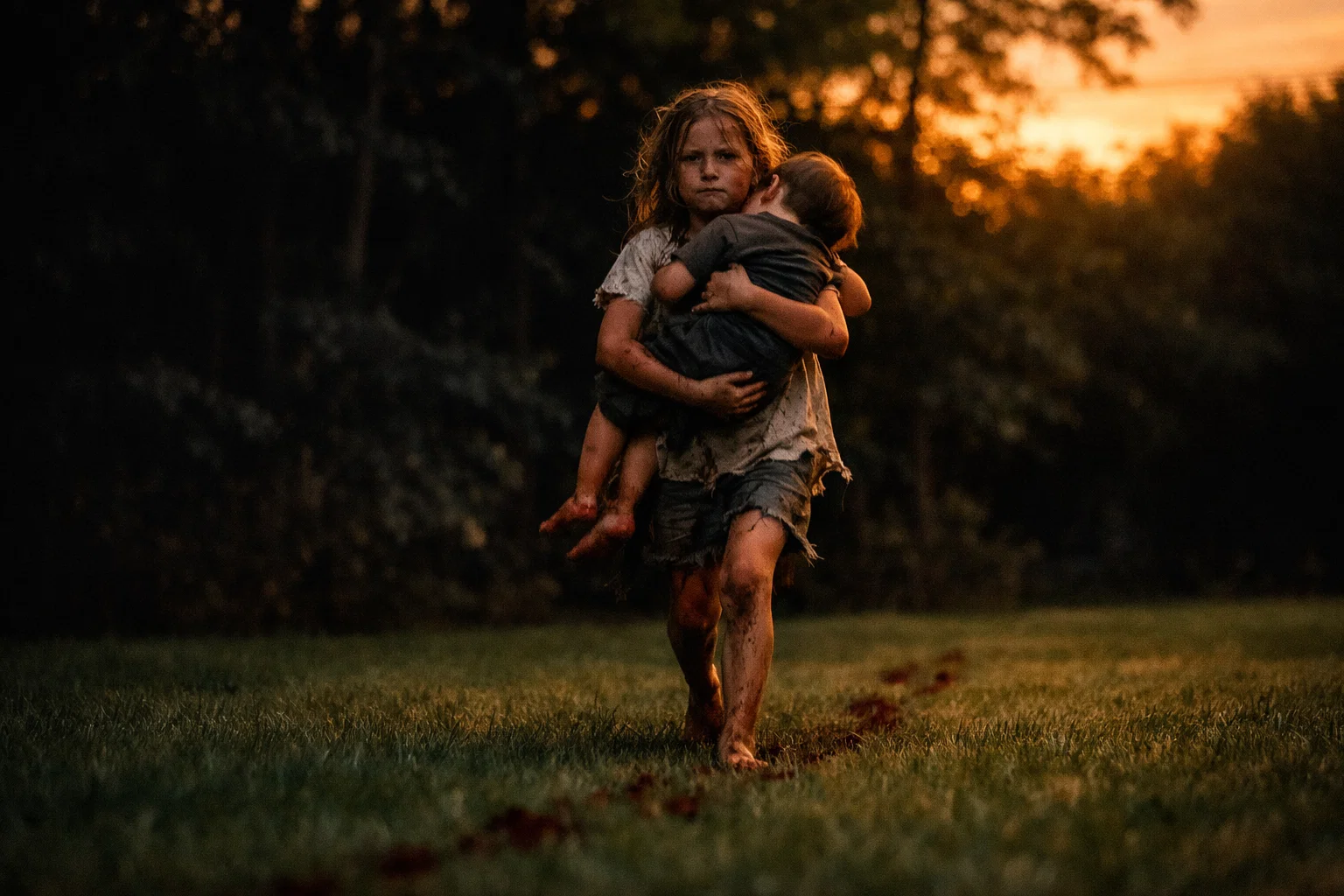
She didn’t stop. Didn’t flinch. Her jaw was locked, eyes fixed on something I couldn’t see—some finish line only she believed in.
She was carrying Noah against her chest, both arms wrapped under him, his head on her shoulder. Her unicorn shirt was ripped down the side. Her feet were bare and leaving something dark in the grass behind her.
I reached her in ten seconds.
“Lila, baby—”
“Don’t.” Her voice came out hoarse. Cracked. Like a woman twice her age. “Don’t stop me. I have to get him inside.”
“Lila, it’s me. It’s Mommy. I’m here.”
Her legs buckled.
I caught them both.
We sank into the grass. I took Noah from her arms—he resisted at first, his tiny fingers knotted in her hair—and the second his weight left her, something in Lila’s face just… collapsed.
She didn’t cry. That was the part that broke me. She was seven years old and she had run out of tears somewhere in those woods.
Noah was breathing. I checked his pulse with shaking hands. Weak, fast, but there. His lips were dry and cracked.
Lila’s feet were a disaster. Both soles split open, caked in dried blood and packed dirt. Her knees were raw. A bruise had bloomed across her right cheek like a storm cloud.
“What happened?” I whispered. “Baby, talk to me. Where are Grandma and Grandpa?”
She didn’t answer right away.
She looked at Noah. Made sure he was still breathing. Then she looked at me.
“Grandma left us in the car,” she said. “She said she’d be right back.”
I felt the world tilt.
“She walked into the store,” Lila said. “And she didn’t come back.”
“How long were you in the car?”
“A really long time. Noah got hot. He was crying so hard.” Her voice was flat now, like she was reading something she’d already memorized. “I tried all the buttons. The door handles. Nothing worked. I honked the horn. I screamed out the window.”
“Sweetheart—”
“Nobody stopped, Mommy. People walked right past.”
I pressed my hand to my mouth.
“Then Grandpa came. He broke the window with a rock.” She paused. “But he wasn’t right.”
“What do you mean, wasn’t right?”
“His eyes. He kept calling me Emma.” She looked at me steadily. “My name isn’t Emma.”
“He grabbed my arm really hard,” she said. “He pulled at Noah. He was yelling about people coming for us. People who wanted to hurt us.”
“Did he hurt you? The bruise on your face—”
“He didn’t mean to. He was scared. But he wasn’t… him. You know? He wasn’t Grandpa.”
I knew. I just didn’t know it yet.
“I got scared,” she said. “So I ran into the woods. He can’t run fast. And Noah can’t run at all.”
“You ran into the woods with a baby.”
She nodded. “I sang to him. So he wouldn’t be scared.”
My throat closed entirely.
I dialed 911 while she talked.
“There’s a seven-year-old with lacerations on both feet, a possible facial contusion, and an infant showing signs of dehydration. My address is—” I rattled it off. “I’m a nurse. I’m on scene. Send paramedics and police.”
The dispatcher was calm. I was not.
Lila watched me dial without expression. Then she reached over and rested one dirty hand on Noah’s chest. Just to feel him breathe.
“I found a stream,” she said. “I put water on his lips like you showed me. The time you said that’s what you do when someone can’t drink.”
“I said that?”
“When you were watching a nature show. You said it to Dad.” A pause. “I remembered.”
Officer Reyes arrived first. Young. Sharp eyes. He crouched down to Lila’s level without anyone telling him to.
“Hey,” he said. “I heard you carried your brother through the woods.”
“I didn’t have a choice,” she said.
He nodded slowly. “What’s your name?”
“Lila.”
“Lila, I need you to tell me everything you can remember. Can you do that?”
“Yes.” She straightened up. “I can do that.”
She talked for twenty minutes straight while paramedics worked on Noah and dressed her feet. She gave Reyes the store name, described the car, described what Grandpa was wearing, described the direction he’d gone when she ran.
She never once said she was scared.
But I saw her hands trembling the whole time.
The ambulance took both kids to St. Mercy’s—the same hospital I’d just walked out of.
The ER attending was Dr. Okafor. I knew him. I’d handed him charts a hundred times. Watching him examine my daughter was something I would never fully explain to anyone.
“She’s going to need stitches on both feet,” he said quietly. “Noah’s dehydrated but responsive. He’ll be okay, Sarah. You got to them in time.”
“She got to them,” I said.
He nodded. “Yeah. She did.”
Noah was put on IV fluids. He fell asleep within an hour, his little face finally losing the strained, sunburned look.
Lila got eight stitches total. She watched the needle go in without flinching.
“Does that hurt?” the nurse asked her.
“Yes,” Lila said. “But I’ve felt worse today.”
The nurse caught my eye over Lila’s head. I looked away before I started crying again.
My phone rang at 10:14 PM.
Caleb. My brother. He lived three states away and called maybe four times a year.
I stepped into the hallway.
“Tell me where Mom and Dad are,” I said before he could speak.
Silence.
“Caleb.”
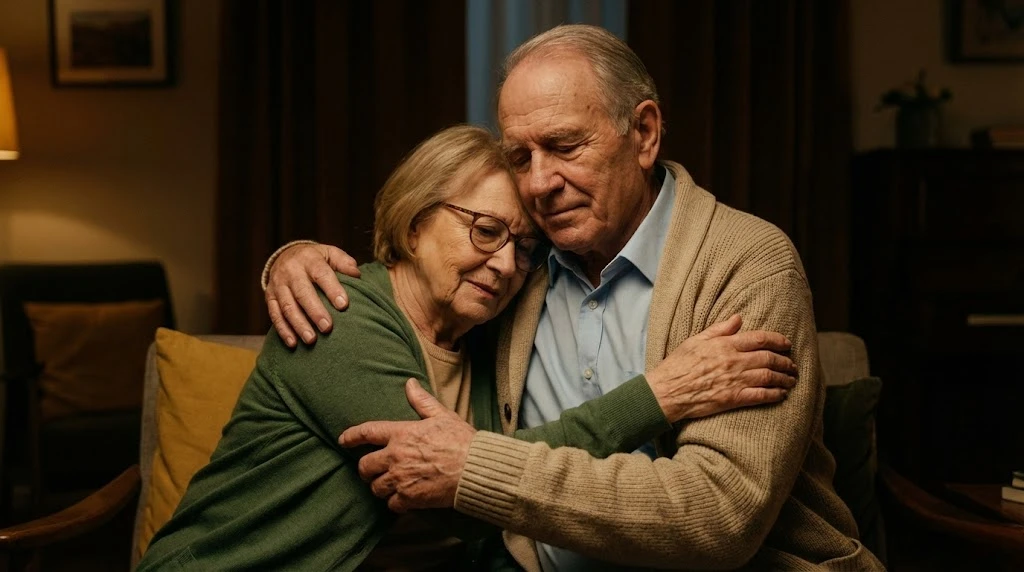
“They found Mom,” he said. “Miles from the house. She was wandering in her pajamas. She didn’t know her own name, Sarah. She didn’t know who the officers were.”
The hallway felt very long suddenly.
“What is it?”
“Alzheimer’s. Advanced. The doctor said she’s had it for a while. We just—” He stopped. “We didn’t see it. Or maybe we didn’t want to.”
“And Dad?”
A longer silence.
“Caleb, tell me.”
“They found a tumor. Brain tumor. Inoperable. It’s been pressing on his frontal lobe for months, affecting his behavior, his perception. He thought—” His voice cracked. “He thought someone was coming to take the kids. He wasn’t acting out of cruelty, Sarah. He genuinely believed he was protecting them.”
I leaned against the wall.
“He cried when they told him what happened,” Caleb said. “He couldn’t remember most of it. But he cried.”
I went back into Noah’s room and sat between my children.
Lila was half-asleep but she reached for my hand automatically.
“Mommy.”
“Right here.”
“Is Grandpa going to be in trouble?”
I looked at my daughter—seven years old, stitches in both feet, dried mud still in her hair—asking me if her grandfather was going to be in trouble.
“No, sweetheart,” I said. “He’s sick. He needs help.”
She was quiet for a moment.
“That’s what I thought,” she said. “He kept calling me Emma and I knew that wasn’t real. People only do that when something’s wrong in their brain.” She paused. “I learned that from you.”
“You learned a lot from me.”
“More than you think,” she said. And she fell asleep holding my hand.
Daniel came home the next morning. I called him at midnight and he was at the hospital by 7 AM, still in the clothes he’d boarded the plane in.
He stood in the doorway of Noah’s room for a long time without moving.
Then he crossed the room and wrapped both arms around me and said nothing.
There’s nothing to say to that. There’s no version of words that lands right. He just held on.
Later, in the hallway, he finally spoke.
“She carried him for hours,” he said.
“Hours.”
“Through the woods. With no shoes.”
“She found a stream. She wet his lips. She hid when she heard her grandfather coming.”
Daniel pressed a fist to his mouth.
“She’s seven, Sarah.”
“I know.”
“She’s seven years old.”
“I know, Daniel.”
He turned to the window. Outside, the parking lot was gray and ordinary. Cars moving in and out. People living their regular Tuesday.
“I should have been here,” he said.
“You couldn’t have known.”
“I should have been here anyway.”
I didn’t argue with him. Some guilt is just real, and it doesn’t move faster because you push at it.
Ruth was transferred to Meadowfield Memory Care within the week.
I visited her on a Thursday afternoon. She was sitting in a garden chair by a window, looking at the yard. When I came in, she looked up.
“Hello,” she said pleasantly.
“Hi, Mom.”
She smiled. “Are you a nurse here?”
“Yes,” I said quietly. “Something like that.”
She patted my hand. “You have a kind face.”
I sat with her for forty-five minutes. She talked about a vacation she’d taken in her twenties. She described her mother’s kitchen. She laughed at a joke I didn’t understand.
She never once asked about the children.
It wasn’t cruelty. It wasn’t choice. She was just gone—still warm, still breathing, still laughing at old jokes—but gone from the person I’d needed her to be.
I drove home and sat in the driveway for a while.
Samuel started radiation two weeks later. He had good days and bad days. On a good day, he called me.
“Sarah.”
“Dad.”
“I need to tell you—” His voice was different. Slower. Stripped of its usual bark. “I know what happened. They told me. I know what I did.”
“Dad, you were—”
“Don’t.” He stopped me gently. “Don’t make it easier for me to live with. Just let me say this.” A pause. “I scared her. I scared Lila. She ran into the woods because of me.”
“Yes,” I said.
“And she still got him home.”
“Yes.”
“She’s braver than I’ve ever been,” he said quietly. “Your daughter is braver than I’ve ever been in my life.”
His voice broke on the last word.
I didn’t know what to say to my father when he cried. So I just stayed on the line with him. Sometimes that’s what staying means.
Lila started therapy three weeks after it happened.
Her therapist was a woman named Dr. Haines, who had warm eyes and a bookshelf full of small plants. Lila liked her immediately, which wasn’t something I’d expected.
The nightmares came first. She’d wake up rigid, both hands fisted in the sheets, gasping—and then she’d be up and moving toward Noah’s room before she was fully awake. Checking. Making sure.
It took months for that to slow down.
But slowly, carefully, it did.
She stopped waking up every night. She started sleeping through. She laughed at school again—real laughter, not the performance of it.
She still checked on Noah before bed every single night without fail.
I didn’t try to stop her.
The year she turned eight, she ran into my room at 6 AM, book in hand.
“Mom. I’m writing something for school. Can I read you the beginning?”
“It’s six in the morning, Lila.”
“I know. Can I read you the beginning?”
I sat up. “Go ahead.”
She cleared her throat. She’d been practicing the voice.
“The day I became a real big sister, I was seven years old and very scared. But I remembered something my mom always says: scared isn’t the opposite of brave. Scared is where brave has to start.”
I stared at her.
“Do you like it?” she asked.
“Where did you hear me say that?”
“I don’t know. You probably said it when you didn’t think I was listening.” She tilted her head. “I listen to everything, Mom.”
The essay was called The Day I Became a Big Sister for Real.
She turned it in on a Wednesday.
Her teacher, Ms. Brennan, called me that same afternoon. I almost didn’t pick up—I was between patients.
“Mrs. Calloway,” she said.
“Kowalski,” I said. “I kept my name. But go ahead.”
“I’m sorry.” A pause. “I read Lila’s essay.”
“Okay.”
“I’ve been teaching for nineteen years.” Another pause, longer this time. “I had to step outside to finish it. I’m calling you from the parking lot right now.”
I leaned against the wall of the break room. The coffee machine hummed.
“She’s going to be something,” Ms. Brennan said. “Whatever she chooses to be. She’s going to be something.”
“I know,” I said.
“Does she know?”
I thought about Lila. The way she carried Noah through the trees. The way she wet his lips with stream water. The way she hid under tree roots and stayed silent when her grandfather’s voice echoed through the dark—because she knew, at seven years old, that keeping quiet was the same as keeping them safe.
“I’m going to make sure she does,” I said.
The school held an assembly in the spring. It was a small thing—no cameras, no news crews. Just the auditorium and folding chairs and every kid’s parents squeezed into the back rows.
They gave out citizenship awards. Book prizes. Attendance ribbons.
And then Ms. Brennan stood up and called Lila’s name.
Lila walked to the front in her cleanest sneakers, the white ones she’d saved for important occasions.
Ms. Brennan handed her a certificate and leaned in to say something I couldn’t hear.
Whatever it was, Lila looked out at the audience. Found my face. Held it.
Then she smiled—not the performance of it. The real thing.
Outside afterward, Noah ran ahead of us across the school lawn, tottering on his toddler legs like he owned the whole yard.
Lila watched him with her hands in her jacket pockets.
“He doesn’t remember it,” she said.
“No,” I said. “He doesn’t.”
“I’m glad.”
I looked at her profile—the cheek that had bruised and healed, the chin that had been set so hard in the dark that night.
“Are you okay?” I asked.
She thought about it for a real moment. Not a polite one.
“I think so,” she said. “Mostly. Dr. Haines says the hard stuff stays with you, but you get to decide where you carry it. Like a backpack.” She paused. “I think I’m figuring out where to put things.”
“That’s a really smart way to think about it.”
“She’s a really smart lady.”
Noah shrieked at a bird across the yard and Lila took off running after him without another word—her clean sneakers flashing in the spring light, her laugh loud enough to reach me from thirty feet away.
I can’t undo what happened. I can’t give her back the version of childhood where she didn’t have to be brave like that.
But I can tell you this:
My daughter was seven years old and alone and terrified in the dark, holding a baby who couldn’t walk, and she chose not to stop. She chose him over her fear. She chose the stream water and the tree roots and the aching arms and the bleeding feet—and she chose to keep moving.
She didn’t have superpowers. She had love. And she had a memory: that’s what you do when someone can’t drink.
She listened when she didn’t know she was listening.
She loved before she knew what love cost.
And that love carried them both out of the dark and into the grass and into my arms—and all the way to a Thursday afternoon in a school parking lot where a teacher had to step outside to finish reading what she’d written.
Lila is eleven now. Noah is five.
He calls her “Leela” because he still can’t get the name right and she refuses to correct him.
She says she likes the way he says it.
I believe her.
Original fictional stories. AI-assisted creative content.