
My name is Rachel Monroe. And the night my daughter was born was the night I finally understood the difference between a man who loves you and a man who needs you to believe he does.
The first contraction hit at 9:42 p.m.
I was folding laundry—a mundane, ordinary thing—when the pain arrived. Not sharp. Not dramatic. Just a deep, low tightening that made me go still, one hand braced flat against the dryer, the other pressed to my belly.
I breathed. I told myself it was nothing.
I was thirty-eight weeks pregnant. Everyone said first labor was long and gradual. Everyone said I’d know when it was real.
By 10:10, I knew.
The pain had rhythm now. Waves that stole my breath, bent me forward, palms on my thighs, counting seconds I couldn’t trust.
I sat on the edge of the bed and called my husband.
Andrew Monroe picked up on the fourth ring.
“What’s up?” he said—distracted, casual, like I’d interrupted something minor.
“Andy,” I said softly, already breathing differently, “I think I’m in labor.”
A pause. Then a sigh.
“Already?”
“Yes.” Another wave hit as I said it. I grabbed the headboard. “I’m serious. I need you to come back. Right now.”
“Rachel.” That tone. The tone he used when he thought I was catastrophizing. “You’re probably just uncomfortable. It’s your first time. Lie down, drink some water.”
“I can’t lie down,” I said through my teeth. “Please. Where are you?”
“With my parents. We’re leaving early for the trip.”
The words landed slowly. Like they had to travel a great distance to reach me.
“You’re—leaving?” I said. “Andrew, I cannot do this alone.”
He laughed. One short, dismissive exhale.
“You can get to the hospital yourself,” he said. “You’re strong. Drive carefully. Call me when you’re checked in.”
“I’m scared,” I said—and I hated the smallness in my voice. I hated that I had to say it.
“You’re being dramatic. I’ll have my phone on.”
The line went dead.
I sat there with the phone still pressed to my ear, staring at the wall, while the next contraction crashed through me hard enough to make me cry out. Not a sob. A cry. A sound that echoed off the bedroom walls and didn’t sound like me at all.
I don’t remember deciding to drive. I only remember being behind the wheel, hands shaking, belly pressing tight against the seatbelt, keys rattling in the ignition.
Three blocks. That’s how far I made it.
The pain hit so violently I slammed the brakes and barely rolled into the dark parking lot of a closed pharmacy. The street was silent. Not quiet—silent. That particular emptiness that exists after midnight in a neighborhood that’s already asleep.
I folded forward until my forehead touched the steering wheel.
Slow in. Slower out. The way they’d taught us in the birthing class Andrew had attended once and then stopped coming to.
I called my sister. No answer.
My closest friend, Dana. Voicemail.
Then the hospital labor line.
“I’m in labor,” I gasped. “I’m alone in my car. I don’t think I can drive.”
The nurse’s voice sharpened instantly. “Are you safe? Are you in a secure location?”
“I think so. Yes. A parking lot. I just—I need a minute.”
“Stay on with me,” she said. “Tell me what you’re feeling.”
I told her. Contractions every three to four minutes. Duration forty-five seconds, maybe more. Back pain radiating forward. I recited the numbers like a patient woman, even as my body made a liar of my calm voice.
The dashboard clock crept past midnight.
My phone stayed silent.
By 1:06 a.m., I was shaking so hard I couldn’t hold my water bottle.
Then my phone buzzed.
Andrew.
His name glowed on the screen.
I stared at it.
I knew that voice before I heard it—frantic now, suddenly urgent, suddenly present. The voice of a man who realized, too late, what he’d done.
I didn’t answer.
Some calls, if you pick them up, you give something away that you never get back.
The ringing stopped. Then started again. And again. Back to back to back, as if volume could undo absence.
A text came through.
ANDREW: “Where are you? Answer me. I’m turning around.”
I laughed once—sharp, bitter—and the laugh turned into a contraction and the contraction turned into a scream that I swallowed alone in the dark.
I called 911.
“I’m in active labor,” I said, voice cracking. “I’m alone in my car at the pharmacy on Westfield and Pine. I can’t drive. Something feels wrong.”
“Stay calm,” the operator said. “We’re dispatching now. I’m going to stay on the line with you. What’s your name?”
“Rachel.”
“Rachel, I need you to keep talking to me. How far apart are the contractions?”
“Two minutes,” I gasped. “Maybe less.”
“Okay. You’re doing great. Help is almost there.”
Headlights swept the lot four minutes later. An ambulance and a patrol car, moving fast, no siren—just lights cutting through the dark like something sent specifically for me.
A paramedic opened my door and knelt beside me. Female, mid-thirties, dark eyes that didn’t flinch.
“Hi. I’m Tanya. What’s your name?”
“Rachel,” I whispered.
“Rachel.” She said it like she was anchoring me. “We’ve got you. You’re not alone anymore.”
Inside the ambulance—too bright, too loud, everything moving fast—Tanya held my hand while her partner worked and spoke in low, serious tones. She caught me watching her face for the worst.
“Eyes on me,” she said quietly. “You’re okay.”
My phone buzzed again across the stretcher. Andrew’s name.
Tanya glanced at it. “Is that your support person?”
I swallowed. “He was supposed to be.”
She didn’t ask anything else. She just nodded once and shifted her attention entirely back to me.
The hospital doors opened into controlled chaos. I was moved fast, rolling under fluorescent lights, voices overlapping—until I saw him.
Andrew stood by the nurses’ station. Pale. Jacket still on. Eyes wide and frantic the way eyes get when guilt finally catches up to negligence.
“Rachel!” He crossed the lobby in three strides. “Why didn’t you answer? I’ve been calling—I got here as fast as—”
“You laughed,” I said.
My voice was quiet. Steady in a way that surprised even me.
“I told you I was scared,” I said. “And you laughed. And you told me I was being dramatic.”
He opened his mouth.
“I screamed alone in a parking lot at midnight,” I said. “I called 911 because I had no one else.”
A nurse appeared at my side. “Mrs. Monroe, we need to go.”
Andrew reached for my arm. “Rachel, please, let me—”
“Don’t follow me in,” I said.
I wasn’t angry. That was the strangest part. I wasn’t shaking with rage or shaking with heartbreak. I was completely, precisely calm—the way you go calm when something inside you makes a final, clean decision.
They rolled me into the delivery room.
He didn’t follow.
Labor is its own country. You cross a border going in and you are not the same person on the other side.
The hours blurred—pain, voices, breathing, the mechanical hum of monitors, the occasional gentle hand of a nurse named Megan who murmured, “You’ve got this, you’ve got this,” until I believed her.
Tanya stayed past the end of her shift. She didn’t announce it. She was just there when I looked for her.
And then—at 4:47 in the morning—my daughter cried.
A sound so fierce, so definite, so entirely alive that it obliterated everything else in the room.
They placed her on my chest.
She was warm. She was furious about existing. She smelled like something new and irreplaceable.
“Hi,” I whispered, crying now without restraint, “hi, baby. I’m your mom.”
Something broke open in my chest—not damage. The opposite of damage. The kind of opening that only comes after you’ve endured something you weren’t sure you could endure.
I had made it. She had made it.
We had done it without him.
Andrew was in the waiting room when a nurse went out ninety minutes later. He was given a bracelet and told to come in quietly.
He stood at the foot of the bed and looked at his daughter with an expression I’d never seen on him—something unguarded and terrified and real.
I watched him look at her.
“She’s perfect,” he whispered.
“She is,” I agreed.
He looked at me. His eyes were red. His voice broke slightly. “Rachel, I am so sorry. I panicked. I thought it wasn’t serious. I thought—”
“Andy.”
He stopped.
“I know what you thought,” I said carefully. “You thought I was exaggerating. You thought your plans mattered more. You thought I’d be fine because I’m usually fine.” I paused. “And I was. But not because of you.”
He pressed his fingers to his mouth and looked away.
“I’m not going to yell at you,” I said. “Not tonight. Not here.” I looked down at my daughter. “But this isn’t something we fix with a conversation.”
He stood there for a long time. Then he sat in the chair beside the bed and didn’t say anything else.
Sometimes the right response to causing harm is to finally, finally go quiet.
I gave him six weeks.
He came to every appointment. He held her when she cried at 3 a.m. He apologized in the thorough, effortful way of a man who had genuinely understood what he’d done.
It wasn’t enough.
Not because he hadn’t changed. Maybe he had. But I kept lying awake beside him and hearing that laugh—short, dismissive, cutting—and feeling the way the phone had gone dead in my hand while a contraction ripped through me alone.
Some sounds don’t unhear themselves.
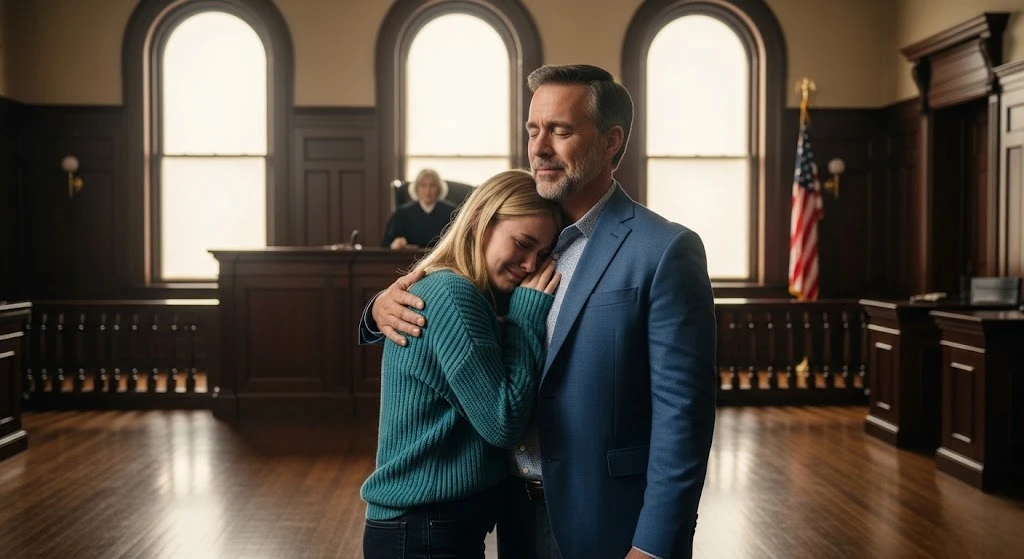
I filed for divorce eight weeks after my daughter came home. My attorney—a woman named Lorraine who wore a very good blazer and asked exactly the right questions—listened to the full account and said, simply, “We’ll make sure you and your daughter are protected.”
Andrew didn’t contest it.
I think some part of him knew.
The divorce was finalized seven months later.
I remember sitting in my car in the courthouse parking garage and waiting to feel something—grief, relief, sadness, rage. Instead I felt something clear and uncomplicated, like standing at a window in the morning and seeing that the storm has passed and the sky is absolutely ordinary and beautiful and yours.
I texted Lorraine: It’s done.
She wrote back: Go get lunch. You’ve earned it.
I did. A place I’d always wanted to try that Andrew had found boring. I sat by the window alone with my daughter in her stroller, and I ordered whatever I wanted, and I ate it slowly, and I watched her sleep.
Today, she’s fourteen months old.
She laughs at everything. Ceiling fans. Her own feet. The sound of crinkling paper.
She has no idea that she was born in the back of an ambulance because her father thought labor was an inconvenience. She has no idea that the first human beings to welcome her into the world were a paramedic named Tanya and a 911 operator whose name I never learned and a nurse named Megan who held my hand through the worst of it.
She doesn’t know any of it yet.
Someday, I’ll tell her.
Not to make her angry. Not to teach her to distrust. But to teach her what I had to learn the hard way, in a dark parking lot at midnight, alone with a body that wouldn’t wait for someone who wasn’t coming:
The people who show up when it costs them something—those are the ones who love you.
Everyone else is just comfortable in your vicinity.
I raise her in a house where love is a verb. Where people show up. Where “I’m scared” is never met with laughter.
She doesn’t know it yet. But she’s learning it every day—in the way I answer when she calls, in the way I come when she needs me, in the way I never, ever make her wait.
I kept Tanya’s number.
Two months after the birth, I sent her a message:
“You stayed. You didn’t have to. I want you to know it mattered more than I can say.”
She wrote back the next morning:
“That’s the job. But thank you. How’s the baby?”
“Perfect,” I wrote. “Furious about being awake. Perfect.”
“Ha,” she replied. “Sounds about right. Take care of yourself, Rachel.”
I do, now.
That’s the ending I didn’t expect—not dramatic, not cinematic. Just: I take care of myself now. I didn’t used to know how. I thought asking for help was weakness. I thought needing someone made me dependent. I thought if I was strong enough, I wouldn’t need anyone to show up at all.
I was wrong.
Needing people is not the same as being abandoned by them.
The difference is who you choose.
And I choose well, now.
Every day, I choose well.
Andrew remarried last spring. Someone I don’t know. I heard through mutual friends that he’s attentive now—present, involved, the kind of husband he wasn’t when it cost him something.
Good.
Let him be that for someone else.
My daughter and I have plans.
We’re going to see the ocean for the first time this summer—her first time, really—and I’ve already imagined the exact moment she sees the water and realizes the world is enormous and astonishing and hers.
I will be right beside her when it happens.
That’s the job.
That’s the whole job.
Original fictional stories. AI-assisted creative content.