My name is Nora Haines, and the morning I walked into the Whitmore Grand Hotel I was wearing the same jacket I had slept in for three nights.
The zipper was broken. The left sleeve had a tear at the elbow I had been hiding by keeping my arm bent. My shoes were held together partly by habit and partly by a strip of electrical tape I had found outside a bodega on Fifth. I knew how I looked. I had been knowing how I looked for about six weeks, ever since the sublet fell through and the storage unit took the last of what I had.
But the lobby was warm. That was the whole reason I had come in.
Not to steal anything. Not to cause trouble. Just to sit for forty minutes in a place that had heat and was not a bus shelter, because the temperature outside had dropped overnight and my hands had stopped feeling like mine somewhere around Eighth Avenue.
I found a chair along the wall and I sat down. I folded my hands in my lap. I looked at the floor.
I was not bothering anyone.
The lobby moved around me the way lobbies do: rolling suitcases, quiet phone calls, the soft piano from somewhere overhead. A woman in a camel coat walked past without looking at me. A man in a suit walked past without looking at me. I was good at being invisible by then. I had practice.
What I did not have practice for was the footsteps that stopped directly in front of me.
I looked up.
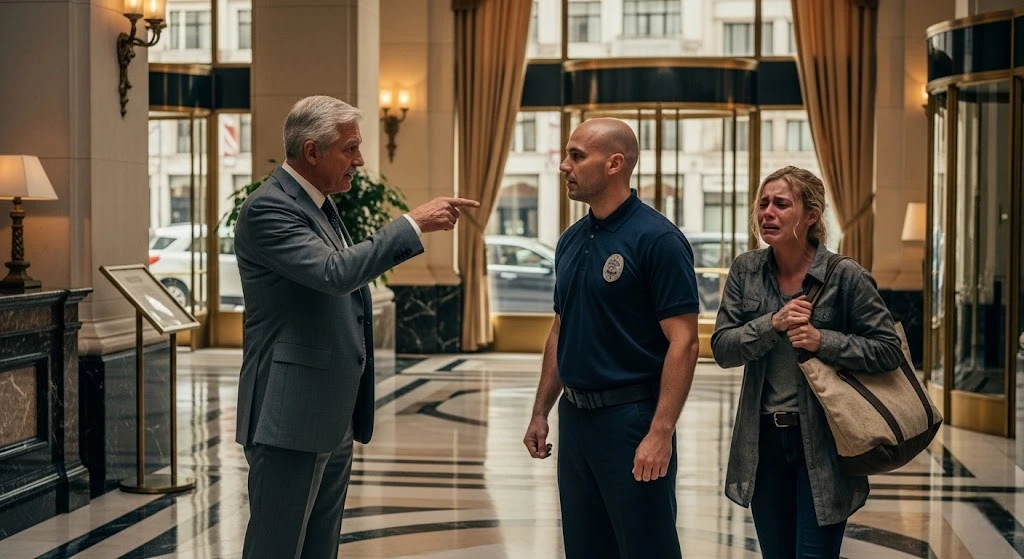
The security guard was big. Not tall, just wide, the kind of wide that fills a doorway and knows it. Dark uniform, silver badge, lanyard with a keycard. His face had already made a decision about me before his mouth caught up.
“You need to leave,” he said.
“I am just sitting,” I said.
“This is not a shelter.” He said it loud enough that the woman at the front desk looked up. “You cannot be here.”
“I am not doing anything.”
He reached down and closed his hand around my wrist.
It was not violent, exactly. It was the kind of grip that does not ask. The kind that assumes permission because it has never had to ask for it. He pulled upward and I had two choices: stand up or get dragged, so I stood up, and then I was moving whether I wanted to or not, my feet catching the floor in stumbling half-steps as he steered me toward the main doors.
I made a sound. Not words, not a scream, just something that came out of my throat on its own when my body realized it had lost control of where it was going. Sharp. Involuntary. It embarrassed me even as I made it.
He did not look at me. He looked forward, at the doors, at the exit, at the problem being solved.
“YOU CANNOT BE HERE LOOKING LIKE THAT.”
His voice filled the lobby. I felt people turning. I felt the specific quality of being watched that only happens when everyone is pretending not to watch.
The doors were maybe fifteen feet away.
Then a voice came from somewhere to the left. I could not see the source. It was not close. But it was the kind of voice that does not need to be close.
“STOP.”
One word. Flat. Absolute.
The guard’s hand loosened on my wrist. Not much, but enough. He turned his head.
I turned mine.
A man was walking toward us from the far side of the lobby. Silver hair, dark suit, the unhurried stride of someone who has never needed to run because things have always waited for him. He was not young. He was not loud. But something about the way the lobby reorganized itself around his movement told you everything before he said another word. Staff straightened slightly. A passing bellhop stepped aside without being asked.
He did not slow down as he reached us.
He stepped directly between me and the guard, and with one flat hand to the guard’s chest he pushed him back. Not hard enough to be assault. Hard enough to be completely clear.
He looked at the guard the way you look at something you have already decided about.
“YOU ARE FIRED,” he said. “GET OUT.”
The guard’s mouth opened. Something moved across his face. Argument, calculation, the dying reflex of a man who is used to being the authority in a room suddenly realizing he is not the authority in this room. His mouth closed. He looked at me, then at the silver-haired man, then at the floor.
He turned and walked toward the side corridor without another word.
The lobby exhaled around us.
The silver-haired man turned to me. He did not look at my jacket. He did not look at the tape on my shoe. He looked at my face, actually looked at it the way almost no one had in six weeks, and then he extended his hand. Open. Unhurried. An offer, not an instruction.
I looked at his hand.
I looked at him.
He did not say anything. He just waited.
I put my hand in his.
His grip was warm and completely steady, and he walked me gently away from the doors and back into the lobby. I followed because what else do you do when the first person in six weeks treats you like you are worth the trouble.
We sat in two chairs near the window. He asked a woman at the front desk for coffee, two cups, without making a production of it.
“James Whitmore,” he said, when the coffee came.
I stared at him. The name was on the building. Literally on the building outside, carved into the stone above the entrance. I had walked under it twenty minutes ago.
“Nora,” I said. “Nora Haines.”
He nodded like that was enough.
“I own this building,” he said, “which means what happened to you in it is my fault.” He said it simply, without performance. “I am sorry.”
I opened my mouth and then closed it because I had been about to say it is fine out of pure reflex. I stopped myself.
“It was not fine,” I said instead.
“No,” he agreed. “It was not.”
We sat there for a moment with that between us, which was somehow better than the apology alone.
He asked me, carefully and without prying, what had happened. I gave him the short version. Sublet fell through. Storage unit cleaned out. Six weeks. Hands that stopped feeling like mine on cold mornings. He listened without filling the silences. When I finished he was quiet for a moment.
“I have a building on Clement Street,” he said. “Transitional housing. A friend of mine runs it. Good woman. No waiting list right now. If you want, I can make a call.”
I looked at him. “Why?”
He thought about it honestly. “Because you were sitting quietly in a chair,” he said, “and someone decided that was a problem.” He paused. “I know the difference between a real problem and a person someone just does not want to look at.”
My throat tightened in a way I had not expected.
“Okay,” I said. “Yes. Please.”
He made the call right there at the table while I drank my coffee with both hands around the cup because the warmth was something I had been missing without realizing it.
I moved into the Clement Street building four days later. A room with a window. A radiator that worked. A lock on the door that was mine.
The guard had already been written up twice. The third strike came a little differently than he expected.
I think about that lobby sometimes. The marble floor, the piano overhead, the cold sitting in my hands when I walked through the doors. I think about how close I was to those fifteen feet and the exit and whatever came after.
And I think about a hand, extended. Open. Waiting.
Not everyone in a lobby is a guest. Sometimes the person who belongs there most is the one everyone is trying to remove.
Original fictional stories. AI-assisted creative content.