The bell chimed as Marcus pushed open the glass door of Riverside Bistro. Heads turned. Conversations paused.
He wore three layers of mismatched clothing. His hair was matted. The smell hit the room instantly—sweat, dirt, weeks without shelter.
The hostess stepped back, hand covering her nose. “I’m sorry, we’re… fully booked.”
Marcus looked at the half-empty dining room. “Just one table. Please.”
She shook her head quickly. “I can’t seat you right now.”
An older couple near the window whispered. A businessman pulled his briefcase closer.
Marcus’s shoulders sagged, but he didn’t leave. “I have money. I just want lunch.”
A blonde waitress named Ashley approached, iPad in hand. She got three feet away and stopped cold.
“Oh my God.” She turned on her heel and retreated to the kitchen, gagging.
Marcus stood frozen in the entryway, clutching crumpled bills in his fist.
Another waitress, brunette with a high ponytail, walked out carrying menus. The manager had sent her.
She made it two steps before the smell overwhelmed her. Her face twisted. She pressed her apron to her nose and backed away fast.
“I can’t,” she muttered to the hostess. “I’m sorry, I just can’t.”
The entire restaurant watched. Some with pity. Most with disgust.
Marcus’s voice cracked. “I just want to eat.”
From the back of the dining room, a waiter in a black button-down looked up from wiping down a table.
His name was David. Thirty-two. Former EMT. He’d seen worse.
He set down his rag and walked straight toward Marcus. No hesitation. No hand over his nose.
“Sir, right this way.”
The hostess blinked. “David, you don’t have to—”
“I got it.”
He guided Marcus to a corner booth by the window. Pulled out the chair. Handed him a menu like he was any other customer.
Marcus stared at him, eyes wet. “You’re not gonna kick me out?”
“Why would I do that?”
“I… I smell bad. I know I do.”
David sat across from him for a moment. “You’re a customer. That’s all that matters to me.”
He poured water into a glass without flinching. Set it down gently.
“Take your time with the menu.”
Marcus’s hands shook as he opened it. “I haven’t eaten hot food in two weeks.”
“Then let’s fix that.”
David walked back to the kitchen. Ashley stood near the dishwasher, arms crossed.
“You’re really serving him?”
“I am.”
“David, the smell is horrible. Customers are complaining.”
“Then they can leave.”
The manager, a thin man named Gerald, stepped forward. “David, I appreciate the sentiment, but this is a business. We have standards.”
David turned slowly. “He’s not breaking any laws. He has money. He’s sitting quietly. What standard is he violating?”
Gerald hesitated. “He’s… disruptive.”
“Or maybe we’re just uncomfortable. That’s on us, not him.”
Silence filled the kitchen.
David grabbed a notepad and walked back out.
Marcus had chosen the cheapest item—a bowl of soup.
“Just the soup?” David asked gently.
“It’s all I can afford.”
David wrote something down. “Got it. Be right back.”
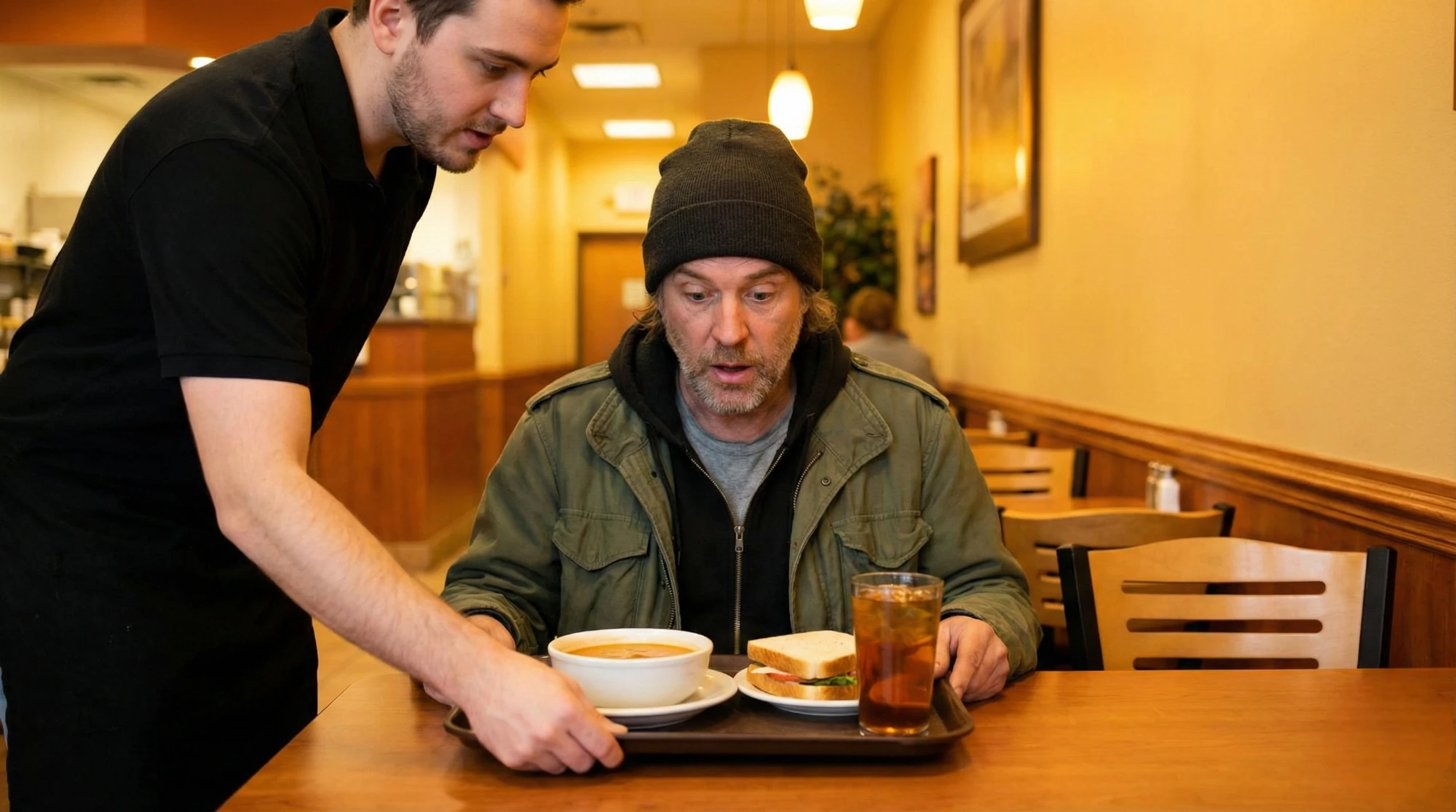
Ten minutes later, he returned with a tray. Tomato soup. Grilled cheese sandwich. Side salad. Iced tea.
Marcus’s eyes widened. “I didn’t order all this.”
“On the house.”
“I can’t—”
“You can. Eat.”
Marcus broke. Tears streamed down his dirt-streaked face as he picked up the spoon with trembling hands.
David stood nearby, not hovering, just present.
The soup was warm. The bread was crispy. For the first time in weeks, Marcus felt human.
Across the dining room, Ashley and the brunette waitress watched from a distance, whispering.
An older woman at a nearby table leaned toward her husband. “That’s the kindest thing I’ve seen all year.”
After thirty minutes, Marcus finished every bite. He wiped his face with a napkin and reached into his coat.
He pulled out $40 in crumpled bills and coins. Everything he had.
David brought the check. $12 for the soup.
Marcus counted out the money slowly. He left $28 on the table.
David’s eyes widened. “Sir, you don’t need to—”
“You treated me like a person.” Marcus’s voice was steady now. “That’s worth more than money.”
He stood. Extended his hand.
David shook it without hesitation.
As Marcus walked toward the door, something shifted in the restaurant. The older woman started clapping. Then her husband. Then a young couple by the bar.
The applause spread.
Marcus paused at the door, turned back, and nodded once. Then he left.
David stood holding the $28, stunned.
The manager approached quietly. “That was… that was something.”
Ashley walked over, face flushed. “I feel like garbage.”
“You should,” David said simply.
The brunette waitress stared at the empty booth. “I didn’t even try.”
David pocketed the tip. “He didn’t need your pity. He needed respect.”
By the end of the shift, the story had spread to the entire staff. The hostess couldn’t meet David’s eyes. Ashley requested to go home early.
The manager pulled David aside. “You know we’re supposed to refuse service if—”
“If what? If someone’s poor? Dirty? Inconvenient?”
Gerald sighed. “You made your point.”
Two days later, Marcus returned. Clean clothes. Showered. Hair trimmed.
He walked in and the hostess froze.
“Table for one?” she asked quietly.
“Please.”
David wasn’t working that day. But the brunette waitress, Claire, stepped forward.
“I’ve got this one.”
She seated him. Brought him water. Took his order without judgment.
When the check came, Marcus left a $20 tip on a $15 meal.
Claire stared at it, throat tight. “Sir, this is too much.”
“Someone taught me that respect is priceless. I’m just passing it on.”
She nodded, unable to speak.
That evening, Claire found David in the break room. She handed him an envelope.
Inside was the $20 and a note: Thank you for showing me what kindness looks like. I’ll do better. – Claire
David smiled. “Keep it. Use it to pay it forward.”
“I will.”
Ashley never came back to work. She quit the next week. The hostess requested a transfer to a different location.
But Claire stayed. And she never forgot the lesson.
The manager quietly updated the staff handbook: All customers will be treated with dignity, regardless of appearance or circumstance.
Marcus eventually found housing through a local shelter. He’d visit the restaurant once a month, always leaving generous tips, always spreading the kindness he’d received.
David never sought recognition. He simply believed everyone deserved a hot meal and a moment of humanity.
And the two waitresses who’d turned away? They learned the hardest way that compassion isn’t optional—it’s the minimum we owe each other.
Justice was served that day, not in punishment, but in transformation. One act of decency had rippled through an entire restaurant, changing hearts and policies forever.
Marcus was seen. David was honored. And kindness won.
Original fictional stories. AI-assisted creative content.