The manager’s hand came down fast.
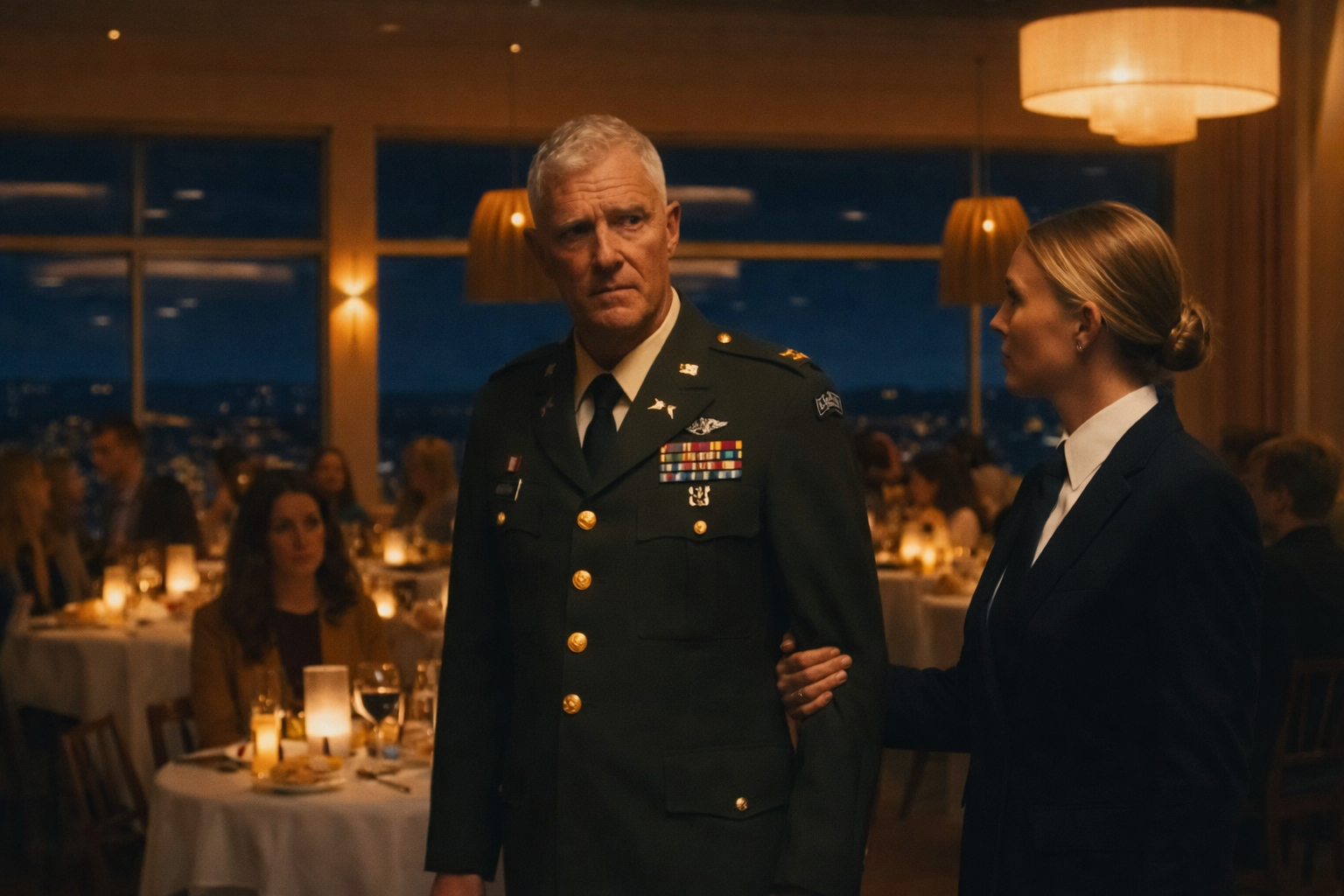
Firm fingers wrapped around the old man’s forearm, stopping him just inside the doorway — two steps past the threshold, not a single inch more.
A tablecloth slipped from someone’s hands.
Glasses clinked sharply at the bar.
And the entire dining room went silent.
“Sir.” The manager’s voice was clipped, official. “You cannot come through here. Do you understand?”
The old man blinked.
He was seventy-three. Broad-shouldered once, now slightly stooped. His Army dress uniform — pressed with careful deliberation that morning — hung on a frame that had carried it for decades. His name tag read: HAYES. His chest bore ribbons that most people in the room couldn’t name.
His eyes scanned the room with the practiced calm of a man trained never to show confusion.
But he was confused.
“I was invited,” he said quietly. “A young woman named Sarah called me. Said someone wanted to see me.”
The manager’s expression didn’t soften.
“Sir, I need to ask you to wait.”
A couple near the window whispered to each other. A man at the bar put down his drink and turned to stare. Near the back, a woman pressed a napkin to the corner of her eye.
No one said anything.
No one moved.
James Hayes — retired Staff Sergeant, thirty-one years of service, the last four spent in a VA waiting room trying to remember who he was without a rank — stood very still and wondered if he’d made a mistake.
He almost stepped back.
“Please don’t.”
The voice came from across the room — a young woman, mid-thirties, rising from her seat with visible urgency. Her chair scraped the floor and she crossed the dining room in quick, deliberate strides, hands clasped in front of her like she was trying to hold herself together.
“Please don’t go,” she said again, breathless. “I’m so sorry — the timing — it was supposed to be—”
She looked at the manager, flustered.
He dropped his hand from James’s arm and stepped aside.
“Apologies, Sergeant,” the manager said, and his voice had completely changed. “We just — we didn’t want you to walk in before we were ready.”
James stared at him.
“Ready for what?”
Nobody answered.
Instead, the hostess appeared at his elbow and said, softly, “This way, sir.”
He followed her into the dining room, and that was when he really saw it.
The room was packed.
Not with strangers — or at least, not entirely. Faces turned toward him with expressions he couldn’t immediately read. Not pity. Not awkwardness.
Something else.
Something that made the muscles along his jaw go tight in a way he hadn’t felt since he stood at a graveside in Arlington.
People clutching envelopes in their laps.
A man wiping his eyes quickly, like he’d been caught at something private.
A woman in a blue blazer standing near the back with her hand pressed flat against her chest.
At the center of the room stood a single table. One chair, facing the crowd. A small spotlight angled from the ceiling above it.
James stopped walking.
“I don’t understand,” he said.
The young woman who had crossed the room — Sarah, he now understood — came to stand beside him.
“My name is Sarah Malone,” she said. “You won’t remember me. I was eleven years old the last time I saw you. You were stationed near Fort Bragg. You were friends with my father.”
He looked at her more carefully.
“Tom Malone’s daughter.”
She nodded, and her chin trembled, but she kept her voice steady.
“My dad passed four years ago. But before he did, he told me something. He told me that during his worst deployment — the one he never talked about — you pulled him out of a situation that should have killed him. He said you never mentioned it. Never filed for commendation. Just kept moving.”
She paused.
“He told me you were the reason I got to grow up with a father.”
James said nothing.
His jaw worked once, slowly.
“Tom never should’ve told you that,” he finally said. “I was just doing—”
“Your job. I know.” She smiled softly. “He said you’d say exactly that.”
From a table near the front, a heavyset man in his fifties stood up. He had the build of someone who used to be military and still moved like it.
“Sergeant Hayes. My name is Devlin Cross. Third Battalion. You probably don’t remember me either — I was twenty-two, barely keeping it together in Kandahar. You sat with me for four hours after we lost Ramirez. You didn’t say much. You just… stayed. I never told you what that meant.”
James looked at him.
“Devlin.” His voice was lower now. “I remember you.”
Devlin sat down heavily, like the words had taken something out of him.
Then a woman near the center of the room stood.
“I’m Angela Marsh. Army nurse, retired. You donated blood twice during a crisis that nobody on the base would talk about officially. The second time they told you your levels were too low. You argued with the medical officer for twenty minutes and then lied on the form.” She paused. “The soldier you gave blood to is my son. He’s thirty-one now. He coaches Little League on Saturdays.”
James pressed his lips together.
“That was a long time ago,” he said.
“It was,” Angela said. “But he’s still alive.”
One by one, they rose.
A man in a business suit who said James had written him a letter of recommendation from overseas — handwritten, on official letterhead — when he applied to college after his mother died and he had no one to ask.
A woman who said James had stopped at a roadside breakdown outside of Fayetteville, called a tow truck, waited with her for ninety minutes in the July heat, and paid for the repair without leaving a name.
A younger veteran, early thirties, who said James had spoken at a VA group session five years ago and said something so specific — something about survivor’s guilt that James had apparently shared from his own experience — that it was the first time he’d felt like someone understood.
The room filled with voices, one after another, overlapping like water rising around him.
James sat down.
He didn’t remember choosing to. His legs just took him to the chair, and his body settled into it, and he sat with his hands on his knees and his jaw very tight.
And then something happened that James Hayes had not let happen in thirty-one years of service and eleven years of retirement.
His eyes filled.
Not gradually. Not politely. The way it happens when the body finally decides it’s done waiting for permission — a sudden, total welling, and then two slow lines tracking down the creases of a face that had been trained to hold still under fire.
He didn’t wipe them.
He sat there in the spotlight in his dress uniform, medals on his chest, tears on his face, hands flat on his knees — and he let it happen. Because there was no rank to protect here. No unit watching. Just a room full of people who already knew exactly who he was.
Sarah crouched beside him.
“There are more,” she said gently. “Letters. From people who couldn’t be here tonight. We contacted VA records, old unit rosters, family members. We’ve been collecting for eight months.”
She placed a wooden box on the table. Dark stained, simple. No embellishment. The kind a man like James would actually like.
“Three hundred and forty-seven letters,” she said. “From people whose lives you changed. Most of them said the same thing — that you never seemed to know you’d done it.”
He stared at the box.
“I was just—”
“Don’t say ‘just doing your job,'” said Devlin from across the room. A ripple of soft laughter moved through the crowd.
James almost smiled. Almost.
Instead, he placed one hand flat on top of the box and sat with that for a moment.
The manager appeared at the edge of the spotlight, his usual professional composure entirely gone.
“Sergeant Hayes,” he said, “I owe you an apology for the door. We had strict timing and I overcorrected.” He paused. “For what it’s worth — my uncle served in the same theater you did, in ’03. He came home. A lot of his friends didn’t. He always said the ones who made it back owed something to the ones who held the line when it counted.” The manager straightened. “Tonight we wanted to honor someone who held the line.”
James looked at him for a long moment.
“Your uncle make it okay?” he asked.
The manager’s throat moved. “Yeah. He did.”
“Good,” James said simply.
The lights in the room shifted — slightly warmer, slightly softer. Someone in the kitchen had clearly been waiting for a signal.
Waitstaff began moving quietly through the room. Wine was poured. Bread arrived. The low hum of conversation returned — not performative now, but genuine. People turning to their neighbors, leaning in.
Sarah sat down across from James and folded her hands on the table.
“How are you doing?” she asked carefully.
He thought about the question with the thoroughness of a man who had been trained to assess situations before speaking.
“I retired eleven years ago,” he said. “And I’ve spent most of that time wondering if any of it mattered.”
She held his gaze.
“And now?”
He tapped the top of the wooden box once.
“Ask me again after I read these.”
She smiled. “Fair.”
He picked up the box and held it in both hands.
Three hundred and forty-seven letters. Eight months of searching. A room full of people who drove or flew in, who rearranged schedules, who chipped into a dinner fund because someone made a call and said: there’s a man who should know what he did.
He had spent eleven years in a house with a lawn he mowed on Tuesdays.
He had spent eleven years wondering if he’d been forgotten.
He had not been forgotten.
Not by a single one of them.
“I want to say something,” he said suddenly. The room quieted again, without prompting, like they’d all been waiting.
James Hayes — seventy-three years old, thirty-one years of service, three hundred and forty-seven letters in a box — looked out at the crowd.
“In the military,” he said, “you learn real fast that you don’t fight for a flag. You don’t fight for an idea.” He paused. “You fight for the people on your left and your right. The ones you eat with. The ones who know what you’re thinking before you say it.” His voice was steady. Quiet. The voice of a man who had spoken in difficult moments before and knew how. “I never thought I was doing anything remarkable. I just thought I was showing up for the people next to me.”
He set the box down.
“Turns out,” he said, “some of them were standing next to me without me knowing it.”
Angela Marsh started crying first.
Then the man in the business suit.
Then Devlin Cross — loudly, unselfconsciously, in the way of a man who had stopped pretending a long time ago.
Devlin stood up.
Then Angela stood up.
Then the woman by the window. Then the younger veteran. Then the man in the business suit, still wiping his face with the back of his hand. One by one — and then all at once — every person in that dining room rose to their feet.
The applause that followed wasn’t polished. It wasn’t the kind that waits for a cue. It was the kind that starts before people decide to start it — hands coming together because there was no other way to respond to something that had just become permanent.
The waitstaff stopped in the aisles and clapped. The hostess pressed both hands together near the kitchen door, her shoulders shaking. The manager — the one who had stopped James at the entrance — stood at the back of the room with his arms at his sides, and after a moment, he began clapping too. Slowly. Deliberately. Like he was trying to put something into it.
The sound filled the restaurant completely.
James sat in the center of it, still in his chair, tears still on his face, one hand resting on the wooden box.
He did not stand. He did not wave. He did not speak.
He just looked out at the room — at all of them, standing, clapping, some of them crying, some of them smiling, all of them there — and for the first time in eleven years, he understood what he had been to them.
He set one hand on the box of letters.
He did not feel forgotten anymore.
He felt, for the first time in eleven years, exactly what he was: a man who had mattered — every single day — to more people than he could count.
The candle on his table burned steady and clear.
The wooden box stayed under his hand all through dinner.
And when the evening ended — when the last glass was raised and the last story was told — James Hayes walked out of that restaurant carrying three hundred and forty-seven reasons to remember that a life of service, quietly lived, is never quietly received.
It just sometimes takes the people you saved long enough to find their way back to you.
Original fictional stories. AI-assisted creative content.