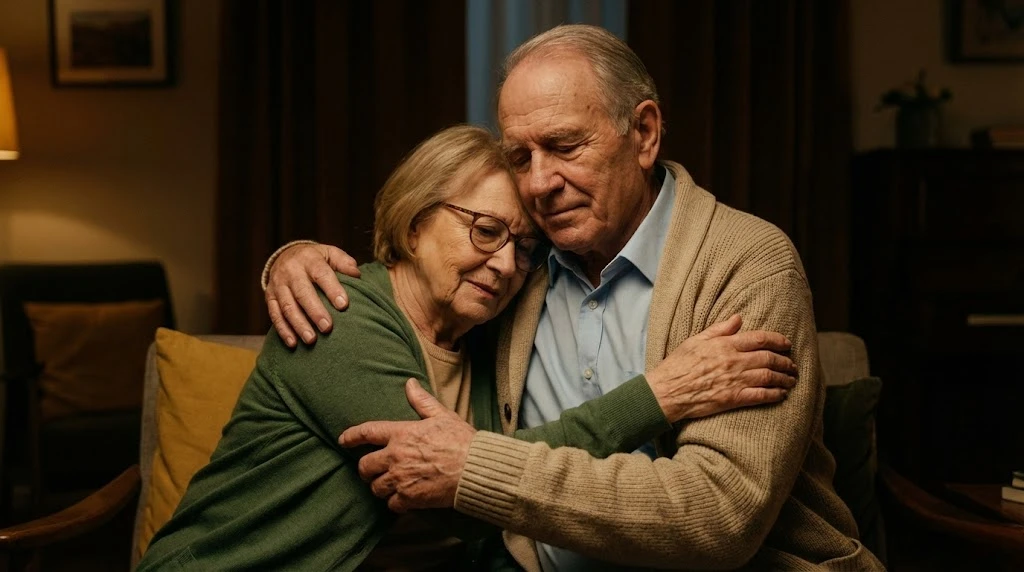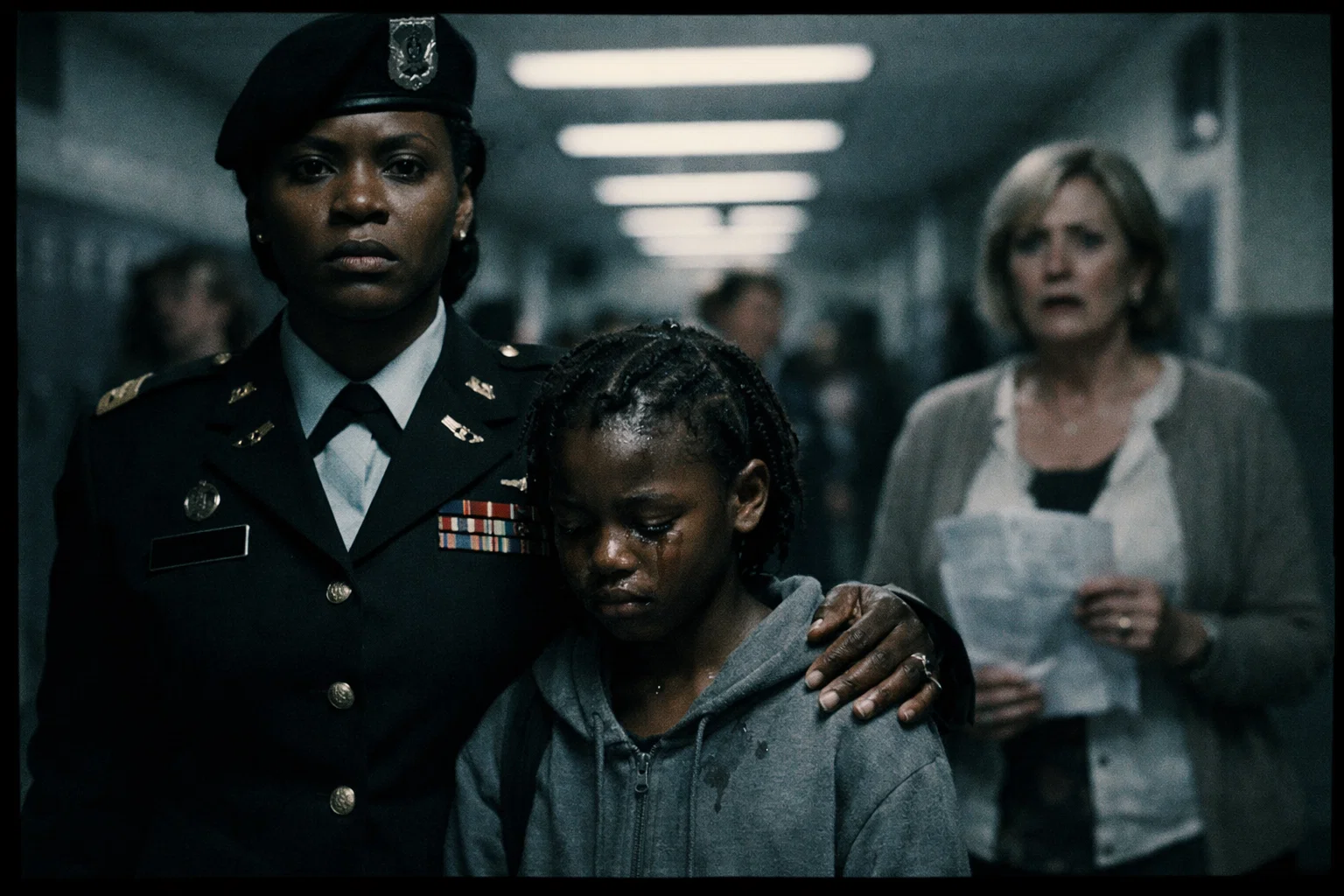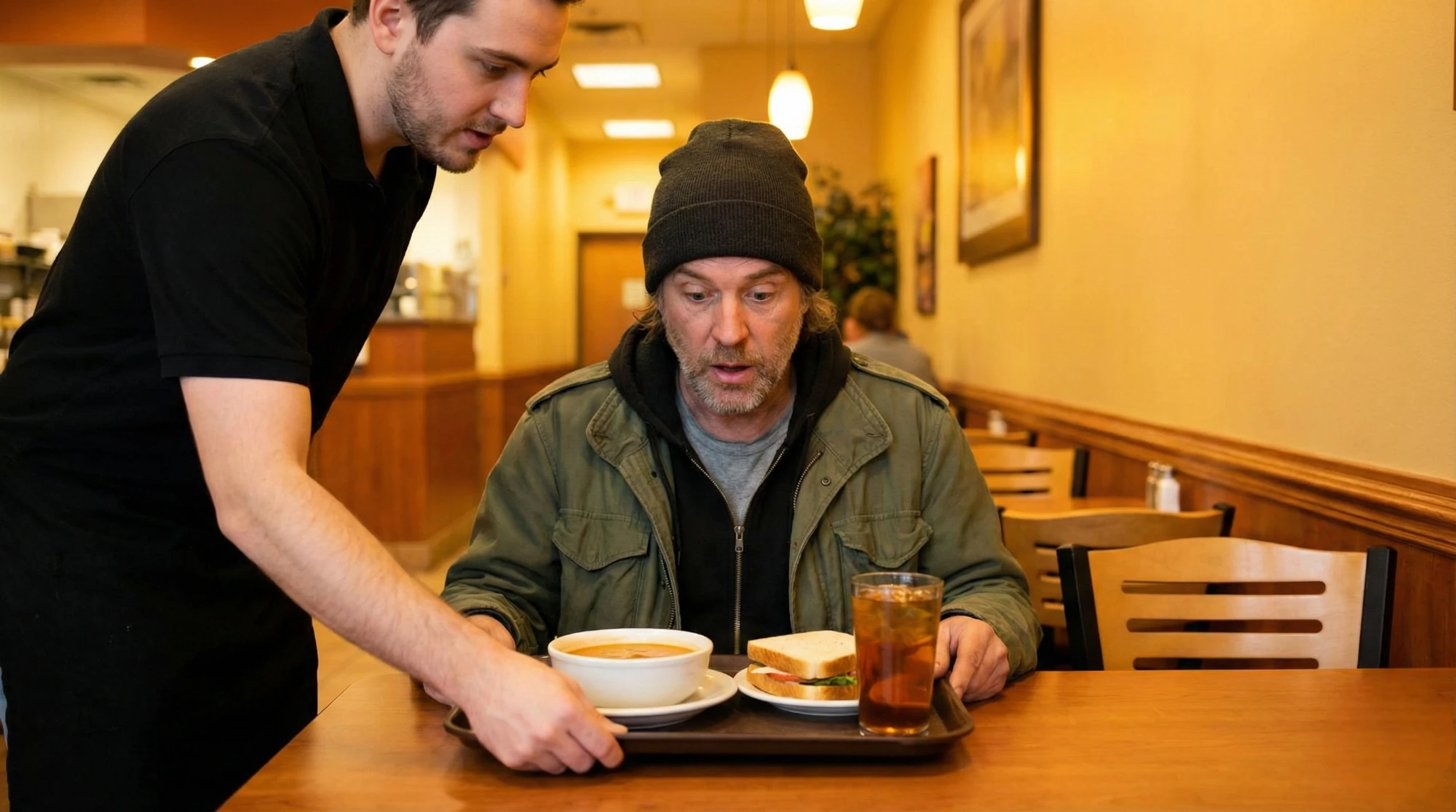

The door slammed so hard the porch light flickered.
I stood there in the cold, wearing a thrift-store coat and borrowed shoes, and I listened to the click of my daughter’s deadbolt sliding home.
Three seconds. That was how long Jessica had looked at me before deciding I wasn’t worth the inconvenience.
I pulled my collar up and walked to the next house.
Michael’s door opened two inches. Just enough for him to see my face.
His jaw tightened. Not with grief. With irritation.
“Mom.” He glanced over his shoulder. “This is… I have people over.”
“I just need somewhere to sleep tonight,” I said. “One night.”
He exhaled sharply and reached into his back pocket.
“Here.” He pressed a folded fifty-dollar bill through the gap. “Get a motel. I can’t have you here right now. Do you understand how this looks?”
The door clicked shut.
I stared at the fifty in my palm.
Fifty dollars.
Twelve years ago, I had written Michael a check for his law school tuition. Three hundred and forty thousand dollars. I remembered the exact number because I had smiled when I wrote it, thinking of his future.
He gave me fifty.
I put it in my coat pocket and kept walking.
The third house was at the end of a side street three miles from the wealthy district where Jessica and Michael lived.
The paint on the fence was peeling. The garden was small and tangled with dead winter plants. The porch light had a crack in the glass casing that someone had sealed with electrical tape.
I raised my fist to knock.
The door opened before I could.
Daniel stood in the light, wearing a faded sweatshirt with a school logo on the chest. He looked at me for one full second—not at my coat, not at my shoes, not over my shoulder—just at me.
“Mom,” he said.
And he stepped back to let me in.
Sarah was in the kitchen. She came out fast when she heard Daniel’s voice, drying her hands on a dish towel, and stopped when she saw me.
I braced myself.
Sarah and I had never been close. I had made sure of that, quietly, over years of carefully chosen silences at dinner tables and pointed questions about Daniel’s finances and future. I had never been cruel outright. I was too careful for that.
But I had never been kind, either.
She looked at me standing in her small hallway in a borrowed coat and said, “You’re freezing. Come sit down.”
“I don’t want to impose—”
“You’re not imposing.” She took my arm gently and guided me to the couch. “Daniel, make tea.”
“Already on it,” he called from the kitchen.
I sat.
The couch was worn at the armrests and the cushions were mismatched, but there was a blanket folded over the back and she shook it out and put it around my shoulders without being asked.
I didn’t know what to say.
So I said nothing.
They fed me. Pasta from a pot on the stove, bread from a bag on the counter, hot tea in a mug that had a chip on the handle. Daniel sat across from me and didn’t ask why I was there or what had happened. He just passed me the bread and talked about his students like I was any ordinary guest at his table.
Sarah asked if I took sugar.
“Two,” I said.
“Same as Daniel,” she said, smiling at him over my head.
That small moment—private and warm and completely unconcerned with me—hit me somewhere I hadn’t expected.
They were happy.
Not in the way Jessica was happy, with her renovated kitchen and her charity galas and the hollow, performance-grade contentment of people who have everything they wanted and feel nothing from it. Daniel and Sarah were happy in a quieter, realer way—the kind that comes from genuinely choosing each other every day in a house with a cracked porch light and mismatched couch cushions.
I had spent twelve years pitying my son’s life.
I was sitting inside something I didn’t know I’d been missing.
That night, after Daniel showed me to the spare room, I lay on the narrow bed and listened to the house settle around me.
Their voices drifted through the wall. Low. I couldn’t make out words. Then I heard Sarah clearly.
“We could sell the rings. The gold alone would—”
“No.” Daniel’s voice, firm. “We’re not doing that.”
“Daniel. She’s our family.”
“I know.” A pause. “I’ll call the school tomorrow. Ask about the advance on next month’s salary.”
“And if they say no?”
“Then we figure it out another way.”
A long quiet.
“She looked so tired,” Sarah said softly.
“I know.”
Another silence.
Then Daniel said, very quietly, “I don’t care what she has or doesn’t have. She’s my mom.”
I pressed my hand over my mouth in the dark.
I had built a textile empire. I had negotiated contracts with international banks. I had stared down partners who’d underestimated me for thirty years.
And I was lying in my youngest son’s spare room, crying into a pillow, because his wife wanted to sell her wedding ring to buy me food.
Let me take you back to where it started.
Three weeks earlier. Twenty-third floor. Charlotte skyline through floor-to-ceiling glass.
My name is Linda Miller.
For thirty-five years I have run Miller Textile Group—twelve factories, contracts with four of the country’s top clothing chains, a workforce of nine hundred and sixty people. When my husband died twelve years ago, everyone waited for the company to fall apart.
It didn’t.
I held it together with twelve-hour days and a ferocity that surprised even me. I learned every corner of the business. I renegotiated every contract. I fired the partners who tried to push me out and replaced them with people who understood that I wasn’t temporary.
When my husband died, the company was worth eleven million.
Today it’s worth fifty-eight.
I don’t say that to impress you. I say it because it matters to the rest of this story.
It started with a phone call from Robert.
Robert Haines had been my attorney for nineteen years. He called me on a Tuesday evening while I was still at my desk.
“There’s been a development,” he said. “Regarding the estate planning documents.”
“What kind of development?”
“Someone accessed the draft files. From inside the company server.”
I set down my pen. “Who?”
He hesitated. “The access log shows Jessica’s login credentials.”
I was quiet for a moment.
“And the documents she accessed?”
“The preliminary inheritance allocation. The one we drafted last spring.”
I thought about that for a long time after I hung up.
Jessica had logged into my private estate files.
She’d seen the draft numbers. She knew what she was potentially set to receive. And she had never mentioned it to me—not a word, not a question, not even a casual reference.
Which meant she was waiting.
I called Robert back the next morning.
“I want to run a test,” I said.
“What kind of test?”
“The kind that tells me who my children actually are.”
Robert was quiet for a moment. “Linda—”
“I’m not being dramatic. I need to know.” I looked out at the skyline. “I’ve given them everything. The houses, the education, the connections, the money. I’ve been generous in ways I’m not sure were good for them.” I paused. “I want to know what happens when I have nothing.”
Another silence.
“You want to approach them as someone in need,” Robert said slowly.
“I want to knock on their doors and ask for help. That’s all.”
“And if they turn you away?”
I looked at the city below me, small and clean from this height.
“Then I want to know that too.”
The disguise wasn’t elaborate. I didn’t need it to be.
I had my hair pulled back and my face bare of the makeup I normally wore. I dressed in clothes I’d bought at a Goodwill on the edge of town—a worn coat, flat shoes, a plain gray scarf. I left my phone at the office, left the car in the parking garage, and took a rideshare to the edge of Jessica’s neighborhood.
I walked the rest of the way.
It was November. Cold, but not brutal. The kind of cold that makes you want to be inside, which was the point.
I stood at Jessica’s door for a long moment before I rang the bell.
She opened it, and I watched her face move through recognition in stages.
Confusion first. Then something tightening around her eyes.
“Mom.” She looked past me, as if checking whether anyone had seen me arrive. “What are you—why are you dressed like that?”
“I need some help,” I said. “Just a night or two. Things have gotten complicated and I need—”
“Complicated how?” Her voice had gone careful. Flat. The voice she used in meetings when she was about to say no and didn’t want to look like the bad guy.
“I had some financial trouble. It’s temporary. I just need—”
“Mom.” She cut me off. “I’m sorry, but this isn’t a good time. I have the Harrington dinner tomorrow and I just—this isn’t something I can take on right now.”
“Jessica—”
“I’ll have Marcus call you a car.”
The door closed.
I stood on the porch.
The Harrington dinner.
My daughter had a social engagement tomorrow and therefore could not take in her mother for one night.
I walked to Michael’s house.
You already know how that went.
I told Robert everything the next morning, standing in his office with the fifty-dollar bill on his desk between us.
He stared at it.
“He gave you fifty dollars,” Robert said.
“Through the door. He didn’t open it more than two inches.”
Robert said nothing for a moment. Then he said, “And Daniel?”
I described the night. The couch blanket. The tea with two sugars. The conversation I’d heard through the wall about the wedding rings.
Robert was quiet for a long time.
“What do you want to do?” he said finally.
“I want to move forward with the revised documents.”
“You’re sure?”
“I’ve never been more sure of anything in my professional life.”
He nodded slowly and pulled a folder from his desk.
“Then let’s talk about what happens next.”
I went back to Daniel’s house that afternoon.
I knocked instead of walking in, even though Sarah had told me the night before that I didn’t need to.
Daniel opened the door. He looked tired—I realized later he had asked about the salary advance that morning and been told it would take two weeks—but he smiled when he saw me.
“You didn’t have to knock,” he said.
“I know.” I looked at him. “I have something to tell you.”
We sat at his small kitchen table. Sarah stood by the counter with her coffee cup, watching me with careful eyes.
I told them.
Not everything—not the full financial picture, not the estate documents, not Robert’s name. Just enough.
I told them that the trouble had been a test. That I wasn’t in financial difficulty. That I had come to their doors on purpose to see what would happen.
Daniel’s face went very still.
“Jessica turned you away,” he said.
“Yes.”
“And Michael.”
“Yes.”
He looked down at the table. A muscle moved in his jaw.
“Mom.” His voice was quiet. “Why didn’t you just ask us?”
“I needed to know without asking.” I looked at my hands. “I’ve given money my whole life. To everyone. I didn’t know anymore what it meant to the people receiving it.”
Sarah said nothing. She was watching me carefully.
“I heard you last night,” I said. “Through the wall. I heard you talking about the rings.”
Sarah blinked.
“I wasn’t meant to hear that. I know.” I looked at her directly for the first time in years—really looked at her, not at the surface of her the way I always had. “I owe you an apology that’s been overdue for a long time.”
She set down her coffee cup.
“You were going to sell your wedding ring,” I said. “For me. After I spent twelve years treating you like you weren’t good enough for my son.”
Silence.
“Sarah,” I said. “I’m sorry. Truly.”
She was quiet for a moment.
Then she said, “I didn’t do it for you, Linda.”
I looked up.
“I did it for Daniel.” Her voice was even. “He loves you. That’s why.”
“I know.” I exhaled. “I know that. And I don’t deserve it.”
She crossed the kitchen and sat down across from me.
“You don’t get to decide what you deserve,” she said quietly. “That’s not how family works.”
Two days later, Robert arrived at the house.
He pulled up in the town car with two of his associates, all three of them in dark coats, looking dramatically out of place on the narrow side street.
Daniel answered the door and stared.
“Mrs. Miller asked me to meet her here,” Robert said politely.
“I—” Daniel looked back at me. “Mom?”
“Let him in,” I said.
Sarah appeared from the hallway. She looked at Robert, then at me, then at the folder under Robert’s arm.
“Should I make coffee?” she said.
“Please,” Robert said gravely.
We sat in the living room—Robert and his associates on one side, Daniel and Sarah on the other, me in the middle—and Robert opened the folder.
“I’ve revised the estate documents,” he said, “per Mrs. Miller’s instructions from this week.”
Daniel looked at me. “Mom—”
“Let him finish.”
Robert outlined the structure carefully. The primary inheritances. The trust provisions. The changes from the original draft.
When he was done, the room was very quiet.
Daniel said, slowly, “What about Jessica and Michael?”
“There are provisions for them,” Robert said. “Reduced significantly from the original allocations, and subject to certain conditions regarding the restoration of communication with your mother. That’s separate from what we’re discussing today.”
He slid a single document across the coffee table.
Daniel picked it up. His hands were not entirely steady.
He read it once. Then again.
“A deed,” he said.
He looked up at me.
“Mom.” His voice cracked. “What is this?”
“It’s the deed to a house,” I said. “Three bedrooms. Two bathrooms. A big garden on the south side for whatever Sarah wants to grow. In a good school district near where you work.”
Sarah’s hand went to her mouth.
“We can’t—” Daniel started.
“It’s not a gift,” I said. “It’s recognition. It’s what I should have done years ago instead of assuming you needed to be fixed.”
Sarah was crying silently. Not dramatically—just quietly, the way someone cries when they’ve been holding something for a long time and the pressure finally releases.
“Linda,” she said. “We didn’t expect anything.”
“I know.” I leaned forward and took her hand. “That’s exactly the point.”
The call from Jessica came that evening.
She had heard from Michael, who had heard from Robert’s assistant, who had—inadvertently—confirmed that the estate documents had been revised.
My phone rang at seven fifteen.
“Mother.” Jessica’s voice was tight and controlled. “We need to talk.”
“All right,” I said.
“Michael and I are coming over. To Daniel’s.” A pause, weighted with how much that sentence cost her. “We need to discuss this as a family.”
They arrived forty minutes later. Jessica in a cashmere coat. Michael in a pressed blazer. Both of them standing in Daniel’s small living room looking like they’d accidentally walked into the wrong neighborhood and were trying not to show it.
Sarah offered them coffee. They both declined.
“I don’t understand,” Jessica said, cutting straight through the pleasantries. “You came to my door in that—condition. Why didn’t you just tell me what was happening?”
I looked at her. “I did tell you. I told you I needed help.”
“You told me you had financial trouble. You didn’t tell me it was a test.”
“No,” I agreed. “I didn’t.”
“That’s not fair.” Her voice rose slightly. “You can’t—you can’t run a test and then punish us for failing it without telling us the rules.”
“Jessica.” I kept my voice calm. “You looked at me through your door and closed it. I wasn’t performing poverty convincingly enough or poorly enough for it to matter. I was just your mother, standing on your porch in the cold, asking for help. And you sent me away.”
Her jaw tightened.
“And Michael.” I turned to him. He was looking at the floor. “You gave me fifty dollars. Through a two-inch gap. Because you were worried about how it would look.”
“I didn’t know—”
“You didn’t know I still had money,” I said quietly. “That’s right. You didn’t. And so you found out what you actually thought I was worth.”
The room was silent.
Michael said, very quietly, “We regret it.”
“I know you do.” I looked at them both. “Now. With the documents on the table and Robert’s number in your phones. Now you regret it.”
Jessica’s eyes filled. She was good at this—the visible emotion, the impressive control, the suggestion of vulnerability that never quite broke open. I had always thought it was elegance. Now I recognized it for what it was.
Performance.
“We’re your children,” she said.
“You are,” I said. “You always will be. That doesn’t change.”
“Then why—”
“Because consequences are not the same as punishment.” I looked at her steadily. “I love you, Jessica. I loved you when you shut the door in my face. But love isn’t the same as reward. You made choices. Those choices have weight. That’s all.”
She turned away and pressed her fingers to her lips.
Michael sat down heavily on the arm of the couch.
“What do we do now?” he asked.
“You could start,” I said, “by apologizing to your brother and his wife. In your own words. Without the estate documents in the room.”
Neither of them moved for a long moment.
Then Michael stood up. He crossed the room and stood in front of Daniel.
“I’m sorry,” he said. He sounded exhausted. Human. “I’ve been—I’ve treated you like you were less than us for years. You’re not. You never were.”
Daniel looked at him for a moment.
“I know,” he said.
He shook Michael’s hand.
Jessica went to Sarah.
It was not a warm reconciliation. It was cautious and still, like two people finding their footing on unfamiliar ground. But Sarah accepted the words for what they were and offered her own with more grace than either of them had earned.
I watched from the side of the room.
Robert, who had quietly returned for this second meeting, appeared in the doorway. He looked at me and tilted his head slightly.
I nodded.
The path was there. The rest would take time.
But the foundation—the real one, not the one built on money and obligation—was starting to be cleared.
Later, when everyone had gone and the street was quiet again, I sat with Daniel and Sarah on the mismatched couch.
The house smelled like coffee and the lingering warmth of too many people in a small space.
Daniel had his arm around Sarah. She was leaning into him, still holding the deed like she thought it might dissolve.
“You know,” Daniel said, “you could have just asked.”
“I know.”
“We would have taken you in either way.”
“I know that too,” I said. “Now.”
He looked at me sideways. “Was it worth it? The whole thing?”
I thought about Jessica’s door slamming. Michael’s fifty dollars. The sound of Sarah’s voice through the wall, saying we could sell the rings.
I thought about this couch and the chipped mug and two sugars.
“Yes,” I said.
He nodded. Didn’t push it.
We sat there for a while without talking.
At some point Sarah fell asleep between us, the deed still folded in her hand. Daniel reached over quietly and took it from her fingers so she wouldn’t crease it, and set it on the coffee table with the same careful attention he gave to everything that mattered to him.
I watched him do it.
My youngest son. The one with the modest salary and the peeling fence and the cracked porch light.
The only one who had opened his door.
I had built a company worth fifty-eight million dollars and raised three children in houses better than anything I’d grown up in, and the most valuable thing I owned was this moment.
The rights to it couldn’t be purchased.
The access to it couldn’t be inherited.
It could only be earned—by being, consistently and without audience, the kind of person who opens the door.
Daniel looked over and caught me watching.
“Stop being sentimental,” he said. “It’s weird.”
I laughed.
For the first time in weeks—maybe longer—I laughed.
“Go to sleep, Daniel.”
“You first.”
“I’m the mother.”
“That’s not how sleeping works.”
“It is in my house.”
“This is my house.”
I smiled.
“Not anymore,” I said. “I just bought you a new one.”
He groaned and dropped his head back against the cushion, and Sarah stirred and muttered something and pulled the blanket up without fully waking, and outside the cracked porch light buzzed softly in the cold.
I closed my eyes.
The door had been opened.
And I was finally on the right side of it.
Original fictional stories. AI-assisted creative content.