The headquarters of Cyber Core Technologies pierced the downtown skyline like a monument to wealth — fifty-three floors of glass, steel, and calculated power. It was the kind of building that made people feel small on purpose. The lobby alone cost more to build than most neighborhoods earned in a decade.
Maxwell Drake ran the place.
At forty-four, he was the most feared CEO in the American tech industry — immaculate suit, jaw like carved granite, a handshake he used the way other men used weapons. He had built Cyber Core into a billion-dollar fortress of digital security, serving banks, defense contractors, and foreign governments. He did not look at janitors. He did not acknowledge elevator operators. And he had never once — in three years — looked directly at the man who drove him to work every single day.
That man was Bernard Cole.
Bernard was forty-eight, quiet, and tired in the way only honest men get tired. His hands were rough from years of labor before this job. His back hurt most mornings. He drove Drake’s armored black Mercedes without complaint, arrived fifteen minutes early every day, and asked for nothing. He had learned, very quickly, that invisible was safe.
But on this particular Thursday, being invisible wasn’t enough.
Adrian’s school had shut down for a fumigation sweep — no warning, no substitute care. The neighbor who watched the boy had called in sick that morning. Bernard’s shift started in forty minutes. Missing work meant termination. Termination meant no rent. No rent meant the apartment. The apartment was the last place that still smelled faintly like Elena.
He couldn’t lose it.
So he did the only desperate thing a desperate father could do. He settled twelve-year-old Adrian under an old blanket in the back of the Mercedes, parked deep in the cold underground garage of the building, and said the three most important words he knew.
“Don’t. Move. Okay?”
Adrian looked up from his taped-together laptop with those enormous, quiet eyes. “Yes, sir.”
Forty-three stories above the garage, the building was already burning — not with fire, but with data.
It had started at 6:47 a.m. A rogue process, invisible at first, threading itself through Cyber Core’s primary server architecture like a needle through silk. By eight, three departments were flagging anomalies. By nine, the CTO was white-knuckling a tablet in the war room on the forty-third floor.
Patricia Monroe was the smartest person in most rooms she entered, and she knew it. Thirty-nine, composed, with a PhD from MIT and a decade of field experience. She had stopped three major cyberattacks in the past two years. She had never panicked.
She was close to panicking now.
“It’s adaptive,” she told the room, her voice tight. “Every firewall we build, it consumes. It uses our own defenses as fuel. We keep strengthening it every time we try to stop it.”
Drake paced behind her. Eighteen specialists surrounded the table — flown in on emergency calls from Germany, Japan, Israel, and three U.S. agencies. The best money could buy, all of them staring at their screens with the same helpless expression.
“Every minute costs us three million dollars,” Drake said, his voice dropping to a hiss. “Every. Minute.”
“I understand, sir.”
“Do you?” He stopped pacing. “Because from here, it looks like a room full of PhDs watching a clock.”
No one answered.
In the basement, Adrian was bored.
He opened the laptop — cracked screen, duct-taped hinge, battery that ran out in forty minutes. His mother’s photo was taped to the upper corner of the lid: Elena Cole, smiling in a yellow kitchen, forever thirty-one. He had been staring at that photo since the cancer took her five years ago, every time he needed courage.
His fingers drifted to the keyboard out of habit. The laptop found a signal — a weak, improvised Wi-Fi network someone upstairs had jury-rigged in a panic. He connected without thinking about it.
What loaded on his cracked screen stopped his breath.
A river of data, cascading in real time. He wasn’t supposed to see it. But there it was — the guts of a massive system in active collapse. Adrian leaned closer. His mind, which turned code into music, found the pattern in seconds.
“Oh no,” he whispered.
He had read about this exact construct once, deep in a security forum at 1 a.m. while his dad thought he was sleeping. A parasitic code loop — it fed on resistance. Every defensive response fed it energy. Every patch, every firewall, every block gave it more mass, more mutation vectors, more strength.
The people fighting it upstairs were feeding it.
The only way to kill it was to starve it. Drop the firewalls. Let it burn through its own fuel with nothing to consume. But that required someone willing to leave every defense down for exactly the right window of time — and typing faster than the mutation rate.
Adrian looked at the timestamp on the data stream. Two hours and nineteen minutes since first contact. The system would cascade into full failure in less than three hours.
He looked at his mother’s photo.
He looked at the garage ceiling.
He opened the car door.
Adrian knew the building better than most employees. Three years of sitting in the basement while his dad waited — he had memorized the camera positions, the guard rotations, the maintenance routes. He moved up the emergency staircase like a shadow, sneakers silent on the concrete steps.
The secondary server room was on the forty-second floor. It required a biometric access card he didn’t have.
But he knew something the architects had apparently forgotten: the magnetic emergency locks released automatically on smoke detection. And those detectors were absurdly sensitive.
He pulled the old lighter from the side pocket of his backpack — his dad’s, left in the car glove box for years. He sparked it once, twice, three times beneath the ceiling sensor.
A soft chime. A pressure release. The heavy door swung open with a quiet click.
Adrian slipped inside.
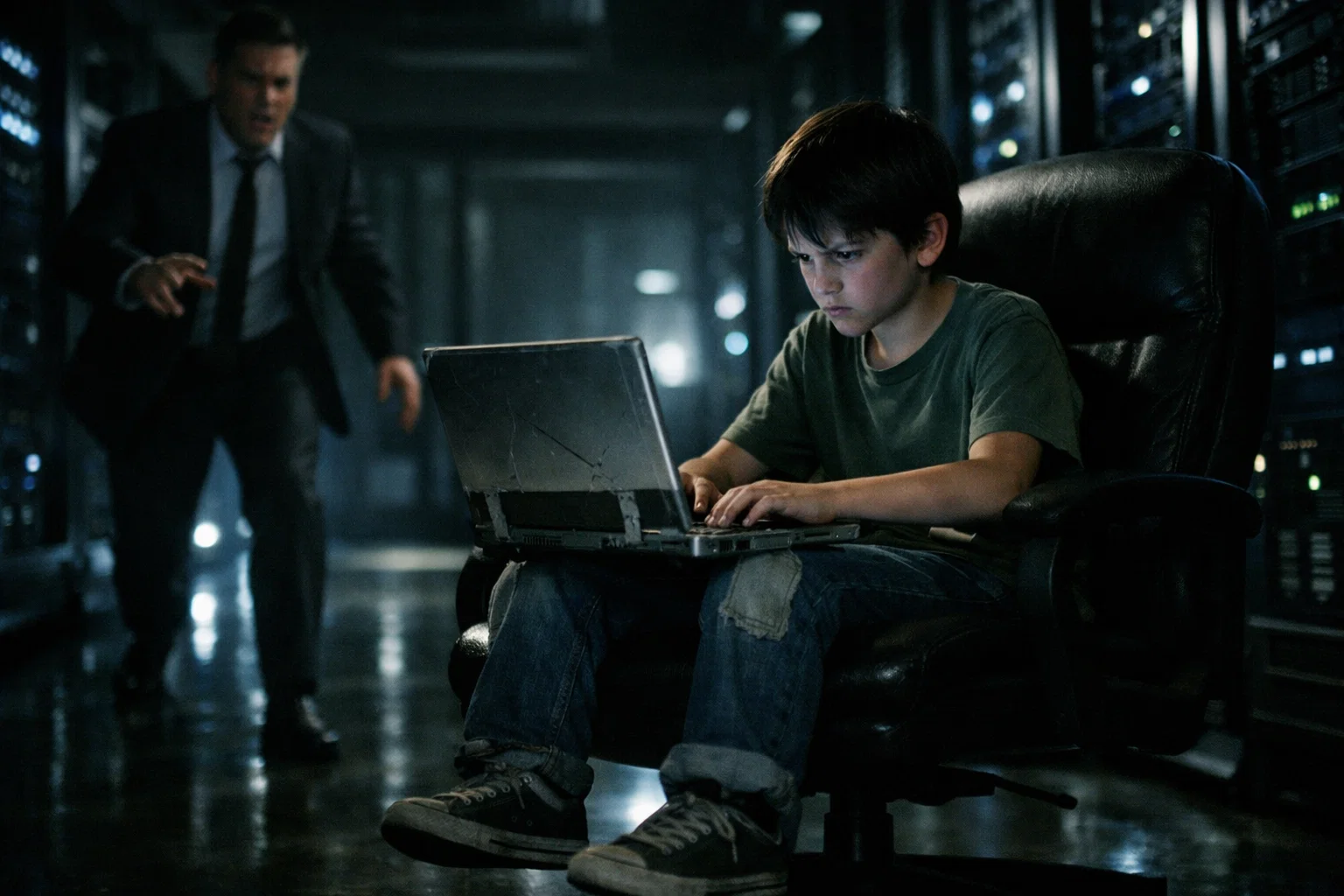
The secondary server room was cold and blue — rows of humming machines, blinking lights, the quiet desperation of a system trying to save itself. Adrian climbed onto the maintenance chair at the primary terminal. His sneakers dangled above the floor. He plugged in a custom cable he’d built from salvaged parts and connected the taped-up laptop.
His fingers began to move.
He wasn’t building walls. He was dismantling them — carefully, surgically, in the exact sequence the parasite needed to strand itself with nothing to feed on. His mind and the keyboard became a single thing. The cracked screen filled with cascading command lines.
He had maybe ninety seconds.
Upstairs, Patricia Monroe nearly knocked her chair back. “Mr. Drake.” Her voice cracked for the first time anyone had ever heard. “Someone just accessed the secondary server room from floor forty-two. They’re systematically deactivating every active firewall in sequence.”
Drake’s face went cold. “What?”
“All of them. One by one. Whoever this is — they’re inside the system.”
“Get security there. Now.”
Drake personally led the team.
Four armed guards, two senior engineers, and a furious CEO pouring out of the elevator onto forty-two. They hit the server room door at a run, weapons raised, ready for a corporate spy, a foreign operative, a coordinated breach team.
What they found was a boy.
Twelve years old. Green faded T-shirt. Jeans with a patch on one knee. Sneakers with a hole at the left toe. Sitting in an oversized chair that made him look even smaller, typing on a laptop held together with gray duct tape, completely focused, completely calm.
The room went silent.
Drake stared. One of the German specialists — gray beard, three decades in the field — literally took off his glasses.
“What is this?” Drake’s voice came out quiet first, then cracked into a shout. “What the hell is THIS?! Get that kid away from the terminal right now. This is a billion-dollar security operation, not a daycare for—”
“Sir.” Patricia stepped forward, her eyes locked on the monitoring display on the wall. “Look at the indicators.”
No one moved.
The red numbers — which had been climbing toward catastrophe for hours — were blinking. Slowly. One after another. Amber. Then green.
Drake looked at the board. He looked at the boy. He looked at the board.
“Eighty seconds,” Adrian said quietly, not looking up. “That’s all I needed. Give me eighty more seconds.”
“Stop him,” Drake said.
The largest guard stepped forward.
“Adrian!”
Bernard Cole appeared in the doorway. His face was the color of chalk. He had come looking for his son when the commotion started and followed the noise to this floor. His hands were shaking. His eyes went from the guard, to his son, to the CEO who employed him, and back to his son.
“Adrian, step away from that—”
“Dad.” Adrian still didn’t look up. His fingers never slowed. “Forty seconds.”
Drake rounded on Bernard with the full force of his contempt. “He’s your son?” The words came out like an accusation. “You hid your son in my building. In my car. And now I find him sabotaging my—”
“He’s not sabotaging anything.” Patricia’s voice was sharp. “Sir, look at floor forty-three’s live feed.”
On the wall display behind her, the war room monitors were shifting. Every red indicator, one by one, bleeding into green. The cascade failure was decelerating. The mutation rate was dropping.
The parasite was starving.
“Three,” Adrian said. “Two. One.”
The entire room filled with green light.
The automated system voice was almost gentle: “Threat neutralized. All systems nominal.”
The silence lasted ten full seconds.
The German specialist sat down heavily in the nearest chair. He put his glasses back on, then took them off again. “We were so obsessed with fighting it,” he said, to no one in particular, “that we forgot to think.” He looked at Adrian — this boy with the patched jeans and the dead battery laptop. “He didn’t fight it. He understood it.”
Drake was not moved.
His face had gone through shock and landed somewhere worse: humiliation. A twelve-year-old in a hole-toe sneaker had done in ninety seconds what eighteen of the most expensive minds in the world could not do in three hours. In Drake’s building. On Drake’s watch.
“I don’t care.” Drake’s voice was dangerous and flat. “He broke in. He accessed restricted systems. This is a federal matter.” He turned to Bernard. “Take your kid and get out of this building. You’re terminated. Both of you are going to the police.”
Bernard’s face crumpled. He had known this moment was possible from the second he put Adrian in that car. He nodded slowly, the way people nod when the worst thing they feared finally arrives.
Adrian stood up from the chair. He unplugged his laptop. He touched his mother’s photo once — just once — and tucked the machine under his arm.
“My mom used to say,” he said clearly, looking at Drake with those enormous dark eyes, “that when a person has power, that’s when you find out who they really are.”
He took his father’s hand.
They walked toward the door.
They didn’t make it out.
A voice stopped them — not loud, not dramatic, but the kind of quiet that commands a room full of people to go still.
“Maximiliano.”
Nobody called Drake that anymore. Not since the company went public. The name came from the doorway, carried by a seventy-two-year-old man in a plain gray suit who moved with the unhurried certainty of someone who had nothing left to prove. Arthur Calloway. Founder of Cyber Core Technologies. The man who had started the company in a rented garage thirty-eight years ago with a used PC and a second-hand modem. He still owned fifty-three percent of the shares. He still came in on Thursdays.
He had been in the building the whole time.
He had heard everything.
Calloway looked at Drake the way a man looks at a fire he helped start. He looked at Bernard — hands calloused, back slightly bent, eyes red. He looked at Adrian — the laptop under one arm, the patched jeans, the photo of his mother taped to the lid.
He was quiet for a long moment.
“Is this how you run my company?” he said, finally. “A boy just saved eight hundred million dollars — and your response is to have him arrested?”
Drake’s jaw moved. “Sir, there are protocols—”
“I built the protocols.” Calloway’s voice didn’t rise. It didn’t need to. “And I built this company. And I know exactly what I built it for.” He walked forward until he was standing in front of Adrian. He crouched down, slowly, the way old men do with sore knees, until he was eye level with the boy. He looked at the laptop. At the photo. At the face of the child.
“Do you know what I was doing at your age?” Calloway asked.
Adrian shook his head.
“Taking apart my mother’s television to see how it worked. She wasn’t happy about it.” A small smile. “What’s your name?”
“Adrian.”
“Adrian.” Calloway straightened up. He turned back to the room — to the eighteen specialists, to Patricia Monroe, to the guards, to Drake. “I want this boy and his father taken care of. Tonight.” He looked at Drake. “And I want a full apology — in front of every employee in this building — from you, to them, before end of business tomorrow. Is that understood?”
Drake said nothing.
“Maxwell.” The name came out like a period.
“…Understood.”
The apology happened at 4:00 p.m. the following day.
The entire staff of Cyber Core Technologies — nearly four hundred people — gathered in the main atrium. Drake stood at the center in his perfect suit, looking like a man swallowing glass, and apologized. To Bernard Cole, standing in his driver’s uniform. To Adrian Cole, standing beside his father in the same green T-shirt, because it was all he had.
It was not a comfortable apology. Drake was not a comfortable man.
But he said the words. And the room heard them.
Bernard didn’t cry during the apology. He waited until they were back in the elevator, just the two of them, before his shoulders shook once — just once — and he pressed his fist to his mouth.
“It’s okay, Dad,” Adrian said.
“I know,” Bernard said. “I know it is.”
Within the week, Arthur Calloway’s lawyers had drawn up an ironclad scholarship agreement. Full academic sponsorship at the country’s top technology institute. Private tutors in cryptography, systems architecture, and applied mathematics. A guaranteed leadership position at Cyber Core upon graduation — if Adrian wanted it. No strings.
Bernard was promoted to head of internal building security. Triple his former salary. Benefits. A parking spot that wasn’t in the basement.
Drake was not fired.
Calloway kept him on, which was a mercy Drake spent a long time not understanding. But the CEO who emerged from that week was a quieter man — still sharp, still demanding, still not easy to work for. But he looked at the people in the elevator now. Not warmly. But he looked.
Three months later, the auditorium of Cyber Core Technologies was packed to capacity.
Investors, journalists, government officials, executives from four countries. Every seat filled. A single spotlight on the stage. And at its center, twelve-year-old Adrian Cole in a tailored suit that Arthur Calloway had insisted on gifting him — though Adrian had insisted right back on keeping the old laptop tucked under one arm.
He stepped to the microphone.
“My name is Adrian. I’m twelve years old. I don’t have any degrees.”
His voice was steady. Quiet, but it filled the room.
“My mom died when I was seven. My dad works double shifts most weeks so we don’t have to choose between heat and groceries. Everyone I’ve ever met told me that to be successful, you need money, connections, and the right last name.”
He paused. Set the old laptop on the podium with both hands.
“But my mom told me something different. She said the smartest person in any room isn’t the one with the most diplomas. It’s the one who’s willing to think in a way no one else dares.” He touched the photo taped to the lid — just briefly, just once. “This computer belonged to her. It barely runs. The screen is cracked. The battery lasts forty minutes on a good day.”
He looked out at four hundred people who were completely still.
“But with it, I learned to see patterns where everyone else only saw chaos. And I think that’s the only thing that actually matters.”
The auditorium came to its feet.
The applause was so loud it shook the glass panels in the ceiling. Journalists were writing. Executives were already pulling out phones. In the back of the room, Maxwell Drake stood and applauded — not because he had to, but because he had finally, reluctantly, understood something.
In the front row, Bernard Cole sat in his new seat — the one with the reserved placard that now read Director of Facility Security — and cried without shame.
That night, driving home through the city, the lights of the skyline spread wide ahead of them.
“Mr. Calloway said we can move,” Adrian said. “Bigger place. Better neighborhood. He already has a few options.”
Bernard was quiet for a moment. He thought of their apartment — the walls that needed painting, the window that stuck in winter, the kitchen where Elena had sung while she cooked. The way the whole place still felt like she was just in the next room.
“That apartment was the last home she knew,” he said softly. “I’m not ready.”
Adrian leaned back in his seat. He looked at the city lights. “Then we stay.”
“You sure?”
“She’s still there.” He said it simply. Like it was true. Like it was enough. “We stay as long as you need.”
Bernard didn’t answer. He just drove — hands steady on the wheel, back a little straighter than it used to be, eyes clear.
Some things don’t need words.
Original fictional stories. AI-assisted creative content.