
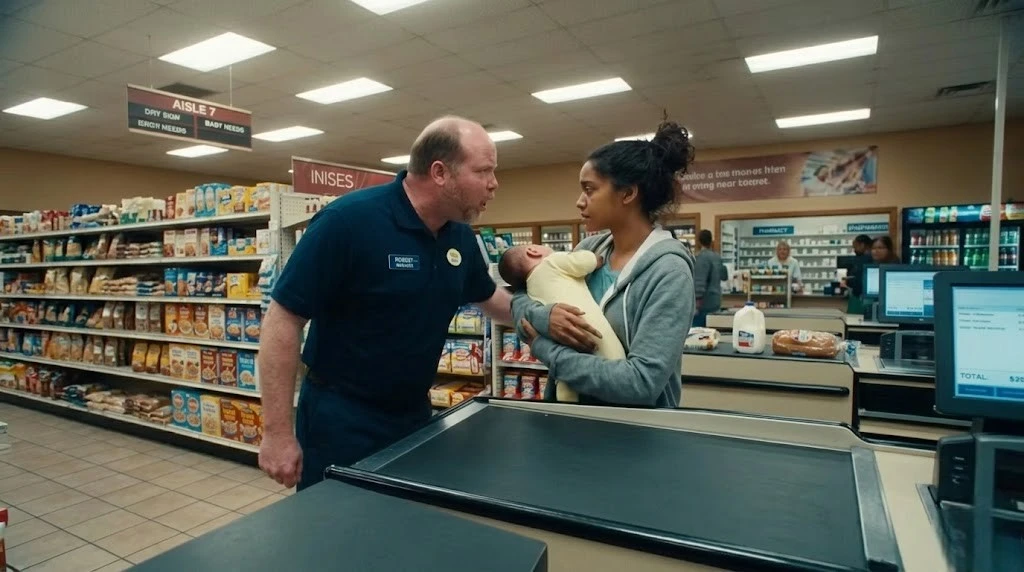
Sofia hadn’t slept in six days.
Not real sleep. Not the kind that restored anything.
She’d had stretches — forty minutes here, an hour there — but they felt less like rest and more like the body briefly shutting itself down before forcing itself back online to handle the next cry, the next feeding attempt, the next small emergency that somehow felt enormous at two in the morning.
Her son, Lucas, was eight weeks old.
He was tiny, furious at the world, and he needed formula. The kind she could only get from the grocery store six blocks from her apartment. She’d been putting it off all morning — the thought of going outside, of people, of the stares — but Lucas was hungry, and that was the only thing that still cut through the fog without negotiating.
She put on her shoes.
She picked up her son.
She went.
She pushed through the glass doors at 3:14 in the afternoon.
Lucas wailed the moment the cold air hit him.
Sharp, breathless cries that bounced off the produce display and snapped heads around in both directions.
Sofia felt the heat crawl up the back of her neck. The apologetic reflex that had been drilled into her since childhood.
“Sorry,” she murmured to no one. “We’ll be quick. I’m sorry.”
She moved fast, head down, Lucas pressed against her shoulder, whispering broken lullabies into his hair.
“It’s okay, mijo. We’re almost there. Almost.”
He did not find that convincing.
A woman reaching for a bag of oranges pulled her arm back slightly, as if the crying were something that could get on her.
Near the dairy case, a man in a fleece vest exhaled — long, loud, and deliberately audible.
Sofia didn’t look at him.
She already knew what that sound meant.
She’d been hearing it for eight weeks.
The infant formula was in aisle nine.
One can left. The specific kind her pediatrician had recommended after the infection disrupted her milk supply and turned every feeding into a daily source of shame.
She grabbed it like it might disappear.
Lucas had escalated to the frantic stage by then — the stage where his whole small body shook between breaths.
“I know,” she said softly. “I know, I know. Almost done.”
She turned toward the registers.
The line was long.
Of course it was.
Carol Jenkins had been on register three since seven that morning.
Her coworker had quit on Monday with no notice, which meant doubles until corporate decided to care, and corporate was not in a hurry.
She was tired, her lower back ached, and she had two hours left.
But when she saw Sofia step into line — the baby’s red face, the formula can clutched like it was the most important object in the building, the dark circles so deep they looked like bruises — something in Carol went quiet and alert.
She’d been somewhere close to that before.
Close enough to recognize it immediately.
She was about to say something when it started.
“Seriously.” A man three people back, loud enough to make sure everyone heard. “Is there anyone who can do something about this?”
“I can’t hear myself think.” A woman near the magazine rack, not quite under her breath.
“Some people have absolutely no consideration.”
Sofia leaned forward slightly, voice barely above a whisper.
“I just need to pay for this. Please. He’s hungry. I walked here.”
“Hon—” Carol started.
The office door opened.
Brian Caldwell had the posture of a man who believed in procedure the way some people believe in religion.
Eleven years managing this location. Customer satisfaction scores tracked like a hobby. An orderly store was a successful store. Complaints were signals. Signals required responses.
He scanned the line.
The irritated customers.
The crying.
The young woman at the front, visibly shaking, clutching the formula can.
He did the math.
“Ma’am.”
He said it with the measured calm of someone who’d taken a conflict resolution seminar and genuinely believed it had worked.
“I’m going to have to ask you to step outside until your child settles down.”
Sofia blinked.
“I just need to pay for this,” she said. “Please. That’s all. He’s hungry.”
“We’ve received several complaints.” Brian’s voice stayed level. “Your child is disrupting other customers.”
Disrupting.
The word landed somewhere deep.
“He’s a baby,” Sofia said, very quietly. “He’s eight weeks old. He’s hungry.”
“I understand that.” He did not look like he understood that. “But we have a responsibility to all of our customers, and—”
“I am one of your customers,” she said.
Her voice cracked on the last word.
She hadn’t meant it to.
Brian’s jaw tightened.
“Ma’am, I’m asking you to step outside. You’re welcome to come back in once he’s calm.”
Carol had gone very still behind the register.
Her hands sat flat on the counter.
She was watching. Not speaking. Just watching.
Sofia looked at the formula can in her hand.
Then at the door.
Then at Lucas, whose face had gone the particular shade of red that meant he’d been crying long enough for it to physically hurt.
Her shoulders dropped.
She stepped out of line.
She made it two steps toward the door.
Then something stopped her.
Not a sound. Not a person.
Just a thought, arriving with unusual clarity through the fog of six sleepless days.
I am not doing anything wrong.
It was so simple it almost startled her. She’d been apologizing since she walked in. Apologizing for the crying, for the space she was taking up, for the inconvenience of her son’s hunger existing in a room full of strangers who’d rather not think about it. She’d been treating her presence here as a problem to be managed.
But she’d walked six blocks.
She had exactly the right amount of money for exactly one item.
Her son was hungry.
She was not doing anything wrong.
She stopped walking.
Lucas cried.
The fluorescent lights hummed.
Brian stared at the back of her head.
“Ma’am,” he said again. Firmer.
She didn’t move.
“Ma’am, I need you to—”
“Excuse me.”
The voice came from behind her, further back in the line.
Quiet. But it carried.
Sofia turned.
A man stood near the middle of the queue — maybe forty, dark-haired, plain gray t-shirt and jeans. He hadn’t been loud. He hadn’t made a scene. He’d just stepped slightly forward, and something about the way he moved made a small circle of space open around him naturally.
His eyes were on Brian.
“I couldn’t help but overhear,” he said.
Brian turned. His expression shifted slightly — the involuntary recalibration of a person suddenly uncertain about the room.
“Sir, this is a store matter—”
“Daniel Reyes.” The man reached into his back pocket, opened a small wallet, and held up a badge. Calm. No drama. Just the badge. “Columbus PD. Off-duty.”
The line went absolutely silent.
The woman who’d complained about not hearing herself think stopped moving.
The man in the fleece vest stared at his phone screen without actually looking at it.
Brian stared at the badge.
“Officer Reyes—”
“A crying infant,” Daniel said, “is not a disruption that justifies removal from a place of business.” His voice was even, unhurried, with no anger in it — which somehow made it harder to argue with than anger would have been. “She has the legal right to be here and to make her purchase.”
“We received multiple complaints—”
“I heard them.” Daniel glanced briefly at the people around him, then back at Brian. “I was standing right here.”
A beat.
No one in the line said anything.
“A baby being hungry,” Daniel continued, “is not a conduct issue. Asking a new mother to sit on a curb in the afternoon heat while her infant cries — that is.”
Carol’s hands were still flat on the counter.
But now she was looking up.
“She walked here,” Daniel said. “She’s buying one item. She’s doing everything right.” He tilted his head slightly. “Let her finish.”
Brian opened his mouth.
Closed it.
Opened it again.
“I was following procedure,” he said finally. The words sounded thinner than he’d intended.
“Then I’d recommend reviewing the procedure,” Daniel said simply.
A beat of silence that lasted slightly longer than comfortable.
Brian shifted his weight. “The other customers were—”
“I know what the other customers were doing,” Daniel said. “I was one of them.” He paused. “None of us said anything we should be proud of.”
That landed differently.
The man in the fleece vest had been holding a box of crackers for the past two minutes without moving. He put it down on the nearest shelf. Didn’t look at anyone.
The woman in the beige coat was suddenly very interested in her own phone.
“She’s been standing here,” Daniel continued, “apologizing to a room full of people for the fact that her infant is hungry. She walked here. She found what she came for. She stood in your line.” He looked at Brian steadily. “At some point, the person doing everything right stops being the problem.”
Brian said nothing.
His face was doing something complicated.
You could see, watching him, the exact moment a man realizes he has been entirely certain about something that was entirely wrong — and that there are witnesses.
Brian looked at Sofia.
She was still standing in the middle of the aisle, holding Lucas against her chest, watching him with an expression that had moved somewhere past exhausted and embarrassed into something steadier and harder to name.
He looked at the line.
At Carol.
At Daniel, who had put the badge wallet away and was just standing there with his hands at his sides, waiting.
“Ma’am.” Brian’s voice had changed. The manager-seminar calm was gone. What was left was just a man who’d realized he’d made a mistake in front of a roomful of people and couldn’t find a way to exit cleanly. “Please — step back up to the register. I apologize for the confusion.”
Sofia held his gaze for a moment.
She didn’t say it was fine.
She didn’t smile.
She just walked back to the front of the line and set the formula can on Carol’s counter.
Carol scanned it without a word.
Then she paused.
Set the can down.
Took a breath.
“I should’ve said something,” she said quietly. She was looking at the counter, not at Sofia. “When he first told you to leave. I was standing right here and I just — I didn’t.”
“I know,” Sofia said.
“That’s not an excuse.”
“No.” Sofia looked at her. “But you’re saying it now.”
“It’s not the same as saying it when it mattered.”
“It always matters,” Sofia said. “It just matters differently at different times.”
Carol finally looked up.
For a moment neither of them said anything.
It was the kind of silence that sometimes happens between two people who have both carried something heavy for a long time and happened to set it down in the same place.
“Twelve forty-seven,” Carol said softly.
Sofia paid.
Daniel was near the entrance when she came through.
He wasn’t waiting exactly — more like he’d happened to end up there, giving her space to pass.
She stopped.
“Thank you,” she said.
He shook his head slightly. “You didn’t need me.”
“I was about to go sit on a curb.”
“Yeah.” A short pause. “But you hadn’t walked out yet.”
She didn’t have an answer for that.
He held the door open.
“Take care of yourself,” he said.
Then he walked toward the parking lot, unhurried, hands in his pockets, back to whatever the rest of his Tuesday looked like.
Sofia stood on the sidewalk for a moment.
Lucas was quiet now — worn out, heavy against her shoulder, one small fist pressed against her collarbone like a comma.
The afternoon was cooler than it had been earlier.
She looked down Maple Avenue — the sidewalk stretching back toward her apartment, the light long and golden on the pavement, the way it only got in the late afternoon of certain fall days when the city looked briefly like it was trying.
She started walking.
She thought about the moment she’d stopped.
Two steps from the door.
She still wasn’t entirely sure what had held her. Exhaustion didn’t usually make people braver. But something had clicked into place — some quiet refusal, arriving too late to prevent everything but just in time to prevent the last thing.
She’d held still.
And then someone else had spoken.
She didn’t know Daniel Reyes. She’d probably never see him again. He’d just been a man in a gray t-shirt who’d been standing in a grocery store line on a Tuesday and had decided not to keep looking at his phone.
She thought about that for a whole block.
About how many times she’d been on his side of something.
About how many times she’d exhaled and looked away.
Lucas made a small sound against her neck — not a cry, just a murmur, the semi-conscious noise of a baby settling deeper into sleep.
She kissed his head.
“We’re going home,” she told him. “We did it.”
Brian Caldwell stood in the back hallway for a long time after the store settled.
He replayed the sequence.
The complaints. His decision. The badge. The way the room had shifted.
He’d been so certain he was handling it correctly. Logical. Measured. By the book. A manager’s job was to maintain the environment, and the environment had been disrupted, and he had taken steps to address the disruption.
That was what he’d told himself.
He walked slowly to his office and sat down.
His phone had eleven unread notifications. He opened the first one. A screenshot — grainy, angled, clearly taken from a line in a grocery store — of a man crossing his arms in front of a woman holding a crying baby. The caption read: This is the manager at the store on Maple. He asked a new mom to go wait on the curb.
He set the phone down.
Stared at the surface of his desk.
Picked it back up.
Watched the video.
It was strange, watching yourself from outside. You assumed you looked measured. Professional. Appropriate. But looking at the footage, he could see what everyone else in that line had seen: a man who had decided that a baby’s hunger was a problem he needed removed from his building.
He’d thought he was protecting the customer experience.
He’d just been protecting his own discomfort.
He set the phone face-down again.
His chest felt tight.
He didn’t go home until eight.
By five o’clock, two clips from that afternoon had found their way online.
The first caught Brian from behind — arms crossed, manager’s voice, the woman with the crying baby stepping quietly out of line.
The second picked up with Daniel’s badge coming out: calm, precise, unhurried. Officer Reyes. Columbus PD. The two words that changed the air in the whole building.
By seven, both clips were circulating in neighborhood groups and parenting forums and a few local news feeds.
By nine, the comment sections were running long.
The corporate district manager called Brian at 8:04 the next morning.
The call lasted forty-three minutes.
Brian was placed on administrative review.
A mandatory retraining on accommodation of caregivers with infants was issued for all store managers in the district.
The regional office sent a statement to the neighborhood association.
It said things like we take these concerns seriously and this does not reflect our values.
Whether they meant it, at least they said it.
Which was, if nothing else, a starting point.
Three weeks later, a small laminated card appeared near register three.
Carol had written the text herself on her break.
Management approved it the same day — faster than anything she’d submitted in fourteen years.
Families with young children are always welcome here. If you need any assistance, please let us know.
She straightened it on its stand, stepped back, and looked at it for a second.
Then she went back to her register.
It wasn’t much.
But she’d been doing this job long enough to know that most things that lasted didn’t start any bigger than that.
Sofia got home just before four.
She fed Lucas — really fed him, full bottle, no interruptions — and then she sat in the kitchen for a long time after, the empty can on the table and the afternoon light crossing the floor in long slow strips.
She called Elena.
Elena answered on the first ring.
“Sofia. Are you okay? I tried you twice—”
“I’m okay.” A long exhale. “Something happened today. I’ll tell you the whole thing later. But we’re home. We’re good.”
“You sure?”
“Yeah.” She looked at Lucas in his seat, his chest rising and falling in the unhurried rhythm of a baby who has finally given in completely to sleep. “I’m sure.”
“Dinner this weekend,” Elena said. “Both of you. Non-negotiable.”
“Okay.”
“I’m making the chicken. And the rice. And don’t say you’re not hungry because I already know.”
Sofia almost smiled.
“I wasn’t going to say that.”
“Good.” A pause. “I love you.”
“I love you too.”
She hung up.
Sat with the quiet.
Then she got up, washed her face, and started thinking about dinner.
Outside, the city kept going.
The afternoon turned to evening.
Lucas slept.
Completely, peacefully, the way babies sleep when the world has briefly given them exactly what they needed.
Later that night, one of the women who’d been standing in that line posted in the neighborhood group.
She didn’t say much.
Just: I was in that store today. I heard everything. I didn’t say anything. I’ve been thinking about that all evening. I won’t make that same choice again.
Nobody argued with her.
Someone replied: That’s all any of us can do.
The post got forty-seven likes by morning.
Brian never saw it.
But Carol did.
She saved it without sending it to anyone.
Then she sat with it for a while.
She thought about fourteen years at that register. About the thousands of transactions that had blurred together — the quiet ones, the rushed ones, the ones where someone was clearly having a terrible day and she’d had the option to make it slightly less terrible and had taken it or hadn’t.
She thought about Sofia’s face when she walked back in. The way she hadn’t smiled at Brian when he apologized. Hadn’t offered him the easy forgiveness that would have let everyone move on quickly.
She’d just walked back to the counter.
Done what she came to do.
Carol respected that.
She thought about Daniel too — the badge coming out, the measured voice, the total absence of satisfaction in it. He hadn’t enjoyed it. He hadn’t been performing. He’d just seen something out of alignment and used what he had to correct it, the same way you’d catch something falling off a shelf.
That was a different kind of bravery.
The kind that didn’t require an audience.
The kind that just required paying attention.
She closed the app.
Put her phone in her apron pocket.
Three more customers in line.
She smiled at the first one.
“Hi there,” she said. “How’s your afternoon going?”
Some things you hold onto not because they change what happened, but because they remind you that people are still paying attention.
That somewhere inside the ordinary machinery of a Tuesday afternoon, someone saw something unfold and carried it home with them.
That they stayed with it.
That it cost them something.
That mattered.
Even quietly.
Even small.
Original fictional stories. AI-assisted creative content.