
The rain had been falling for three days when Ethan Miller heard the levee break.
“Noah! Wake up!”
He scooped his four-year-old from bed and ran. The water was already at the porch. Black, churning, impossible.
“Hold my neck, buddy. Tight.”
Ethan scrambled onto the trailer roof with Noah clinging to him. Below, his truck vanished into the darkness. Then the trailer lurched.
“We’re moving,” Ethan realized.
The metal house spun like a toy in the current. They were headed straight for the Route 9 bridge.
“Cover your head!” Ethan yelled, curling around Noah.
The impact shattered everything. Father and son plunged into freezing water.
“Daddy!” Noah choked.
“I got you!” Ethan grabbed his son’s pajamas, pulling him close. “Get on my back!”
Something hard slammed into Ethan’s shoulder. The snap echoed through his body. His collarbone shattered. His right arm went useless.
“Just hold on,” Ethan gasped through the pain.
But the current was dragging them toward the Devil’s Throat—a narrow gorge that swallowed boats whole. Ethan kicked with everything he had, but his legs were failing.
He was drowning. They both were.
Then he saw it. A submerged car wedged against rocks. Their only chance.
Ethan reached it with his last strength. The water was chest-deep even standing on the roof. Too deep. The current too strong.
Above them, a news helicopter circled, its camera rolling.
“Noah, listen to me.” Ethan’s voice was calm. “We’re going to play a game. I’m going to lift you up. You reach for the sky. Don’t look down.”
“Okay, Daddy.”
Ethan planted his feet on the car’s luggage rack. He grabbed Noah with his good hand and his broken arm, forcing dead muscles to obey one final command.
He pushed.
Ethan sank beneath the water.
He locked his knees. He locked his elbows. He became stone.
Underwater, his lungs screamed. His body begged him to surface, to breathe, to save himself.
No. If I move, he falls.
Above the surface, Noah rose completely out of the water, held high by trembling arms.
In the helicopter, cameraman Frank Sorvino stopped breathing.
“What is he doing?” the news anchor asked.
“He’s standing on the bottom,” Frank choked out. “He’s drowning himself to keep the kid dry.”
On live TV, millions watched the hands. Rigid. Unmoving. Just hands and a child reaching toward the helicopter light.
One minute passed.
“Get the boat there!” Frank screamed into his headset, abandoning protocol. “Now!”
Two minutes.
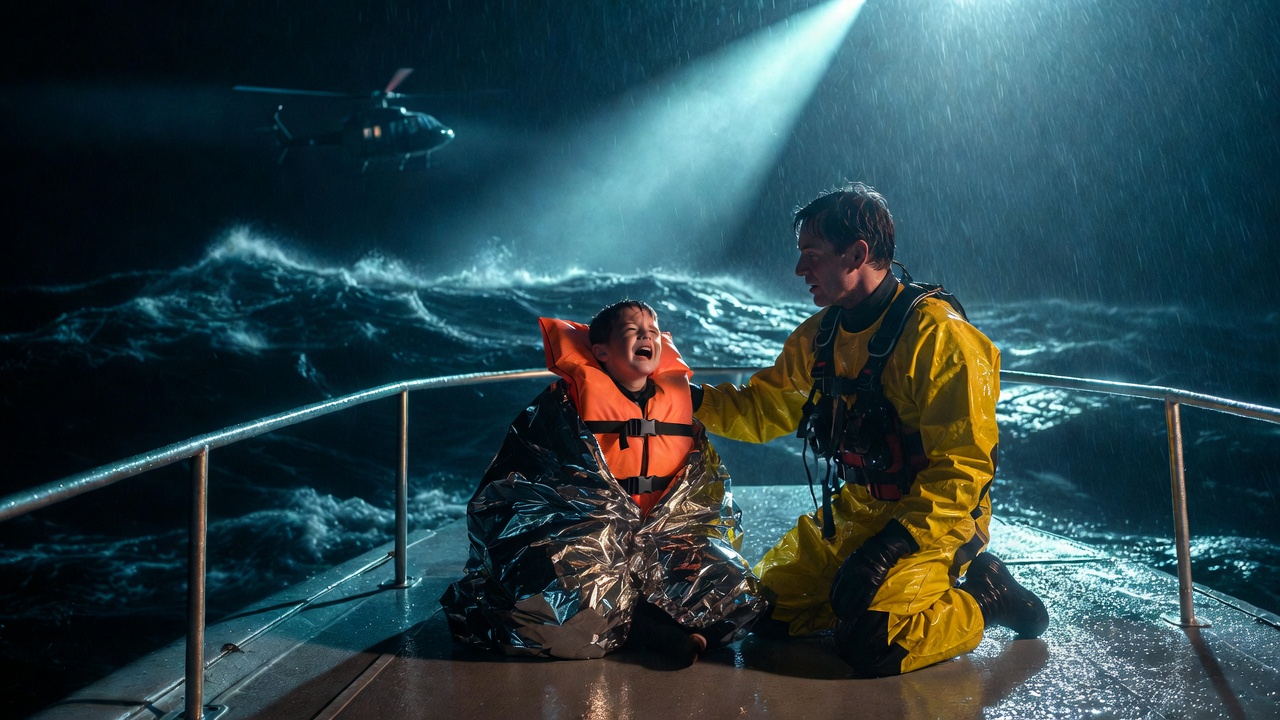
The rescue boat fought around the bend. A rescuer in a yellow suit reached out.
“I got him!” He pulled Noah into the boat.
The instant the weight lifted, the hands slipped beneath the water.
No struggle. No surfacing.
Ethan was gone.
Frank put his camera down and wept, broadcast live to a heartbroken nation.
The photo—the hands lifting the child—became the defining image of the decade. They called it “The Pedestal.” It won the Pulitzer.
Donations poured in. A trust fund was established. Noah was adopted by his aunt.
But money couldn’t fix the hole.
Noah grew up terrified of water. He hid during rainstorms. He couldn’t look at the famous photo. Those hands looked like ghosts.
“Your dad was a hero,” strangers said constantly.
But Noah wasn’t proud. He was angry. Angry that the price of his life was his father’s breath.
When he turned eighteen, he shocked everyone. He enlisted in the Coast Guard.
“Why?” his aunt asked. “You hate water.”
“I fear it,” Noah said. “And I owe him.”
Training nearly broke him. During pool survival, he panicked. He froze. He was four years old again, drowning.
But he visualized the hands. The strength it took to stay under while your lungs burned.
He didn’t quit, Noah told himself. He stayed until the end.
Noah graduated top of his class. He became a rescue swimmer, jumping from helicopters into raging seas.
He was reckless. Fearless. Searching for something in the water. Maybe the man he lost.
At twenty-four, Noah received a letter from Frank Sorvino.
“Meet me at the river. I have something for you.”
Noah drove to the memorial park. A bronze statue stood there—two hands rising from stone, lifting a child.
Frank looked frail. The cynicism was gone from his eyes.
“I’ve held onto this for twenty years,” Frank said, pulling out a tablet. “The raw footage had high-gain audio. The microphone on the rescue boat picked up something just before they reached you.”
Noah’s heart stopped. “He spoke?”
“Watch.”
Noah pressed play. The roar of water filled the speakers. He saw himself suspended in the air.
Then he heard it. A voice. Guttural, strained, bubbling through water.
“Look at the sky, Noah. Don’t look down. Daddy is lifting you to the stars. I’ve got you. I’ve always got you.”
Noah froze.
Twenty years. He’d convinced himself his father died terrified and alone.
But the voice wasn’t scared. It was calm. Full of love. Even while drowning, Ethan was parenting. Comforting his son until the very last second.
Noah broke. The tears came fast, washing away two decades of guilt.
“He wasn’t afraid,” Noah whispered.
“No,” Frank said softly. “He was a mountain.”
That evening, Noah stood before the bronze statue in his Coast Guard dress blues. The sun was setting over the calm river.
He took off his white service cap and placed it gently on the bronze fingers.
“I made it, Dad. I’m saving people too. Just like you.”
He stood watching the water flow. For the first time in his life, the water didn’t look like a monster.
“You can let go now,” Noah whispered. “I can swim on my own.”
He knew the truth now. No matter how deep the water got, he would never really sink. He was being held up by a love stronger than death.
The hands had never let go.
Original fictional stories. AI-assisted creative content.