
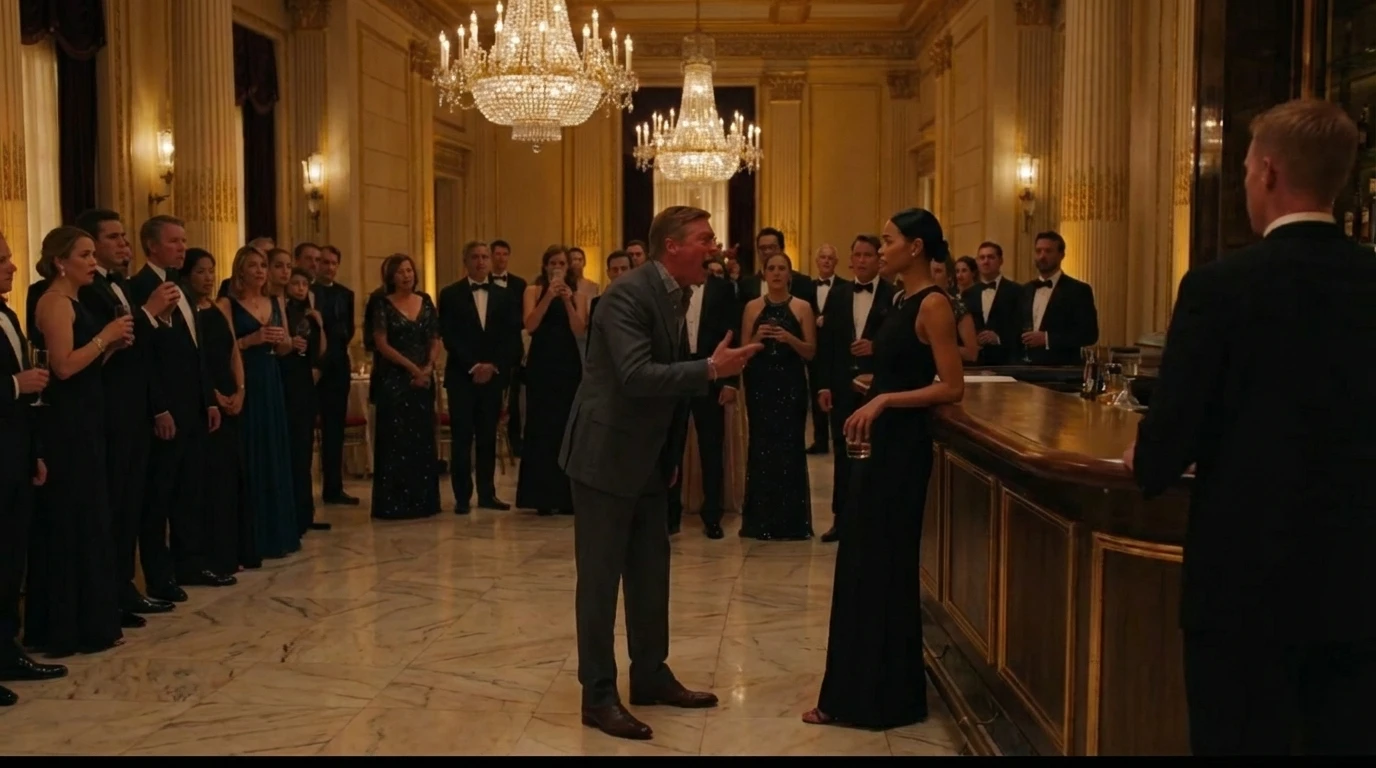
The Grand Meridian ballroom was packed wall-to-wall with power players. CEOs. Investors. The kind of people who closed million-dollar deals over cocktails.
Crystal chandeliers cast golden light across marble floors. A live string quartet played softly in the corner. Servers in crisp white uniforms navigated the crowd with champagne trays.
Claire stood near the bar, tablet in hand, reviewing acquisition files. Black dress. No jewelry. No designer handbag. She looked young. She looked invisible.
That was the point.
She’d been watching Richard Lawson for three months. CEO of Vertex Capital. Known for aggressive buyouts and even more aggressive treatment of anyone he considered beneath him.
Tonight would be interesting.
“Hey,” a voice snapped behind her. “Staff aren’t supposed to hang around the guests.”
She turned. A man in his fifties, tailored Tom Ford suit, Rolex catching the light. Richard Lawson himself.
“I’m actually attending—”
He didn’t let her finish.
His hand moved. The wine glass tipped. Red liquid cascaded down the front of her dress.
Gasps erupted around them.
Claire froze. The stain spread fast. Cold. Sticky. The expensive vintage soaked through the fabric.
Lawson barely glanced at her. “Watch where you stand.”
“Sir, I didn’t—”
“It’s fine,” a woman’s voice interrupted. Heels clicked closer. Amanda Reed, HR director at Lawson’s firm. She smiled thinly. “She’s just an intern. Accidents happen.”
Laughter rippled through the nearby crowd. Nervous. Entertained. Safe.
Phones came out. Video recording lights blinked red across the room.
Claire looked down at her trembling hands. “I’m sorry. I didn’t mean to be in the way.”
Lawson waved dismissively. “Get cleaned up. And tell catering we need faster service. This is embarrassing.”
A few more people laughed.
Amanda leaned closer, voice low but audible. “Honestly, they let anyone in these days.”
Claire nodded slowly. Her jaw tightened. But she kept her face neutral.
Then she reached into her bag.
The room watched, expecting her to pull out tissues. Expecting her to leave in shame.
Instead, she pulled out a matte black card. American Express Centurion. She placed it carefully on the marble bar.
The sound was soft. But in the sudden quiet, it cut like a blade.
“I’d like to purchase this hotel,” she said. “Effective immediately.”
Silence crashed over the crowd.
Then laughter exploded.
Amanda tilted her head, patronizing smile widening. “That’s not funny, sweetie. You should leave before you embarrass yourself more.”
Lawson’s smirk was cruel. “Is this performance art? Because it’s pathetic.”
Someone nearby whispered, “She’s probably having a breakdown.”
Another voice: “Call security.”
Claire met Lawson’s eyes. “I’m completely serious.”
The hotel manager appeared, drawn by the commotion. Michael Torres. Twenty years in hospitality. He’d seen everything.
His gaze dropped to the card on the bar. His face went white.
“Ma’am,” he stammered. “May I verify this?”
“Please do.”
She slid her tablet toward him. The screen displayed banking credentials, corporate documents, transfer authorizations.
The manager’s hands shook as he scrolled. His throat bobbed. “I need to call corporate. Right now.”
Lawson laughed harder. “You’re actually entertaining this? You’re letting interns play games now?”
The manager didn’t respond. He was already on the phone, voice urgent and hushed. “Yes. Yes, I’m looking at it now. Whitman Holdings. Full authorization.”
Security radios crackled to life.
The string quartet stopped mid-measure.
More phones came out. The crowd pressed closer.
Amanda’s smile cracked. “Who do you think you are?”
Claire straightened. The wine dripped onto the floor. She didn’t move to wipe it.
“My name is Claire Whitman,” she said evenly. “I’m the majority shareholder of Whitman Holdings.”
The murmur spread like wildfire through the ballroom.
Someone gasped. “Wait—Whitman Holdings? The Whitman Holdings?”
“That’s impossible,” another voice said.
Lawson’s jaw tightened. “Whitman Holdings doesn’t have a—”
“A visible heir?” Claire finished. “That was deliberate. My grandfather founded the company in 1968. My father passed control to me six months ago after his retirement.”
“I’ve never seen you at any board meetings,” Lawson challenged.
“You wouldn’t. I observe remotely. I prefer to see how people behave when they think no one important is watching.”
She paused.
“It’s very revealing.”
The manager returned, face pale, voice tight. “Sir, the transaction is valid. Ownership transfer is complete. Ms. Whitman now controls this property.”
Lawson took a step back. “That’s impossible. You can’t just—you can’t buy a hotel in the middle of a party.”
“I can when I own forty-three percent of the parent company’s stock,” Claire said calmly. “Which I do.”
Amanda’s face flushed. “This is ridiculous. Richard, call your lawyer.”
“I am a lawyer,” Claire said. “Corporate law. Harvard. Class of 2020.”
The crowd’s energy shifted. Whispers turned urgent.
“Oh my God.”
“Is she serious?”
“Someone Google her.”
“Holy shit, it’s real.”
Claire turned to security. Two guards approached, uncertain.
“Please escort Mr. Lawson and Ms. Reed off the premises. Immediately.”
Amanda’s eyes went wide. “You can’t be serious.”
“I don’t employ people who humiliate others for sport,” Claire said. “And as of four minutes ago, everyone in this building works for me.”
Security moved in, professional and swift.
Lawson raised his hands. “Wait. Wait. This is a misunderstanding. I didn’t know who you were.”
“You didn’t ask,” Claire cut him off. “You saw someone you assumed had no power. You didn’t listen. You didn’t care.”
She paused, letting the words settle.
“That wasn’t a misunderstanding, Mr. Lawson. That was a choice.”
“I was just—it was a joke,” he stammered.
“Was it?” Claire’s voice stayed level. “Because I didn’t see you laughing.”
His mouth opened. Nothing came out.
Amanda tried a different approach. “Ms. Whitman, surely we can discuss this professionally—”
“Like you discussed me thirty seconds ago?” Claire asked. “When you said ‘they let anyone in these days’?”
Amanda’s face went red. “I didn’t mean—”
“Yes, you did.”
Security took position on either side of them.
Lawson’s voice rose. “Do you know who I am? I have connections. I’ll sue you for defamation, for—”
“For what?” Claire interrupted. “Removing you from property I own after you assaulted me?”
“I didn’t assault—”
“You poured wine on me. Deliberately. There are forty-seven phone recordings of it.”
She gestured to the crowd. Every phone was still pointed at them.
“You also told me to deliver a message to catering. Which means you believed I was staff. Which means you intentionally humiliated someone you thought couldn’t fight back.”
Lawson’s face turned purple. “This is insane. You can’t just—”
“Security,” Claire said quietly. “Now, please.”
They moved. Professional. Efficient.
Lawson tried to pull away. “Get your hands off me!”
“Sir, please don’t make this difficult,” the guard said.
Amanda was already walking, heels clicking fast, head down.
The crowd parted. A pathway opened to the exit.
Security guided them through it. Phones tracked every step. Every angle. Every moment of humiliation.
The doors closed with a heavy thud.
The ballroom exhaled collectively.
Claire turned to face the remaining guests. Hundreds of eyes. Hundreds of phones still recording.
The silence was deafening.
“I apologize for the disruption,” she said. Her voice carried across the room. “Please enjoy the rest of your evening. The bar is open. Dinner will be served in fifteen minutes.”
She paused.
“And please—treat people better than you did five minutes ago. Because you never know who you’re really talking to.”
She walked toward the exit, heels clicking on marble.
Someone started clapping.
Then another.
Then the entire room erupted in applause.
Claire didn’t look back.
Outside, she finally allowed herself a breath. She looked down at her ruined dress and smiled.
Her assistant appeared with a garment bag. “Your backup outfit, Ms. Whitman. And I’ve already contacted our PR team. The video’s trending. Six million views in twenty minutes.”
Claire nodded. “Good. Make sure Lawson’s board sees it. And Amanda’s HR director certification body.”
“Already sent. Also, the Wall Street Journal is calling.”
“Tell them I’ll give a statement in the morning.”
“And Lawson’s lawyer called three times.”
“Block the number.”
“Done.”
Claire changed quickly in a private room. Blue dress this time. She checked her phone.
Fifteen text messages. Eight calls. Three emails from Lawson’s legal team.
She deleted them all.
By the time she returned to the ballroom, the energy had completely shifted. People approached carefully. Respectfully.
“Ms. Whitman, I just want to say—”
“That was incredible—”
“I’ve always admired your grandfather’s work—”
She smiled politely. Shook hands. Made small talk.
But she was watching. Always watching.
Because that’s what she did. Observed. Learned. Waited for the right moment.
By morning, Lawson had been removed from his CEO position. Emergency board meeting. Unanimous vote.
Amanda lost her HR director license. State investigation. Ethics violations.
The video hit forty million views by noon.
Fifty million by evening.
Claire’s statement was simple: “Power isn’t about humiliating people. It’s about lifting them up. If you can’t understand that, you shouldn’t have any.”
The Grand Meridian became the new headquarters for Whitman Holdings’ philanthropy division.
She established a scholarship fund for hospitality workers. Full ride. No restrictions.
And every employee—from intern to executive—wore the same badge. No hierarchy visible. Just names.
Because Claire learned something her grandfather taught her when she was ten years old: respect isn’t about what someone can do for you. It’s about recognizing they’re human, regardless of what they can’t.
Lawson learned that lesson too.
Just twenty million views too late.
He posted an apology video. Scripted. Desperate.
It got ratioed in minutes.
His wife filed for divorce two weeks later. His country club revoked his membership. Three of his biggest clients terminated their contracts.
Amanda moved to a different state. Changed her name on social media. But the internet never forgets.
Claire never mentioned them again.
She had more important work to do.
Like building a company culture where everyone mattered. Where respect wasn’t optional. Where power came with responsibility.
And every year, on the anniversary of that night, she wore a black dress to the gala.
No jewelry. No designer bag.
Just a reminder.
That power isn’t about what people see.
It’s about what they choose to do when they think no one’s watching.
Original fictional stories. AI-assisted creative content.
I am typically to running a blog and i really respect your content. The article has really peaks my interest. I am going to bookmark your web site and preserve checking for brand spanking new information.
Where can you watch the entire show please