The restaurant was the kind of place where the bread cost more than Maya’s last meal had, three days ago.
She stood outside with her palm pressed against the cool glass door. Through it she could see white tablecloths, tall candles, crystal glasses catching light. People were laughing with their mouths full.
She pushed the door open.
The cold air hit her first.
Then the silence.
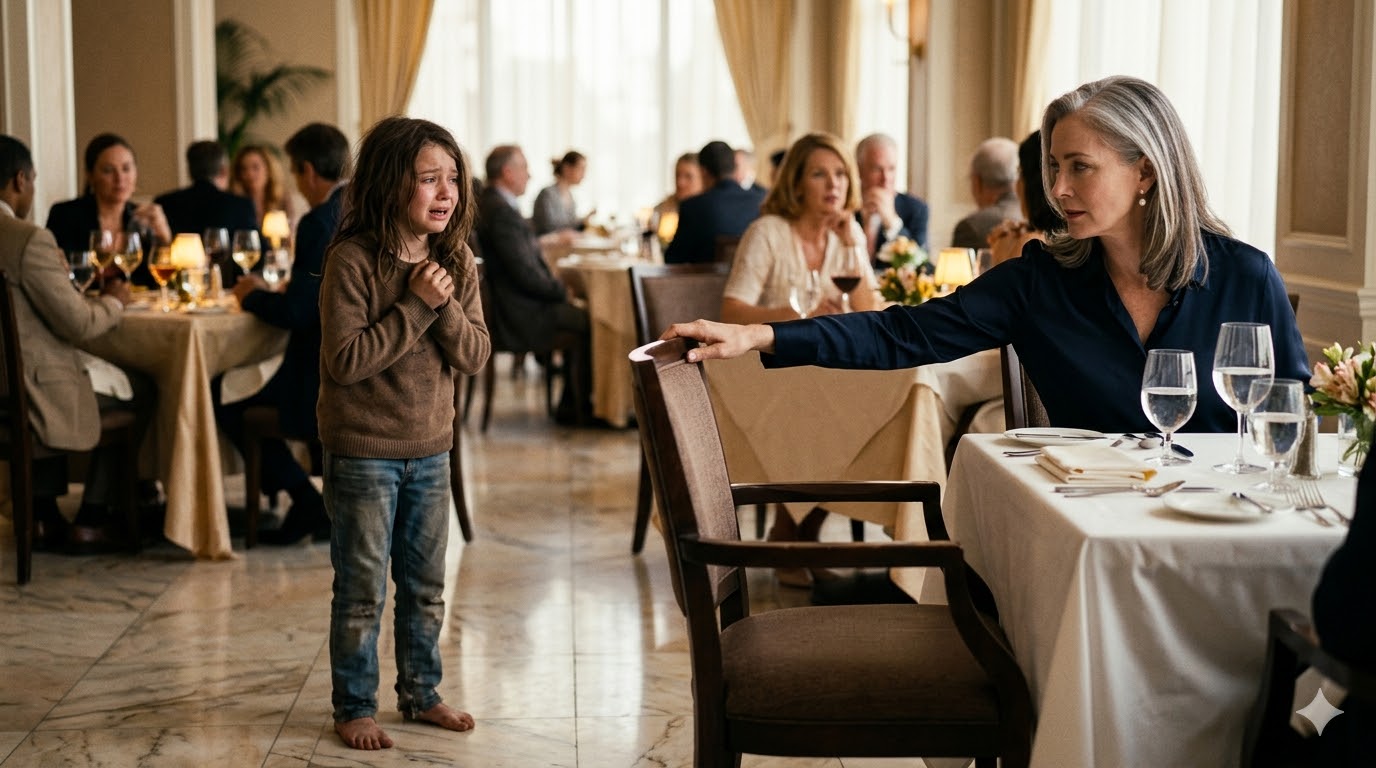
Conversations slowed. A woman in pearls looked up. A man in a gray suit glanced at Maya’s bare feet and immediately looked away, as if eye contact might cost him something.
Maya walked forward anyway.
She moved between the tables carefully, not touching anything. She found the woman sitting alone in the corner — straight back, silver earrings, a plate of barely-touched sea bass in front of her. The woman wasn’t looking at her phone or reading. She was simply sitting, as if the room existed specifically to accommodate her stillness.
Maya stopped beside the table.
She folded her hands.
“Excuse me,” she said. “May I eat what you don’t finish?”
She wasn’t begging loudly. She wasn’t performing. She was simply telling the truth.
The woman looked up.
For one second — just one — something cold crossed her face. An irritation. An inconvenience. This was not the kind of thing that happened at this kind of table.
Then it was gone.
“Sit down,” the woman said.
Maya didn’t move.
“I said sit.” The woman pulled out the chair across from her with one hand. “I’m not going to bite you.”
Maya lowered herself into the seat carefully, like the chair might change its mind.
The woman raised two fingers. The waiter appeared at her elbow within seconds.
“Bring her a plate,” the woman said. “Something warm. And bread — real bread, not the decorative kind.”
The waiter blinked. “Ma’am, this is a —”
“I know what this is. Bring the food.”
He left.
Maya studied the woman’s hands. No rings. One bracelet — simple gold. A watch that didn’t draw attention to itself.
“What’s your name?” the woman asked.
“Maya.”
“How old are you, Maya?”
“Ten.”
The woman nodded, slowly, like she was calculating something she hadn’t decided yet.
“I’m Victoria,” she said.
The food came. Maya ate without rushing, even though her stomach was screaming at her to go faster. She chewed carefully. She didn’t spill. She didn’t speak with food in her mouth.
Victoria watched her with an expression that gave nothing away.
“Where do you sleep?” she asked.
“Different places.”
“Alone?”
“Mostly.”
Victoria set down her champagne glass.
“What happened to your family?”
Maya looked up. Her eyes were steady in a way that seemed older than ten.
“My father left before I can remember. My mother got sick. She died last spring.”
She said it plainly. Not for pity. Just facts, the way you give directions.
Victoria was quiet for a moment.
Then she reached across the table and slid her untouched sea bass onto Maya’s plate.
“Eat,” she said.
The other diners watched.
A woman at the adjacent table leaned in toward her husband and murmured something. He shrugged, returning to his phone. A man by the window photographed the scene — quietly, like it was an interesting thing he’d found on the sidewalk.
No one came over. No one offered help. They watched like they were waiting to see how it would end.
When Maya finished the second plate, she placed her fork down neatly and folded the cloth napkin before she set it on the table.
Victoria noticed.
She stood and buttoned her jacket.
“Come with me,” she said.
Maya looked up at her.
“You don’t have to,” Victoria said. “I’m not going to ask you to do anything you don’t want to do. But I’m not going to pretend I didn’t see you, either.”
Maya looked at the folded napkin. Then at the woman.
Then she stood up.
The car was black, quiet, and warm. The driver didn’t ask questions.
Victoria looked out the window for a block, then turned.
“You folded that napkin,” she said.
Maya glanced at her. “What?”
“Back at the table. You folded the cloth napkin before you left.”
“My mother said it was polite,” Maya said. “To leave things how you found them.”
Victoria turned back toward the window.
She didn’t say anything else until the car stopped.
The house was enormous.
Maya stood on the gravel drive and tilted her head back to see the top of it. Three floors. Iron gates still sliding shut behind them. Gardens she could only partially see in the fading afternoon light.
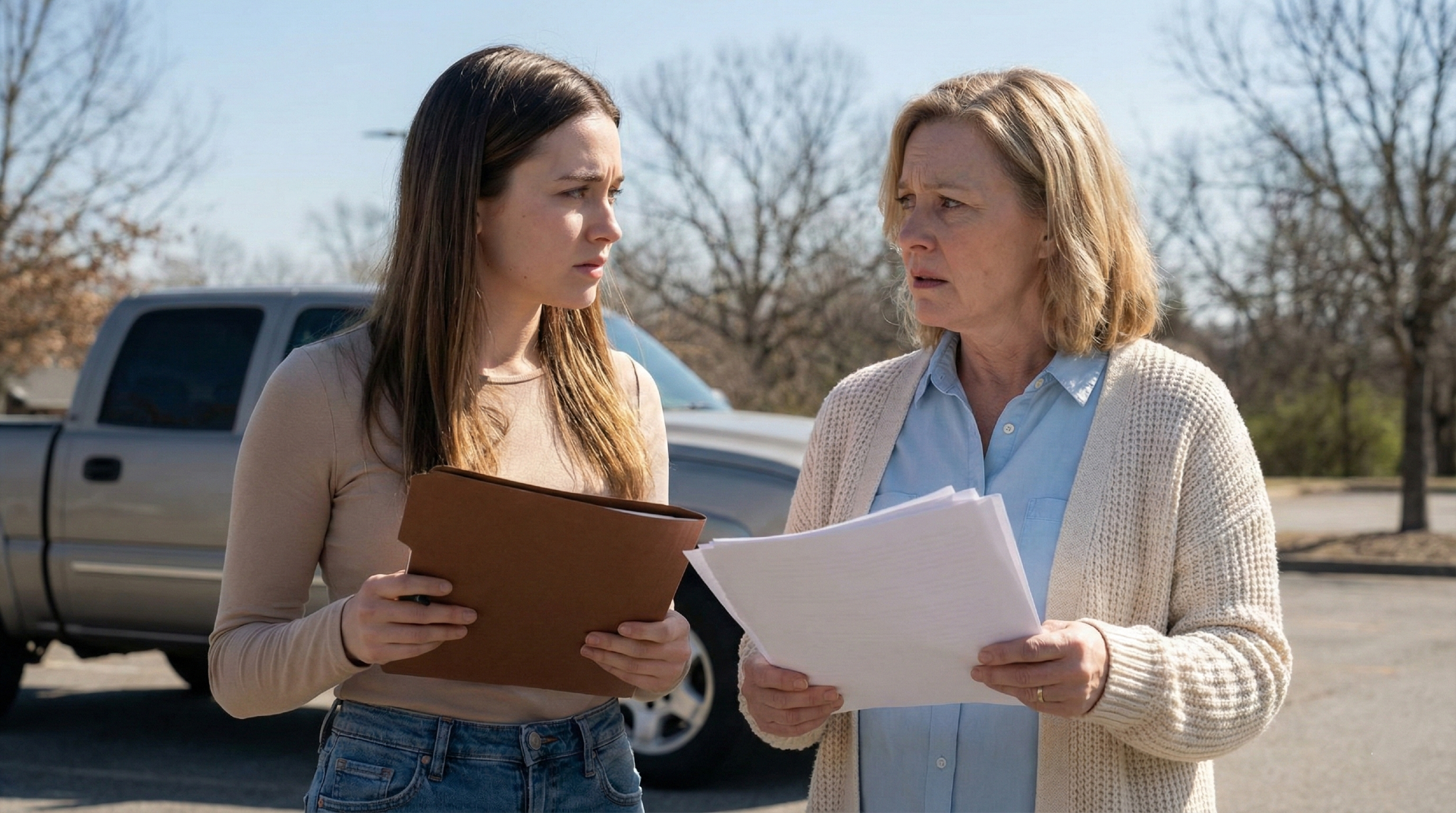
A woman appeared at the front door. Tall. Dark blazer. Clipboard tucked under one arm.
“This is Claire,” Victoria said. “My assistant.”
Claire looked Maya up and down without any expression at all.
“You’re bringing her inside?” she asked.
“Yes.”
“Victoria.” Claire lowered her voice. “This is not a good idea —”
“She needs a shower, clean clothes, and dinner.” Victoria walked past her. “In that order.”
Claire’s jaw tightened. She turned and smiled thinly at Maya — the kind of smile that doesn’t involve the eyes.
“Right this way,” she said.
The bathroom was bigger than the doorway where Maya had slept in February.
She stood under hot water for fifteen minutes and didn’t move. She just let it run.
When she came out, there were clothes folded on the bed. Soft ones. New ones with the tags still on.
She dressed slowly.
Then she sat on the edge of the bed and looked at her own hands.
They were still shaking.
Downstairs, Claire stood just inside Victoria’s study with the door halfway closed.
“You know nothing about this child,” Claire said. “She could be lying about all of it.”
“She’s ten and she was barefoot in November,” Victoria said.
“There are organizations. Shelters. You could make a donation —”
“I didn’t ask for alternatives, Claire.”
“And when something goes missing?” Claire pressed. “When you wake up and find her gone along with your jewelry?”
Victoria looked up from her desk.
“Then something will be missing,” she said. “I didn’t bring her here for my things.”
Claire held her clipboard tighter.
“I just want to be on record,” she said.
“Noted,” Victoria said. “Close the door on your way out.”
That night Maya ate two full plates of pasta in the kitchen.
The cook, a round woman named Donna, refilled Maya’s bowl without asking and pretended very hard not to notice Maya crying quietly over the second serving.
Victoria appeared in the doorway with a glass of water.
She sat down across the table.
“I want to ask you something,” she said. “And you can say no.”
Maya looked at her.
“Would you like to stay here for a while? We’d get you to a doctor. Enroll you in school — if you want.”
Maya was quiet for a long moment.
“What if I’m bad at school?” she asked.
“Then we figure that out together,” Victoria said. “But the street doesn’t have to be your only future.”
“Why are you doing this?” Maya asked. Not challenging. Genuinely wanting to understand.
Victoria was quiet.
“Because someone did something like this for me, once,” she said. “And I never got the chance to say thank you.”
Maya looked down at her bowl.
“Okay,” she said.
The weeks moved quickly.
Maya started at a local public school. Reading was hard. Math was harder. Some kids stared. A girl named Lily didn’t — she just slid over at the lunch table and said, without looking up from her sandwich, “You can sit here.” That was enough.
A tutor named Mr. Osei came three evenings a week. He had a calm voice and the patience of someone who had never once in his life been in a hurry. He never made Maya feel stupid, even when she read the same sentence five times.
Victoria rearranged her travel schedule. She moved calls earlier so she could be home for dinner. When Maya had nightmares — and she had them, sometimes — Victoria sat on the edge of the bed and talked about nothing until Maya fell back asleep.
Claire noticed all of it.
She started logging things. A missing pen. A vase she claimed had been moved. Small observations, stacked together quietly like kindling waiting for a match.
Six weeks in, it came apart.
Maya came downstairs to find Claire standing in the living room, holding something up in the light.
Gold. Delicate. A bracelet that looked old.
“I found this in Maya’s drawer,” Claire said.
Victoria turned toward Maya.
That one second — the flicker of uncertainty on Victoria’s face, so fast it barely registered — felt like a crack opening under Maya’s feet.
Maya went cold.
“I didn’t take it,” she said.
Claire tilted her head sympathetically. “I’m not accusing anyone. I’m simply showing Victoria what I found.”
“In my drawer,” Maya said. “That you went into.”
“I was helping with laundry —”
“Claire.” Victoria’s voice was very quiet. “Leave the room.”
Claire left. The door clicked shut behind her.
Victoria sat down on the couch. She looked at Maya for a long moment.
“Go to bed,” she said finally. “We’ll sort this out in the morning.”
Maya didn’t sleep.
She lay on top of the covers and stared at the ceiling. She thought about leaving. She thought about where she would go — which alley, which stairwell. She ran through her options the way she used to, automatically, before she’d started to forget she had to.
She thought about the cloth napkin she’d folded at the restaurant.
Leave things how you found them.
She closed her eyes.
At 2 a.m., Victoria sat in her office and pulled up the security system.
She found the hallway camera outside Maya’s room. She rewound to that afternoon — 3:17 p.m.
She pressed play.
She watched Claire open Maya’s door. She watched Claire take the bracelet from her own jacket pocket. She watched Claire cross to the dresser, open the top drawer, and place the bracelet at the very back.
Victoria sat completely still.
She watched the footage twice more.
Then she picked up her phone.
In the morning, Claire arrived at eight o’clock, as usual.
Victoria was standing in the front hall.
“Close the door behind you,” Victoria said.
Claire set down her bag. She looked at Victoria’s face and said nothing.
“Nine years,” Victoria said. “I trusted you with everything. My calendar, my finances, my legal documents. Everything.”
Claire lifted her chin slightly. “I was protecting you from a mistake —”
“You planted evidence on a ten-year-old child.” Victoria’s voice didn’t rise. It dropped. Quieter than normal. “I have the footage, Claire. From four angles.”
Something shifted in Claire’s expression. Something small went out of it.
“I’ll clear out my office,” she said.
“Security cleared it this morning,” Victoria said. “Your personal items are in a box by the gate. Get out of my house.”
Claire picked up her bag. She walked to the door and opened it.
She paused without turning around.
“You’ll regret this,” she said.
The door closed.
The fallout started three days later.
A financial journalist published a piece citing anonymous sources claiming Victoria’s company had been mismanaged for years — citing doctored internal memos. Regulatory complaints were filed. Three business accounts were frozen.
Claire had spent nine years as the gatekeeper of Victoria’s professional life. She had access to everything. And she had been patient.
One evening, Maya found Victoria sitting at the kitchen table staring at her phone.
“Is it bad?” Maya asked.
“It’s manageable,” Victoria said. But her voice was tired in a way Maya hadn’t heard before.
“Is it because of me?”
Victoria looked up sharply. “No,” she said. “This is between me and someone who made a choice to be dishonest. That has nothing to do with you.”
Maya nodded.
She picked up a dish towel and started drying the plates that were still in the rack.
“Okay,” she said.
Two weeks later, a child welfare officer called.
Victoria’s legal instability had flagged on a routine review. A temporary foster placement was recommended while the investigation continued.
That evening, Victoria sat across from Maya and told her plainly what had happened.
Maya listened. She looked at the floor. She nodded once.
“Okay,” she said.
But that night, she was gone.
Victoria’s driver found Maya three blocks from the restaurant where they had met — sitting on a low wall with her backpack on her lap, watching the street.
He brought her home without making a phone call.
Maya walked into the apartment — they had already been looking at smaller places — and stood in the kitchen doorway. Victoria was sitting at the table. She looked like she hadn’t moved in hours.
“I don’t want safe if safe means I have to leave you,” Maya said. Her voice cracked on the last word. “I’d rather be back on the street and know where you are.”
Victoria closed her eyes.
Then she stood up and crossed the room and put her arms around Maya, and Maya let herself be held, and neither of them said anything for a long time.
“Okay,” Victoria said finally. “We do this differently.”
One week later, Victoria sold the mansion.
No announcement. No statement to the press. She told her remaining staff. She packed what mattered. The rest went into storage or was donated.
She and Maya moved into a two-bedroom apartment on the third floor of a quiet building downtown.
Small kitchen. One bathroom. A radiator that knocked in the middle of the night like it was apologizing.
The first morning, Maya woke up early and sat on the kitchen counter eating cereal, watching traffic below.
“Is this weird?” she asked when Victoria appeared in the doorway.
“Probably,” Victoria said. She poured coffee. “Is it okay?”
Maya thought about it honestly.
“It’s quieter,” she said. “I like quiet.”
The investigation dragged on.
Victoria worked from the kitchen table while Maya did homework across from her. They ate dinner together every night. They argued about what to watch on the one small TV. Maya learned that Victoria hated cilantro and always put it in her food anyway. Victoria learned that Maya could read three chapters of a book before breakfast if no one interrupted her.
One night Maya opened her laptop and started writing.
She didn’t tell Victoria what she was writing.
She just typed for two hours.
She wrote about a girl who was hungry. About a woman who moved a chair. About a house with tall gates and a bathroom bigger than an alley. About a drawer. About a camera. About choosing a small apartment over everything because some things mattered more than what you owned.
She posted it at 11 p.m.
By morning it had been shared fourteen thousand times.
The story found the people who had been there.
Three diners from the restaurant came forward and confirmed what they had witnessed. The man who had photographed Maya and Victoria at the table published the image with Maya’s written permission.
A financial journalist dug deeper into the regulatory complaint and found that the supporting documents had been selectively altered. File metadata pointed directly to Claire’s personal work laptop.
Claire was called in for questioning.
She held out for six hours.
Then she confessed. On record. To everything — the bracelet, the leaked documents, the fabricated financial reports, the anonymous tips to the press.
All of it.
Victoria’s lawyer sent a two-line email: The accounts are unfrozen. The investigation is closed.
Victoria read it at the kitchen table while Maya was in her room finishing a book report on the American Revolution.
She set down her phone.
She sat very quietly and listened to the sound of Maya’s pen moving in the next room.
“Everything okay?” Maya called out.
“Yeah,” Victoria said. “Everything’s okay.”
Second Chance House opened six months later.
Not a mansion. A four-floor building in a neighborhood Victoria used to drive past without stopping — twelve rooms, a small library, a garden in the back with a bench and two cherry trees.
They built it together. Victoria handled the legal framework and financing. Maya sat in on every planning meeting and said very little but paid close attention to every single detail.
On the first day the doors opened, a girl with no shoes walked up the front steps.
Maya crossed the room before any of the staff did.
She pulled out a chair.
“Sit down,” she said. “Are you hungry?”
The letter arrived on a Tuesday evening, forwarded from Victoria’s family lawyer with minimal explanation.
Victoria read it standing at the kitchen counter.
Then she sat down.
Then she read it again.
Her father had had a son from an early relationship — a half-brother Victoria had only known of vaguely. He had left the country years ago, with no contact. The letter, written in her father’s hand and notarized before his death, mentioned a daughter. A child the son had abandoned before disappearing entirely.
The girl’s name was listed.
Maya.
The DNA test took eight days.
Victoria said nothing to Maya until the results came back confirmed.
She sat her down at the kitchen table with a glass of juice and the letter.
Maya read it carefully. She read it a second time.
Then she looked up.
“So you’re my aunt,” she said.
“Apparently,” Victoria said.
Maya looked back at the letter.
“Did you know?” she asked. “When you helped me at the restaurant?”
“No.”
“Would you have helped me anyway?”
“Yes.”
Maya was quiet.
“Okay,” she said. She picked up her juice.
Victoria watched her. “That’s it? Okay?”
Maya shrugged.
“You already felt like family,” she said. “This is just the paperwork.”
Three weeks after that, the lawyer appeared in his office with a different kind of document.
Victoria’s father had left a portion of his estate in trust for an unknown grandchild — contingent only on that grandchild being found and identified.
Maya was that grandchild.
She sat across from the lawyer with Victoria beside her and listened to every word.
When he finished, she was quiet for a moment.
“What can I do with it?” she asked.
“Legally,” the lawyer said, “it’s yours to direct, with Victoria as your guardian until you’re eighteen.”
Maya turned to Victoria.
“I want to build something real,” she said. “Not for me. Bigger than what we have. A place with a real school inside. With more rooms. With — ” She stopped. “Is that stupid?”
“No,” Victoria said.
“Good.” Maya turned back to the lawyer. “How do we start?”
The groundbreaking for the new building happened on a rainy Saturday in March.
Maya stood in the mud in brand-new rain boots and held a shovel that was almost as tall as she was.
A journalist called out from the small crowd of press.
“Maya! What do you want people to take from your story?”
Maya thought about it. Genuinely.
“Next time you see someone who needs something,” she said, “pull out a chair.”
Claire was sentenced three weeks later.
Fraud. Evidence tampering. Obstruction. The judge reviewed the footage — all four angles — before the hearing even concluded.
Maya didn’t attend.
She sent a written statement through the lawyer. Six sentences. The last one read: I don’t need an apology. I just need her to stop.
That evening, Victoria and Maya drove back to the apartment.
Small kitchen. Same radiator. Same view of the street below where the lights were starting to come on.
Maya dropped onto the couch and pulled her knees up.
“Are you happy?” Victoria asked from the kitchen.
Maya looked at the ceiling.
“Yeah,” she said. She thought about it a second longer. “Yeah. I actually am.”
Victoria came and sat beside her with two mugs of tea.
Outside, the rain started again, hitting the window in the quiet, specific way it did only on evenings when nothing needed to happen.
Neither of them said anything else.
They didn’t need to.
Everything that mattered had already been said — the first time, over a plate of food, at a table in a restaurant where no one else had thought to pull out a chair.
END.
Original fictional stories. AI-assisted creative content.