The auditorium smelled like cheap floral arrangements and ambition.
Rows of folding chairs. Pastel streamers taped too carefully to the cinder-block walls. Programs printed on cardstock with the school seal and someone’s hopeful idea of elegance. Outside, it was a bright Ohio spring afternoon. Inside, it felt like a performance.
Daniel arrived thirty minutes early.
He asked the school secretary if he was in the right building. She pointed him toward the auditorium without looking up. He wiped his hands on his jeans before pushing through the double doors, as if afraid of leaving fingerprints somewhere he shouldn’t be.
He found a seat in the second row, near the aisle. Close enough to see Caleb on stage.
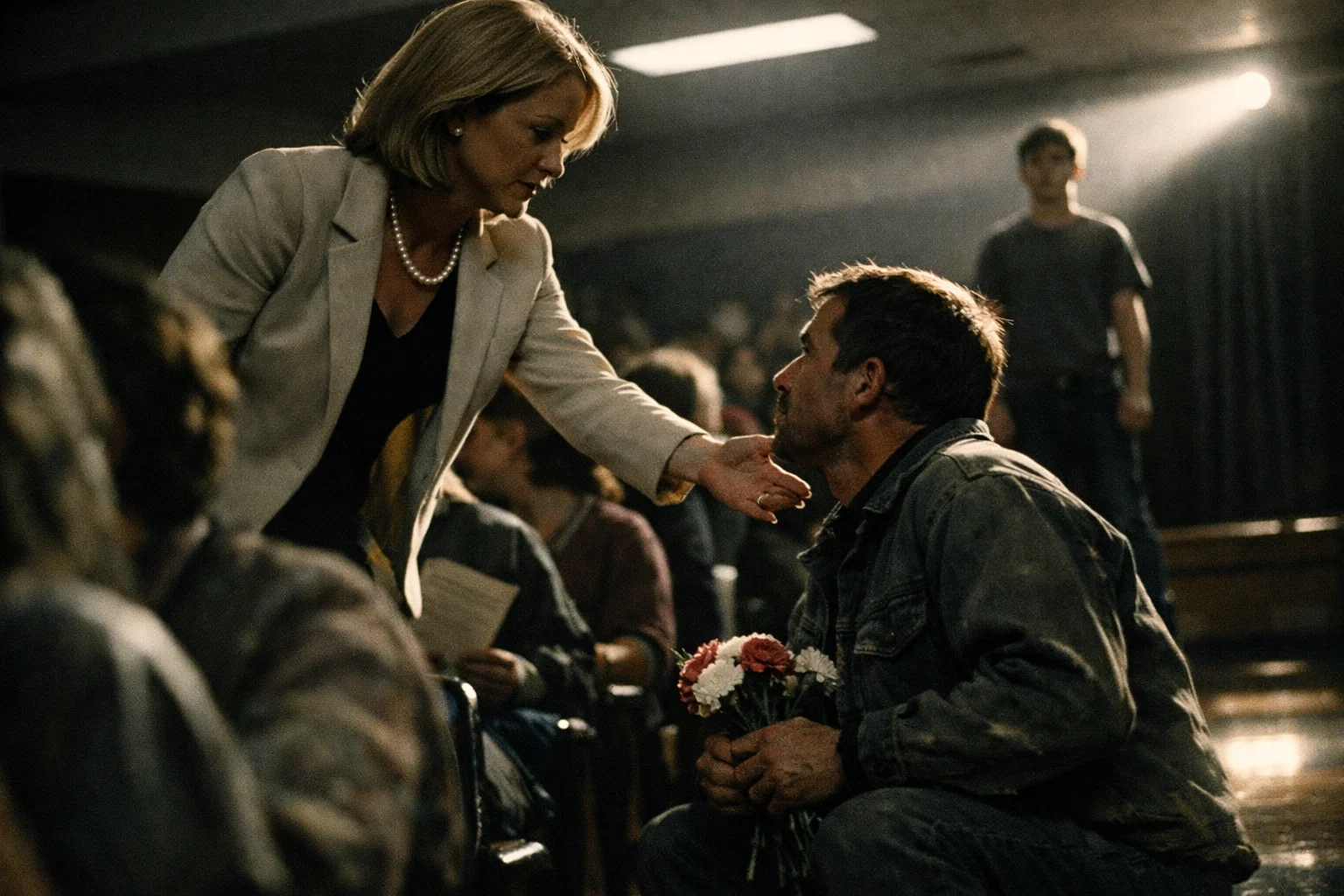
He sat down carefully, like a man used to taking up as little space as possible. Worn jeans. A faded work jacket. Boots that had done more work in the last month than most people’s gym memberships. A small tear at the cuff of his left sleeve where a nail had caught it on a job site in February. In his hands, three grocery-store carnations still in their plastic sleeve.
He hadn’t had time to find a vase.
The seats around him filled steadily. Mothers in soft floral dresses who nodded at each other across the rows. Fathers in pressed khakis who talked about the Bengals and upcoming summer travel. A few grandparents with cameras already unpacked.
Nobody nodded at Daniel.
He didn’t seem to expect them to. He kept his eyes on the stage, watching the faculty arrange themselves, watching for Caleb.
Then a voice, low and precise, came from his left.
“Excuse me. These seats are reserved for families.”
He turned.
The woman was in her mid-forties. Pearls. A cream blazer. The kind of expression that had spent years perfecting the art of seeming polite while meaning something else entirely.
Daniel blinked once. Slow. “I am family.”
Her smile did not change. “I think there may have been a mistake. The reserved section is for scholarship recipients’ immediate family.”
“He’s my son.”
A pause. Brief but loaded.
“I see.” She tilted her head, studying him the way people study something that doesn’t match the label on the shelf. “Well. We’ll need to verify that with the office. In the meantime, there’s plenty of seating in the general area in the back.”
Three rows back, I saw the whole thing. I watched Daniel’s jaw tighten — just once, just briefly — and then go still. I watched him look down at the carnations.
He began to stand.
It happened quietly. That’s the part I keep coming back to. There was no scene. No confrontation. Just a man made to feel like a mistake in a room that was supposedly celebrating his son.
A few heads had turned. A few whispers were already traveling down the rows. Someone near the front murmured something to their spouse. Someone else glanced back at Daniel and then quickly away, the way people do when they’ve witnessed something uncomfortable and have no intention of intervening.
Daniel stepped into the aisle.
He smoothed the plastic around the carnations. He looked once more toward the stage, where Caleb was standing with the other honor students, hands clasped behind his back, white shirt pressed, posture straight. The picture of someone who’d earned his place.
And then Caleb’s eyes found his father.
And in that moment, everything that happened next began.
Caleb had been watching for the last two minutes.
He had seen the woman approach. Had seen the gesture toward the back of the room. Had seen his father stand up — not with anger, but with that particular kind of quiet resignation that Caleb had watched his whole life and never been able to name until right now.
He knew the name for it now.
It was the way his father looked every time the world reminded him he was supposed to stay in the back.
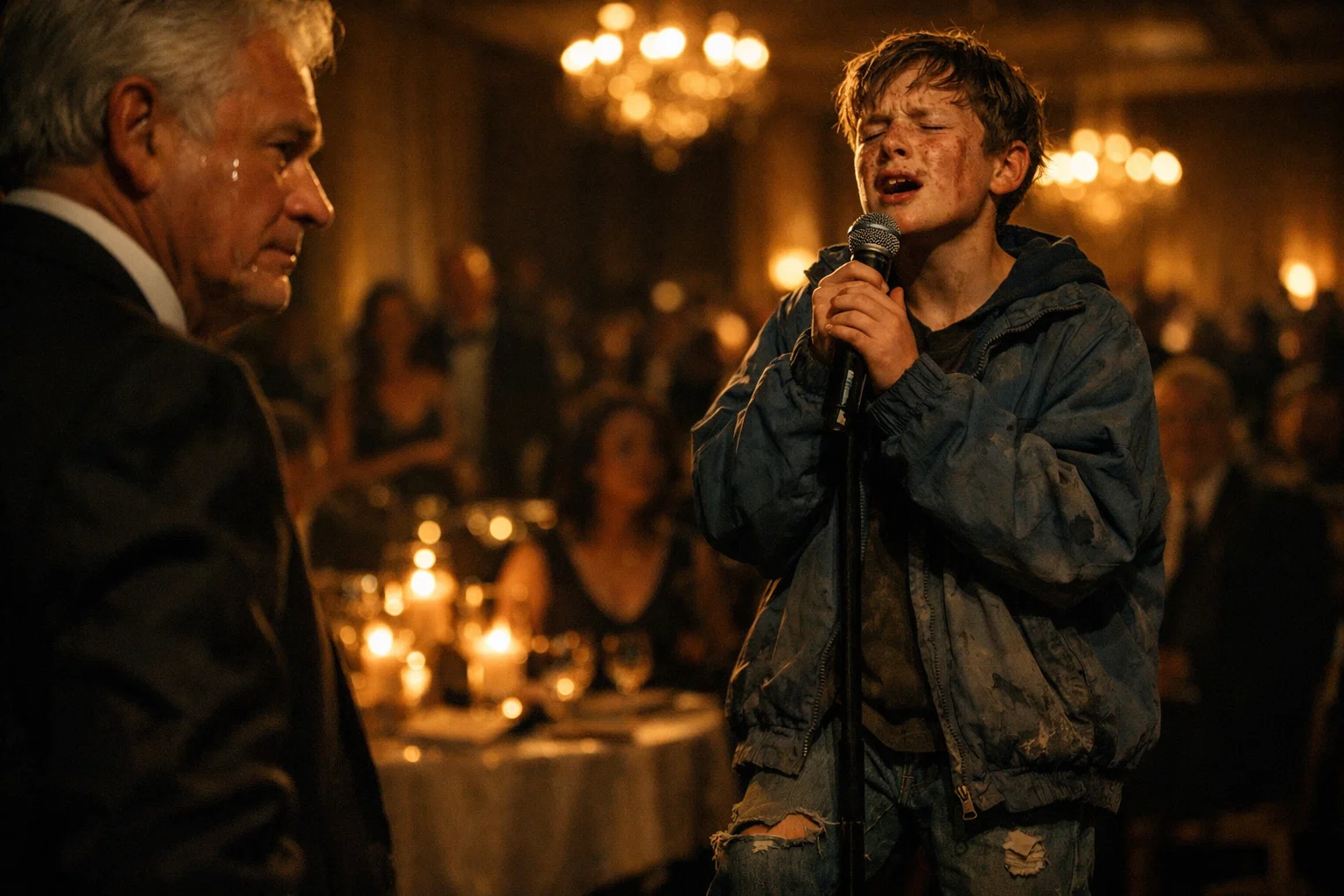
Caleb stepped forward before his name was called.
The principal was mid-sentence — something about “celebrating academic excellence and the families who make it possible.” He stopped when he noticed the boy at the microphone.
“Sir.” Caleb’s voice came out steadier than he expected. “Before you continue. I need to say something.”
The room shifted. Not loudly. The way a room shifts when a child interrupts an adult and everyone is suddenly waiting to see if it will be embarrassing or extraordinary.
The principal leaned toward him. “Caleb, we’re almost to your section—”
“They just asked my dad to move,” Caleb said, still at the microphone. “Because they thought he didn’t belong in the reserved section.”
A sharper murmur. Heads turning. Programs lowering.
The pearl-wearing woman sat up straighter, color rising in her neck. “This is highly inappropriate—”
“Ma’am.” Caleb turned to look at her. Not angrily. Directly. “With respect. It is exactly the time.”
Daniel had stopped in the aisle.
“Caleb,” he said, barely above a breath. “It’s fine. Don’t—”
“Dad.” Caleb looked at him from the stage. Just that. Just Dad. Not pleading. Not performing. Just — seeing him. “Sit down. Please.”
Daniel didn’t move for a moment. I watched his hands tighten again on those carnations. I watched the struggle cross his face — the father’s reflex to shield his child from anything, even from the truth the child was trying to tell.
But Caleb held his gaze. And after a long few seconds, Daniel took one slow step back. Sat down on the edge of his chair. Not in the reserved section yet. But not in the back either.
The principal made another attempt. “Perhaps we could—”
“My dad works construction,” Caleb said into the microphone. “Seasonal contracts. Sometimes the work dries up in winter, and he picks up whatever he can — loading docks, landscaping, whatever. He has never once complained about any of it in front of me.”
Silence now. Genuinely still.
“He never missed a parent-teacher conference,” Caleb continued. “Not one. Even when he had to change out of his work boots in the parking lot before coming inside. I used to wonder why he did that. I know now.”
A woman in the fourth row pressed her fingers to her lips.
“He taught himself algebra again,” Caleb said. “At the kitchen table. At night. After his shifts. He watched YouTube videos and worked through my textbook problems so he could help me when I got stuck. He left school at sixteen. He learned geometry at forty-two. For me.”
The pearl-wearing woman had sat back down fully now. Her posture was different. Smaller.
“He worked double shifts the year my mom got sick,” Caleb said. His voice did change then — not breaking, but thinner. “I was eleven. He kept the lights on, kept the food on the table, kept showing up to everything I had going. My science fair. My spelling bee. My first tryout for the baseball team — which, for the record, I did not make. He was there anyway.”
A teacher near the side wall turned away slightly to collect herself.
“He stood in the back because he got there late from work.” Caleb swallowed. “He always stood in the back. He thought that was his place. I spent a long time thinking that was just who my dad was. Quiet. In the back. Out of the way.”
He paused.
“Then I got older, and I understood something. He didn’t stand in the back because he thought that was his place.”
Another pause. The room breathed shallowly.
“He stood in the back so there would always be a seat for me.”
Nobody said anything.
Not the principal. Not the pearl-wearing woman. Not the fathers in pressed khakis or the mothers with their programs folded in their laps. Not the grandparents with their cameras now lowered.
Daniel’s head had dropped. Not from shame. From something harder to watch than shame — from the particular anguish of a private man having the things he’d done in the dark brought into a lit room.
“When I got nominated for this scholarship,” Caleb said, “he didn’t say he was proud. He said we’d figure out how to make it happen. Like I might need help getting here. Like the college application process was just another problem we’d solve at the kitchen table.”
He looked at the front row.
“Last winter, I found out he sold his truck.” A murmur moved through the room. Sharp and startled. “The old blue pickup — some of you probably saw it outside this school for years. He sold it so I could go to a coding camp in Columbus. I didn’t know until my friend’s dad mentioned seeing it at the auto lot.”
Daniel had not looked up.
“He hasn’t bought new boots in three years,” Caleb said. His voice was quieter now. “I noticed. I asked him about it once. He said the old ones still work fine.” His eyes moved briefly to his father’s worn boots. “He didn’t buy new boots so I could have books.”
The silence was complete.
“And if there is a seat reserved for family in this room,” Caleb said, “it belongs to him.”
He stepped back from the microphone.
No one applauded immediately. That surprised me. Instead, there was that collective inhale — the auditorium remembering it had been holding its breath.
The principal stood at the side of the stage for a moment, expression stripped of its ceremony. He looked like a man recalibrating. Then he stepped down from the stage entirely.
He walked to the second row. He walked to Daniel.
He put a hand — quietly, without fanfare — on Daniel’s shoulder. The auditorium could hear it. Not because it was loud, but because the room had become so still.
“Sir,” the principal said. “Your seat is right here.” He gestured toward the front row.
The pearl-wearing woman looked at the floor.
She shifted her purse without a word and moved one seat over.
Daniel didn’t move immediately. That habit again — the deep-grooved reflex of a man who had been redirected so many times that invitation felt like a test. He looked at his son on stage.
Caleb gave a small nod.
Daniel stood. Walked back one row first — to where he’d been sitting. Picked up the carnations he’d nearly left behind. Then walked forward. Past the second row. Past the whispers and the lowered eyes and the woman who had asked him to move. He took the open seat in the front row.
Each step was slow. Measured. The kind of steps a man takes when he is not in a hurry but has somewhere to be.
When he sat down, he placed the carnations on his knee and folded his hands over them. Back straight. Shoulders steady. Eyes on his son.
No one questioned it.
The ceremony resumed.
Names were called. Scholarships announced. Applause offered and received. The principal’s voice had regained its composure, but something in the room had shifted — an adjustment so subtle you couldn’t point at any one moment, but one that everyone present would carry home.
When the principal reached the scholarship nominations, he paused just slightly before Caleb’s name.
“This year’s recipient of the Forsythe Academic Excellence Scholarship,” he said, “demonstrated not only academic distinction, but — as we have all witnessed today — exceptional character.”
Caleb walked forward to accept the certificate and a modest check that would help cover his first semester’s textbooks.
The applause was different from the applause before. Not louder. But fuller, somehow. The kind of sound a room makes when it is paying for something and knows it.
Daniel did not stand. He did not hoot or wave. He simply clapped, hands together, steady and even, the way he had clapped for every school thing Caleb had ever done — science fairs, spelling bees, a baseball tryout that went nowhere.
His eyes were bright. His shoulders were back.
He looked like a man sitting somewhere he had always belonged.
After the ceremony, the folding chairs scraped and the room rearranged itself into the usual post-event small talk. Families clustering. Certificates being photographed. Someone near the refreshment table laughing too loudly about something.
Daniel waited by the aisle.
Caleb came down from the stage with the certificate under his arm and walked straight to him. They embraced — briefly, clumsily, the way fathers and teenage sons do when affection doesn’t always find its proper shape. A hand on a back. A shoulder held.
Daniel pulled back first. He held out the carnations.
“These are for you,” he said.
Caleb looked at them for a moment. Then shook his head. “No. They’re for you.”
Daniel’s face did something complicated. He looked down at the flowers. At his own rough hands holding them. At his son’s face.
Then he smiled. Small, tired, real.
“Okay,” he said.
The pearl-wearing woman passed them on her way toward the exit. She slowed for a fraction of a second. Half a step. She looked at Daniel — not at his jacket, not at his boots, but at him — and she said, quietly, “Congratulations.”
She didn’t wait for a response. She kept walking.
Daniel watched her go. He didn’t answer right away. Then, to no one in particular, he said, “Thank you.”
Not sarcastic. Not triumphant. Just a man who had learned to take small things at face value because he had rarely been given more.
As they left the building — father and son side by side, certificate under one arm, grocery-store carnations in the other — the principal held the door open for them.
“Mr. Aldridge,” he said.
Daniel turned.
“We’ll be in touch regarding the scholarship reception dinner next month.” The principal met his eyes. “You’ll receive a proper invitation this time. Reserved seating.”
Daniel nodded once. “I’ll be there.”
He stepped through the door. Into the bright Ohio afternoon. Into the parking lot where his old blue truck had once sat for years. Into a spring evening that asked nothing of him that he hadn’t already given.
Caleb kept pace beside him, squinting against the sun.
“You okay?” Caleb asked.
Daniel was quiet for a moment. He looked up at the sky.
“Yeah,” he said. “Yeah, I’m okay.”
They walked to the bus stop without hurrying.
In Daniel’s hand, the carnations.
In Caleb’s, the certificate.
Between them, a silence that needed nothing added to it.
That day, the principal sent a written apology to Daniel Aldridge on behalf of the school. He also quietly revised the ceremony volunteer guidelines to remove any language about “verifying family identification.” The pearl-wearing woman — whose name, I later learned, was Maureen — attended the scholarship reception the following month. She did not sit in the front row. She sat in the middle, close to the aisle, and she did not approach Daniel with anything other than a polite nod.
Caleb graduated the following spring. First in his class. Full ride.
Daniel was in the front row.
He wore new boots.
Original fictional stories. AI-assisted creative content.