The gala was the kind of event where no one actually talked to the staff.
Daniel had learned that on his first shift. You move with the tray, you smile if they look at you, and you become invisible the moment they look away. It was easy enough. He’d been invisible his whole life.
But the piano was impossible to ignore.
It stood near the far wall of the grand hall — a black Steinway concert grand, polished so perfectly that it reflected the chandelier above it like a second sky. Daniel had passed it six times in the last hour. Each time, his steps slowed just a fraction.
“Daniel.” His coworker Marcus nudged his arm. “Table four needs refills.”
“I know,” Daniel said. “I’m going.”
But his eyes stayed on the piano for one more second.
Marcus followed his gaze. “Don’t even think about it.”
“I’m not thinking about anything.”
“You’ve been staring at that thing all night.”
Daniel didn’t answer. He turned toward table four and kept walking.
The party swelled around ten o’clock. More laughter. Louder conversations. The kind of noise that money makes when it has nowhere left to go.
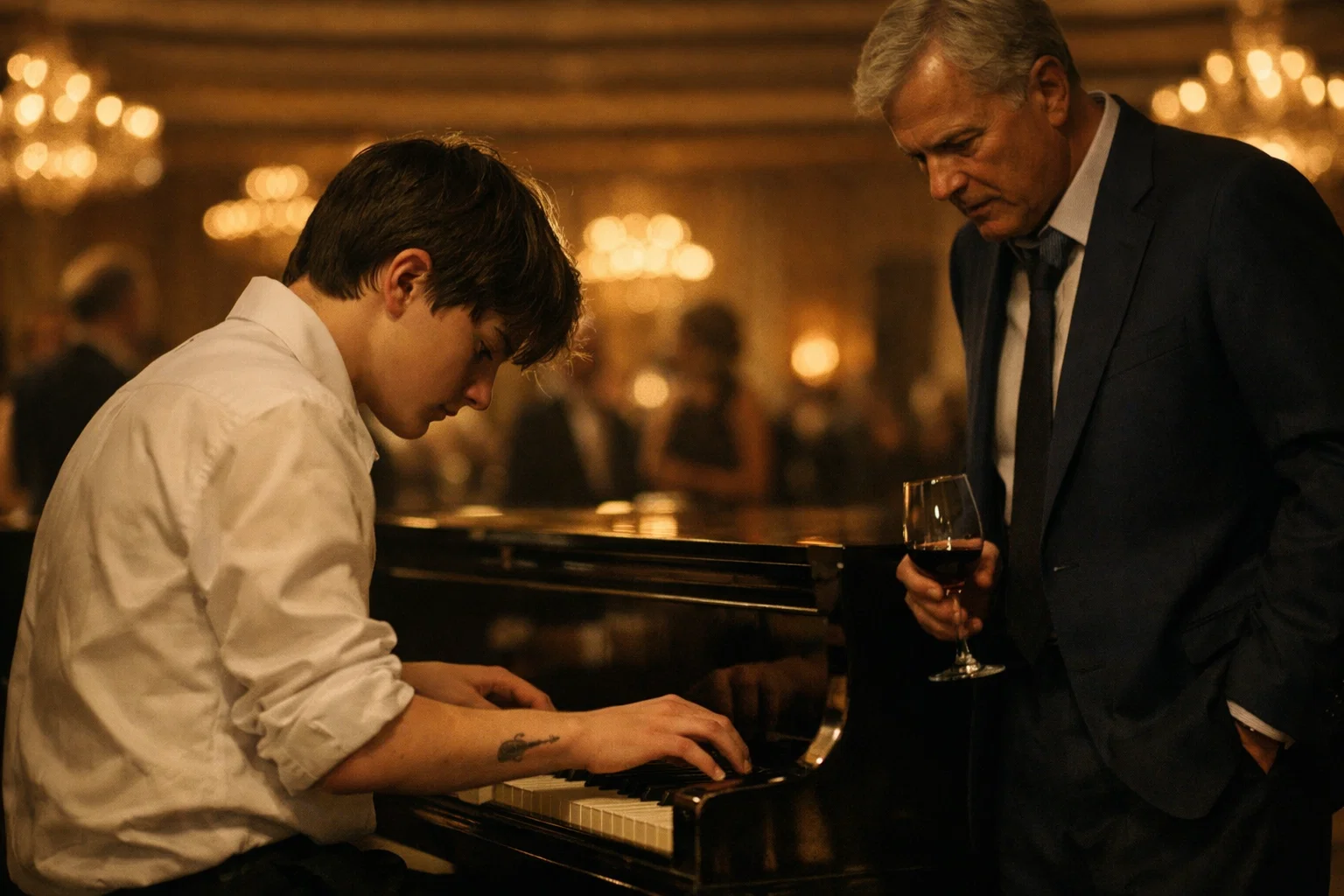
Daniel stood near the back wall, tray balanced, watching a cluster of men near the piano. The loudest one was impossible to miss — tall, navy suit, silver watch that caught the light every time he moved his hand. He had the voice of someone who had never once been interrupted.
His name, Daniel had heard one of the guests say, was Caldwell. Richard Caldwell. Something about real estate and something about hotels and something about “the fund.”
Daniel didn’t care about any of that.
He cared about the piano.
He had been building toward the question all night. Rehearsing it silently while he poured drinks. Excuse me, sir. Would it be possible — Would anyone mind if — Could I —
He swallowed. Set his tray on a side table.
Walked over.
“Excuse me,” he said.
Caldwell glanced down. His eyes moved fast — uniform, tray, shoes, face. The assessment took under two seconds.
“Yeah?”
“I was wondering,” Daniel said, “if I could play the piano. Just for a moment. If no one’s using it.”
A beat of silence.
Then Caldwell laughed.
It wasn’t cruel, exactly. It was the laugh of a man who found something mildly surprising, like a dog trying to open a door.
“You?” He glanced at the men beside him. “He wants to play the piano.”
Two of them smiled. One looked away.
“Have you ever even touched a piano in your life?” Caldwell asked, loud enough that the couple behind him turned to look.
Daniel felt the heat crawl up his neck. Every instinct told him to apologize, step back, pick up his tray, disappear.
He didn’t move.
“Yes,” he said quietly. “I have.”
Caldwell tilted his head. “What’s your name?”
“Daniel.”
“Daniel.” He repeated it slowly, like he was deciding whether it was worth remembering. “Listen, Daniel. This is a two-hundred-thousand-dollar instrument at a private event. It’s not a toy.”
“I know what it is.”
Something in the boy’s voice made Caldwell pause — not long, just a flicker.
Then he smiled again and turned back to his guests. “Go refill something.”
The small laugh that followed wasn’t from everyone. But it was enough.
Daniel stood still for one more second.
Then he turned, walked to the piano bench, and sat down.
The movement was quiet. Almost gentle. But it landed on the room like a dropped glass.
Marcus, across the hall, went rigid. He made a sharp cut-throat gesture with one hand.
Daniel didn’t see it.
He placed his hands above the keys. Not pressing. Just hovering — the way you might hold your palms over a fire to feel the heat before you commit to the warmth.
His left sleeve shifted back slightly.
On his inner wrist: a small tattoo. A guitar. Simple lines, faded slightly with age. The kind a kid might have gotten from a street artist, or drawn on himself with a marker that seeped into the skin and never fully left.
Caldwell turned at the sound of the bench moving.
His eyes found the tattoo.
He stopped laughing.
His glass stayed halfway to his mouth.
Daniel pressed the first key.
A single note — clear, centered, perfectly weighted — rang out and touched the ceiling. Every conversation within twenty feet softened. Not stopped. Just softened.
He pressed another.
And another.
And then something opened.
The melody came out of him the way breath comes — not forced, not performed, just released. It moved through the hall like something that had been waiting in the walls. It was not a showy piece, not a competition piece. It was the kind of music that makes people suddenly aware of everything they’re feeling and haven’t said.
Guests turned one by one.
A woman stopped mid-sentence, her champagne forgotten in her hand.
Two men near the bar went quiet and didn’t realize it.
A server by the kitchen door stood frozen with a tray of empty glasses, not moving, not wanting to make a sound.
Caldwell had not moved at all.
His eyes were fixed on the tattoo. On the boy’s hands. On the keys.
His guest leaned toward him. “Richard, who is this kid?”
Caldwell didn’t answer.
Because he was already somewhere else.
Seven years earlier, a video had circulated in private music circles. Not widely — it never made it to the mainstream. But among people who knew music, it was discussed in a particular tone. Hushed. Almost reverent.
A child, maybe seven or eight years old, playing a battered electric keyboard set up beside a subway entrance. The video was shot on a phone, shaky, backlit. The sound quality was poor.
None of that mattered.
The boy played with a precision and emotional depth that had no business existing in an eight-year-old. Seasoned musicians had watched it and said nothing for a while afterward.
And beside the keyboard, drawn on the concrete in chalk — or maybe marker, it was hard to tell — was a small guitar shape.
The video disappeared after a few weeks. The boy was never identified. Never found.
Caldwell had tried, once. Briefly. He told himself it was out of professional interest.
The tattoo on the boy’s wrist was the same shape.
Same proportions. Same faded lines. Like it had been redrawn from memory, from a symbol that meant something private.
The music swelled.
Caldwell walked forward slowly, without noticing he was moving.
Daniel finished.
The last note faded slowly — reluctantly, almost — like it didn’t want to leave.
The hall was silent for a full three seconds.
Then someone started clapping. Then another. And then, with a kind of inevitability, the whole room was applauding. A few people stood. One older woman pressed her hand to her chest.
Daniel lowered his hands to his lap.
He looked at the keys for a moment, like he was saying goodbye to something.
Then he looked up, and his face did something complicated — caught between pride and exposure, like he’d shown something he normally kept hidden and wasn’t sure it had been safe to do.
Caldwell was standing two feet away.
The smirk was gone. Every trace of it.
“What’s your name?” he asked.
“You already know my name.”
“Your full name.”
A pause. “Daniel Reeves.”
Caldwell looked at his wrist. “The tattoo.”
Daniel didn’t cover it. “Yeah.”
“The subway. Seven years ago. That was you.”
It wasn’t a question. Daniel’s jaw tightened slightly. “You saw that?”
“I did more than see it.” Caldwell’s voice was lower now. “I spent three weeks trying to find out who you were. Where you’d come from.”
Daniel stared at him.
“Why?” he asked.
“Because I’d never heard anything like it.” Caldwell exhaled slowly. “And then you were just gone.”
The applause had died down. The hall had returned, slowly, to its own noise. But the space around the piano felt sealed off. Private.
Daniel looked at his hands.
“We moved,” he said. “My mom got sick. We had to leave the city.”
“Where did you go?”
“Wherever was cheapest.” He said it without bitterness. Just fact. “She needed doctors. And then she needed different doctors. And then she just needed to rest somewhere quiet.”
Caldwell was quiet for a moment. “I’m sorry.”
“She’s still alive,” Daniel said quickly. “She’s better now. Mostly.”
The relief in his voice when he said mostly was the saddest word in the sentence.
“She was the one who taught me,” he continued. “Before she got sick. She played in church. She used to say music was the only thing that didn’t cost anything to give.”
He paused.
“Then it got so it couldn’t pay for anything either. So I stopped.”
Caldwell looked at him carefully. “But you didn’t forget.”
Daniel glanced at the piano. “No. You don’t forget things like that.”
“How long have you been back in the city?”
“Eight months. This job is—” He gestured at the uniform. “It helps. My mom can’t work much. I do what I can.”
“You’re fifteen.”
“Sixteen in March.”
Caldwell’s business partner, a lean man named Fischer, had drifted over during the last exchange. He waited until Daniel stepped away to refill his neglected tray before touching Caldwell’s elbow.
“You’re thinking about it,” Fischer said.
“I’m thinking about it.”
“Richard.” Fischer kept his voice measured. “He’s a waiter at a party. You don’t know his background, his training, whether he can read music, whether he’s consistent, whether he has the discipline—”
“You heard what he just played.”
“I heard a talented kid. There are a thousand talented kids.”
“Not like that.”
“You’re reacting emotionally. The tattoo, the story about the mother—”
“Don’t.” Caldwell’s voice cut flat. “Don’t do that.”
Fischer raised his hands. “I’m just saying. It makes for a good story. Doesn’t make it a good investment.”
Caldwell turned and watched Daniel move through the crowd, tray level, expression neutral. The boy caught his eye briefly and looked away first.
“It’s not an investment,” Caldwell said. “It’s a correction.”
Fischer didn’t answer.
“I laughed at him,” Caldwell said. “In front of thirty people, I told him to go refill something.” He was quiet for a moment. “He was right. I was wrong. That has to mean something.”
Daniel was near the kitchen entrance when Caldwell caught up with him.
“I want to talk to you properly,” Caldwell said. “Not here. Can you give me ten minutes after the event?”
Daniel looked at him steadily. “Why?”
“Because I want to offer you something.”
“What kind of something?”
“Training. Real training, with people who know what they’re doing. And eventually — if you want it — performances. Real venues.”
Daniel’s expression didn’t change. But something behind his eyes shifted.
“You laughed at me an hour ago,” he said.
“I know.”
“You told me to go refill something.”
“I know that too.”
“So why would I trust you?”
It was a fair question. Caldwell didn’t try to talk around it.
“You don’t have to trust me yet,” he said. “Come meet my people. Hear what they say. If it doesn’t feel right, you walk away and nothing’s lost.”
“And if it does feel right?”
“Then maybe the world doesn’t miss what it almost missed.”
Daniel looked at him for a long moment.
“I have to get back to work,” he said.
“I know. Ten minutes. After.”
A pause. Then Daniel nodded once — small, guarded — and turned back toward the hall.
The ten minutes turned into two hours.
They sat in a small lounge off the main hall, Caldwell’s jacket draped over the back of his chair, the silver watch face-down on the table like he’d decided to stop tracking time.
Daniel talked more than he’d expected to.
About his mother’s hands — how they’d looked on piano keys versus how they looked folding laundry now. About the subway, the cold, the coins that people threw without looking. About the day he’d decided to stop playing because every song reminded him of before, and before hurt too much.
About how he’d sat down at the Steinway tonight because the thought of not doing it had hurt even more.
Caldwell listened without interrupting. It was, Daniel realized, the first time an adult in a suit had listened to him without looking at his watch.
“I can’t promise you everything works out,” Caldwell said eventually. “I can’t promise people love it or that it goes anywhere.”
“I’m not asking for promises.”
“What are you asking for?”
Daniel thought about it.
“A chance to find out if I’m actually good,” he said. “Not just good for a waiter at a party. Actually good.”
Caldwell leaned forward.
“You’re not good for a waiter at a party,” he said. “You’re good. Full stop.”
It wasn’t easy.
Nothing that followed was.
There were months of early mornings and late evenings in a practice room that smelled like wood polish and old carpet. There was a teacher named Simone who was the hardest person Daniel had ever met and the most honest. She told him in the second week that his technique had gaps and his left hand was lazy and his pedal timing was self-indulgent. She also told him, at the end of that same session, that she’d been teaching for thirty years and she could count on one hand the students who made her feel the way he made her feel.
He held onto that.
There were hard nights too. Nights when his mother was in pain and he couldn’t focus, when he came to practice already hollowed out and had nothing to give. Nights when he wondered if he was doing any of this for the right reason or just because someone powerful had told him he should.
He called Caldwell once, late, and said, “I don’t know if I want this.”
Caldwell was quiet for a moment. Then he said: “What do you want?”
And Daniel was quiet for a long moment.
“I want to play,” he said finally. “I just don’t know if I want everything around the playing.”
“Then focus on the playing. Let the around-part figure itself out.”
It wasn’t advice exactly. But it was enough.
The invitation came nine months after the gala.
A concert hall on the east side. Not Carnegie, not yet. But real — a proper venue with a real stage and a real program and Daniel’s name printed in ink on the physical flyer.
Daniel Reeves. Piano.
He stood in the wings twenty minutes before the lights went down, in the closest thing to dress clothes he owned, staring at the Steinway on stage the way he’d stared at the one in the grand hall.
Simone came up behind him. “Stop looking at it like it might bite you.”
“I’m not nervous,” he said.
“You are absolutely nervous.”
“I’m—” He exhaled. “Yeah. I’m nervous.”
“Good,” she said. “It means you understand what’s at stake.”
“What is at stake?”
She looked at him calmly. “Tonight, nothing. You play, people listen, you go home. That’s all.” She paused. “But every night you play, you give someone something they needed. You don’t always know who. You rarely find out. But it happens. That’s what’s at stake.”
Daniel nodded slowly.
“Your mother’s in the third row,” she said.
He blinked.
“Caldwell arranged it. Car service, accessible seating, the whole thing.” She squeezed his shoulder once and walked away.
When Daniel walked out onto the stage, the applause was polite — the audience didn’t know him yet. He was new. Unproven.
He sat at the bench.
He put his hands above the keys.
For one moment, it was exactly like the party. The same stillness. The same held breath.
He played.
He played the piece he’d written himself — the one he hadn’t shown anyone, the one he’d built from the memory of his mother’s hands moving over a cheap upright keyboard in a small apartment, from the sound of subway trains underneath music, from every coin in a cup on a cold floor, from the long silence of a hospital room.
By the third movement, the hall was completely still.
Not politely still. Actually still.
The kind of quiet that means something.
He reached the final passage — the part he’d written last, one night after his mother laughed at something stupid on television and the laughter had caught him off guard with how normal it sounded, how alive — and he played it simply. Without flourish. Just the notes, the way they were meant to be.
The last one hung in the air.
Then it was over.
The silence lasted four full seconds.
Then the hall came apart.
Not polite applause. Real applause — the standing, unplanned kind that happens when people forget they’re in a formal setting.
Daniel sat with his hands still on his knees and looked out at the audience.
In the third row, a woman he recognized was crying and trying not to show it. She was not succeeding.
He stood. He bowed once, then again.
And in the back of the hall, slightly apart from the crowd, Richard Caldwell stood without clapping — not from indifference, but because both hands were pressed together near his mouth, like he was trying to hold something in.
His eyes were wet.
He’d been wrong about this boy once.
He would make sure, for the rest of his life, he was not wrong about anything else that mattered.
Afterward, in the corridor backstage, Daniel found Caldwell waiting.
“Well?” Daniel said.
Caldwell looked at him for a moment. “You know how it was.”
“I want to hear you say it.”
A beat. Then Caldwell said, simply: “The world almost missed you.”
Daniel looked at the floor. His jaw worked.
“I almost missed me,” he said.
Caldwell nodded.
“That’s the part we fixed,” he said.
Daniel looked up.
And for the first time since the night at the piano bench — since the laughing and the silver watch and the go refill something — he let himself smile. Fully. Without holding anything back.
“My mom wants to meet you,” he said.
“I’d like that,” Caldwell said.
“She’s going to make you uncomfortable.”
“How?”
“She’s going to thank you. Repeatedly. And loudly.”
Caldwell almost smiled. “I’ll survive.”
“She’ll probably cry.”
“So will I,” he said quietly.
And neither of them said anything else.
Because some things don’t need a final word.
They just need to be true.
Original fictional stories. AI-assisted creative content.