CHAPTER 1: THE WEIGHT OF THE CLOTH
The Sunday morning air outside Mama’s Kitchen usually smelled like maple syrup and burnt coffee. Today it smelled like cheap lager and cruelty.
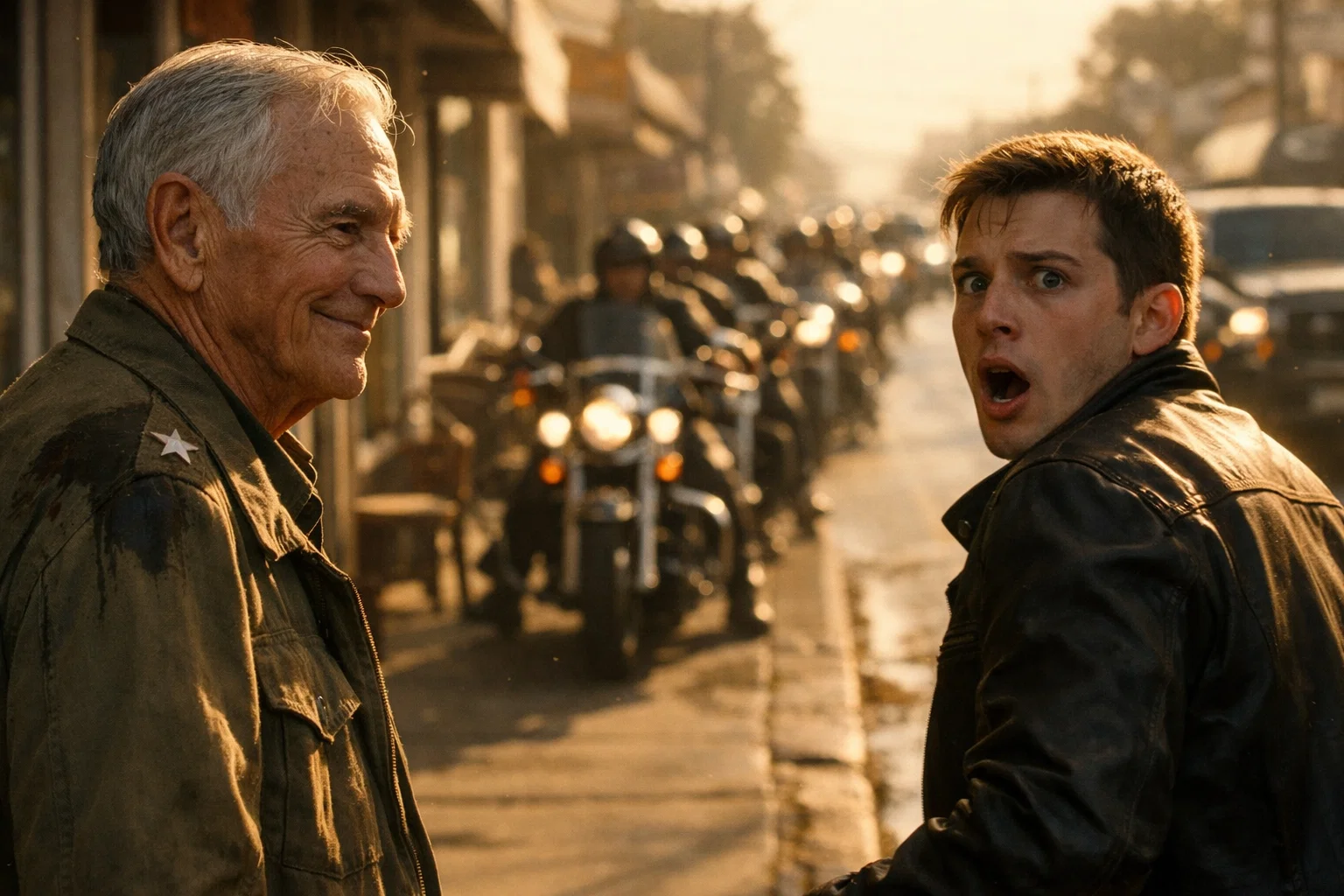
Samuel “Sam” Cole stood on the sidewalk in his olive-drab jacket, spine ruler-straight, boots polished to a shine that embarrassed the pavement. He was seventy-eight years old, and he moved through the world like a man who had long ago made peace with everything in it—except for wasted time.
“Check this guy out,” Jax Mercer announced to nobody and everybody. He revved his bike twice—a habit he had when he needed to fill silence he couldn’t handle. “Full uniform on a Sunday. What’s the occasion, Grandpa? VFW bingo night?”
Sam didn’t answer. He was doing his box breathing—four in, four hold, four out—the same technique he’d drilled into recruits in four different decades. He wasn’t ignoring Jax. He was deciding.
“I’m talking to you.” Jax stepped off his bike and walked a slow circle around Sam, the way a dog circles something it hasn’t decided to bite yet. “Where’d you get that thing? Goodwill? Halloween?”
The Silver Star on Sam’s lapel caught the morning sun.
Jax grabbed the jacket’s collar. For a quarter of a second, Sam’s right hand moved—a flash of speed that had no business being inside a seventy-eight-year-old body. His grip locked onto Jax’s wrist with the cold precision of a steel trap.
Their eyes met.
Jax saw something in Sam’s face that he would not be able to describe later—not anger, not threat. Something older. Something that had survived things Jax couldn’t name.
Then Sam let go. He let his shoulders drop. He looked small.
“I just want my coffee, son,” Sam said quietly.
Jax laughed—too loud, too fast. “Yeah. That’s what I thought.”
He grabbed the can of lager from his buddy Derek’s hand and upended it over Sam’s silver head.
The liquid soaked dark and slow into the jacket’s shoulders.
Sam closed his eyes. His lips began to move.
“He’s praying!” Derek hooted. “He’s actually praying!”
Sarah Chen, who had served Sam his three-dollar coffee for five years and received a five-dollar tip every single time, burst through the diner’s screen door. Her hands were shaking.
“Jax Mercer, you stop that right now—”
“Go back inside, Sarah,” Jax said without looking at her. “This is between us and the ‘Commander’ here.” He did air quotes with his fingers.
“He is twice the man you will ever be,” Sarah said. Her voice cracked on the last word.
Sam opened his eyes. He looked—not at Jax, not at the seven bikers forming a loose half-circle around him—but at the horizon. At the long straight road that ran out of Oak Creek toward the interstate.
His lips were still moving.
“Who are you praying for, old man?” Jax mocked. “God? You think God’s got time for your Sunday suit?”
“Not for myself,” Sam said. His voice was gravel under a slow wheel. “For you, son.”
Jax blinked. “What?”
“I’m praying for you. Because once they see what you’ve done to this jacket—” Sam paused. A low vibration moved through the soles of their shoes, up through the pavement, barely a tremor. “—I won’t be able to stop them.”
Jax looked down the road.
Far away, at the edge of town, something was moving.
CHAPTER 2: THE SIGNAL
The vibration became a sound. The sound became a rumble. The rumble became something else entirely.
From the north end of town, where County Road 9 met Main Street, the horizon changed color—black and chrome, rolling forward in a column.
“What is that?” Derek said.
Nobody answered because nobody knew. They counted without wanting to: ten vehicles, then twenty, then fifty. Motorcycles. Black SUVs. Pickup trucks. Not a single one had a sticker or a logo. They moved in formation, with the kind of coordinated precision that had nothing to do with leisure riding.
Sarah’s hand found the doorframe.
Jax stood very still. “Sam,” he said slowly. “What did you do?”
“I didn’t do anything,” Sam said. “I simply exist. They do the rest.”
The column did not speed up. It did not slow down. It rolled into Oak Creek the way a tide rolls in—inevitable, indifferent to whether you were ready.
Three hundred motorcycles. Thirty black SUVs. Men and women in dark clothing, some in tactical vests, some in riding gear. None of them were wearing colors. None of them were advertising. They were not a club. They were not a gang.
They were a response.
They came to a stop in a half-mile arc around the block outside Mama’s Kitchen.
The engines cut.
The silence was heavier than the sound had been.
One man walked forward. He was perhaps fifty, with close-cropped gray hair and the kind of stillness that very still water has before something breaks the surface. He wore no insignia. He wore a single black jacket with nothing on it. His hands were relaxed at his sides.
He stopped six feet from Sam.
“Commander,” he said. One word.
Sam looked at him for a long moment. “Elias.”
“We received your signal.”
Jax looked between the two men. “What signal? He was just—he was just standing there—”
“He was praying,” Elias said. He turned his eyes on Jax, and Jax took a step backward without deciding to. “The Commander only prays in the field when he’s protecting someone who doesn’t know they need protecting.”
“That’s—” Jax tried to laugh. It came out wrong. “That’s not a signal.”
“For us it is.” Elias reached down and lifted Sam’s beer-soaked jacket by the collar, examining the stain on the shoulder. He turned it over. He saw the Silver Star. He saw the three unit patches beneath it. He set it down with the careful reverence of a man handling a document that could not be replaced.
He stepped back and looked at the seven Iron Thorns.
“Do you have any idea,” Elias said quietly, “who you just poured beer on?”
Nobody answered.
“I’ll tell you anyway.”
CHAPTER 3: THE ACCOUNTING
Elias did not raise his voice once. He spoke the way a judge speaks when the verdict has already been written—clearly, without hurry, without need for emphasis.
“This man served three tours in Vietnam. He ran black operations in Central America in the eighties that are still classified. He built the private security training program that guards seven current heads of state, two sitting Supreme Court justices, and four Fortune 100 executives. He trained me. He trained every single person you see behind me.”
Elias gestured toward the column of vehicles without looking back.
“He retired to this town five years ago. He orders a three-dollar coffee every Sunday. He tips five dollars. He does not bother anyone.”
He walked slowly toward Jax.
“And you poured beer on his jacket.”
Jax’s bravado had been dissolving in pieces since the first motorcycle arrived. Now the last of it was gone. “Look, man, we didn’t know—”
“That’s exactly the problem,” Elias said. “You looked at a quiet old man in a worn jacket and you saw nothing. You didn’t see his service. You didn’t see his losses. You didn’t see that this—” He touched the Silver Star with one finger. “—means he ran back into enemy fire to pull out a nineteen-year-old kid who would have bled out in a rice paddy.”
Sam said nothing. He was watching the horizon again, the way he watched it when he was somewhere else in his memory.
“You saw easy,” Elias continued. “You chose cruelty because it felt safe.” He stopped two feet from Jax. “Nothing about this moment is safe.”
From behind the column, a second figure walked forward—a woman in her forties, compact and precise in her movements. She stopped at Elias’s shoulder.
“Maya,” Sam said softly.
“Commander,” she said. Her voice was even, but her jaw was tight.
“You came all the way from D.C.?”
“First flight out when Elias called.” She looked at Jax without expression. “I was in a security briefing for a NATO summit when the message came through. I excused myself.”
Jax looked from Maya to Elias to the silent hundreds behind them. “This is—you’re all—”
“His students,” Maya said. “And we don’t forget our teachers.”
Officer Danny Miller had rolled up in his cruiser during Elias’s speech and was leaning on the hood with his arms folded. He was twenty-six years old and he had been on the force for eight months. He did not know what to do with any of this.
“I should probably—” Miller started.
Elias held up one finger without looking at him.
Miller closed his mouth.
“Here is what’s going to happen,” Elias said to Jax. “You are going to apologize. Not to me. Not to your crew. To him.” He nodded toward Sam. “And you’re going to mean it. And then we’re going to discuss what comes after that.”
Jax looked at Sam. Sam was looking at the pavement, his hands loose at his sides, his face wearing that expression of profound and exhausted pity.
“I’m—” Jax cleared his throat. His voice came out younger than he wanted it to. “I’m sorry, sir.”
Sam looked up.
“I didn’t—I didn’t know who you were.”
“That,” Sam said, “is what I was hoping you’d understand. You don’t have to know who someone is to treat them with respect.”
Jax had nothing to say to that. He had never had anything to say to that. It was the problem.
“Knees,” Elias said.
“What?”
“On your knees. All of you.”
The Iron Thorns—seven men who had spent the last three years building a local reputation on the back of noise and intimidation—dropped to the sidewalk outside Mama’s Kitchen one by one, with the slow compliance of men who have finally, completely, run out of options.
The five hundred professionals behind them watched without expression.
Officer Miller stared at his shoes.
Sarah, still in the doorframe, pressed one hand over her mouth.
Sam looked down at the seven kneeling men.
He looked tired. He looked old. He looked exactly like what he was—a man who had seen enough cruelty to know it never came from strength, only from fear, and that punishing it was never as satisfying as people hoped.
“Get up,” he said quietly.
Jax looked up. “Sir?”
“I said get up.” Sam reached down and helped Jax to his feet himself—one hand under the younger man’s elbow. “I don’t want you on your knees. I want you on your feet being something better than what you were this morning.”
CHAPTER 4: THE TERMS
Elias laid it out. He was not theatrical about it. He was specific and practical in the way that effective people always are.
“You will sell your bikes,” he said. “All seven. The money goes to the Veterans’ Resource Center on Route 12. Every dime.”
Jax opened his mouth.
“If you’re about to negotiate,” Elias said, “don’t.”
Jax closed his mouth.
“You will perform forty hours of community service at that same center. Not a check, not a donation drive. Forty hours of showing up and doing what they tell you to do.”
Derek raised his hand slightly. “What if we—”
“Derek,” Sam said.
Derek’s hand went down.
“And if I hear—from anyone, anywhere in this county—that any one of you has laid a hand on someone, talked down to someone, used your size or your noise to make someone feel small—” Elias let the pause hold long enough to be uncomfortable. “We will know. And we will come back. And I promise you, this was the polite version.”
The seven men nodded. It was not the nod of men agreeing. It was the nod of men who understood they had no remaining leverage.
“Good,” Elias said.
He turned to Officer Miller.
“Officer. Nothing illegal happened here today. The Commander chose not to press charges for the assault, which is his right.” He reached into his jacket and removed a business card, held it between two fingers. “This is my direct number. If these seven men comply with the terms, please confirm that with me within sixty days. If they don’t—” He glanced back at the column of vehicles. “—I’ll find out regardless.”
Miller took the card. He looked at it for a long time. Then he nodded once.
“Yes, sir,” he said—and clearly had not meant to say sir, and clearly couldn’t help it.
Elias almost smiled. He turned back to Sam.
“Breakfast?” he said.
Sam looked at the diner. He looked at Sarah, who was already moving back toward the kitchen, wiping her eyes with her apron sleeve in a way she probably thought nobody noticed.
“She makes terrible eggs,” Sam said.
“I know,” Elias said. “I’ve had them.”
“Best coffee in the county.”
“I know that too.”
They walked inside together.
CHAPTER 5: WHAT THE DINER HOLDS
By ten o’clock, Mama’s Kitchen was full. Not the uneasy, half-occupied full of a bad Sunday—genuinely full, with Elias’s people taking up every table and the counter, ordering enough food to keep Sarah and her one part-time cook working without pause for two hours.
The Iron Thorns sat on the curb outside. Nobody told them to. They simply had nowhere else to go, and somehow the curb seemed right.
Maya sat across from Sam in the corner booth. She had a coffee she wasn’t drinking. Sam had pancakes he was working through slowly.
“You didn’t have to call,” Sam said.
“Elias called,” Maya said. “I came on my own.”
“From a NATO briefing.”
“You taught me that some things outrank briefings.” She looked at him steadily. “You look thin.”
“I’m fine.”
“You’re eating alone on Sundays in a small town and you’ve been doing it for five years.”
Sam put his fork down. “Maya.”
“I’m not saying it as a criticism. I’m saying it as a fact.”
“I like this town.”
“I know you do.” She turned her coffee cup in its saucer. “I know you came here after Thomas died because it was quiet and because nobody knew you and you needed both of those things.” She looked up. “I also know that you’ve been quiet long enough.”
Sam looked at the wall, where Sarah had, in the time it took them to order, produced from somewhere in the back a simple oak frame and put the beer-stained jacket inside it. It was not perfectly hung. It was slightly crooked. It was the most respectful thing Sam had seen anyone do in years.
“He would have been forty-three this year,” Sam said.
“I know.”
“I keep thinking—if I’d run a different training program, if I’d—”
“He chose to serve,” Maya said. “You taught him how to serve with integrity. That’s not a failure. That’s the whole job.” She paused. “You can’t spend the rest of your life in a booth grieving someone who died proud of everything you taught him.”
Sam was quiet for a while.
Sarah refilled his coffee without being asked. “On the house, Commander,” she said, and was gone before he could object.
“They’re going to call me that now,” Sam said.
“They were always going to call you that,” Elias said from two tables over without looking up from his own plate.
Sam shook his head. But something in his face had shifted—some weight that had been sitting behind his eyes for five years had moved, not gone, but redistributed, made bearable.
Outside, through the diner window, he could see Officer Miller standing beside his cruiser, watching the seven men on the curb. Watching them with the careful attention of a young cop learning something he hadn’t been taught at the academy.
CHAPTER 6: THE RECKONING ON THE CURB
Jax sat on the curb with his elbows on his knees and stared at the gutter.
Derek sat beside him. Neither of them spoke for a long time.
“You think they’ll actually come back?” Derek said.
“Yes,” Jax said.
“How do you know?”
“Because they came the first time.” Jax rubbed his face. “Nobody mobilizes five hundred people as a bluff.”
Derek was quiet. Then: “We were wrong.”
“Yes.”
“I mean—I knew we were being jerks, but I didn’t think—”
“You didn’t think he was anybody,” Jax said. “That was the whole problem. I didn’t think he was anybody either.” He watched a sparrow land on the sidewalk three feet away, peck at something, fly off. “That’s not an excuse.”
“No,” Derek agreed.
They sat with that for a while.
“You know what gets me?” Jax said. “He helped me up. After everything—after all those people, after being embarrassed in front of the whole town—he reached down and helped me up.”
Derek didn’t answer.
“He didn’t have to do that,” Jax said. “He could have let me kneel there. He could have—I don’t know—made a speech, made it a thing. He just reached down.”
“What do you think that means?”
Jax was quiet for a long time. “I think it means he’s a better man than I’ve been pretending I have any right to judge.” He stood up slowly. “Come on. Let’s go find out where that Veterans’ Center is.”
CHAPTER 7: THE FINAL SALUTE
By the time the column rolled out of Oak Creek, it was past noon and the Sunday light had gone golden.
Elias was the last to leave. He stood on the sidewalk with Sam while the final SUVs pulled away. The town had come out—not intrusively, not in a crowd, but in ones and twos along the sidewalk, watching with the quiet attention of people who understood they were seeing something they would describe to their grandchildren.
“Don’t wait five years next time,” Elias said.
“I wasn’t calling you,” Sam said. “I was praying.”
“I know. That’s how we knew.” Elias put his hand on Sam’s shoulder. “Your signal hasn’t changed in thirty years. Box breathing, closed eyes, lips moving. We trained ourselves to watch for it.”
Sam stared at him. “You—”
“Maya’s idea. After you retired.” Elias shrugged. “We set up a monitoring protocol. Any time anyone reported seeing it, we’d get a message.” He paused. “Sarah called the hotline forty minutes before you even opened your eyes.”
Sam looked at the diner window. Sarah, inside, caught his eye and gave him a small, pointed look that said: yes, I did, and I would do it again.
Sam laughed. It was a real laugh, from somewhere he hadn’t accessed in a long time.
“You’re all insane,” he said.
“You made us this way,” Elias said. He pulled Sam into a hug—brief, firm, the hug of men who had been in the same foxhole and didn’t need to explain it. “You built something, Sam. You don’t get to disappear into a diner booth and pretend it doesn’t exist.”
He stepped back. Mounted his bike.
“Breakfast is on me next time,” Sam called.
“It was on you this time too. I ran your card when you weren’t looking.”
Sam shook his head as the last motorcycle pulled away.
He stood on the sidewalk alone—except that he was not alone. Officer Miller was parked across the street, and when Sam looked up, Miller stepped out of his cruiser, stood straight, and gave a crisp, full formal salute.
Sam raised his right hand and returned it.
He stood there for a moment longer, watching the empty road.
The beer was gone. The jacket was framed on the diner wall. The seven men who had tried to make him small were driving themselves to a Veterans’ Center to sign up for forty hours of showing up.
And somewhere, in the specific alchemy of that Sunday morning, something in Sam’s chest that had been locked for five years opened—not with drama, not with noise—but with the quiet, decisive click of a door that had always been unlocked from the inside.
He walked into the diner, sat in his booth, and ordered another coffee.
Sarah brought it without a word. Set it down. Put her hand on his shoulder for exactly two seconds.
It was enough.
Outside, a neighbor who had watched the whole morning from his porch crossed the street and waved—an actual wave, not a nod, not a polite half-glance, but the full open-handed wave of a man acknowledging another man’s worth.
Sam waved back.
Then he finished his coffee, left his five-dollar tip, and walked home down the center of the sidewalk, unhurried, unbowed, taking up exactly as much space as he had earned—which was, it turned out, considerably more than Oak Creek had previously understood.
The jacket stayed on the diner wall for eleven years.
People argued later about whether it was the Silver Star that stopped you when you walked in, or the beer stain, or the two together.
What they agreed on was this: it stopped you. You looked at it, and you stood up a little straighter, and you thought about how you had treated the quiet person next to you that week, and whether you would want five hundred people to know.
Some lessons, once taught, don’t need to be repeated.
Most do.
But this one took.
Original fictional stories. AI-assisted creative content.