Margaret stood in Frank’s study, hands shaking as she held the divorce papers.
Fifty-two years of marriage. And this is how it ends.
She’d come looking for stamps. Found betrayal instead.
The papers were dated three weeks ago. His signature already there. A space left blank for hers.
“You coward,” she whispered to the empty room.
Her chest felt tight. The kind of tight that sent women her age to the emergency room. She sat down hard in his leather chair, the one he’d forbidden her to use for decades.
That’s when she saw the envelope.
It was yellowed with age, tucked beneath the divorce papers like it had been placed there deliberately. Her name written across the front in Frank’s young handwriting.
Margaret—Open Only If I’m Gone
But he wasn’t gone. He was at physical therapy for his hip. He’d be home in an hour.
Her fingers trembled as she broke the seal.
My dearest Margaret,
If you’re reading this, I’m dead. And there are things you need to know.
I was diagnosed with early-onset Alzheimer’s five years ago. The doctors said I’d have maybe ten good years left. Maybe less.
I didn’t tell you because I couldn’t bear to watch you sacrifice the rest of your life taking care of a man who won’t remember your face.
You deserve better than watching me fade away.
The divorce papers are my gift to you. I’ve already signed them. I’ve arranged everything—sold my share of the house to Eddie, set up a trust so you’ll never worry about money. You’ll be free.
Find someone who can remember why you laugh at old Westerns. Someone who won’t forget your sister’s name or ask you three times what day it is.
I’m doing this because I love you too much to trap you.
Forever yours, even when I don’t know who I am,
Frank
Margaret read it twice. Then three times.
The date at the top: February 14, 2019. Five years ago.
The Alzheimer’s. The diagnosis. The secret.
Her mind raced backward through the last five years. The moments she’d dismissed. The signs she’d ignored.
Frank asking the same questions. Getting frustrated with simple tasks. That day last month when he couldn’t find his way home from the grocery store he’d been going to for thirty years.
“Oh, Frank,” she breathed.
The front door opened.
She heard his uneven footsteps in the hallway. The thud of his cane.
“Margaret?” His voice sounded uncertain. “You home?”
She wiped her eyes and walked out of the study, the letter still in her hand.
He stood in the living room, looking older than she’d let herself notice. His shoulders stooped. Confusion flickering across his face.
“Who are you?” he asked quietly.
The words should have broken her. Instead, they made everything clear.
“I’m your wife,” she said, walking toward him. “My name is Margaret. We’ve been married for fifty-two years.”
He frowned. “I… I’m sorry. I don’t…”
“It’s okay.” She took his hand. It felt exactly the same as it had in 1972 when he’d slipped a ring on her finger. “Do you know your name?”
“Frank.” He said it like he was testing the word. “Frank Morrison.”
“That’s right.” She guided him to the couch. “Frank, I need to tell you something.”
He looked at her with such raw vulnerability that her throat closed up.
“I found your letter,” she said. “The one you wrote five years ago.”
His eyes widened. “The letter.” He swallowed hard. “Then you know.”
“About the Alzheimer’s? Yes.”
“Did you find the—” He stopped. “The papers?”
“The divorce papers. Yes.”
A tear rolled down his weathered cheek. “I’m sorry, Margaret. I’m so sorry. You should sign them. You should be free. I won’t remember you soon and I can’t—I can’t do that to you.”
She set the letter on the coffee table and took both his hands in hers.
“Frank Morrison, you listen to me.”
He looked up.
“I didn’t marry you because I thought life would be easy. I married you because when I looked at you, I saw home.”
“But I’m forgetting—”
“Then I’ll remember for both of us.” Her voice cracked. “You think I’m going to abandon you because your mind is sick? Would you have left me if I’d gotten cancer?”
“Never.” The word came out fierce. “Never.”
“Then why would I leave you?”
“Because this is different. I’ll forget your birthday. I’ll forget our children’s names. I’ll forget I love you.”
She squeezed his hands tighter. “But I won’t forget. And every single day, I’ll remind you.”
“Margaret—”
“Do you know what day it is?”
He blinked. “Thursday?”
“It’s Valentine’s Day, Frank. February fourteenth.”
Something flickered in his eyes. A memory, maybe. Or just the wish for one.
“I made a reservation,” he said suddenly. “At that Italian place you like. Didn’t I? I remember… making a call…”
“You did.” She smiled through her tears. “You made it three weeks ago. You wrote it down on the calendar so you wouldn’t forget.”
He looked at the wall calendar, then back at her. “I did that?”
“You’ve been doing things like that for years. Writing everything down. Setting alarms. Fighting like hell to hold onto us.”
“It’s not enough.”
“It’s everything.”
She stood and walked to the fireplace, took the divorce papers from where she’d left them on the mantel.
Frank watched her, his eyes following her movements like he was afraid she’d disappear.
Margaret held the papers up, then tore them clean in half.
“No,” Frank said, standing too quickly. He winced as his hip protested. “Margaret, no. You have to—”
“I don’t have to do anything except love you.” She tore them again. And again. “That’s the only thing I have to do.”
The pieces fell like snow around her feet.
Frank stared at them, then at her.
“I won’t remember this tomorrow,” he whispered.
“Then I’ll tell you again.”
“Or the day after.”
“Then I’ll tell you every day.” She crossed back to him. “For as long as we have.”
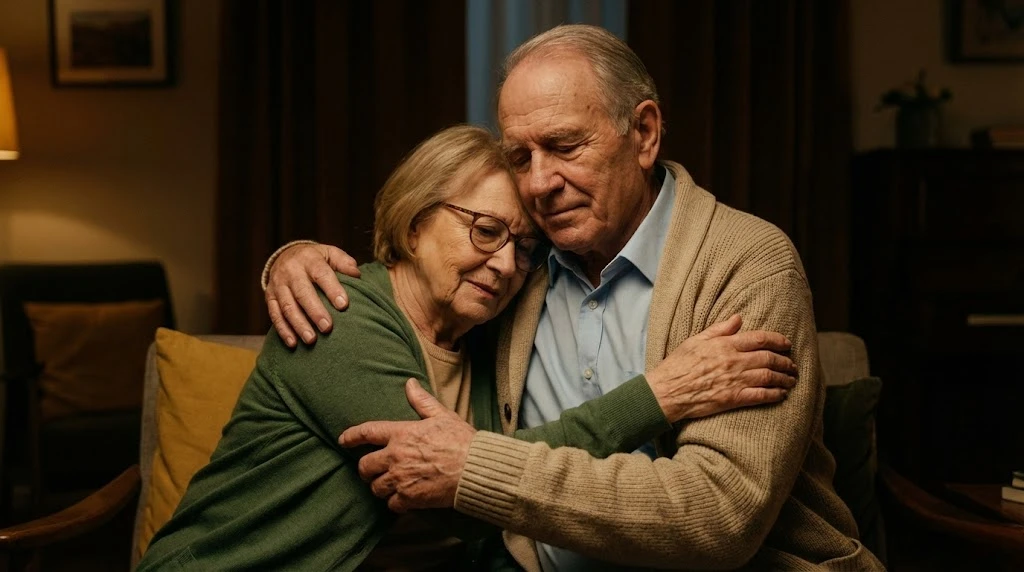
He pulled her close, and she felt his whole body shaking.
“I’m scared,” he said into her hair.
“I know. Me too.”
“What if I forget how much I love you?”
She pulled back just enough to look him in the eyes. “Then I’ll love you enough for both of us. And when you look at me and don’t know who I am, I’ll introduce myself and we’ll start again.”
“That’s not fair to you.”
“Frank, fifty-two years ago you promised to love me in sickness and in health. Did you mean it?”
“Yes. God, yes.”
“Then let me keep the same promise.”
He cupped her face with trembling hands. “You’re sure?”
“I’ve never been more sure of anything.”
They stood there in the wreckage of the torn papers, holding each other the way they had on their wedding night.
“We still have that reservation,” Margaret said finally. “Think you can remember it for another three hours?”
Frank pulled back and smiled—actually smiled. “I wrote it down.”
“I know you did.”
“Margaret?”
“Yes?”
“Who are you again?”
She froze. Then saw the corner of his mouth twitch.
“You’re messing with me.”
“Maybe.” His eyes cleared for a moment, sharp and present and entirely Frank. “Or maybe I just wanted to hear you say your name again. I like the way it sounds.”
She laughed and cried at the same time. “You’re impossible.”
“And you’re stuck with me.”
“For better or worse,” she agreed.
They went to dinner. Frank forgot the waiter’s name twice and got confused about which year their son graduated college. But when the violinist came to their table, he took Margaret’s hand and said, “Dance with me.”
“There’s no dance floor, Frank.”
“Then we’ll make one.”
So they swayed between the tables while other diners watched and smiled. He stepped on her foot once. Lost the rhythm twice. But he held her close and whispered, “Thank you for staying.”
“Thank you for loving me enough to try to let me go,” she whispered back.
That night, Margaret taped the torn divorce papers into a shoebox along with Frank’s letter.
Then she started a new notebook.
On the first page, she wrote:
Frank—
Your name is Frank Morrison. You are 74 years old. You have Alzheimer’s disease.
I am Margaret Morrison. I am your wife. We have been married for 52 years.
You love black coffee, old Westerns, and the way I laugh at things that aren’t funny.
You are scared. I am too.
But we are not doing this alone.
Every morning, I will tell you who you are. And every morning, I will remind you that you are loved.
That is my promise.
Happy Valentine’s Day.
Love always,
Margaret
The next morning, Frank woke up confused.
Margaret opened the notebook and read it to him.
When she finished, he looked at her with tears in his eyes.
“You’re really staying?”
“I’m really staying.”
“Even though—”
“Especially because.”
He reached for her hand. “What’s your name again?”
“Margaret.”
“Margaret.” He tested it. Smiled. “That’s a beautiful name.”
“Thank you. What’s yours?”
“Frank.”
“Nice to meet you, Frank.”
He laughed—a real laugh that sounded like the man she married fifty years ago.
“Nice to meet you too, Margaret.”
And every day after that, she introduced herself again.
Some days he remembered. Some days he didn’t.
But every single day, he smiled when she said her name.
And every single day, she loved him exactly the same.
Original fictional stories. AI-assisted creative content.