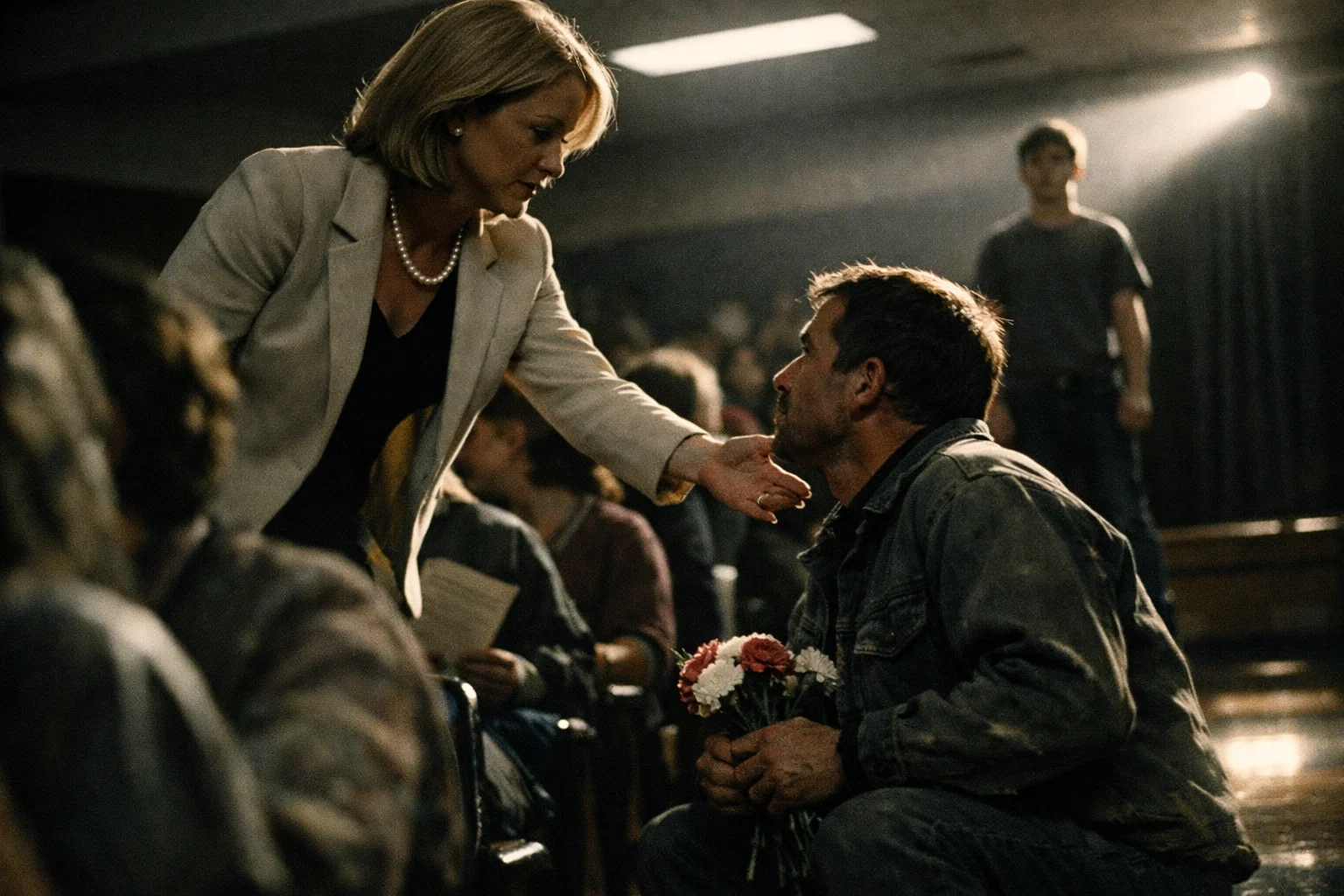
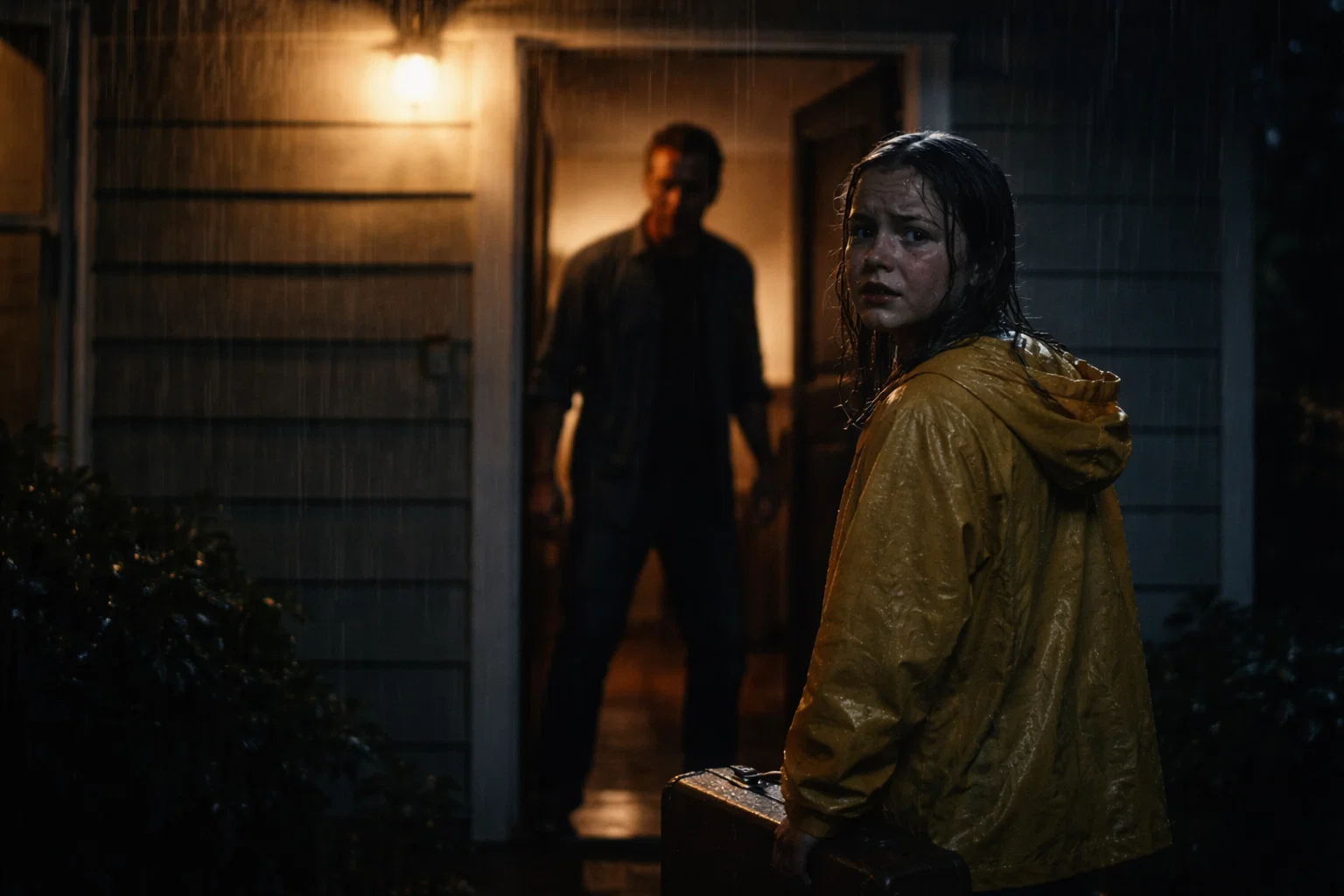
The night I drove Lily out of the house, it was raining so hard the gutters were overflowing.
I remember the sound of the front door slamming. I remember the way the porch light flickered once and went dark. I don’t remember deciding to pour the first drink, but I remember finishing the bottle.
That was ten years ago. I’ve been trying to forget it ever since. I haven’t managed it once.
My name is Michael Carter. I was forty-two when I destroyed the best thing in my life.
I was a construction materials supplier in Portland, Oregon. I had a house with a good furnace, a truck that started every morning, and a wife — Laura — who made everything feel like it was worth getting up for.
Laura died on October 14th. Black ice. A county road just past midnight.
The paramedic who called me was careful with his words. He said she had passed quickly. He said she likely didn’t suffer. I thanked him and hung up the phone and stood in the kitchen for forty minutes without moving.
That part, I could survive.
What I couldn’t survive came three weeks later.
I was going through her dresser — clearing things out the way you’re supposed to do, the way grief counselors tell you to do — when I found the bundle of letters at the very bottom, beneath a folded shawl.
They were tied with a white ribbon. Old paper. Blue ink. Addressed to someone named David.
I told myself not to read them.
I read every one.
They were love letters. Written before we were married. Tender, intimate, the kind of letters you never want to find in your dead wife’s dresser. I could have put them away. I could have told myself it was the past, that everyone had a past, that it had nothing to do with the life we’d built together.
Then I hit the last page. A single line.
“For our daughter, Lily — may she always know she is loved.”
I sat down on the floor.
Our daughter. Not yours. Not mine. Ours — hers and David’s.
I sat there a long time.
By the time Lily came home from school that afternoon, I had worked myself into something I’m still ashamed of.
She pushed open the front door, dropped her backpack in the hall — same as always — and called out, “Dad? You home?”
“In the kitchen,” I said.
She appeared in the doorway in her yellow raincoat, cheeks still pink from the cold, homework folder tucked under her arm.
“You okay?” she asked. She could always read me.
“Where did you come from?” My voice came out flat and strange.
She blinked. “What?”
“I said, where did you come from? Who is your father?”
The color drained from her face. “Dad, you’re scaring me.”
“I found the letters, Lily.” I pushed them across the table toward her. “I found everything.”
She looked at the papers but didn’t touch them. Her voice dropped to barely a whisper. “Dad, I don’t know what those say. I don’t know anything about—”
“She wrote about you,” I said. “Laura. To a man named David. You are his daughter.”
“I don’t even know who that is.”
“That’s not my problem.”
She flinched like I’d struck her.
The room went quiet. I could hear the rain beginning outside, ticking against the window above the sink. Lily stood very still, her yellow raincoat dripping onto the kitchen floor.
“Please,” she said, very quietly. “Please don’t do this.”
“Pack a bag,” I said. “I want you out of this house tonight.”
“Dad—”
“I am not your father!” My voice cracked the air like a whip. “I never was! Every year I spent raising you, buying your clothes, sitting at your school plays — that was a lie. She made a fool of me, and I won’t spend another night under the same roof as her mistake.”
She didn’t yell back. She didn’t throw anything. She was fourteen years old and she just stood there, looking at me, and said nothing.
Then she turned, picked up her backpack from the hall, and walked out the front door.
I watched from the kitchen window as her small figure moved down the street and disappeared into the dark and the rain.
I poured another drink.
The weeks that followed were the ugliest of my life, and I’ve had some ugly weeks.
Neighbors asked about Lily. I told them she’d run away. I said it so many times it started to feel true.
Social services knocked twice. I told them she’d gone to stay with a relative. I don’t know why they accepted that. Maybe they were overworked. Maybe I was convincing. Maybe the world just let me off the hook that I didn’t deserve.
I went back to work. I drank less — eventually. I fixed the gutters, repainted the fence, told myself that clearing out the lie meant I could start over.
But some nights I’d wake up at 3 a.m. and hear something in the hallway. A step. A breath. The soft creak of a door.
I’d lie very still, heart going hard, and wait.
There was never anyone there.
A decade passed the way bad decades do — slowly, and then all at once.
By fifty-two I was grayer, stiffer, and alone in a house that had grown too large. My back ached in the mornings. I drank coffee instead of whiskey, which I told myself was progress.
I drove past Lily’s old school sometimes on the way to job sites. Told myself it was just the route. Told myself I didn’t slow down on purpose.
I had mostly convinced myself she was fine. Young people were resilient. She would have landed on her feet. She was probably married somewhere, teaching school, living a normal life, and — if she ever thought of me at all — had decided I wasn’t worth the bother.
That was the story I told myself when the nights got long.
The knock came on a Tuesday afternoon in March. Early spring, mud still on the sidewalk, sky the color of old denim.
I opened the door and found a young woman in a white lab coat, holding a clipboard. Dark hair pulled back. Quiet, careful eyes.
For one moment she reminded me so much of Laura that I forgot to breathe.
“Mr. Carter?” she said.
“That’s me.”
“My name is Dr. Emma Collins. I’m a genetic counselor with the Northwest Genomics Center.” She paused. “I’m here about your daughter, Lily.”
The word daughter landed like something thrown at my chest.
“You’d better come inside,” I said.
Dr. Collins sat across from me at the kitchen table and put a folder between us. She didn’t open it right away.
“Mr. Carter, I want you to understand that what I’m about to tell you is the result of a DNA verification process initiated by another party — not by you, and not by Lily.”
“What party?” I said.
“Lily’s medical team. She needed a verified biological match for a transplant evaluation, and when her records were pulled, your name appeared as a listed parent.” She looked at me steadily. “There was a question of biological parentage that needed to be resolved.”
“You’re going to tell me she’s sick,” I said. My voice was flat.
“She has end-stage kidney failure,” Dr. Collins said. “She has been on the transplant list for eighteen months. She is running out of time.”
I stared at the tabletop.
“And you said she needed a biological match.”
“Yes.”
“And you’re here because—”
“Because the DNA analysis confirmed that you are her biological father, Mr. Carter. Genetically. Without question.” She slid the folder toward me. “The letters you may have found — whatever they contained — were mistaken, or misread, or referred to something else. Lily is your daughter by blood. She always was.”
The room tilted.
I don’t know how long I sat there. Long enough for the coffee to go cold. Long enough for Dr. Collins to stop talking and simply wait.
“Where is she?” I said.
“Providence Medical Center. Room 412.”
I stood up and picked up my truck keys off the counter.
“Let’s go,” I said.
I had not been inside a hospital since Laura died in one.
The fluorescent lights. The smell of antiseptic and floor wax. The particular quality of silence that wasn’t really silence at all — monitors beeping, carts rolling, someone crying quietly behind a curtain.
Dr. Collins walked me down a corridor and stopped outside a door with a small window.
“She doesn’t know you’re coming,” she said. “She asked us to find you, but she doesn’t know we did.”
“She asked you to find me?”
“About three months ago. When the prognosis got worse. She said—” Dr. Collins paused. “She said, ‘If I don’t make it, please try to find my father. I don’t want him to find out from a stranger.'”
I couldn’t speak.
“I’ll give you a moment,” Dr. Collins said, and stepped back.
I stood at that window for a long time.
She was thinner than I remembered. Pale, her dark hair loose against the pillow, an IV line taped to the back of her left hand. She was reading — a paperback, held up close to her face — and every few seconds she turned a page.
She still did that. Read the same way.
I had forgotten I knew that about her.
I pushed open the door.
The sound of the door made her look up. For one second — just one — her face was completely open. Pure shock.
Then she controlled it.
“Hi, Dad,” she said.
Her voice was steady. Steadier than mine would have been.
“Hi, sweetheart,” I said. The word came out before I had time to stop it.
I crossed the room and sat in the chair beside her bed. For a long moment neither of us spoke. She put her book face-down on the blanket. I looked at my hands.
“How long have you been sick?” I asked.
“Really sick? About two years. The kidneys started going before that.”
“Why didn’t you—” I stopped.
“Contact you?” She gave a short, dry laugh that didn’t have much humor in it. “Dad. Come on.”
“Right.” I cleared my throat. “Right. That’s fair.”
She looked at me for a long moment. Her eyes — soft brown, just like Laura’s — were steady and a little sad and not, as far as I could tell, angry.
“I heard what you told the neighbors,” she said. “That I ran away.”
My throat tightened. “Lily—”
“I’m not saying it to hurt you. I just want you to know I heard it. A friend of mine still lived on the street. She told me.” She smoothed the blanket with her free hand. “I didn’t contact authorities or anything. I figured you’d said what you needed to say.”
“I was wrong,” I said.
She was quiet.
“Everything I believed — the reason I did what I did — I was wrong about all of it. The DNA results prove it. You are my daughter. You were always my daughter.”
“I know that,” she said simply.
“You know?”
“I always knew, Dad. I didn’t know why you thought otherwise. I didn’t know about the letters, not for years. But I knew I was your daughter. I just—” She glanced at the window. “I figured you just didn’t want me anymore.”
The words went through me like a blade.
“That was never true,” I said. “Not one day.”
She looked back at me. Something in her expression shifted — not forgiveness exactly, not yet. But a crack in a wall.
“What did the letters say?” she asked.
I told her everything. The letters to David. The line about our daughter, Lily. The way I had read it, drunk on grief, ready to find somewhere to put the pain.
When I finished, she was quiet for a moment.
“Mom had a boyfriend named David before you,” she said. “His daughter was named Lily, too. She died. When I was born, Mom used the same name.” She paused. “She told me that once, when I was little. I didn’t really understand why at the time.”
The silence stretched out.
“She was writing to him about his daughter,” I said slowly. “Not mine.”
“Sounds like it.”
I covered my face with my hands.
“Dad.” Her voice was soft. “Don’t.”
“I threw you out into the rain,” I said. “You were fourteen years old, and I threw you out into the rain, and I told you—”
“I know what you told me.”
“I told you that you were her mistake.” The words tasted like ash. “That’s what I said.”
“Yeah.” A pause. “That one stuck for a while, I won’t pretend otherwise.”
I lowered my hands. She was watching me without flinching.
“Where did you go?” I said. “After that night?”
“Slept in the park the first two nights. Then a shelter found me — they called a family named the Harts. Jim and Carol Hart, out in Gresham. They fostered me, and then they adopted me, basically, even though the paperwork was messy.” She smiled, very faintly. “Good people. I finished high school, got a scholarship, became an English teacher.”
“An English teacher,” I repeated.
“Ninth grade. I’ve been doing it six years.” Another small pause. “I like it. The kids are a lot of work, but they’re funny.”
Something in her voice when she said that — the way she spoke about her students, easy and real — made me think about all the school events I had sat through when she was small, the parent-teacher conferences, the way she used to read everything she could get her hands on. She had always been going to become a teacher. I had just missed watching her get there.
“The Harts,” I said. “Do they know you’re here?”
“Carol passed two years ago. Jim’s in assisted living. He knows.” She glanced at her hand, the IV line. “He wanted to come, but the travel is too much for him now.”
“I’d like to meet him,” I said. “If that’s okay. To thank him.”
She looked at me for a long beat.
“Yeah,” she said. “I think he’d like that.”
I met with the transplant team that same afternoon.
Dr. Marcus Webb, the lead surgeon, was a calm, serious man who used a lot of words carefully and didn’t waste any of them.
“You’re a strong match,” he said. “A living donor transplant gives the best long-term outcomes. The procedure itself carries risk for the donor — it’s major surgery — but your health indicators are good. Recovery takes four to six weeks.”
“When can we do it?” I asked.
He looked at me over his reading glasses. “You don’t want to discuss it with family first? Consider your—”
“I’m her family,” I said. “When can we do it?”
He nodded once. “We can schedule for Thursday.”
I went back to Lily’s room that evening and stayed until the nurses asked me to leave at nine o’clock.
We talked for three hours straight. She told me about her first year of teaching, about a boy in her class who had memorized half of The Outsiders for extra credit and delivered it to the class like a performance. She told me about an apartment she’d had in Northeast Portland with a radiator that banged all winter and a landlord who refused to fix it. She told me about Carol Hart — the way Carol used to make waffles on Sundays, the way she always had a paperback tucked in her apron pocket.
I told her about the roses I’d planted on the porch — the pink climbing variety she used to stop and smell on the way to school. I told her I’d been doing some volunteer work with a youth building program, teaching kids basic carpentry. She smiled at that.
“You were always good at building things,” she said.
“I was better at breaking them,” I said.
She didn’t argue with that. But she didn’t let it settle either.
“People can do both,” she said. “That’s sort of the whole point.”
The surgery was on a Thursday morning at 7 a.m.
I lay on the table in a pre-op room that smelled like antiseptic and clean linen, staring at a ceiling tile, and thought about October nights and rain and a fourteen-year-old girl in a yellow raincoat.
A nurse squeezed my hand briefly. “Ready, Mr. Carter?”
“Yes,” I said.
I woke up in recovery to the sound of beeping monitors and a dry throat and a pain in my left side that was dull but very definite.
Dr. Webb appeared at the edge of my vision.
“Surgery went clean,” he said. “She’s in recovery. Both of you are stable.”
I closed my eyes.
“Thank you,” I said.
We were in adjacent rooms on the fourth floor for the next five days.
On the second day, when I could manage a slow shuffle down the hall, I went to her doorway and knocked on the frame.
She was sitting up in bed, reading again — different book. She looked up and broke into a real smile, not the careful measured ones from before. A real one.
“Look at you,” she said. “Vertical.”
“Don’t push it,” I said. “I’m held together with surgical tape.”
I sat in the chair beside her and we watched a bad game show on the wall TV and didn’t talk much and it was, I thought, the most comfortable I had felt in ten years.
On the fifth day, complications developed.
My remaining kidney was under strain — expected but significant. I was moved to a monitoring unit. At the same time, Lily spiked a fever. The new kidney was adjusting, but her body was fighting the process and losing ground.
The surgical team moved quickly and quietly and didn’t alarm us. But I knew from the way Dr. Webb spoke that we were in a fragile window.
I asked him directly: “Is she going to make it?”
He was quiet for a moment. “She has a real chance. The fever is responding to treatment. But the next seventy-two hours will tell us more.”
“And me?”
“You’re going to be fine,” he said. “The kidney is compensating well. You’ll have some lifestyle adjustments, but you’ll have a full life.”
“Just save her,” I said.
“We’re doing everything we can,” he said. “You should rest.”
I did not rest.
I lay in my bed and stared at the ceiling and talked to Laura inside my head the way I had not done since the year she died.
You should have told me, I thought. About David. About his daughter. If you had just told me, none of this would have happened.
But even as I thought it, I knew it wasn’t fair. Laura hadn’t known she was going to die on an October night at forty-one. She probably thought she had decades to explain everything, to find the right words, to sit Lily down and tell her the story of a name she’d been given in memory of another child.
She ran out of time.
We all nearly ran out of time.
On the seventh morning, I was cleared to walk the hall unassisted.
I went to her room.
She was awake. The fever had broken overnight. She was pale and tired but her eyes were clear, and when she saw me she reached out her hand.
I took it and held it.
“Still here,” she said.
“Still here,” I agreed.
We sat like that for a long time. The sun was coming through the window at a low angle, catching the dust motes in the air, laying a warm stripe across the floor.
“I’ve been thinking,” she said finally.
“What about?”
“About what happens when we get out of here.” She looked at me carefully. “I’m not going to move in with you, if that’s what you’re imagining.”
I laughed — and immediately regretted it because my side hurt. “I wasn’t imagining that.”
“Good. Because I have an apartment and a job and a life I’m going back to.”
“I know.”
“But—” She paused. “I’d like to have dinner sometimes. If you wanted.”
“I want,” I said.
She nodded, satisfied.
“Okay,” she said. “Dinner.”
We were discharged on different days — her first, me two days later.
Jim Hart drove up from his assisted living facility in a car that was probably too large for him to be driving and sat with her in the lobby as she waited for discharge paperwork. He was a big, quiet, silver-haired man in his late seventies, and when Lily introduced us, he looked at me for a long moment without speaking.
Then he said, “She’s a remarkable woman. You should know that.”
“I do,” I said.
He nodded once. Then he reached out and shook my hand with a grip that was still strong.
“Take care of her,” he said.
“I’m going to try,” I said.
Three months later, we had dinner at a Vietnamese restaurant on NE Alberta Street that Lily had picked because she said their broth was perfect and she refused to accept any argument about it.
She was right. The broth was perfect.
She told me about her class — they were doing To Kill a Mockingbird, and a student named Jaylen had written an essay arguing that Scout was the real hero of the whole book and had submitted twelve pages of evidence to prove it.
“Is he right?” I asked.
“Honestly? Maybe.” She smiled. “I gave him an A and told him to tone it down slightly.”
I laughed.
Across the table, in the warm light of the restaurant, she looked healthy. She looked rested. She looked — and this was the word that kept coming to me, the one I hadn’t been able to use in so long — she looked like herself.
“Dad,” she said.
“Yeah.”
“I need you to stop looking at me like I’m made of glass.”
“I’m not—”
“You’ve been doing it since the hospital. I can see it. I’m fine. The kidney is working. My numbers are good. I’m not going anywhere.”
I looked at the table. “Force of habit,” I said.
“Well.” She reached across and tapped my hand once, firmly, the way you’d tap a table to make a point. “Break it.”
I looked up at her.
“Okay,” I said.
“Good.” She picked up her chopsticks. “Now eat. Before it gets cold.”
I went home that night and sat on the porch for a long time.
The roses were blooming — pink, climbing, heavy with early summer scent. The street was quiet. Somewhere two houses down, a kid was kicking a soccer ball against a fence, and the rhythmic thud of it was almost companionable.
I thought about what I had spent ten years becoming — a hollowed-out man in an empty house, so convinced he had been wronged that he couldn’t see what he’d done.
I thought about Lily sitting across from me in that restaurant, tapping the table, telling me to break the habit of looking at her like she might disappear.
She was right. I needed to break it. She wasn’t going to disappear.
I had spent ten years disappearing from her. She had spent ten years without disappearing from me — not from my memory, not from the way I slowed down past her school, not from the sobs I imagined in the hallway at 3 a.m.
She had been there the whole time. I was the one who had gone.
The kid down the block sent the soccer ball rattling into the fence one last time and then went inside, and the street went quiet.
I sat there until the stars were properly out.
Then I went inside, washed the dishes from breakfast, and called Lily to confirm dinner for the following Sunday.
She picked up on the second ring.
“Dad,” she said. “I just got home.”
“I know. I just wanted to confirm Sunday.”
“Sunday is confirmed.” A pause, and I could hear the smile in it. “Go to bed, Dad.”
“Goodnight, sweetheart.”
“Goodnight.”
I put the phone down and looked at the kitchen — at the table where I had once pushed letters across the surface toward a fourteen-year-old girl and watched the color drain from her face.
Same table. Same room.
Everything else was different.
I turned off the light and went to bed, and for the first time in ten years, I slept straight through until morning.
Original fictional stories. AI-assisted creative content.