Riley Graves had one rule: don’t talk about her dad.
Not at school. Not with her friends. Not even in her own head, if she could help it.
Grandma Patrice had made it simple when Riley was six. “He left. People who leave don’t come back. That’s the end of it.”
So Riley stopped asking. She got good at it — the way you get good at anything you practice for eight years.
She was fourteen now, sitting in a hard plastic chair outside Family Court Room 4, wearing her only good sweater. Her sneakers were two sizes too small. She hadn’t told anyone.
“We’re just going to talk to the judge,” Patrice said, smoothing her skirt. “You let me handle it.”
“What if he’s in there?” Riley asked.
Patrice’s jaw tightened. “Don’t look at him.”
He was in there.
Riley saw him the moment she walked in — a man in a pressed jacket sitting at the far table, hands folded, eyes down. He looked up when the door opened. He looked straight at her.
She looked away first.
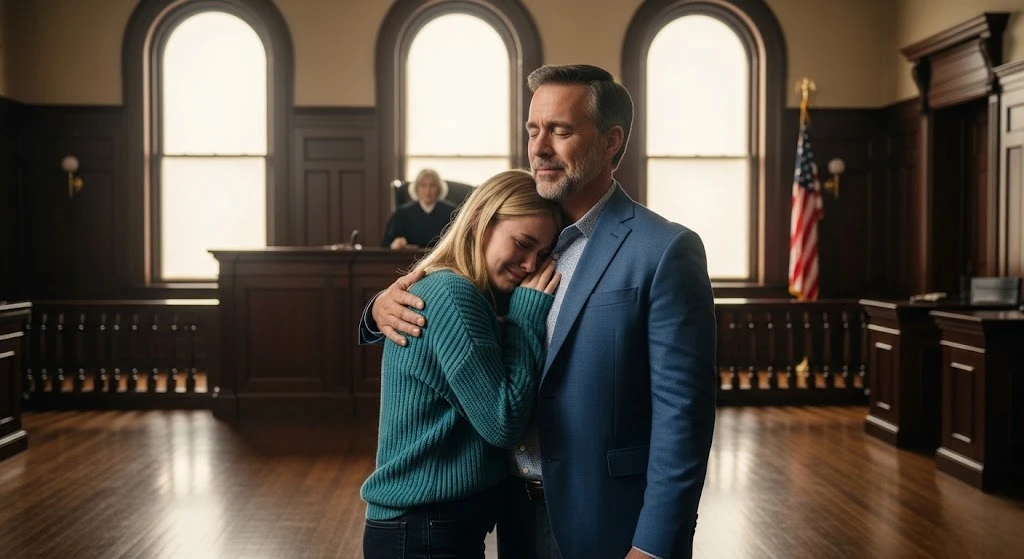
The courtroom was smaller than she’d expected. Wood-paneled walls. An American flag in the corner. A judge — silver-haired, black robe, reading glasses low on her nose — reviewing papers at the elevated bench.
A worn shoebox sat on the corner of the bench. Riley didn’t know why.
“Be seated,” the judge said without looking up.
The caseworker, Ms. Delgado, presented the case in flat, procedural language. Guardian income. State thresholds. Petition for custody. Riley sat next to Patrice and stared at her hands and tried not to hear any of it.
Then Patrice’s attorney stood up and said the word abandoned, and something cracked open in Riley’s chest.
“He abandoned this child at six years old,” the attorney said. “He has had no meaningful presence in her life. No contact. No—”
“That’s not accurate.”
The voice came from the other table. Low. Careful. Not loud, but it filled the room anyway.
Riley looked up.
The man — her father, Daniel Graves, a stranger — was on his feet. His attorney grabbed his sleeve. He didn’t sit back down.
“I tried to contact her every year,” he said. “Every birthday. Every Christmas. I filed four petitions for visitation. I sent—”
“Mr. Graves.” The judge’s voice was quiet but absolute. “Sit down. You’ll have your turn.”
He sat. His jaw worked. His eyes went to Riley for just a second.
She looked away again.
Patrice’s attorney finished. Daniel’s attorney stood and began laying documents on the judge’s table — bank records, court filings, dates and amounts going back eight years.
Riley watched the judge’s face as she read. It didn’t move much. But her eyes slowed down on one page. Then stopped.
“Mrs. Calloway,” the judge said.
Patrice straightened. “Yes, Your Honor.”
“A custodial account was established in Riley’s name in 2017. Monthly deposits made by Daniel Graves over seven years. Totaling forty-three thousand dollars.” The judge looked up over her glasses. “You were listed as account co-manager.”
“I used those funds for Riley’s benefit,” Patrice said smoothly. “School supplies. Medical—”
“Documented uses account for approximately four thousand dollars,” the judge said. “I’m asking about the remaining thirty-nine.”
The courtroom went very quiet.
Patrice’s attorney leaned in and whispered something. Patrice’s chin lifted.
“I managed the household as I saw fit,” she said.
The judge held her gaze for a long moment. Then she set the papers down and reached for the shoebox at the corner of her bench.
“There is one more item.” The judge lifted the lid and looked inside. “Eight birthday cards. Mailed to this address on March 4th of each year, 2016 through 2023. Each containing a handwritten note and a twenty-dollar bill.” She looked up. “According to the postal records submitted, all eight were signed for at the Calloway residence.”
Riley felt something cold move through her.
“Riley never received these,” the judge said. It wasn’t a question.
Patrice said nothing.
“Mrs. Calloway.”
“She was too young,” Patrice said finally. Her voice had gone flat. “I was protecting her.”
“From birthday cards.” The judge’s tone didn’t rise. It didn’t need to.
Silence.
The judge picked up the shoebox and looked at Riley directly.
“Miss Graves,” she said, her voice shifting — still firm, but something gentler underneath. “I’d like you to look at what’s inside this box.”
Riley stood up without deciding to.
She crossed to the bench. The judge slid the box toward her.
Riley looked down.
Eight envelopes. Each one opened — by someone else. Each one with a card inside. She picked up the one on top.
The handwriting was slanted and a little messy, the kind that clearly tried to be neat and didn’t quite get there.
Happy birthday, Rye-Rye. You’re eight years old today and I think about you every single minute. I hope you’re eating enough and that you still like orange things. I love you more than I know how to say. — Dad.
A twenty-dollar bill was folded inside.
Riley picked up the next one. Then the next.
Happy birthday. You’re nine today.
Happy birthday. You’re ten.
Happy birthday. You’re eleven.
Eight years. Eight cards. Eight times someone had sat down and written her name in slanted handwriting and put it in an envelope and sent it to an address where someone else signed for it and put it in a box and never said a word.
Riley’s hands were shaking.
She didn’t realize she was crying until a tear hit the back of her hand.
She turned around.
Daniel was on his feet. He hadn’t been told to stand. He just was — jacket wrinkled, hands open at his sides, watching her with an expression that looked like a man who had been holding his breath for eight years and couldn’t do it anymore.
Riley took one step. Then another. Then she was running — past the tables, past the gallery rail, across the courtroom floor — and she hit his chest hard enough that he stumbled back a step.
His arms came around her instantly.
She gripped his jacket with both fists and sobbed into his shoulder. He squeezed his eyes shut and held on — tight, certain, like he was afraid that if he loosened his grip even slightly she might disappear again.
The courtroom was completely silent.
The judge set her glasses on the bench and did not reach for them again.
Behind them, Patrice sat very still. Her hands were in her lap. Her church face was gone. What was underneath it was harder to look at — not cruelty, not coldness, but something smaller and more ordinary. Fear. Grief. A woman who had loved a child so ferociously she’d burned everything else down to keep her close.
It didn’t make it right. Nothing made it right.
But Riley, with her face buried in her father’s shoulder, wasn’t thinking about Patrice.
She was thinking about orange. About slanted handwriting. About eight envelopes that had been waiting in a box for her to find them.
She was thinking: he remembered. Every single year.
The judge’s ruling came twenty minutes later.
Primary custody transferred to Daniel Graves, effective immediately. Patrice Calloway to repay the misused custodial funds in full, under court supervision. Supervised visitation, six months, subject to review.
Patrice nodded once when the judge finished. She didn’t look at Riley.
Daniel’s hand found Riley’s shoulder as they walked out of the courtroom, and she let it stay there.
In the hallway, she looked up at him.
“The orange raincoat,” she said. “You remembered that?”
He looked at her. “I remembered everything.”
She didn’t smile yet. But somewhere behind her eyes, something that had been locked for eight years turned over, very slowly, like a key in a door that had almost rusted shut.
“We’re getting a two-bedroom?” she asked.
“Already saved up for it.”
“I want to paint the walls.”
“Whatever color you want.”
“Orange.”
He laughed — too loud for the hallway, a little wrecked around the edges. A woman passing gave him a look. He didn’t notice.
“Orange it is,” he said.
They walked out together into the afternoon light. Not fixed. Not finished. But no longer broken in the same way.
The shoebox was entered into the court record. Patrice paid the first installment forty-three days later.
And on March 4th — Riley’s birthday — she woke up in a room painted Autumn Blaze orange, in an apartment in Columbus, to the smell of pancakes and the sound of someone in the kitchen who had spent eight years making sure she’d get here.
She got up. She went to the kitchen. She sat down.
“Happy birthday, Rye-Rye,” her father said.
She rolled her eyes. She smiled. She ate.
The empty seat was gone. The door had been opened. And the man who had spent eight years knocking — quietly, persistently, without fanfare — had finally been let in.
Not by fate. Not by luck.
By a judge. And a shoebox. And thirty-nine words in slanted handwriting that had been waiting eight years to be read.
Original fictional stories. AI-assisted creative content.