My grandmother kept the necklace in a velvet pouch at the bottom of her jewelry box.
She never wore it. Never talked about it. When I was ten I asked her once, and she pressed her lips together and looked out the window like I’d said something painful. She changed the subject so smoothly I almost thought I’d imagined asking.
Her name was Dorothy Hale. She died three weeks ago at eighty-one, in the hospital bed my mother had ordered moved to the living room so she wouldn’t have to die among strangers.
I was there when she went. So was my mother, Karen. My aunt Patricia. And the necklace was still in that velvet pouch on her nightstand — like it was waiting for something. Like it had unfinished business.
My name is Emma Hale. Twenty-six years old. Broke in the specific way that follows a graduate degree and a city you can’t actually afford. I owe two months of back rent, and my landlord stopped being patient last Tuesday.
I knew the necklace was real gold. I knew that much. And I told myself my grandmother would have understood.
I hoped she would.
The pawnshop on Delancey Street didn’t have a proper name on the sign anymore — just the three gold balls, the universal symbol, and a handwritten note in the window: OPEN. FAIR PRICES. NO QUESTIONS. The bell above the door rang twice when I pushed inside.
It smelled like time in there. Wood polish and something metallic. Glass cases ran the length of the room, full of watches and rings and things that used to mean something to somebody.
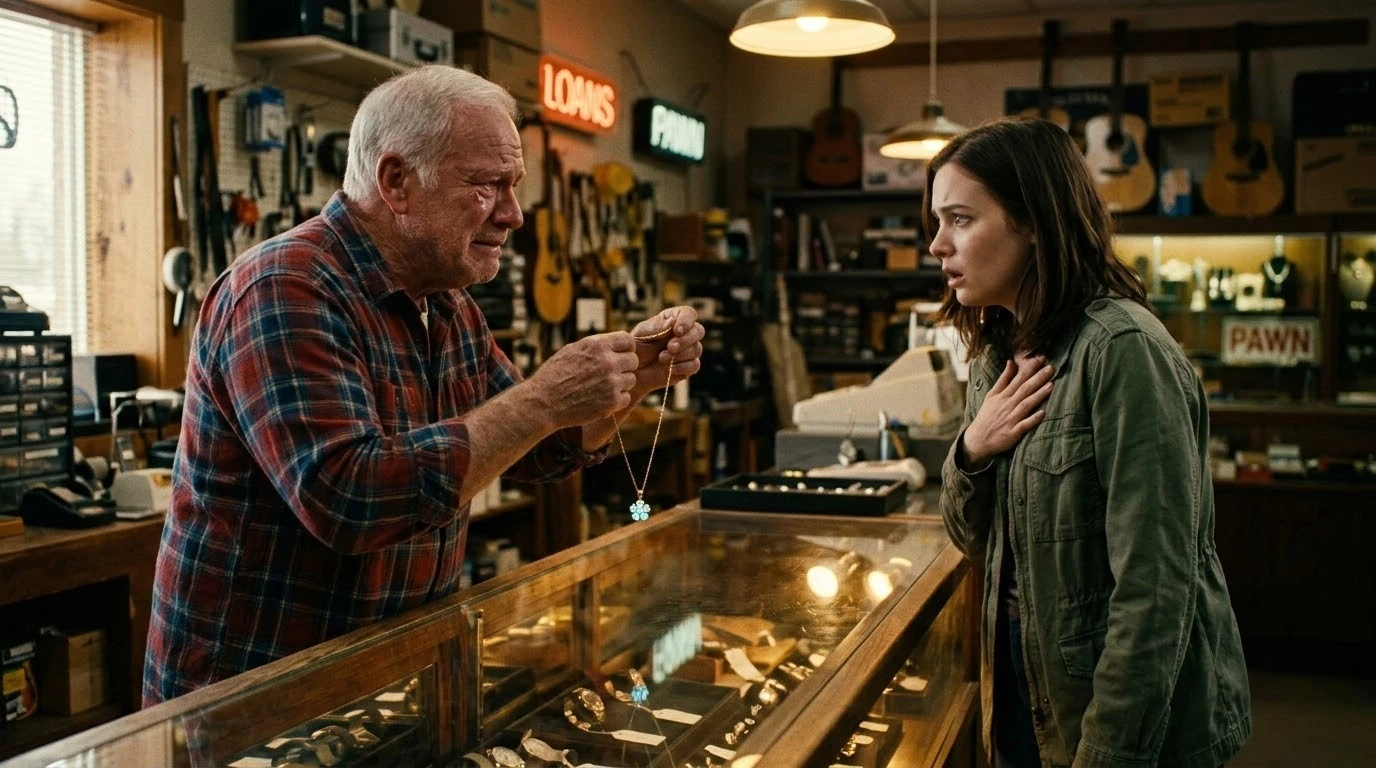
The man behind the counter was old. Not frail-old — more like carved-old. Wide through the shoulders, white hair trimmed close, hands that looked like they’d done real work once. He had reading glasses on a chain around his neck and he was polishing a pocket watch when I came in.
He looked up.
“Help you?” he said.
“I need to sell a necklace,” I said. I set the velvet pouch on the glass.
He put down the pocket watch and reached for it. His hands were steady — professional. He opened the pouch and let the necklace slide into his palm.
And then he went completely still.
Not the stillness of appraisal. Something else. Something that started in his hands and moved upward through his whole body until even his breathing seemed to stop.
“Sir?” I said.
He didn’t answer.
He was staring at the necklace like it had spoken to him. Like it had called his name from across a very long distance.
It was a simple piece — a thin gold chain, a small pendant in the shape of a forget-me-not flower, pale blue enamel on the petals. I’d always thought it was pretty but modest. Nothing remarkable. Just my grandmother’s.
His fingers closed around it, very gently.
When he looked up, his eyes were wet.
“Where did you get this?” he said. His voice had changed entirely.
“It was my grandmother’s,” I said. “She just passed.”
“Your grandmother.” He said the words like he was testing them. Like he needed to hear how they sounded out loud.
“Dorothy Hale,” I said. “Born Dorothy Kessler. She—”
He put both hands flat on the counter.
The sound wasn’t loud. But it landed like a verdict.
“Dorothy Kessler,” he repeated.
Not a question. A recognition.
I felt something shift in the air between us. I didn’t know what it was yet — but the hairs on my arms stood up.
“Did you know her?” I asked.
He didn’t answer right away. He picked up the necklace again and held it under the counter lamp. The pendant caught the light and the little enamel petals glowed pale blue — the same color they must have been half a century ago.
His hand started to tremble.
“This is the necklace I gave my beloved fifty years ago,” he said. His voice cracked on the last word. He pressed his lips together. His jaw was tight. “I bought it from a jeweler on Fifth Avenue. I saved for three months. I gave it to her the night I asked her to wait for me.”
I took two steps back.
It wasn’t a decision. My body just did it.
“WHAT?” The word came out too loud for the small room — too sharp, too raw. Then quieter, barely above a whisper, with my hand pressed against my chest: “That can’t be.”
“I was being shipped out in four days,” he said. “She said yes.”
The room felt wrong. Too small and too large at the same time.
“My name is Robert Callahan,” he said. “And I have been wondering about that necklace for fifty years.”
I didn’t leave.
I don’t know why I stayed. Maybe because my legs weren’t working properly. Maybe because something in the way he said her name — Dorothy — made it impossible to walk out.
He came around the counter and gestured to two wooden chairs near the back wall. An old man’s pawnshop, an old man’s chairs, a story I had no category for.
We sat.
“Tell me,” I said. “Tell me what happened.”
He was quiet for a moment. Then he started.
“We grew up on the same street in Brooklyn. Knew each other since we were twelve. By seventeen I knew she was it for me.” A pause. “She felt the same. Back then, you knew things like that and you just — knew.”
“When did you leave?” I asked.
“’74. Vietnam was winding down but I enlisted anyway. My father had served. His father had served. Stupid, maybe.” He looked at his hands. “But I went.”
“And you wrote to her?”
“Every week for two years.” He folded his hands. “And then her letters stopped coming.”
“She stopped writing?”
“Twelve weeks of silence. I thought something had happened to her. I almost went AWOL to come home and check.” He shook his head. “When I finally got back, she was gone. Her family said she’d moved. No forwarding address. A neighbor told me she’d gotten engaged.”
He looked up. There was something in his face that wasn’t grief exactly — more like a wound that had healed badly and never stopped aching.
“I assumed she’d changed her mind,” he said. “Decided I wasn’t worth waiting for.”
“She got married in 1976,” I said slowly. “To my grandfather. Howard Hale.”
“I know,” he said. “I looked her up eventually. Saw she had a family. Seemed settled.” He paused. “I didn’t interfere. What would have been the point?”
“But she wasn’t,” I said.
He looked at me.
“Settled,” I said. “Not entirely. She kept that necklace in a velvet pouch for fifty years and never wore it and never explained it and every time someone asked she just — closed. Like a door slamming.” My throat was tight. “I always knew it meant something. I just didn’t know what.”
Robert Callahan looked at the necklace resting on the counter between us.
“It meant she remembered,” he said.
I called my mother from the parking lot.
She picked up on the second ring. “Emma? Did you sell it?”
“No,” I said. “Mom, I need to ask you something and I need you to be honest with me.”
A pause. “What’s going on?”
“Did Grandma ever mention someone named Robert Callahan?”
Silence.
Not thinking-silence. Not confused-silence. The kind of silence that knows exactly what it’s being asked and is buying time to decide how to answer.
“Mom.”
“Where did you hear that name?”
“He’s here,” I said. “He owns a pawnshop on Delancey. He recognized the necklace. He says he gave it to her in 1974 before he shipped out — that he asked her to wait for him.”
Another silence. Longer this time.
“Mom. Did you know about him?”
“Emma—”
“Did you know?”
She exhaled. Slow and deliberate. “Your grandmother dated someone before your grandfather. It was a long time ago. It didn’t — it wasn’t—”
“She kept his necklace for fifty years, Mom.”
“People keep things.”
“She never wore it. She never explained it. She cried the one time I asked about it and she thought I didn’t notice. That’s not just keeping things.”
“Emma, it was fifty years ago. It doesn’t matter anymore—”
“It matters to him,” I said. “He spent fifty years wondering why she stopped writing. He thinks she chose to stop.”
A long pause. And then, very quietly: “She didn’t stop writing.”
The ground felt like it moved under me.
“What?” I said.
“She didn’t stop writing.” My mother’s voice had changed. Smaller, now. Like she was confessing something she’d carried a long time and was finally putting down. “Your great-aunt Patricia intercepted the letters. Both directions. She thought he was wrong for your grandmother — too poor, too unsettled, going off to war with nothing to offer. She took his letters before Dorothy could read them. She took Dorothy’s letters before they could be mailed. And she told your grandmother that he must have found someone else overseas.”
I pressed my back against the car.
“Your grandmother cried for six months straight,” my mother said, barely above a whisper. “Then she convinced herself it was a sign. That practical was safer than passion. She met your grandfather and he was steady and she said yes because she didn’t have anything left to say no for.”
“Patricia is still alive,” I said.
“Emma—”
“She’s eighty-four and she’s in Boca and she has never said one word about this.”
“It was fifty years ago—”
“It was his whole life,” I said. “It was Grandma’s whole life. That’s not history, Mom. That’s the shape of everything.”
I hung up.
I went back inside.
Robert was still sitting in the wooden chair, turning the necklace slowly in his hands the way people turn things they’ve carried for so long they’ve memorized every edge.
“My great-aunt intercepted your letters,” I said. “And my grandmother’s letters to you. Both directions. For over a year. She decided you weren’t good enough and she made that decision for my grandmother without telling her.”
He didn’t move for a long moment.
Then: “Dorothy didn’t choose to stop writing?”
“No.”
“She didn’t know I kept writing?”
“No. She thought you’d stopped. She thought you’d moved on.”
He looked down at the necklace. His jaw worked, tight, once.
“She married someone else because she thought I didn’t want her,” he said. Not angry. Just careful, the way you handle something that might shatter if you move too fast.
“Yes.”
The word sat between us like something solid.
“She thought I left her,” he said.
“Yes.”
He was quiet for a long time. Then, very quietly: “Was she happy? At all? Some of the time?”
I thought about my grandfather Howard. Patient, quiet, kind. Not a great love. Not the kind of man who makes someone laugh so hard they cry or stay up all night talking until the sun comes up. But decent. Steady. Good.
“He was good to her,” I said. “She had a real life. A real family. It wasn’t nothing.”
“No,” he said. “It wasn’t nothing.”
He looked at me over the necklace. There was a long, quiet grief in his eyes that had clearly had years to settle.
“I would have come back for her,” he said. “If I’d known. I would have come back with nothing to my name and built something from scratch, and it would have been enough because she was—” He stopped. Tried again. Couldn’t quite get there. “She was the kind of person who made everything make sense.”
I didn’t say anything. There was nothing to say to that.
“I’m sorry,” I said finally. “I’m so sorry for what my family did to you both.”
He looked at me steadily. “You didn’t do it. You could have walked out of here the minute this got complicated. You stayed.”
“She kept the necklace,” I said. “She kept it for fifty years and never got an explanation. Someone owed her one. Someone owed you one.”
He held the forget-me-not pendant up one more time, in the light.
“Can I ask — is there a place I could — a grave, somewhere I could—”
“Riverside Cemetery,” I said. “Section F.”
He nodded once.
We sat in the quiet of the shop, two strangers holding fifty years of someone else’s grief between them — finally, after all this time, setting it down somewhere it could rest.
I called Aunt Patricia that evening.
She answered on the fourth ring, warm and easy. “Emma! How are you holding up, sweetheart? Losing your grandmother must be so—”
“Patricia,” I said. “I know about the letters.”
Silence. Complete and immediate.
“I know what you did in 1974 and 1975. I know you took them — his letters to her, her letters to him. I know you told Grandma he’d moved on.” I kept my voice level. “I know all of it.”
“Emma—”
“I’m not calling to fight with you,” I said. “I’m calling because there is a seventy-three-year-old man on Delancey Street who spent his whole life thinking the woman he loved chose to leave him. He deserves the truth. And I needed you to know that the truth is out. That it doesn’t stay buried.”
A long, long silence.
Then, very old and very small: “I thought I was protecting her.”
“I know,” I said. “I think you believed that.”
“He had nothing, Emma. He was going to war and he had nothing to offer her and she deserved—”
“She deserved to choose,” I said. “That’s all. That’s the whole thing. She deserved to make her own choice.”
I hung up.
I went back to Delancey Street one last time.
I brought an envelope. Inside was a photograph I’d found in my grandmother’s things — one my mother hadn’t known existed. Dorothy at nineteen, standing on a Brooklyn street corner, laughing at something off-camera, her whole face lit up. On the back, in my grandmother’s handwriting, neat and careful: Waiting for you. Always.
She’d written it and then, when the letters stopped, she’d never sent it. She’d kept it. Hidden in the same box as the necklace, in the same velvet dark, for fifty years.
I slid the envelope across the counter.
He opened it slowly. When he turned the photograph over and read the back, his hand started to shake. He pressed it flat against the glass, both palms on it, like he needed to feel it was real.
“She wrote that,” I said. “Before she gave up waiting. Before she thought you’d stopped. She was still waiting when she wrote it.”
He didn’t speak for a long time.
“Thank you,” he said finally. His voice was rough. “Thank you for coming back.”
“I almost didn’t,” I said. “I almost just walked out and let it stay buried.”
“Why didn’t you?”
I thought about my grandmother’s face. That specific look she got when anyone came near the velvet pouch — not sad exactly. More like unsolved. Like a question that had been sitting in a room for so long the room had been built around it.
“She kept it,” I said. “Fifty years, and she kept it. That meant something. Someone needed to find out what.”
He picked up the necklace.
“Keep this,” he said, and slid it across to me. “Don’t sell it. It belongs in your family.”
“She’d want you to have it.”
“She’d want both.” He held my gaze. “Keep it for her.”
I took it. Held the forget-me-not pendant in my palm. The enamel was cool and smooth and the same shade of pale blue it had been the night he clasped it around her neck on a Brooklyn street and asked her to wait.
She had waited.
In the only way she had left.
Patricia called my mother the next morning and confessed. Properly. With dates and names and no softening of any of it.
My mother called me after. She didn’t know what to say, so she just said: “You were right to push.”
Six months later, Patricia came back from Boca. She brought a box she’d been holding for decades — my grandmother’s things, things she’d said were lost. Including four letters. Sealed. My grandmother’s handwriting on the envelopes. Robert Callahan’s name on the address line.
Dorothy had written them in the months after she thought he’d gone silent. She’d never mailed them. Couldn’t send them after Patricia told her it was over. Couldn’t throw them away either.
I brought them to Robert on a quiet Thursday afternoon.
He held the sealed envelopes for a long time before he opened them.
I stepped outside and gave him that.
Some things don’t need a witness. Some things just need to finally arrive.
I walked home through the city with the necklace in my jacket pocket and the strange, bittersweet weight of a story that had finally found its landing. Not the ending it deserved — not the one where two nineteen-year-olds on a Brooklyn street corner get to keep what they found. But the true one. The one where both of them finally knew they hadn’t been wrong.
She had waited.
He had kept writing.
The letters just got there fifty years late.
But they got there.
Original fictional stories. AI-assisted creative content.