The park on Calloway Street was the kind of place the city had mostly forgotten.
Chipped benches. Patchy grass. A fountain that hadn’t worked since the previous mayor. The trees were old and indifferent, and on most afternoons the only people who used the park were the ones who had nowhere better to be.
Walter Pruitt was one of those people.
He was seventy-six, thin, with white hair cut close and a posture that still held something upright in it despite everything the years had done to his knees and his back and the rest of him. He walked to the park from his apartment on Cedar six blocks away, slowly, at the same time every day.
And every day, he carried a flag.
Folded into a tight triangle. Thirteen folds, sharp and practiced. The colors had softened over the years—not faded, just quieted, the way things get quiet when they’ve been held carefully for a long time. He kept it on his lap with both hands resting over it, and he looked at the pond, and he did not move.
He had been doing this for nine years.
He had never once been bothered.
Until today.
Jake Calloway ate his lunch on the bench across from the pond three or four times a week.
He worked at the print shop on Monroe. He had a roast beef sandwich, a bag of chips, and seventeen minutes before he had to be back. He had noticed the old man with the flag maybe a dozen times over the past two months—always the same bench, always the same stillness, always those two careful hands resting over the folded triangle.
Today he was on the second half of his sandwich when they came through the north gate.
Three of them. Sixteen, seventeen at most. One had his phone out before he’d even fully entered the park—the camera already sweeping, already looking for something. They moved with the loose, careless energy of people who were bored in a particular way, the kind of bored that needs a target to fix itself.
They found Walter immediately.
“Yo.” The one in the gray hoodie—Tyler—stopped walking. “What is that dude doing?”
“Just sitting there.”
“With a flag.”
Bryce, the one with the phone, had already started filming. “Oh this is good. This is content.”
“Hey old man,” Tyler called. “You waiting for a parade?”
Walter didn’t respond. He looked at the pond.
“He can’t hear you.”
“Or he’s ignoring us.” Tyler’s voice dropped into a different register—still light on top, but testing something underneath. He walked toward the bench.
“What’s with the flag?” he said, standing over Walter now, close enough that his shadow fell across the old man’s hands.
Walter looked up.
His eyes were steady and gray-brown and completely without fear—the eyes of someone who had already survived the worst thing they could imagine and knew that this was not it.
“Move along,” Walter said. Quiet. Even.
“I just want to look at it.” Tyler’s hand shot out and grabbed the corner of the flag.
Walter’s grip locked down immediately. “Don’t.”
“Let go—”
“That is not yours.” Walter held on with both hands, knuckles white, the flag twisted between them. “Let go of it right now.”
“Come on, old man—” Tyler yanked hard.
Walter jerked forward on the bench—and Tyler, thrown off balance, shoved him. One hard push to the shoulder.
Walter went sideways.
He didn’t fall completely—the armrest caught him—but the impact was enough. His grip broke. The flag pulled free.
The triangle unfolded as Tyler stumbled back with it, one corner dragging across the pavement, and the sound it made was nothing, it was just fabric on concrete, but Walter made a sound that had nothing to do with his shoulder.
It was the sound of something irreplaceable being handled by someone who didn’t know what it was.
He got up from the bench. Slowly, painfully, both hands reaching for the flag.
“Give it back,” he said. His voice had changed—not loud, not angry. Just stripped down to something very old and very serious. “Please.”
Tyler held it up out of reach, laughing. “What is this even—”
He didn’t finish the sentence.
Jake hit the grass at a run.
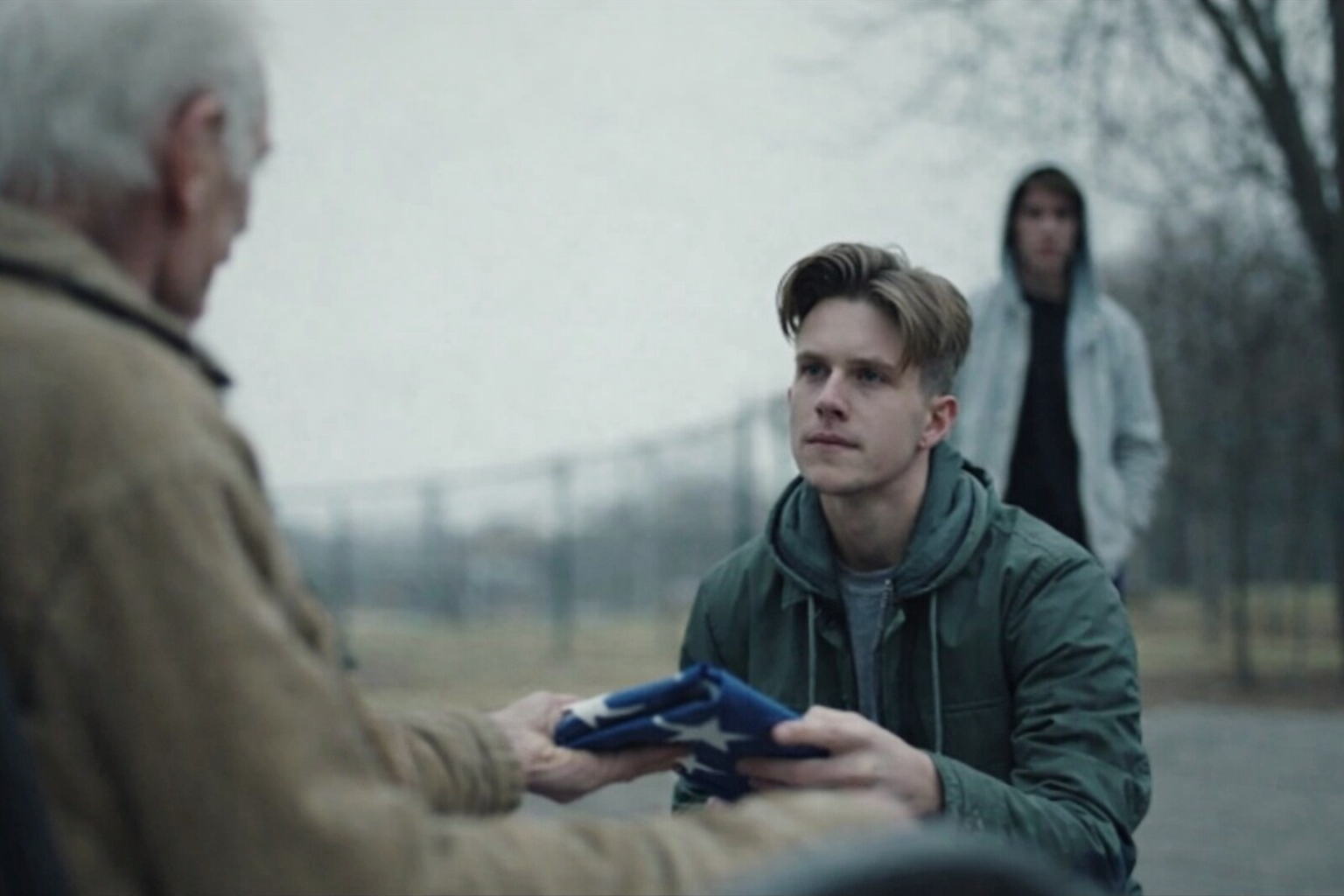
He covered the distance between the benches in about four seconds—not thinking, not planning, just moving, the sandwich on the bench behind him already forgotten. He came in from the side, got between Tyler and Walter, and took the flag.
Not gently. He grabbed it with both hands and pulled it free from Tyler’s grip in one clean motion and turned and placed it directly back into Walter’s hands.
The whole thing took maybe two seconds.
Then he turned back around.
Tyler was staring at him. The laughter was gone. Bryce still had the phone up but had stopped moving entirely. The third one had taken a step back.
Jake looked at Tyler.
Not with anger. With something quieter and worse than anger—the flat, total attention of someone who was not going to look away.
“You put your hands on him,” Jake said.
Tyler’s chin came up. “It’s a park, man. I can—”
“You shoved a seventy-year-old man off a bench.” Jake took one step toward him. “And you took something out of his hands that you have no idea what it is.”
“It’s a flag—”
“It’s his son.” Jake’s voice didn’t rise. “His son came home in a box in 2005 and that flag was on the box and this man has been sitting on that bench every single day for nine years.” He let that land. “That’s what you just threw on the ground.”
The park around them had gone completely still.
Tyler’s expression moved through several things quickly—contempt, uncertainty, something that might have been the beginning of shame. He settled on contempt because it was easier.
“You don’t know me,” Tyler said. He stepped forward, shoulders squaring, voice dropping. “You need to back up.”
Jake didn’t move.
“Or what?” Jake said.
“Or I’ll—”
“Go ahead,” Jake said.
One word. Completely calm.
Tyler stopped.
This was the moment. The moment where it goes one way or the other—where the person backs down or commits, where the bluff gets called or doesn’t.
Tyler was bigger than he’d looked from across the park. He had three inches on Jake and probably twenty pounds. He had two friends behind him and a phone on him and the kind of confidence that came from never having been seriously hit.
Jake had none of that.
He just stood there with his hands at his sides and waited.
And Tyler—who had shoved a seventy-six-year-old man six minutes ago without thinking twice—found that he could not make himself close the remaining distance.
Something in Jake’s stillness made it impossible. Not the physicality of it. Something else. The complete absence of anything that needed to prove itself.
You can’t fight someone who isn’t fighting you.
You can only decide what that says about you.
Tyler looked at Bryce. Bryce had lowered the phone. The third one was already angled toward the gate.
“Whatever,” Tyler said.
He turned and walked away.
Bryce followed without a word.
The third one was already at the gate.
Jake watched them leave.
Then he turned to Walter.
The old man had sunk back onto the bench. He was holding the flag against his chest with both arms—not the careful practiced hold of every afternoon, just holding it, the way you hold something you almost lost. His breathing was uneven. His left hand, pressed against the flag, was shaking.
Jake sat down on the far end of the bench.
He didn’t say anything immediately. He gave Walter the space to put himself back together, which took a minute, which was fine.
Around them the park slowly reanimated—the woman with the stroller exhaled and started walking again, the man on the nearby bench leaned back, the delivery guy on the bike rolled forward. Conversations resumed, earbuds went back in.
Life closed back over the moment the way water closes over a stone.
“You alright?” Jake said finally.
Walter’s breathing had steadied. He looked down at the flag in his arms—checking it, running his thumbs along the folds, finding the place where the triangle had come undone and pressing it carefully back.
“My son’s name was Daniel,” Walter said. He wasn’t answering the question. He was saying it because it needed to be said out loud, to someone, right now.
“How old?” Jake asked.
“Twenty-two.” Walter finished pressing the fold back into place. “He loved this park. We used to come here when he was small.”
“That’s why you’re here every day.”
“That’s why I’m here every day.”
Jake nodded.
They sat.
The heron landed at the far bank—it always did, around this time, without fail. Walter watched it. Jake watched it.
“I’ve seen you here before,” Walter said. “The bench across the path.”
“I eat lunch here a few times a week,” Jake said.
“I know.” A pause. “I wondered when you’d say something.”
Jake looked at him.
“I didn’t think it was my place,” he said.
Walter was quiet for a moment.
“It is now,” he said.
What happened next Walter didn’t see coming.
The delivery guy who’d stopped on his bike had filmed the whole thing from the path. Without sound—he’d been too far away. But the picture was clear enough: Tyler’s shove, Walter going sideways, Jake crossing the grass at a run, the flag pulled free and placed back in Walter’s hands in one uninterrupted motion.
He posted it that night. Three words as a caption:
Somebody did something.
By morning it had three hundred thousand views.
The clip was twenty-seven seconds. It ended on Walter pressing the flag back to his chest, and Jake sitting down beside him on the bench.
The comments didn’t talk about Jake.
They talked about Walter.
Who is this man. What is that flag. Where is this park.
Someone found the dedication plaque on the bench—a small metal plate the city had put there six years ago after a local paper ran a short piece about him. Walter Pruitt, Vietnam veteran. For the son he still waits for.
That’s when it went somewhere else entirely.
Jake found out about the video at nine the next morning when his coworker turned her phone toward him over the counter.
He looked at it.
“Hm,” he said.
“You’re literally everywhere.”
“Okay,” he said, and went back to work.
At lunch he bought a roast beef sandwich and walked to the park.
Walter was already on bench seven. Earlier than usual. The flag was on his lap, both hands over it, everything exactly as it always was—except when Jake sat down on the far end, Walter nodded at him. Just once. Small. Like acknowledging weather.
They ate—Jake his sandwich, Walter a thermos of coffee he’d apparently brought for the first time.
“People are saying things,” Walter said. “About the video.”
“I heard.”
“They want to do things. A woman called the parks department. There’s talk of some kind of ceremony.” He paused. “I don’t want a ceremony.”
“Then don’t have one,” Jake said.
“I just want to sit here.”
“So sit here.”
Walter looked at him.
“You make it sound simple,” he said.
“You’ve been doing it for nine years,” Jake said. “Seems like you figured it out.”
Walter made a sound that was almost a laugh. Not quite. But almost.
Bryce came back on Friday.
Alone. Hands in his pockets, walking slowly from the north gate with the particular hesitance of someone who has rehearsed something and is no longer sure it’s enough.
He stopped in front of bench seven.
Walter looked up at him.
“I deleted it,” Bryce said. “The video I took. I deleted it that day, right after.” He swallowed. “And I watched the one that got posted. The real one.”
Walter waited.
“I didn’t know what the flag was,” Bryce said. “I should have—I should have just asked. Instead of—” He stopped. Started again. “I’m sorry. For being there. For filming it. For not saying anything when Tyler—” He stopped again.
Walter studied him for a long moment.
“His name was Daniel,” Walter said. “He was twenty-two years old. He used to do impressions of everyone he knew. He was the loudest person in every room he was ever in.” He paused. “I miss the noise.”
Bryce’s throat moved.
“Daniel,” he said.
“Yes,” Walter said.
Bryce stood there another moment. Then he nodded—a real nod, not performative, the kind that means I will carry this—and walked away.
Jake had watched from his bench.
When Bryce was gone he looked at Walter.
The old man was looking at the pond. His hands were on the flag. His shoulders—which had been drawn up slightly since the afternoon Tyler shoved him, a tension Jake had noticed without naming—had come down.
Not all the way. But down.
“You okay?” Jake asked.
Walter considered the question properly this time.
“Daniel would have liked you,” he said. “He liked people who didn’t make speeches.”
Jake thought about that.
“I just went and got the flag back,” he said.
“Yes,” Walter said. “That’s what I mean.”
The heron landed at the far bank at its usual time.
Walter watched it.
Jake finished his coffee.
Nine years of sitting alone on this bench, and now someone sat on the other end of it. That was all. Nothing dramatic. Nothing ceremonial.
Just the flag in his hands, and the heron on the water, and the sound of someone else breathing nearby.
Daniel would have had something to say about that too.
Walter almost smiled thinking about it.
Almost—and then fully.
Small, private, his own.
The first real one in longer than he could remember.
Original fictional stories. AI-assisted creative content.