Chair 14. That was where Earl Joseph Tagert always sat.
Not because someone assigned it. Because the back wall put distance between him and the door, the angle let him see every entry point, and the left arm had a crack in the plastic shaped exactly like the Perfume River from the air. He’d mapped that crack with his thumb so many times the edges were smooth.
“Check out Top Gun over there.” The voice was wet with the kind of easy cruelty only the young can afford. “What do you think his call sign was? Mothball? Or maybe Captain Dust-Off?”
Lance Corporal Hager leaned forward in his chair, utility uniform starched to a blade’s edge, smelling of boot polish and borrowed confidence. He was twenty-one. He had done one deployment to Okinawa and come back thinking he understood the world.
Earl didn’t move.
“Hey, sir? Excuse me, sir?” Hager pitched his voice for his audience—Torres and No, sitting to his left, watching with the cautious smiles of men who knew they should stop this but wouldn’t.
Earl turned his head. Slow. Mechanical. His eyes—the color of a winter lake just before the ice cracks—settled on the boy.
“Yes,” Earl said. The word was low. Tectonic.
“That jacket.” Hager pointed. “Is that original issue? Or did you find it in a museum gift shop?”
Earl looked down at his sleeve. The cuff was frayed to the white weft of the cotton. Near the pocket, a jagged tear had been closed with a zigzag of dark green thread that didn’t quite match the sun-bleached olive drab. He ran a thumb over the stitch.
“Earlier,” he said.
“Earlier? Like… the Pliocene era?” Hager laughed and the sound bounced off beige walls and floor wax and the muted television in the corner.
“Hager.” Corporal No muttered it like a warning. He was looking at Earl’s hands. Still. Absolutely still. The kind of stillness that isn’t peace — it’s the suppression of something vast.
“I’m just asking! So what was the MOS, Top Gun? Were you a pilot? Did you have a cool call sign, or was it just—”
“Warhammer,” Earl said.
The name didn’t leave his throat. It escaped it. Like a ghost that had been holding its breath for fifty-eight years.
Hager blinked. Then his head snapped back in a loud, jagged bark of laughter. “Warhammer! Oh, that is rich. You hear that, Torres? Grandpa was a medieval weapon. What’d you do, sir? Swing your cane at the VC?”
Earl went back to his hands. He went back to the silence.
He didn’t see the Vietnam vet in the wheelchair by the window stop breathing. He didn’t see the man’s knuckles go white on the armrest. He was somewhere else entirely — somewhere that smelled like copper and burning thatch and the specific silence that follows the last transmission on a dead radio.
Then the double doors at the end of the hall hissed open.
The air didn’t just move. It compressed.
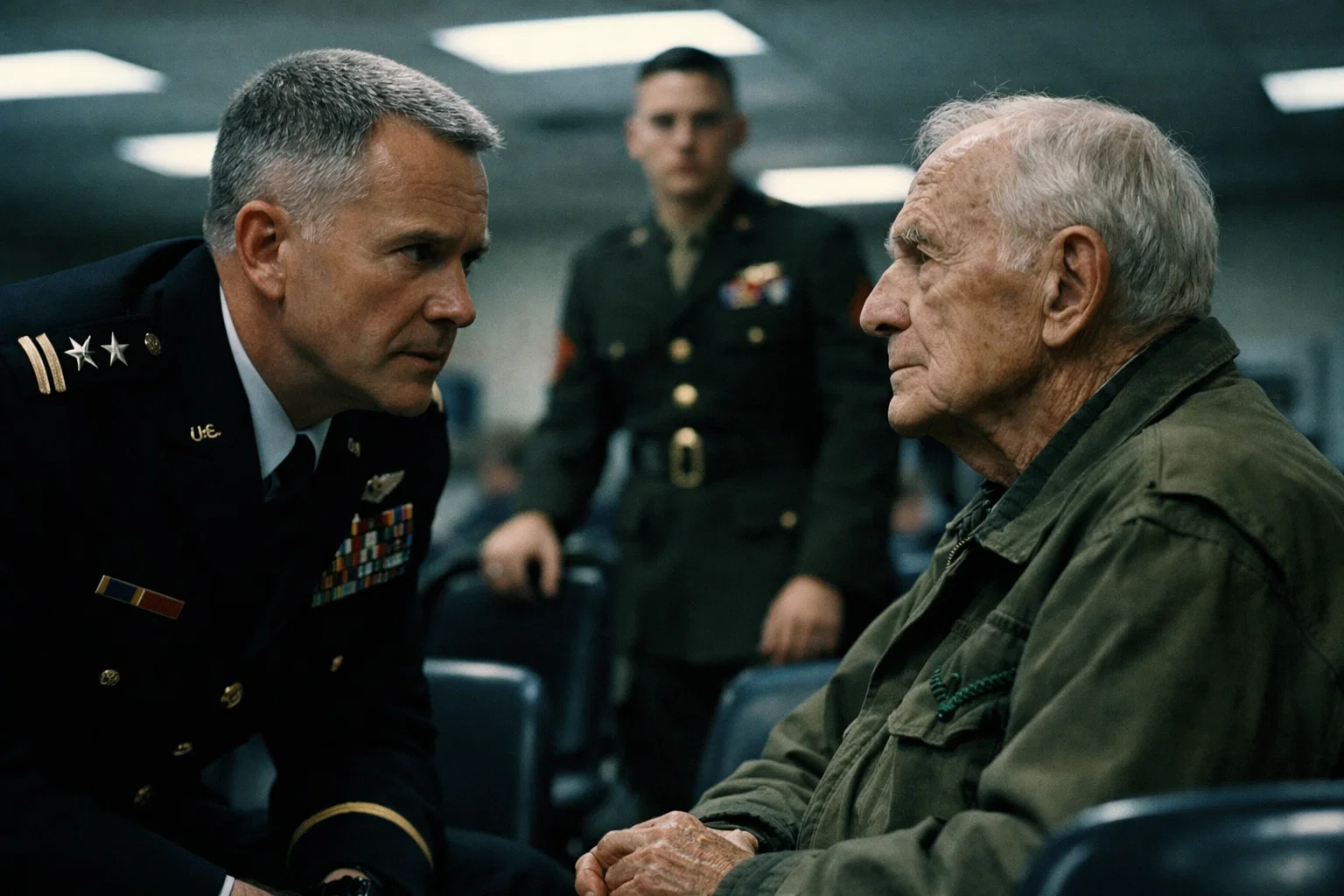
A Major General swept in — silver at the temples, two stars gleaming at his collar, trailing a Colonel and two aides the way a carrier trails destroyers. He moved with the economy of a man who had never in his life wasted a step.
His eyes scanned the room. Standard sweep. Entry points. Personnel. Threat vectors.
Then he stopped.
Not slowed. Stopped. His right foot came down mid-stride and planted like a post driven into bedrock. Every aide, every clerk, every bored civilian wife in the front row felt the ripple of it.
The General was staring at chair 14.
Hager rocketed to his feet. “General, sir!”
Brooke didn’t look at Hager. He didn’t acknowledge the three Marines in utilities. He walked in a straight line toward the old man in the dust-colored jacket, and the room parted around him without being asked.
He stopped two feet away. His chest was rising and falling faster than it should have been for a man who’d just walked twenty yards.
“Tagert?” he said. Not a command voice. Something rawer. “Earl Joseph Tagert?”
Earl looked up. His spine didn’t move. It never moved.
“Yes, sir.”
The General’s hand went to the sleeve of the jacket — the frayed cuff — and touched it the way you touch something you thought was gone forever and still can’t believe is real. Then he turned to the room. The command voice came back, harder and louder than before.
“Colonel. Call the Commandant’s office. Tell them we found him.” He didn’t blink. He didn’t look away from Earl. “And will someone explain to me why the Navy Cross is sitting in a plastic chair in a hallway?”
Hager’s face went the color of a guttering candle.
He looked at the jacket. He looked at the General. He looked back at the man he’d called Mothball, who still hadn’t moved a single muscle.
The General took Earl by the elbow — gently, the way you guide something precious — and steered him to the far end of the corridor, away from the clerks and the open stares. The Colonel fell in behind them. Hager was left standing at the window with Torres and No, none of them speaking, all of them staring at the empty chair.
“My father was a Second Lieutenant named Miller,” Brooke said, when the corridor was quiet enough. “February fourteenth, sixty-eight. Catholic mission, South Sector.”
Earl didn’t answer.
“He had a femoral bleed. The perimeter was boxed. The radio log said a callsign called Warhammer went back into the courtyard for him. The radio log said neither of them came out.”
“The radio log was half-burnt, General,” Earl said. “And Lieutenant Miller had a daughter he’d never seen. He needed to get home.”
Brooke stared at him. “You erased yourself.”
“I made the math work.” Earl’s voice was flat and patient, the voice of a man explaining something obvious to someone smart enough to understand it if they’d just slow down. “A dead officer’s family in sixty-eight got a different package than a Sergeant’s. Different benefits. College fund. Survivor’s pension that didn’t run out in four years. Miller had nobody to ask questions. I had nobody waiting.”
“You had thirty-one more years of service waiting,” the Colonel said from behind them.
“Under different names. Different branches.” Earl shrugged, the faded jacket rising and settling on his shoulders like old water. “The job doesn’t change when the name tape does. You take care of your people. You make sure the ammo arrives and the wounded get out.”
Brooke looked at him for a long moment. “My father spent his entire life looking for you. He died ten years ago. He called every VA from Maine to San Diego. No record of a First Sergeant Tagert at Hue. No Navy Cross for anyone by that name. He thought the Corps had lost you in the paperwork.” He paused. “He died thinking he’d failed you.”
Earl’s jaw tightened. One small movement. The only crack in the stone.
“Your father didn’t fail anyone,” Earl said. “He raised a General. That’s a better legacy than a medal ceremony.”
“Earl—”
“The records are gone, Lewis.” He used the General’s given name and the air in the corridor went thin. “There’s nothing to restore.”
They were wrong about the records being gone.
The Colonel found out twenty minutes later, in the examination room, while a Navy Captain named Vance was pressing careful fingers into fifty-eight years of scar tissue on Earl’s left knee.
“The Quantico archives for Fox Company, Second Battalion, Fifth Marines,” the Colonel said from the doorway. “The entries for February fourteenth through the seventeenth haven’t been redacted. They’ve been physically removed. There’s a ledger note from seventy-two. Records transferred for classified review by a staff officer at Headquarters Marine Corps.” He paused. “The name on the transfer order was yours, First Sergeant. You were working in the personnel office at Henderson Hall. You signed for your own death warrant.”
The paper on the examination table crinkled as Earl’s hands tightened on the edge. One sharp, dry sound. Then silence.
“I needed to be sure,” Earl said. “If the records were gone, no one could question the benefits. No one could take the girl’s school money back twenty years later when an auditor got curious. I was just cleaning up the workspace.”
Vance looked up from the knee. His expression had gone from professional to something harder to name. He traced the largest scar — a deep, star-shaped depression where the shrapnel had settled in and stayed. “You’ve been walking on bone-on-bone contact for fifty-eight years, Earl. The NVA steel didn’t just tear the muscle. It ground the joint down. Most men would be in a wheelchair.”
“A chair is for when you’re finished,” Earl said. “I’m not finished.”
“You will be, if we don’t operate.” Vance stood. “I’m putting you in for surgical review today. Not in a week. Today.”
Earl looked at him. “The General put you up to this.”
“The General doesn’t outrank me in this room,” Vance said quietly. “Your knee does.”
General Brooke appeared in the doorway, having followed the Colonel. He looked at the scar tissue, then at Earl, then at the diagram of the human knee on the wall as if it could explain what he was feeling.
“Let me give you the ceremony,” Brooke said. “Not for the Corps. Not for the record. For my father. He spent his whole life trying to say thank you.”
“Your father being alive was the thank you,” Earl said. “Everything else is just theater.”
“You earned the Navy Cross, Earl. You earned a life where you don’t wait in plastic chairs while children laugh at your jacket.”
Earl was quiet for a moment. Then: “The children are fine. The boy needed to learn something. He learned it.” He began to roll down his trouser leg. “Don’t dig up the dead, Lewis. It only makes the living feel worse. Fix the knee so I can get back to my garage.”
He found Hager still at the window.
The boy’s back was to him. His shoulders had the collapsed look of a man who has just realized the full weight of what he’s done and can’t figure out how to carry it.
Earl stopped behind him. He didn’t touch him.
“It’s not the name that matters, Marine,” Earl said.
Hager turned. His eyes were red at the rims. “I’m sorry, sir. I didn’t know.”
“That’s the problem.” The winter-lake eyes went sharp for just a moment. “You think you only owe respect to the things you already recognize. But the most dangerous things in this world — and the most honorable — are the things that don’t want to be noticed.”
He reached out and tapped the boy’s chest, once, over the heart.
“When you’re in the dark and the radio goes silent, you won’t be looking for a call sign. You’ll be looking for the man who doesn’t leave. Remember that.”
He turned and followed the doctor through the heavy oak door, his limp rhythmic and deliberate, a heartbeat in the floor.
Behind him, General Brooke looked at his Colonel. “Get me the SNCO’s commanding officer for Lance Corporal Hager. Today. Full report of this morning’s conduct in my hands before seventeen hundred.” He paused. “And find Miller’s granddaughter. The daughter would be in her sixties now. She may have children. I want to know who they are before I take another step.”
Three weeks later.
The garage in Scottsdale smelled of cold iron and motor oil. Earl stood at the workbench, a small file rasping against the brass of a carburetor fitting, the single bulb overhead pressing its cone of yellow light onto the pegboard where his tools hung in formation.
He heard the crunch of tires on gravel before the knock.
It was Hager.
Civilian clothes this time — jeans, plain shirt, nothing borrowed from the uniform. He looked younger without the starch. He also looked like he’d slept badly for three weeks, which Earl counted as appropriate.
“The General gave me your address,” Hager said.
“I know.” Earl set down the file. “He called ahead.”
Hager stepped into the garage, scanning the tools, the bench, the jacket on the hook. He stopped in front of it. His hand hovered over the mismatched thread.
“Is it true? Everything the General said?”
“Which part?”
“All of it. The records. The girl’s college fund. Signing your own—” He stopped. “How do you do that? How do you just… erase yourself so someone else can live?”
Earl picked up his coffee mug, the one with the chipped rim. “You’re asking the wrong question.”
“What’s the right one?”
“How do you live so that the erasure was worth it.” He set the mug down. “The answer is: you find out years later that the girl got her degree, and her daughter got her degree, and nobody ever went hungry because an accountant found a loophole in a benefit package. That’s how.”
Hager looked at the thread. “The General told me what you said. About the mends. About looking for the places where things are broken.”
“He talks too much. Habit of rank.”
“He also told me he’s putting a formal letter of reprimand in my record.” Hager’s voice didn’t crack, but it was close. “For conduct unbecoming in the VA waiting room. I’m not arguing it.”
Earl studied him. The arrogance was gone. What replaced it was something quieter and more durable. “Good.”
Hager reached into his pocket and held out a small, folded envelope. “This came to the General’s office. He thought you should have it. He said he didn’t open it.”
Earl took it. He didn’t open it immediately. He set it on the workbench and looked at it.
“Who’s it from?”
“Miller’s granddaughter,” Hager said. “She’s twenty-six. Pre-med, third year. The General found her.”
Earl was still for a long moment. Then he picked up the envelope.
Inside was a single index card. Three lines of neat, careful handwriting:
I don’t know if you’ll read this. My grandmother told me before she passed that someone brought my grandfather home. She didn’t know your name. I didn’t either, until now. Thank you for my whole life.
Earl read it twice.
He set the card down flat on the workbench. He reached into the pocket of the jacket — the one with the mismatched thread — and pulled out a small, tarnished silver ring. He set it beside the card.
Clack.
A sound Miller would have recognized.
“You want to be a Marine, Hager?” Earl said, his voice steady. “Truly?”
“Yes, sir.”
“Then stop looking for the medals. Look for the mends.” He gestured at the tools on the pegboard. “Look for the places where things are broken and find a way to hold them together. Even if nobody ever thanks you. Even if you have to disappear to do it.” He paused. “And even if the thanks comes fifty-eight years late and fits on an index card.”
Hager stood there in the yellow light for a long time. He didn’t offer more apologies. He’d burned through those. He just watched the old man work — the steady hands, the rhythmic rasp of the file, the particular silence of a man at peace with every choice he’d ever made.
When he finally left, the desert sky was going that deep bruised plum that Earl remembered from the mission garden.
He went to the mailbox at the end of the drive. There was an envelope from the VA.
He opened it standing in the driveway, the stars overhead hard and white.
Surgical authorization. Priority scheduling. And beneath it, a handwritten note from General Brooke, three lines: No ceremony. No record change. Just the knee fixed, and thirty-one years of service restored to the pension calculation. You don’t have to be dead anymore, Earl. Not even on paper.
Earl read it twice.
He folded it carefully and put it in his chest pocket.
He walked back to the garage, the limp its familiar rhythm against the gravel. He went to the workbench. He picked up the silver ring and turned it in his fingers, once, twice, the tarnish catching the light. Then he set it back in the jacket pocket and buttoned the flap.
He looked at the hook.
He left the jacket on.
He turned the light on — the second one, the big one, the one he never used because one bulb was always enough for a man working alone.
Tonight, it wasn’t enough.
He sat at the workbench and picked up the file again. The rasp of brass against iron was clean and rhythmic in the warm dark of the Arizona night. The stars were indifferent. The desert was silent. And in the pocket of a faded field jacket, a tarnished ring rested against an index card that had traveled fifty-eight years to find the right address.
It was, Earl thought, a pretty good evening for a dead man.
Original fictional stories. AI-assisted creative content.