The gala was winding down.
Michael Hargrove stepped through the revolving doors of the Imperial Crest Hotel, phone already at his ear, mind already three meetings ahead. Behind him, crystal chandeliers caught the last of the evening light. Valets jogged past. Somewhere inside, a string quartet was wrapping up.
“Finalize the Alderton contract Monday,” he said. “I want it on my desk by eight.”
His seven-year-old son, Ethan, walked beside him, one small hand tucked inside Michael’s. In his other arm, half-hidden beneath his jacket, Ethan carried a worn stuffed lion — fur thinned to almost nothing, one button eye replaced with a mismatched black bead. He’d slept with it every night for five years.
They turned off the main boulevard onto a quieter side street. The hotel light faded. The cold pressed in. Ethan’s footsteps slowed without him realizing why.
Then the wind shifted.
A soft sound floated through the dark.
“You are my sunshine… my only sunshine…”
Ethan stopped walking entirely.
Ahead, near the roll-down shutter of a closed pharmacy, a woman sat on the pavement. Blonde hair loosely tied back, strands loose across her cheek. An oversized coat, the sleeves worn thin at the elbows. A pair of worn forearm crutches lay flat beside her on the sidewalk — one of them propped against the wall, the other fallen. Her left leg was extended at an angle that suggested it didn’t bend easily. In front of her sat an old stroller — and inside, bundled in a faded blanket, was a weathered teddy bear.
She rocked the stroller gently.
“Shh,” she whispered. “Go to sleep, sweetheart.”
Michael glanced over with the practiced blankness of a man who had learned not to see things he couldn’t fix. He tightened his grip on Ethan’s hand.
“Don’t stare. Come on.”
Ethan didn’t move.
The way she said shh — the particular softness at the end, the slight uplift before silence — hit somewhere beneath language. Beneath memory. Somewhere older.
He pulled his hand free.
“Dad.” His voice cracked — not with sadness, but with shock, with something disbelieving. He grabbed Michael’s sleeve and pulled hard. “Hey — Dad. Look. You’re not gonna believe who that is.”
Michael didn’t look. He was already irritated, the rhythm of the call broken, the evening fraying at the edges.
“Ethan. Not now.” He reached down and grabbed the boy’s hand again, firmer this time. “This is not the time for this.”
“But Dad—”
“I said not now.” His voice came out sharper than he intended. Final. The tone he used in boardrooms when discussion was over.
Ethan went quiet.
They kept walking.
But ten steps later, Michael’s feet slowed on their own.
Something nagged at him. He couldn’t name it. Just a pull — irrational, insistent.
He turned back.
The phone call was still live in his hand. He didn’t notice. He looked at the woman properly for the first time.
The crutches on the sidewalk. The way her coat hung over one shoulder. The stroller. The song.
The streetlight above her flickered. Her face shifted into the light — and there it was. A thin scar tracing her right cheek. Pale and healed, but permanent.
Glass fragmentation consistent with facial lacerations.
The accident report. He’d read that line a hundred times.
“No,” he whispered. Not a denial. More like a man testing the word to see if it would hold.
It didn’t.
“Ethan.” He swallowed hard. “Your mom is gone. You know that. The accident—”
“I know what I saw, Dad.” Ethan’s voice was quiet. Not angry. Just certain in the way children are when adults have stopped listening. “I know what I saw.”
Michael had no answer for that.
He didn’t sleep that night.
In the large quiet house in Brookstone Hills, he sat at his desk until 3 a.m. and opened files he hadn’t touched in years. Birthday videos. A hospital photo — Olivia exhausted and laughing, newborn Ethan red-faced on her chest. A short home video from a Sunday morning: she’s at the kitchen window, holding baby Ethan facing outward so he can see the yard, and she’s singing.
“You are my sunshine…”
He pressed pause. Played it again.
The pause before sunshine. The slight breath. The warmth in the space between words.
He pulled up the accident report. Rain-slick bridge on Route 9. Vehicle impact, passenger side. Severe. Olivia Hargrove — missing. No body recovered. Presumed deceased.
He read the line again.
No body recovered.
He closed the laptop. Sat in the dark.
“What if,” he said to no one, “she was just… lost?”
The next morning he went back. No suit. A plain gray coat. He stopped at a coffee cart on the corner and bought the largest hot tea they had.
She had moved slightly — now closer to the bakery two doors down, still rocking the stroller.
He approached slowly and set the tea on the pavement near her without crowding her space.
“You don’t have to take it,” he said. “Just thought you might be cold.”
She looked at the cup. Then at him. Her eyes were blue — distant, like they were focused on something behind him rather than at him.
“I knew someone once,” he said carefully, “who used to sing that song. The sunshine song.”
A long pause.
“Everyone knows that song,” she said.
“The way you sing it,” he said, “is specific.”
She didn’t answer.
“Do you have a child?” he asked.
The silence stretched. A bus rolled past. She watched it.
“Yes,” she finally said. Her voice dropped. “His name is Ethan.”
The word landed like something physical.
“I lost him,” she continued, eyes dropping to the stroller. “I don’t know how. There was rain. Glass. And then…” She trailed off. “He cries in my dreams. Every night. Still small.”
“He’s not small anymore,” Michael said quietly. “He’s seven. He has a stuffed lion he won’t go anywhere without.”
She looked up at him — really looked — for the first time.
“What did you just say?”
“He’s real, Olivia. And he misses you.”
Her hands tightened on the stroller handle.
“Don’t,” she said. “Don’t say that name.”
“Why?”
“Because it hurts.”
“Because it’s yours,” he said. “And because someone’s been waiting for you to come home.”
He didn’t rush it.
He rented a small apartment four blocks away — warm, low light, nothing overwhelming. He found a nurse named Grace, a quiet woman who had worked with trauma patients for twenty years and understood that healing wasn’t a straight line.
“She’ll have good days and hard ones,” Grace told him on the phone. “Don’t push. Don’t celebrate too early.”
“Understood,” Michael said.
He visited every day. Sometimes he brought food. Sometimes he just sat nearby on a bench while she rocked the stroller and talked to the bear. He didn’t correct her. He didn’t try to explain the bear wasn’t real.
On the fourth day, she looked at him and said, “You keep coming back.”
“Yes.”
“Why?”
“Because someone has to.”
She studied him for a long moment.
“You look tired,” she said.
“I am tired,” he admitted.
Something shifted in her face — a flicker of the woman he’d known. “You always pushed yourself too hard,” she said. Then she blinked, confused. “I don’t know why I said that.”
“You said it,” he replied, “because you remember.”
Two nights later, he found police officers standing over her outside the bakery. The stroller had tipped in the wind. The bear lay face-down in a puddle. One of her crutches had skidded off the curb into the gutter. One of the officers had his hand out, gesturing for her to move along.
“She can’t block the entrance, sir,” the officer said when Michael arrived.
“She’s not blocking anything. The bakery’s been closed for three hours.”
“We’ve had complaints from the building next door.”
“I’ll take full responsibility for her presence on this block. In writing, if you want.” Michael kept his voice level. “She’s not a threat to anyone.”
The officers exchanged a look. After a tense moment, they moved on.
Michael crouched down, retrieved the crutch from the gutter, and picked up the bear. Both soaked. He held them carefully and handed them back one at a time.
She clutched it to her chest.
“Thank you,” she whispered.
“They won’t bother you,” he said. “Not while I’m here.”
She looked at him — that searching, distant look — and said, “Why are you kind to me?”
He chose his words slowly.
“Because a long time ago, you were kind to me when I didn’t deserve it.”
On a cold Tuesday morning, he brought Ethan.
He’d prepared him the night before. Sat with him at the kitchen table, the stuffed lion between them, and explained as honestly as a father can explain something this enormous to a seven-year-old.
“She doesn’t remember everything,” Michael said. “Her mind got hurt in the accident, the same way a leg gets hurt. She’s healing. But it takes time.”
Ethan had listened carefully.
“Does she remember me?” he asked.
“She remembers a little boy named Ethan. She just doesn’t know yet that you’re him.”
Ethan picked up the lion. Looked at it.
“Okay,” he said. “I’ll show her.”
The apartment smelled like warm bread from the bakery down the street. Grace had set up the small living room simply: two chairs, a couch, pale light from the curtained window. Olivia sat on the edge of the couch, the bear held loosely in her lap.
Ethan walked in first.
He stopped a few feet from her. Looked at her face the way children look — directly, without armor.
He reached into his jacket and took out the stuffed lion.
Then he walked forward and placed it gently next to the bear in her lap.
Two old toys. Sitting together.
Olivia stared at them. Her hands came forward slowly, trembling, touching each one.
“Why does this feel like something I know?” she whispered.
Ethan didn’t explain. He stepped forward and hugged her.
She went rigid — every muscle tensed, like someone bracing for impact. Then something gave. Slowly, like a door that had been sealed for five years finally pushed open from the inside, her arms came up around him.
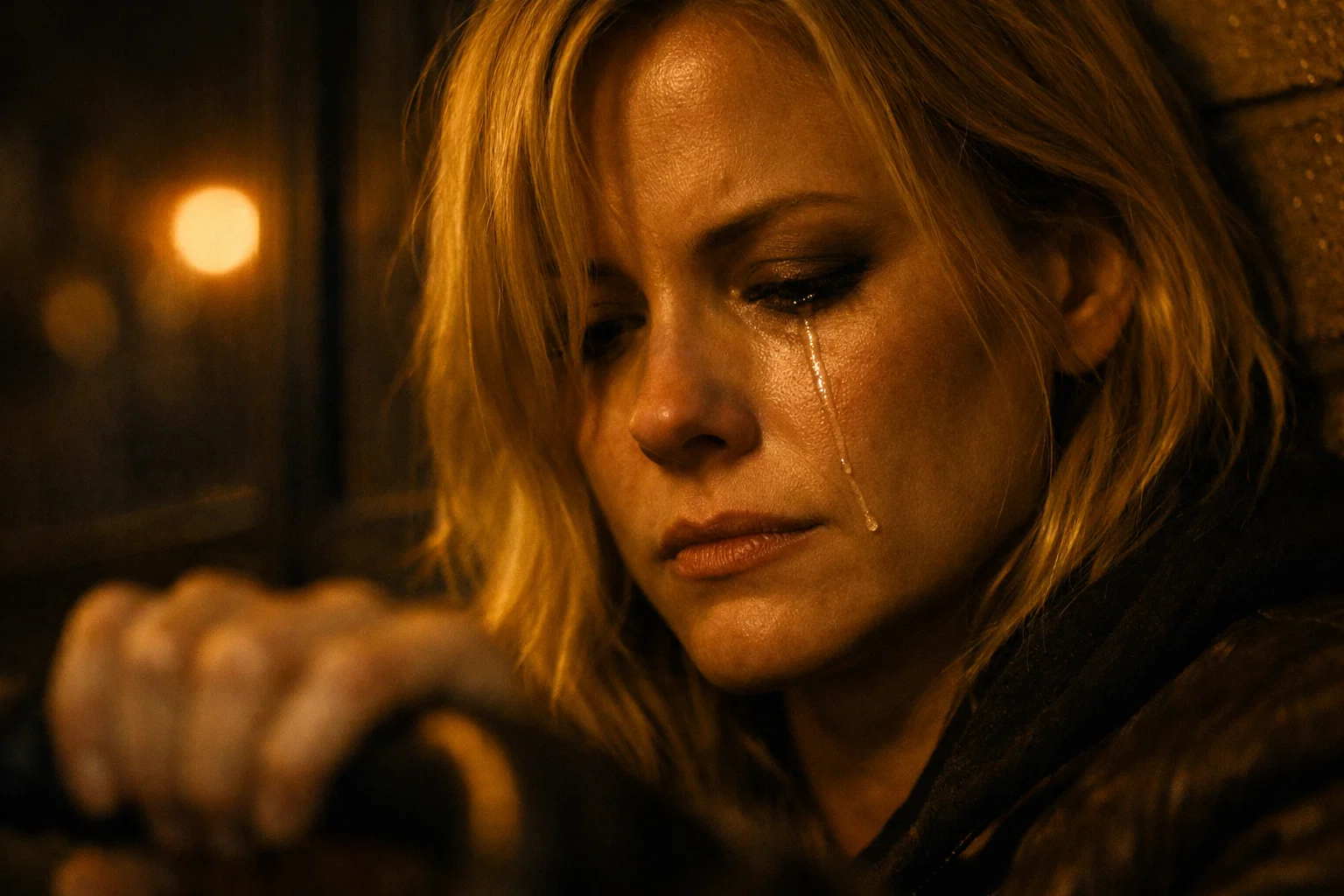
And she began to cry.
Not loudly. Not dramatically. Just deep, quiet, ancient tears — the kind that have been stored somewhere past language, past reason, in the place where the self hides what it can’t afford to lose.
Michael stood in the doorway.
He didn’t move.
He didn’t trust himself to.
The DNA test came back eight days later.
He already knew. He’d known since the night she murmured “Ethan” in her sleep — said it the same way she used to in the hospital, when she was nursing him and thought Michael was asleep in the chair across the room. Quietly. Like a prayer she didn’t need anyone else to hear.
The months after were not a movie.
There were therapy sessions where she came home silent and wrung out and didn’t want to talk. There were nights she woke screaming and couldn’t be touched. There were meals where she suddenly remembered something — you take your coffee with no sugar, you hate the smell of pine, you always had three pillows on your side of the bed — and would look at Michael like he was both familiar and a stranger, and he didn’t know which was harder to bear.
There were also burned dinners that ended in laughter.
Ethan teaching her how to play his favorite video game, patiently, sitting close.
Family photos taped to the fridge — messy, slightly crooked.
One afternoon she sat down at the old upright piano Grace had found at a secondhand shop and placed in the corner. She didn’t say anything. She just started to play.
“You are my sunshine…”
Ethan appeared in the doorway of his room and stood there listening.
He didn’t say anything either.
He didn’t need to.
The community fundraiser was held on a Saturday evening in late spring.
No hotel ballroom. No chandeliers. Folding chairs and a plywood stage in a church community hall, warm yellow lighting, the smell of coffee from the back tables. It was a benefit for a local shelter — Michael had quietly organized it, though his name wasn’t on the program.
Olivia stood backstage in a simple blue dress.
The scar on her cheek caught the light.
Grace touched her arm. “You don’t have to do the whole song. You can stop whenever.”
“I’m not stopping,” Olivia said.
When she walked out, the room quieted without anyone announcing it.
She stood at the microphone. Looked at the audience — ordinary people, folding chairs, a few kids running along the side wall.
“Five years ago,” she said quietly, “I lost everything. My family. My name. Myself.” She paused. “This song was the one thing that stayed. I don’t know why. But every morning I woke up and it was still there.”
Her voice cracked slightly on the opening line.
But she kept going.
“You are my sunshine, my only sunshine…”
By the third line, the room was completely still.
By the end, there were people crying who had never met her. Not out of pity — out of recognition. The particular ache of something lost and returned.
The applause didn’t start all at once. It built — a few hands, then more, then the whole room standing.
Ethan stood on his chair to see better, clapping as hard as he could.
Michael watched from the back, arms crossed, jaw tight.
He’d spent five years building things. Companies. Contracts. A life that looked correct from the outside.
He hadn’t built any of it for the right reasons.
He knew that now.
Outside, it had started to rain. Light spring rain — the kind that doesn’t drench, just touches.
Ethan ran ahead to the parking lot, arms out, face up.
“Ethan, the car’s this way!” Michael called.
“It’s warm rain, Dad! Feel it!”
Olivia laughed. She grabbed Michael’s arm to keep from slipping on the wet pavement, and when she steadied herself, she didn’t let go.
He reached into his coat pocket for the umbrella.
She looked at him.
“Aren’t you going to open it?”
He looked at the umbrella. At the rain. At his son spinning in the parking lot. At the woman standing next to him, scar on her cheek, hand on his arm, finally — finally — home.
He put the umbrella back.
“No,” he said. “I don’t think we need it anymore.”
She tilted her face up toward the rain.
“No,” she agreed. “We really don’t.”
Ethan shouted something joyful and incomprehensible from across the lot. They both started laughing — not politely, not carefully. The way people laugh when they’ve forgotten to protect themselves.
They walked toward him through the rain.
Together. Not hiding. Not lost. Home.
Original fictional stories. AI-assisted creative content.