Marcus Rivera didn’t get nervous before investor meetings.
He got hungry.
He stood at the floor-to-ceiling windows of TechVault’s forty-second floor conference room, watching the San Francisco skyline catch the morning sun, and felt the familiar surge — the same one he’d felt fourteen years ago in a rented garage with one laptop and $800 in credit card debt.
Now the company was worth 2.3 billion dollars.
And today, it was about to be worth more.
“They’re here,” his assistant Claire said from the doorway.
“Send them in.”
Four venture capitalists filed in, sharp suits and sharper eyes. Led by Raymond Holt — sixty-two, silver-haired, the kind of man who had personally killed three unicorns before breakfast and built two more before lunch.
Marcus buttoned his jacket and turned to face them.
“Gentlemen. Welcome to TechVault.”
They shook hands. They sat. Claire poured water. The room smelled like money and quiet desperation dressed up as confidence.
“Before we begin,” Holt said, “I want to say something. We’ve looked at a lot of pitches this quarter. Yours is the only one that made my team nervous. And when my team gets nervous, I get interested.”
Marcus smiled. “Good.”
He clicked to the first slide.
“TechVault’s new security protocol — Vaultlock — is the most sophisticated commercial encryption system ever brought to market. Three years in development. Seven patents pending. Our algorithms are proprietary, adaptive, and, as of last week, completely unbreakable.”
He let that land.
“Unbreakable is a strong word,” said one of the investors — younger, a woman named Dana Park who had the quiet intensity of someone who had heard every pitch and believed none of them.
“It’s the right word,” Marcus said. He clicked to the next slide. “Here’s why.”
Encryption architecture filled the screen. Dense, technical, beautiful.
His lead developer, Josh Tanner, sat along the far wall with the rest of the tech team — ready to field questions, faces arranged in careful confidence.
Marcus walked them through it. Slide by slide. Layer by layer.
The room was with him.
He could feel it — that invisible current of attention, the moment when skepticism softens into fascination. He’d been in enough rooms to know when he had people, and he had them.
He was on slide nine when the door opened.
Not a knock. Just — opened.
Marcus turned.
An older man stood in the doorway. Mid-sixties, maybe. Gray maintenance uniform with a TechVault logo patch on the chest. Thin build, careful posture. A mop bucket behind him in the hallway.
“Sir.” Claire appeared behind the man, face flushed. “Sir, you cannot—”
“I apologize,” the man said. His voice was calm. Unhurried. “I’m sorry for the interruption. My name is David Chen. I work nights. Building maintenance.”
The investors stared.
Marcus felt the heat climb his neck.
“How did you get past security?” he said.
“The door was propped open. I was cleaning the hallway.” David held up a set of cleaning wipes. “I wasn’t trying to interrupt. But I’ve been listening for a few minutes, and I think there’s a problem with the system you’re describing.”
A beat of silence.
Then Raymond Holt’s mouth twitched — not quite a smile. Almost curious.
Someone at the investor table actually laughed. Soft. Politely restrained.
“Claire,” Marcus said, very quietly, “get him out.”
“Mr. Rivera.” David didn’t move. “Line forty-seven. You’re using SHA-256 with a static salt.”
Josh Tanner’s head came up.
“That’s vulnerable to rainbow table attacks,” David continued. “A mid-level attacker could precompute the hash values in roughly eighteen hours. Maybe less with current GPU clusters.”
The room went very still.
“Line ninety-two,” David said. “Your initialization vector is hardcoded into the source. It doesn’t rotate. That means anyone with access to the binary — not even the source code, just the compiled binary — could reverse-engineer the decryption key.”
“Josh,” Marcus said sharply.
Josh was already staring at his laptop screen. His face had done something wrong. Something Marcus didn’t like at all.
“How long would it take?” Dana Park said. She was looking at David now, not at Marcus.
“To fully decrypt a protected file?” David tilted his head slightly. “Six hours. Maybe less. With the right tools, I’d say four.”
“That’s not—” Marcus stepped forward. “That’s not possible. Our team has—”
“Your team built a beautiful system,” David said. “Genuinely. The architecture is elegant. But elegant and secure aren’t the same thing. These are foundational vulnerabilities. They would survive code review unless you were specifically looking for them.”
The silence in the room had changed texture. It wasn’t polite anymore.
Raymond Holt leaned forward. “Can they be fixed?”
“Yes,” David said. “It would take about a week. Maybe less.”
“Marcus,” Holt said quietly, “who is this man?”
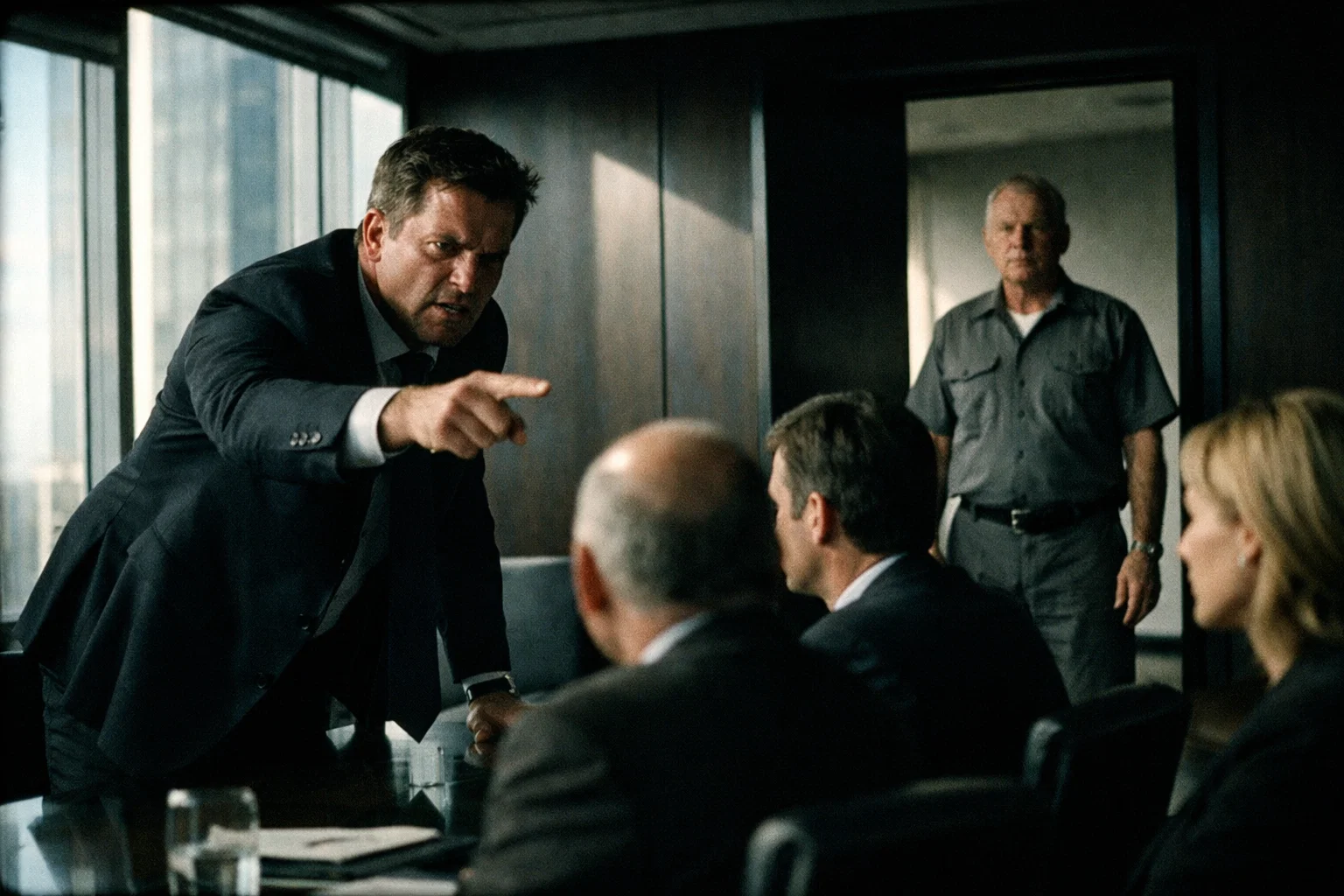
“He’s a janitor,” Marcus said. The word came out harder than he meant it. “He cleans floors. He has absolutely no business—”
“He just described two specific vulnerabilities in your flagship product,” Dana Park said. “In thirty seconds. While holding a mop.”
Marcus’s jaw tightened.
He turned back to David. And something cracked open inside him — the specific, airless panic of a man who has built his entire identity on being the smartest person in the room, and has just been publicly contradicted by someone he considered invisible.
“You clean toilets,” Marcus said. His voice had gone low and ugly. “You empty trash cans. What could you possibly know about encryption?”
David looked at him. Just — looked at him. Like he was reading something written on the inside of Marcus’s chest.
“I know what I know,” he said.
“Get out,” Marcus said. “Right now. Get out of this room.”
“Marcus—” Josh started.
“I said out.” Marcus crossed the room in four steps. He was taller than David. He used the height deliberately, standing close, voice dropping to something that was meant to feel like a wall. “You have no idea what you’re talking about. You don’t belong here. This is a private meeting with people who built things. Not people who clean up after them.”
David didn’t step back.
“The vulnerabilities are real,” he said quietly. “Whether I said them or someone else. They’re real.”
Something snapped in Marcus.
He reached for the water pitcher on the cart near the door — David’s cleaning cart, parked just outside in the hall — and in a motion he would replay for months afterward, knocked it sideways. Water and coffee from the service tray crashed across the floor, splashing against David’s shoes, spreading in a dark pool across the marble.
The room went rigid.
“NOW,” Marcus said, voice climbing. “Get on your knees and clean that up. Because that’s what you’re paid for. That’s your job. That’s what you ARE.”
No one moved.
Dana Park set down her pen. Raymond Holt sat back. Very slowly.
David looked at the spilled liquid. Then at Marcus.
Then — without a word — he walked to his cart, took out paper towels, and knelt on the floor.
He began cleaning.
Marcus stood over him, breathing hard. “This is what happens,” he said, quieter now, the ugliness settling into something worse — something cold and deliberate, “when people forget their place.”
David said nothing. He just cleaned.
“You know what,” Marcus said. “I’ve had enough. You’re done. You’re fired. Get your things out of this building and don’t come back.”
Silence.
David rose. He held the soaked paper towels in one hand. He looked at Marcus for a long moment — and then something happened in his face. Not fear. Not humiliation. Something else entirely.
He smiled.
It wasn’t a nervous smile or an apologetic one. It was quiet and certain, the smile of someone who has just watched a chess piece move exactly where he expected it to.
“What’s funny?” Marcus said.
David didn’t answer. He dropped the towels into his cart and walked out.
The door swung shut.
The room held its breath.
“Someone,” Raymond Holt said, very carefully, “needs to explain to me what just happened.”
Josh’s voice came from the far wall. Flat. Bloodless.
“Everything he said is accurate.”
Marcus turned. “What?”
“Every vulnerability he named.” Josh’s laptop screen was reflected in his glasses, and his face was the color of old chalk. “SHA-256 with a static salt. Hardcoded IV. He’s right. He’s completely right. I don’t — I don’t know how we missed it.”
“That’s impossible.”
“It’s not.” Josh stood up. “Marcus, if we had launched Vaultlock with these flaws — if we had deployed this to enterprise clients — we would have had a data breach within a month. Maybe less. We would have been liable for every record compromised. Every company that trusted us. Class-action. Federal investigation. Criminal exposure, potentially.”
The words landed like something physical.
Dana Park stood. “Raymond.”
“I know,” Holt said. He looked at Marcus. “Who is that man? Not what he does. Who is he.”
“I told you. Maintenance staff. He’s nobody.”
“Find out,” Holt said. “Right now. Because ‘nobody’ just saved your company.”
Marcus called HR from the conference table. He kept his voice level. The investors watched.
He waited.
The answer came back in four minutes.
His HR director’s voice was careful in the way that voices go careful when they’re delivering information that will change things. “David Chen. PhD in cryptography, MIT, 1998. Twenty-two years at the National Security Agency, retired 2019. Specialized in infrastructure vulnerability assessment. He applied for a senior developer position here six months ago.”
Marcus didn’t say anything.
“He was rejected,” the HR director continued. “The hiring committee flagged him as overqualified. They were worried about a cultural mismatch.”
“And then?”
“He applied for a building maintenance position three weeks later. Overnight shift. Hired at standard rate.”
A long silence.
“Why would someone with that background apply for a janitorial job?” Dana Park said quietly.
“His HR file includes a medical accommodation note.” The director’s voice dropped slightly. “His daughter. She’s twelve. She has leukemia. She’s been in treatment at UCSF for eight months. He takes her to her appointments during the day. He needed overnight work.”
Marcus felt the floor shift under him.
Not metaphorically. His knees actually locked.
He stood at the head of a conference table surrounded by forty million dollars of investor attention and he thought about a man kneeling on a marble floor, cleaning up coffee that had been deliberately knocked over, and smiling — smiling — on the way out.
“Get him back here,” Holt said.
“I fired him,” Marcus said.
“Un-fire him.” Holt stood. “Or we leave. With our money. Today.”
Marcus walked to the elevator. Took it to the lobby. Walked out into the parking structure.
David was at the far end of Level 1, loading his cart into the back of an old Toyota Camry. The kind of car a person drives when they’re spending their money somewhere that matters more.
“David.”
David turned. He didn’t look surprised.
“I made a mistake,” Marcus said.
“You made several,” David said. He kept his voice even. No heat in it.
“The investors want you to fix the code.”
“I understand that.”
“Come back inside. Name your terms.”
“No.”
Marcus blinked.
“I don’t want to mop your floors,” David said. “I came here because I wanted to do the work I know how to do. I tried to tell you something that mattered. You humiliated me in front of a room full of people. You knocked over a tray and made me clean it up like—” He stopped. “No. I’m not coming back to mop floors.”
“That’s not — I’m offering you a real position. Senior developer. Whatever you want.”
“Read your employee contract,” David said. “The one you sign everyone to. Page seven. Section twelve.”
He got in the car.
He drove away.
Marcus stood in the parking structure for a moment, listening to the echo of the engine fading.
Then he ran.
He took the stairs. He burst through the fire door into the executive floor hallway and went straight to his office, pulling the employee contract template from his document server with shaking hands.
Page seven.
Section twelve.
Any employee of TechVault Inc. whose direct innovation, identification of critical infrastructure vulnerability, or technical contribution leads to revenue generation exceeding ten million dollars in a single transaction or series of related transactions shall be entitled to equity compensation of zero point five percent of vested shares at the time of deal closure.
He’d written that clause himself. In the early days, when he was trying to poach talent from Google and needed to offer something beyond salary. He’d applied it to all employees — not just developers. He’d been proud of it. Inclusive, he’d called it.
His lawyer confirmed it within the hour.
“If his identification of these vulnerabilities is what saves the deal — and there’s a paper trail showing he reported them before the deal was at risk — then yes.” Her voice was careful. “He’s entitled to the clause.”
“How much is point five percent worth?”
“At current valuation, with the forty million investment triggering a re-valuation?” She paused. “Somewhere between eleven and fourteen million dollars.”
Marcus sat down on the floor of his office.
Not in a chair. On the floor. He just — sat there.
The board met at six that evening. It was not a comfortable meeting. Raymond Holt had sent a representative. Dana Park attended personally.
The options were laid out with clinical clarity: find David Chen, extend a formal offer including equity per the existing contract, issue a public company apology, and bring him on as Chief Security Officer — or lose the funding, face likely whistleblower reporting of the vulnerabilities to regulatory bodies, and explain to the press why TechVault had fired the man who found the flaws in its flagship product.
Marcus listened to all of it.
When it was over, he said: “I’ll make the call myself.”
David answered on the third ring.
“This is Marcus Rivera.”
“I know,” David said.
“The board has authorized a formal offer. Chief Security Officer. Full equity per section twelve of your contract. Current valuation. Vested immediately upon deal closure.”
Silence on the line.
“There’s one more condition,” Marcus said. “From me. Not the board.”
“What’s that?”
“A public apology. Company-wide. On record. What I did today was wrong. I want that to be documented.”
Another pause.
“My daughter has an appointment Friday morning,” David said finally. “I can start Monday.”
“I’ll have the contract ready Thursday.”
“Mr. Rivera.”
“Yes.”
“The clause you wrote — the equity clause. You wrote it to protect yourself from losing talent to competitors.”
“I know.”
“It ended up protecting someone you never thought to protect,” David said. “That’s worth thinking about.”
The line went quiet.
“I know,” Marcus said again. This time he meant it differently.
Monday morning, Marcus stood in the main conference room in front of the entire company — two hundred and forty employees on-site, another ninety on video. He had notes. He didn’t use them.
“Last week I made a series of choices that I am ashamed of,” he said. “I dismissed a man because of the uniform he was wearing. I used my position to humiliate him. When he was right and I was wrong, I made it worse.” He looked out at the room. “David Chen holds a PhD in cryptography from MIT. He spent twenty-two years at the NSA protecting systems more critical than anything we have ever built. He came to this company and asked for a chance to do meaningful work. We turned him down. He came back and took the only job we’d give him. And when he tried to protect us — from ourselves — I fired him in front of our investors.”
He stopped.
“That is not the company I intended to build. It is, however, the company I built. And that’s on me.”
He looked at the back of the room, where David stood beside the door in a pressed gray jacket.
“David. I’m sorry. This company is better because you’re in it. I am sorry that you had to fight to make us see that.”
David gave a small nod.
Applause started near the front. Spread. Not polite applause — the kind that starts quiet and then people actually mean it.
David worked for six days straight.
He brought in two former NSA colleagues on short-term contract. He rewrote the vulnerable components. He documented everything — not just the fixes, but the reasoning, written so clearly that a first-year developer could follow it.
When he presented to the investors on Friday afternoon, he used eleven slides.
No music. No animations. Just architecture diagrams and test results.
Raymond Holt sat very still through the entire presentation.
When it was done, Holt said: “Can you defend this against a nation-state level attack?”
“No commercial system can,” David said. “But I can make it expensive enough that they’ll choose easier targets. That’s the realistic goal.”
Holt looked at him for a moment.
“I’ve been in this industry for thirty-one years,” he said. “I’ve seen maybe fifteen people who actually understand security at this level.” He glanced at Marcus. “How did you almost let him go?”
Marcus didn’t answer.
The deal closed the following Tuesday. Forty million dollars. The re-valuation triggered David’s equity clause.
The shares were worth eleven point seven million dollars on the day of vesting.
Contracts followed. Enterprise clients who had been watching from a distance. A defense contractor. A hospital network. A major financial institution that had previously walked away from TechVault’s pitch.
David’s shares crossed thirty million in valuation within fourteen months.
He kept coming to work in the Camry.
He kept eating in the regular cafeteria with the rest of the staff — not the executive dining room, which Marcus had offered.
One evening in the lab, Marcus brought him coffee.
Set it down. Sat across from him.
“You could retire,” Marcus said. “Three times over.”
“I know,” David said. He was running a stress-test simulation on a new protocol. “I spent twenty-two years doing classified work I couldn’t talk about. Now I get to build something I can. That’s worth more than retiring.”
“Why did you smile?” Marcus asked. “That day in the conference room. When I fired you.”
David looked up.
“Because I knew something you didn’t,” he said. “I’d read the employee contract before I accepted the maintenance job. The equity clause. I knew that if I found something critical — if I reported it through proper channels and it was tied to a deal outcome — that clause applied to me.”
Marcus stared at him.
“You planned this.”
“I reported a vulnerability. The planning was yours — you wrote the contract.” David leaned back slightly. “I came here because I wanted to work. I needed flexible hours and you wouldn’t give me a developer role. So I took what was available and I did my job. What you saw as a weakness — the uniform, the bucket — you let it make you stupid. That was your choice, not mine.”
“You could have used the clause immediately. You didn’t have to come back.”
“I came back because the work matters. If Vaultlock had launched broken and a hospital network lost patient data, people could have gotten hurt. I came back for the work.” He looked at Marcus steadily. “The money was just — legal precision.”
Marcus was quiet for a long time.
“What can I do?” he said finally. “Not for the company. For you. For what I actually did.”
David thought about it.
“My daughter’s treatment center needs infrastructure upgrades. Their systems are twelve years old. When she’s in there, waiting — I sit in that waiting room and I look at their network setup and I think about what I could fix. They don’t have budget.”
Marcus nodded once. “Done. Whatever they need.”
“And,” David said, “there are a lot of people like me. People who have the skills and can’t get in the door because someone looked at their resume and made a call before they read past the job title. TechVault should build a pipeline. Not charity. A real pipeline — recruitment from non-traditional backgrounds, structured mentorship, track record over credentials.”
Marcus opened his phone and started writing.
“What else?” he said.
“That’s enough,” David said. “For now.”
Three months later, the David Chen Education Fund was announced at an all-company meeting.
Full scholarships for children of every TechVault employee. All levels. All departments. David had added one condition: it had to be named after someone already working in the building. Someone everyone had walked past a hundred times.
“Why did you let him do this?” one of the new developers asked David after the announcement. “He humiliated you. Why give him the chance to make it right?”
David considered this.
“Because I have a daughter,” he said, “who is going to grow up in whatever kind of world we build. I’d rather she grow up in one where people can admit they were wrong and fix it.” He paused. “Also because watching Marcus Rivera apologize in front of two hundred people was, honestly, very satisfying.”
The developer laughed.
David smiled. “That’s human. I’m allowed.”
At the dedication of the fund, Marcus stood beside David in the lobby of TechVault’s main building. The plaque was mounted where David’s cleaning cart used to be parked.
The David Chen Education Fund: Because Talent Deserves Dignity.
“You didn’t have to put your name on it,” Marcus said.
“You didn’t have to suggest it,” David replied.
“I needed it to mean something real. Not just a corporate giving program. Real accountability.” Marcus looked at him. “Truly, David. I’m sorry. For all of it.”
“I know,” David said.
His daughter stood beside him, holding his hand. She was thin from treatment, with a bright yellow beanie on her head and eyes that looked like her father’s — quiet and completely alert to everything.
She looked at the plaque.
“Dad,” she said. “That’s your name.”
“It is,” David said.
“Does that mean they’re sorry?”
David looked at Marcus.
Marcus crouched down to her level.
“It means your dad is one of the best people I’ve ever met,” he said. “And I almost missed it because I wasn’t paying attention.”
She thought about this.
“You should pay better attention,” she said.
“I know,” Marcus said. “I’m working on it.”
She seemed to accept this as a reasonable answer.
TechVault went on to become the leading commercial encryption provider in the U.S. market.
Marcus was interviewed the following year in a profile for a business magazine. The journalist asked him what had been the most important decision he’d ever made.
He thought about it.
“Hiring David Chen as CSO,” he said.
“Wasn’t that the board’s decision?” the journalist said.
“Rehiring him was,” Marcus said. “Doing it right was mine.”
The journalist asked him what he meant.
“There’s a difference,” Marcus said, “between doing the necessary thing and doing the right thing. The board told me I had to bring him back or lose the deal. I could have made the offer and kept my distance and called it even. Instead I stood in front of the whole company and said: I was wrong. That was a choice. Nobody made me do that.”
“Why did you?”
Marcus was quiet for a moment.
“Because he asked me to pay better attention,” he said. “And I was finally ready to.”
The journalist wrote that down.
He almost cut it. Too soft, he thought. Not a typical CEO line.
He kept it in.
It was the most quoted line in the piece.
Original fictional stories. AI-assisted creative content.